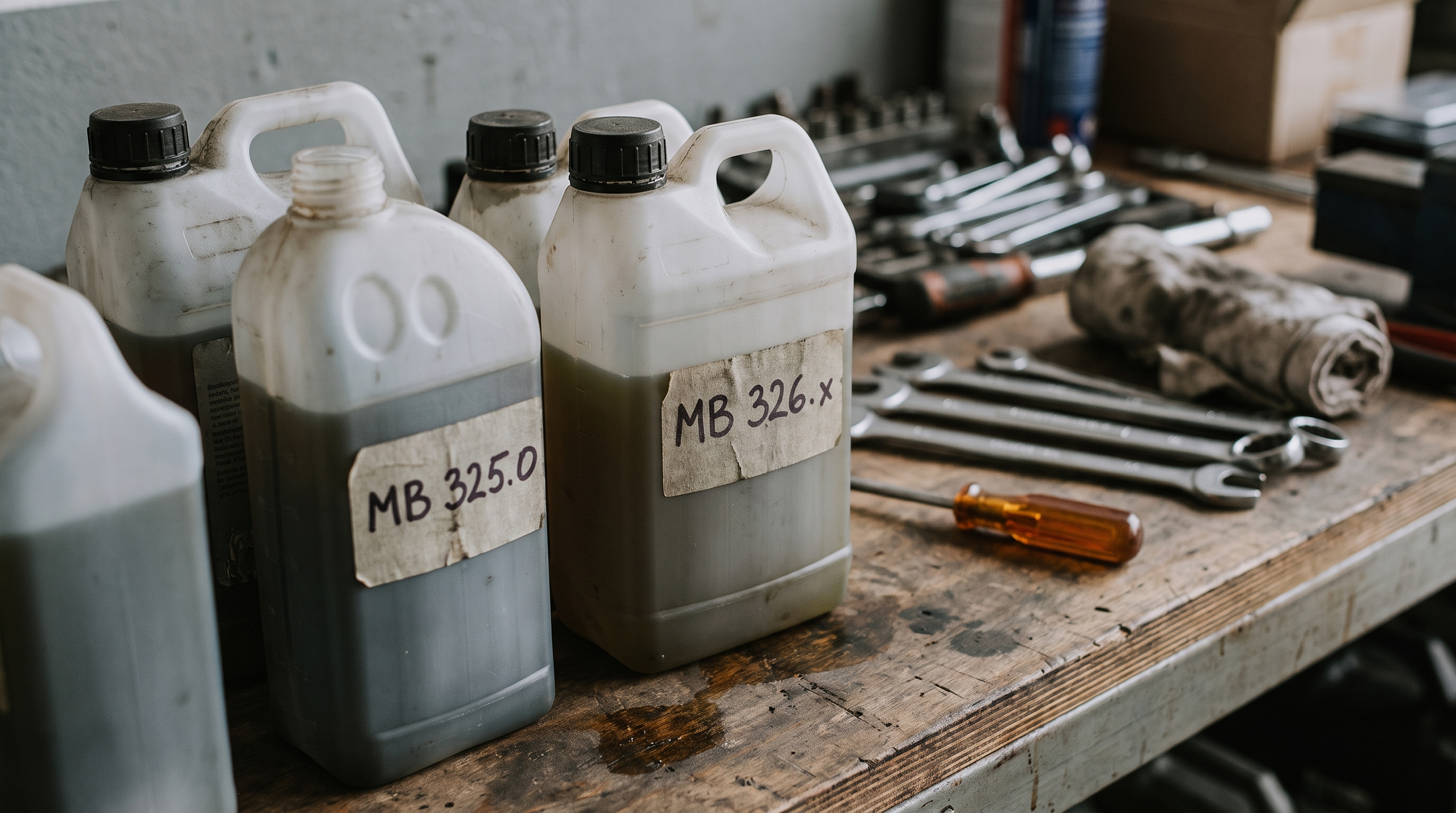
Mercedes Benz Coolant: MB 325.0 and 326.x Explained
Explore the details of mercedes benz coolant specifications MB 325.0 and 326.x, including approved products and essential maintenance insights.
Introduction to Mercedes Coolant
Mercedes benz coolant systems are engineered around specific coolant chemistries that protect dissimilar metals—aluminum heads, magnesium blocks, copper heat exchangers—from galvanic corrosion and cavitation erosion. The company's Operating Fluids system assigns each coolant a three-digit approval code: MB 325.0, 325.2, 325.3, and the newer 326.x series. These codes are not marketing labels; they represent pass/fail laboratory protocols that measure pH stability, foaming behavior, metal-compatibility, and seal-swell characteristics over a simulated service life.
I've spent fifteen years matching sheet approvals to distributor catalogs, and the most expensive mercedes benz coolant mistake is assuming that "European" or "import" on the bottle means it meets your car's spec. A 2015 C-Class calling for MB 325.3 will not tolerate a product approved only to 325.0, even if both are green and both claim extended life. The inhibitor package differs, and the first symptom you'll see is a rusty overflow tank or a heater core that clogs with silicate gel. For more context on how coolant chemistry varies across European makes, see our guide on HOAT Coolant vs OAT vs IAT: What European Cars Require.
This guide walks through what each MB coolant specification means, why the approval code matters more than color or brand, and how to identify the correct product for your model year without guessing. If you've ever stood in front of a parts-store shelf wondering whether the pink jug is the same as the blue one, the answer is in the approval code printed on the back label—not the front.
Explore the details of Mercedes benz coolant specifications MB 325.0 and 326.x, including approved products and essential insights.
What Is Mercedes Benz Coolant?
Mercedes benz coolant is not a single product—it's a family of formulations that meet specific approval standards set by Mercedes-Benz. The two most common designations you'll see are MB 325.0 and the 326.x series (326.0, 326.3, 326.5). These numbers represent approval specifications, not chemical formulas. A coolant carrying MB 325.0 approval has passed Mercedes-Benz's internal testing for corrosion protection, heat transfer, and compatibility with the aluminum, magnesium, and rubber components in their cooling systems. The 326.x approvals typically designate premixed products—coolant already diluted to the correct ratio with deionized water.
How Mercedes Benz Coolant Differs from Standard Coolants
Most generic coolants use older inhibitor technologies—inorganic additive technology (IAT) or organic acid technology (OAT)—that were designed for cast-iron blocks and copper-brass radiators. Mercedes engines, particularly from the mid-1990s forward, use extensive aluminum castings, magnesium valve covers, and specific elastomer seals in water pumps and thermostats. The MB 325.0 and 326.x formulations use a hybrid organic acid technology (HOAT) or a proprietary silicate-based package that protects these materials without forming deposits or attacking seals.
Different car manufacturers specify different coolant formulations due to variations in engine materials, water pump seals, and other components. For Mercedes-Benz, the MB 325.x specification typically relates to antifreeze and corrosion protection, while 326.x is often associated with premixed products. This distinction matters because a coolant approved for a BMW (meeting BMW's own spec) may use a different inhibitor balance—one that works for BMW's alloys but causes galvanic corrosion or seal swelling in a Mercedes cooling system.
MB 325.0 vs. 326.x: What the Numbers Mean
MB 325.0 is the concentrate approval. When you buy a bottle marked MB 325.0, you're getting undiluted antifreeze that must be mixed with distilled or deionized water—typically at a 50:50 ratio for most climates. The 326.x series (326.0, 326.3, 326.5) are premixed approvals. A bottle marked MB 326.5, for example, is already diluted and ready to pour. The decimal suffix sometimes indicates a revision or a specific additive package update, but the key point is this: 325.0 requires dilution; 326.x does not.
When you're looking at a parts catalog or a shelf at a parts counter, verify the MB approval number printed on the label. Color is not a reliable guide—Mercedes coolants are often blue or pink, but so are many non-approved products. The approval number is the only proof that the product has passed Mercedes-Benz's internal corrosion and compatibility tests. If the bottle doesn't carry an MB 325.0 or 326.x approval, it's not approved for use in your Mercedes, regardless of what the marketing copy claims. For more context on how coolant chemistry varies across European makes, see HOAT Coolant vs OAT vs IAT: What European Cars Require.
Why Mercedes Benz Coolant Matters
The mercedes benz coolant specification you choose directly determines whether your cooling system protects or destroys the engine. Mercedes engineers design aluminum cylinder heads, blocks, and radiators to operate within narrow thermal bands; the wrong coolant chemistry accelerates galvanic corrosion, silicate dropout, and cavitation erosion that no amount of flushing will reverse. When a shop fills a W205 C-Class with a generic "universal" green coolant instead of an MB 326.x-approved product, the clock starts on head-gasket weep, water-pump seal failure, and radiator pinhole leaks that appear eighteen months later—long after the customer has forgotten the service.
Coolant degrades over time, losing its anti-corrosion and heat-transfer properties, which can lead to engine overheating. Fresh coolant maintains a stable boiling point above 130 °C under pressure and a freeze point below −37 °C, but additive depletion raises the boiling point and allows localized hot spots near combustion-chamber walls. Those hot spots trigger pre-ignition, knock, and eventually head warpage. The interval Mercedes publishes—typically ten to fifteen years or 150 000 miles for MB 326.x formulations—assumes you start with an approved product; if you deviate, the interval collapses to unknown.
Corrosion Protection and Material Compatibility
Mercedes cooling systems contain five or six dissimilar metals: aluminum alloy castings, copper-brass radiator cores (on older models), steel fasteners, and magnesium transmission coolers. Each metal sits at a different electrochemical potential, so any aqueous solution becomes a battery. MB 325.0 and 326.x specifications mandate hybrid organic-acid inhibitor packages that form nanometer-thick passivation layers on aluminum and copper simultaneously, without the silicate glass that clogs modern microchannel heat exchangers. A coolant that meets one OEM's spec but not Mercedes' will protect some metals while attacking others; you discover which ones failed when the thermostat housing cracks or the heater core starts misting the windshield.
Heat-Transfer Efficiency and Engine Longevity
Modern turbo four-cylinders and V8s generate heat flux densities above 2 MW/m² at the exhaust-valve bridge; the coolant must remove that energy faster than combustion deposits it, or the valve seat sinks into the head. HOAT coolant vs OAT vs IAT: What European Cars Require explains how inhibitor chemistry affects thermal conductivity, but the practical takeaway is simple: lower thermal conductivity means higher metal temperatures, which means shorter component life. An off-spec coolant might keep the gauge in the normal range while cylinder-head temperatures climb ten degrees higher than design intent; that ten-degree margin is the difference between 200 000 miles and a head-gasket job at 80 000.
The cheapest coolant is the one your engine was designed to run—everything else is a loan against future repair costs.
Longevity also hinges on water-pump seal and gasket compatibility. MB 326.x formulations are tested against the exact elastomer compounds Mercedes specifies for shaft seals, O-rings, and hose liners; a coolant that swells or shrinks those elastomers by more than a few percent will cause weeping within a year. You will not see a puddle—modern seals weep vapor that evaporates before it drips—but you will smell it, and you will watch the expansion-tank level drop a few millimeters every month until the pump bearing runs dry.
How to Choose the Right Mercedes Benz Coolant
Selecting the correct mercedes benz coolant for your Mercedes-Benz is not a guessing game. The specification printed on the bottle matters more than the brand name, and the owner's manual is the only document that tells you which MB sheet number your engine requires. If the coolant you're holding doesn't carry that exact approval, it doesn't belong in your system—no matter what the parts-counter clerk says.
Start with the Owner's Manual
Every Mercedes-Benz owner's manual lists a specific MB sheet number under the coolant section: MB 325.0, MB 326.0, MB 326.3, MB 326.5, or MB 326.6. That number is not a suggestion. It defines the corrosion inhibitor package, pH range, and additive chemistry the cooling system was designed around. If your manual calls for MB 326.5 and you pour in a product approved only to MB 325.0, you've just introduced a chemistry mismatch that the system cannot tolerate long-term.
Write down the MB sheet number from your manual before you walk into the parts store. If the manual is missing, call the dealer service department with your VIN—they can pull the spec in seconds.
Read the Label, Not the Marketing
Coolant bottles carry two kinds of information: marketing claims and approval labels. Ignore the marketing. Look for a line that reads "Meets MB 325.x" or "Approved to MB 326.x." The approval must be printed on the bottle, not just mentioned in online product descriptions. If the label says "suitable for" or "compatible with" instead of "meets" or "approved," the product has not passed Mercedes-Benz testing and should not be used.
Some bottles will list multiple approvals—MB 326.5, VW G12evo, BMW blue coolant. That's fine as long as your required MB sheet is among them. A product approved to a newer MB 326.x standard will work in systems that originally called for MB 325.0, but the reverse is not true.
Concentrated vs. Premixed
Coolant comes in two forms: concentrated and premixed. Concentrated coolant must be diluted with distilled water—typically 50/50, though some climates allow 60/40 or 40/60 ratios. Premixed coolant is ready to pour and eliminates the risk of incorrect dilution, but costs more per liter of usable fluid.
If you're topping off a system, use premixed. If you're doing a full flush, concentrated gives you control over the ratio and costs less for large volumes. Never use tap water for dilution—minerals in tap water will plate out on aluminum surfaces and reduce heat transfer.
Step 1
Verify the required MB sheet number
Open your owner's manual to the coolant specification section and write down the exact MB sheet number listed. If the manual is unavailable, contact the dealer service department with your VIN to confirm the specification your engine requires.
Step 2
Check the product label for approval
Examine the coolant bottle for a line stating "Meets MB [number]" or "Approved to MB [number]." The approval must match the number from your manual. Reject any product that uses vague language like "suitable for" or "compatible with" instead of a formal approval claim.
Step 3
Choose concentrated or premixed based on your task
For topping off, buy premixed coolant to avoid dilution errors. For a full system flush, buy concentrated coolant and mix it with distilled water at the ratio specified in your manual—usually 50/50 unless you operate in an extreme climate.
What to Do When the Shelf Is Empty
If your local parts store doesn't stock coolant with your required MB approval, don't substitute. Order the correct product online or visit a Mercedes-Benz dealer. Mixing coolant chemistries—even temporarily—creates precipitates that clog heater cores and reduce coolant flow. The cost of a heater core replacement will exceed the cost of overnight shipping by a factor of ten.
For related fluid specifications across European makes, see HOAT Coolant vs OAT vs IAT: What European Cars Require or Audi VW Power Steering Brake Fluid Requirements Guide.
Best Practices for Using Mercedes Benz Coolant
Proper mercedes benz coolant maintenance starts with the owner's manual. Before you add or replace coolant, verify the specification listed in your service documentation—MB 325.0, MB 325.5, or one of the 326.x variants—and use only approved products that carry that exact approval. The cheapest bottle on the shelf isn't the right bottle if it doesn't meet the spec your engine was designed around.
Check the Spec Before You Buy
Every Mercedes model specifies a coolant approval in the owner's manual or on a label in the engine bay. If the manual calls for MB 325.0, use a product with MB 325.0 approval printed on the label. If it calls for MB 326.0, use MB 326.0. Mixing approved coolants from different spec families introduces chemistry mismatches that shorten service life and reduce corrosion protection. When in doubt, match the spec exactly—guessing costs more than reading the label.
Use the Right Concentration
Mercedes coolant is sold as concentrate or premix. Concentrate requires dilution with distilled water—typically 50/50 for most climates, but consult the manual for extreme-temperature regions. Premix is already diluted and ready to pour. If you dilute concentrate yourself, use distilled water only; tap water introduces minerals that degrade inhibitors and promote scale. Measure carefully—too much water weakens freeze protection, too little water raises the freeze point and reduces heat transfer.
Replace on Schedule, Not When It Looks Bad
Coolant doesn't turn brown or smell burnt when it's done; it loses inhibitor strength invisibly. Mercedes publishes service intervals in the maintenance schedule—often 10 to 15 years for modern 326.x formulations, shorter for older MB 325.0 systems. Follow the interval in the manual, not the color in the reservoir. Waiting until the coolant looks dirty means you've already run past the point where corrosion protection dropped off.
The right coolant is the one that matches the spec in your manual—not the one that matches the color in the bottle.
Bleed the System After Every Fill
Air pockets in the cooling system cause hot spots, trigger false temperature readings, and reduce heater output. After adding coolant, run the engine with the reservoir cap off until the thermostat opens, then top off as the level drops. Some models require a specific bleeding procedure—consult the service manual or use a vacuum-fill tool to eliminate air on the first fill. Skipping the bleed step leaves air in the system, and air doesn't transfer heat.
For related fluid maintenance on European platforms, see Volvo Antifreeze: The Blue-Green Volvo Spec and Approved Products.
Common Mistakes with Mercedes Benz Coolant
Mercedes owners routinely make three errors that turn routine mercedes benz coolant service into expensive repairs: mixing incompatible chemistries, topping off with the wrong product, and ignoring the spec printed on the expansion-tank cap. Each mistake compounds over time, and the damage shows up long after the service interval when you're diagnosing a heater-core blockage or a corroded water-pump housing.
Mixing Coolant Types
The most destructive mistake is combining different coolant chemistries in the same system. G48 (the older ethylene-glycol silicate formulation) and G05 (the phosphate-free organic-acid technology behind MB 325.0) are not compatible. When mixed, the silicate inhibitors in G48 react with the organic acids in G05 and form a gel that clogs narrow passages in the heater core and radiator end tanks. You will not see the sludge immediately—it takes weeks to months—but once it forms, the only fix is a full system flush and component replacement if the blockage is severe.
Topping Off with Generic Products
The second error is topping off the expansion tank with a generic "universal" coolant or an aftermarket product that claims compatibility with multiple OEM specs. Universal coolants use broad-spectrum inhibitor packages that meet minimum performance thresholds across many standards, but they do not carry the specific additive balance that Mercedes validates under MB 325.0 or MB 326.x. The result is a diluted inhibitor concentration that accelerates corrosion in aluminum components—water pumps, radiators, and cylinder heads—over the next 50,000 miles. By the time you notice coolant seepage or overheating, the damage is already done.
If you need to add coolant between service intervals, use only a product that lists the exact MB approval number on the label. The approved list is short: Zerex G05, Havoline Xtended Life, and the Mercedes-Benz genuine concentrate are the three most widely available options. Anything else is a gamble with your cooling system.
Ignoring the Specification Label
The third mistake is ignoring the spec printed on the expansion-tank cap or in the owner's manual. Mercedes publishes the required coolant spec for every model year, and that spec changes across platforms. A 2005 E-Class requires MB 325.0; a 2015 C-Class may require MB 326.3 or MB 326.5 depending on the engine. Using the wrong spec—even if it is an approved Mercedes coolant—means you are running an inhibitor package that was not validated for your engine's metallurgy or operating temperature range. The consequence is the same as using a generic product: premature corrosion and component failure.
When you service the cooling system, verify the spec against the label on the expansion tank or the maintenance section of the owner's manual. If the previous owner used the wrong coolant, the only safe path forward is a complete drain, flush, and refill with the correct product. Topping off a contaminated system only delays the problem.
Using Tap Water for Dilution
A fourth error—less common but still damaging—is diluting coolant concentrate with tap water instead of distilled or deionized water. Tap water contains dissolved minerals (calcium, magnesium, chlorides) that precipitate out at high temperatures and form scale deposits on heat-transfer surfaces. Scale reduces cooling efficiency and creates hot spots that accelerate localized corrosion. The MB 325.0 and MB 326.x standards assume you are using demineralized water; if you use tap water, you void the performance guarantee built into the spec.
Always dilute concentrate with distilled water in a 50/50 ratio. If you are topping off a system that is already at the correct concentration, use premixed coolant (which is already diluted with deionized water) to avoid changing the freeze-point or inhibitor concentration.
For related fluid specifications and common pitfalls in European vehicle maintenance, see our guide on Volvo Antifreeze: The Blue-Green Volvo Spec and Approved Products.
Frequently Asked Questions about Mercedes Benz Coolant
Can I mix different Mercedes benz coolant specifications?
No. MB 325.0, MB 325.5, and MB 326.x specifications are not interchangeable. Each specification represents a different chemical formulation designed for specific engine materials and operating conditions. Mixing them dilutes the protection each provides and can cause corrosion or deposits. If you need to switch specifications, drain the system completely and refill with the correct approved product.
How do I know which mercedes benz coolant my Mercedes requires?
Check three places in this order: the coolant reservoir cap (often stamped with the spec), the owner's manual maintenance section, or the Mercedes-Benz sheet approval database. Do not rely on model year alone—mid-cycle updates and regional variations mean two identical-looking cars can require different coolants. The approval number is the only reliable identifier.
Does coolant color tell me if it's compatible?
Dye color is a marketing choice, not a chemistry indicator. Two pink coolants can have completely different additive packages. The only thing that matters is whether the bottle lists the MB approval number your vehicle requires.
Can I use universal or "European vehicle" coolant?
Only if the bottle explicitly lists the Mercedes-Benz approval number your car requires. Generic "European" coolants often meet no manufacturer specification at all—they're just diluted ethylene glycol with basic inhibitors. Using one voids any claim you might make if the cooling system fails. Approved products cost a few dollars more and eliminate the risk.
How often should I replace mercedes benz coolant?
Follow the interval in your owner's manual—typically five years or 150,000 miles for modern MB 325.5 and MB 326.x coolants, shorter for older MB 325.0 systems. Coolant doesn't wear out from heat; the inhibitor package depletes over time. Once it's spent, corrosion starts even if the fluid still looks clean. If you're unsure of the last change, replace it now and reset the clock.
What happens if I use the wrong mercedes benz coolant?
Short term: nothing obvious. Long term: accelerated corrosion of aluminum heads and blocks, seal degradation, and water pump failure. The damage accumulates invisibly until a gasket blows or a radiator tank cracks. By then the repair cost is ten times what the correct coolant would have cost. There's no safe way to use the wrong spec.
Where can I buy approved mercedes benz coolant?
Mercedes dealers, independent shops that stock OE-supplier brands, and wholesale parts distributors carry approved products. Online retailers often list the approval number in the product description—verify it matches your requirement before ordering. If you're working with a Mercedes C300, confirm the exact spec for your model year to avoid compatibility issues.
Can I top off with water in an emergency?
Distilled water only, and only to get you home. Tap water introduces minerals that plate out on hot surfaces and clog passages. Plan to drain and refill with the correct 50/50 mix as soon as possible—water alone offers no corrosion protection and freezes at 32°F. If you're more than a quart low, the system likely has a leak that needs repair before you add anything.
Conclusion: Ensuring Optimal Performance with Mercedes Benz Coolant
Mercedes-Benz coolant specifications exist because mixing the wrong chemistry into an aluminum engine costs more than doing it right the first time. MB 325.0 and the 326.x variants are not interchangeable suggestions—they are engineering requirements tied to specific alloy formulations, gasket materials, and thermal-management strategies that vary across model years and powertrains.
The approved-product sheets carry legal weight in warranty disputes, and the change interval—five years or 100,000 miles—is a ceiling, not a target. Coolant that looks clean at four years may have depleted inhibitors that no longer protect against galvanic corrosion, and by the time discoloration appears, damage is already underway.
After two decades sourcing OEM and OE-supplier parts for European makes, I've seen more failures traced to "close enough" coolant than to any other single fluid mistake. The spreadsheet that lists every approved product for your chassis code is not busy work—it is the cheapest insurance you will buy for that engine.
If you maintain other European platforms and need the same level of specification clarity, see our guide to Volvo Antifreeze: The Blue-Green Volvo Spec and Approved Products for a parallel breakdown of another tightly controlled coolant standard. The pattern is the same: the manufacturer publishes a chemistry requirement, approves a short list of products that meet it, and expects you to use one of them.
Use the approved product for your spec. Change it on schedule. Keep the paperwork that proves you did both. Everything else is optional.
Written by
Lee Shahin
Founder, European Wholesale Parts
Lee Shahin founded European Wholesale Parts in Pleasanton, California, after 18 years in the Mercedes-Benz and BMW parts trade. He came to the parts side from the shop floor: he opened a European repair shop in Northern California in the early 1990s, specialising in Mercedes-Benz and BMW, and grew it with his wife Laurie into a parts and delivery operation serving body shops and independent repair facilities across the region. Nearly two decades at the parts counter taught him where the expensive mistakes happen, and most of them are fluids: the wrong coolant in an aluminium block, an oil without the sheet approval the engine was designed for, a transmission topped with the wrong ATF. That is what he writes about here. Every article names the manufacturer specification by its exact designation, explains what the wrong fluid does mechanically, lists products that carry the approval, and gives the capacity and interval for the models and years the specification covers. When a reader needs a part sourced, the quote desk at European Wholesale Parts is where Lee and Laurie still answer the phone.