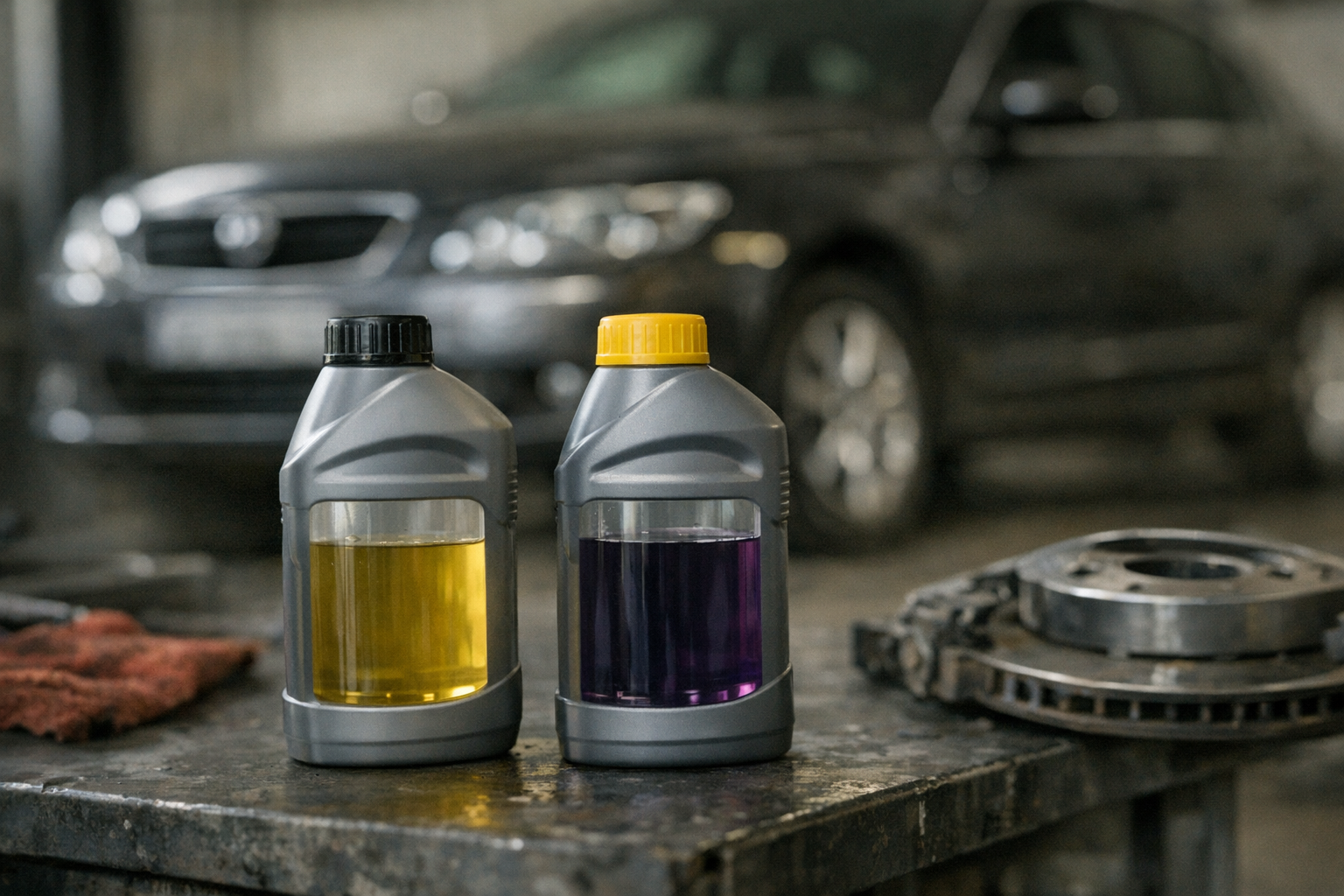
DOT 4 vs DOT 5.1 Brake Fluid for European Cars
Compare DOT 4 vs DOT 5.1 brake fluid for European cars. Learn boiling points, compatibility, flush intervals, and which fluid your BMW, Audi, or VW requires.
Introduction
DOT 4 vs DOT 5.1 Brake Fluid: Which Spec Your European Car Requires
DOT 4 vs DOT 5.1 brake fluid: the difference comes down to boiling points and manufacturer specification. DOT 4 has a dry boiling point of approximately 230°C and a wet boiling point of about 155°C. DOT 5.1 raises those figures to 270°C dry and 180°C wet. Both are glycol-based, hygroscopic, and compatible with the same seals and ABS components. The spec printed on your reservoir cap or in your owner's manual determines which one goes in your BMW, Audi, Mercedes, or VW.
I've watched plenty of confusion at the counter when someone asks whether they can swap DOT 4 for DOT 5.1 or vice versa. The question usually comes from a driver holding two bottles with different labels and similar prices, wondering if the higher number means better performance. In my years selling European parts, the answer is always the same: check what the car requires first, then understand what each fluid does when the brakes get hot.
The difference is in the boiling point—the temperature at which the fluid turns to vapor under pressure. When brake fluid boils, you get a spongy pedal and reduced stopping power because vapor compresses where liquid does not. DOT 5.1 has a higher minimum dry boiling point than DOT 4, which matters if you drive hard, tow heavy, or live somewhere with steep descents.
European manufacturers specify one or the other based on the brake system design, caliper size, and expected duty cycle. A 2015 BMW 328i calls for DOT 4; a 2018 Audi S4 with larger brakes and higher performance expects DOT 5.1. Using the wrong one does not cause immediate failure, but it changes the safety margin when the system heats up. The spec is printed in the owner's manual and usually on the reservoir cap. If you are not sure, look there before you buy the bottle.
For related fluid specifications on European platforms, see our BMW Transmission Fluid Specs: ZF, GM, and DCT Explained for transmission service intervals and approvals.
Both fluids are hygroscopic, meaning they absorb water from the air over time. That lowers the boiling point and increases corrosion inside the brake lines. The flush interval is typically two years regardless of which DOT rating you run, because moisture contamination affects both the same way. The higher dry boiling point of DOT 5.1 does not extend the service life—it just gives you more thermal headroom when the fluid is fresh.
This comparison covers the boiling points, compatibility, pricing, and real-world application of DOT 4 versus DOT 5.1 for European cars. The goal is to show you which fluid your car requires, what happens when you use the wrong one, and when the higher spec actually matters on the road.
Explore the differences between DOT 4 and DOT 5.1 brake fluids for European cars, including features, pricing, and recommendations.
Overview of DOT 4 Brake Fluid
DOT 4 is the factory fill in most European cars built in the last twenty years. I see it spec'd in everything from base-model VWs to mid-tier BMWs, and the reason is straightforward: it handles the heat modern ABS and stability systems generate without boiling under normal driving. The dry boiling point sits at 446°F (230°C), and the wet boiling point—what matters after the fluid absorbs moisture over time—is 311°F (155°C). Those numbers are enough for street use and light performance driving, which covers the majority of what crosses the counter.
What DOT 4 Brake Fluid Is Made Of
DOT 4 is a glycol-ether blend. It is hygroscopic, meaning it pulls moisture from the air through the reservoir cap and brake hoses. That moisture lowers the boiling point, which is why the wet spec exists and why you flush it on a schedule. The glycol base also means DOT 4 is backward-compatible with DOT 3 systems—you can top a DOT 3 car with DOT 4, though the reverse is not recommended because you degrade the higher-spec fluid.
Performance Characteristics for European Cars
European platforms—especially those with corner-heavy braking systems like BMWs with floating calipers or Audis with electronic brake force distribution—generate sustained caliper heat. DOT 4 handles that heat in daily driving and spirited back-road runs. It does not handle track days or repeated mountain descents as well as DOT 5.1, but for the owner who drives to work and occasionally pushes it on a canyon road, DOT 4 delivers what the factory intended. The fluid also plays well with ABS modulators and electronic stability systems, which is why manufacturers spec it across their lineups. For more on how European manufacturers handle fluid specifications across different systems, see our guide on VW 507.00 vs 504.00 vs 502.00 Oil: Key Differences.
Typical Applications and Change Intervals
DOT 4 is the standard in VW, Audi, BMW, Mercedes-Benz and Volvo models that do not carry a performance or M-Sport badge. The flush interval is typically two years or 30,000 miles, whichever comes first. Moisture contamination accelerates in humid climates, so if you are in the Southeast or Pacific Northwest, treat the two-year mark as a hard deadline. The fluid itself is inexpensive—a liter runs eight to twelve dollars—so cost is not the reason to skip a flush. The reason to flush on time is that water in the lines corrodes the ABS modulator and caliper pistons, and those parts cost real money.
Overview of DOT 5.1 Brake Fluid
DOT 5.1 is a glycol-based brake fluid with higher boiling points than DOT 4. The dry boiling point sits at 500°F (260°C) and the wet boiling point at 356°F (180°C). That gap matters when you run a car hard or live where moisture gets into the system fast. I have watched shops assume DOT 5.1 is silicone because of the number, but it is not — it mixes with DOT 3 and DOT 4 because the chemistry is glycol, not silicone.
The spec delivers lower cold viscosity than standard DOT 4, which means the ABS pump and stability-control solenoids move fluid faster at startup in cold weather. European makes that call for DOT 5.1 do it because the brake system runs hotter under sustained braking or because the ABS module sits in a spot that traps heat. Porsche, some BMW M models, and certain Audi RS platforms specify it. The bottle has to say DOT 5.1 on the label; a high-performance DOT 4 that boils at 500°F dry is not the same thing and does not meet the viscosity requirement.
What DOT 5.1 Does Differently
DOT 5.1 pulls moisture at the same rate as DOT 4 because both are glycol blends. The difference is the starting boiling point and the viscosity curve. When the fluid absorbs water over two years, DOT 5.1 still boils higher than DOT 4 at the same moisture level. That does not mean you skip the flush interval — it means you have more margin before vapor lock if you miss the interval by a few months.
The lower viscosity shows up in cold-weather pedal feel and ABS response. If your car specifies DOT 5.1 and you run DOT 4, the ABS will work but the pump works harder and the pedal might feel softer in the first few stops on a cold morning. The wrong viscosity does not damage anything immediately, but it changes how the system behaves at the edges.
When European Cars Require DOT 5.1
Porsche calls for DOT 5.1 across most of the lineup starting in the mid-2000s. BMW specifies it for M cars and some xDrive models with heavy braking duty. Audi uses it on RS models and some S-line cars. Volvo switched certain platforms to DOT 5.1 in the SPA generation. The requirement is in the owner's manual and on the reservoir cap. If the cap says DOT 4, run DOT 4. If it says DOT 5.1, the system was engineered for that viscosity and boiling point.
You can top a DOT 5.1 system with DOT 4 in an emergency because they mix, but the result is a blend with lower boiling points and higher viscosity than the spec requires. Flush it at the next service. Going the other way — topping DOT 4 with DOT 5.1 — raises the boiling point but does not hurt anything. The full benefit comes when you flush the system and fill it with the correct fluid.
For more on how fluid specifications shape European car maintenance, see our guide on Volvo Transmission Fluid by Model: S60, S80, XC90 Guide.
Feature Comparison of DOT 4 and DOT 5.1
The difference between DOT 4 and DOT 5.1 comes down to boiling points and how fast the fluid degrades when it pulls moisture. I've watched both fluids perform at the counter and in the field, and the spec sheet tells you what matters: dry boiling point, wet boiling point, and viscosity.
Boiling Point Specifications
DOT 4 has a dry boiling point of approximately 230°C and a wet boiling point of about 155°C. DOT 5.1 raises the bar with a dry boiling point around 270°C and a wet boiling point of 180°C. The wet number is what counts after the fluid has been in the system for a year or two — brake fluid is hygroscopic, meaning it absorbs water from the air through the reservoir cap and brake hoses. Once moisture gets in, the boiling point drops, and that is when fade starts.
The 25°C advantage in wet boiling point means DOT 5.1 tolerates more moisture before it boils under hard braking. On a mountain descent or track day, that margin keeps the pedal firm when DOT 4 would start to feel soft.
Viscosity and Cold-Weather Performance
Both fluids are glycol-based and compatible with the same seals and ABS components. Viscosity at low temperatures is similar — both stay fluid down to -40°C. European cars with ABS and stability control require a fluid that flows quickly through the pump and solenoid valves, and both DOT 4 and DOT 5.1 meet that requirement. The difference is not in cold flow; it is in thermal margin.
| Feature | DOT 4 | DOT 5.1 |
|---|---|---|
| Dry Boiling Point | ~230°C | ~270°C |
| Wet Boiling Point | ~155°C | ~180°C |
| Base Chemistry | Glycol | Glycol |
| Compatibility | DOT 3, DOT 4 | DOT 3, DOT 4, DOT 5.1 |
| Cold Flow | -40°C | -40°C |
Moisture Absorption Rate
DOT 5.1 absorbs moisture at roughly the same rate as DOT 4 — both are hygroscopic. The advantage is not slower absorption; it is a higher wet boiling point when the moisture does get in. If you flush the system every two years, both fluids will perform. If you stretch the interval to three or four years, DOT 5.1 degrades more gracefully.
Chemical Compatibility
DOT 4 and DOT 5.1 use the same seal materials and are compatible with all European ABS and stability control systems. Neither fluid attacks rubber or corrodes aluminum. The only incompatibility is with DOT 5 (silicone-based), which is not used in any European production car and should never be mixed with glycol fluids.
For more on fluid specifications in European cars, see our HOAT Coolant vs OAT vs IAT: What European Cars Require guide.
Pricing Comparison of DOT 4 and DOT 5.1
DOT 4 runs $8 to $12 per liter at the counter. DOT 5.1 runs $12 to $18 for the same volume. The difference is not markup — it is chemistry. DOT 5.1 uses a higher-grade glycol base and more aggressive additive packages to hit the dry boiling point, and those raw materials cost more. When you multiply that by the four to six liters a European brake system holds, the fluid bill for a DOT 5.1 flush is $25 to $40 higher than DOT 4.
What Drives the Price Gap
The boiling-point requirement is the driver. DOT 5.1 must reach 260°C dry and 180°C wet under FMVSS 116, and the glycol ethers that deliver that performance are not commodity chemicals. Suppliers blend them in smaller batches, and distributors stock them in lower volumes than DOT 4. Lower turnover means higher per-unit cost at every step of the supply chain. The bottle reflects that.
Brand matters less than you think. A house-brand DOT 5.1 that prints the FMVSS 116 compliance on the label performs the same as the OE-branded version that costs $6 more per liter. I have watched shops flush identical systems with both, and the pedal feel and fade resistance are indistinguishable. The OE bottle buys you nothing except the logo.
When the Cheaper Fluid Costs More
Running DOT 4 in a DOT 5.1 system to save $30 on the flush is a miscalculation. The lower wet boiling point means the fluid absorbs enough moisture to drop below the fade threshold in 18 to 24 months instead of 36. You flush twice as often, and the labor cost is $150 to $200 each time. Over six years, you spend an extra $300 in shop time to avoid a $60 material difference. The math does not work.
The inverse — running DOT 5.1 in a DOT 4 system — is not a problem mechanically, but it is a waste. If the car does not generate the caliper temperatures that justify the higher boiling point, the fluid's performance envelope is unused. You are paying for capability the system never stresses. It is not harmful, just inefficient.
Volume Pricing and System Capacity
European brake systems hold more fluid than domestic platforms. A BMW 5-series takes five liters; an Audi Q7 takes six. At $15 per liter for DOT 5.1, that is $75 to $90 in fluid alone before labor. Shops that flush European cars regularly buy DOT 5.1 in five-liter jugs or case quantities, and the per-liter cost drops to $10 to $12. If you are doing the work yourself, the case price makes sense. If you are paying a shop, ask whether they stock bulk — some pass the savings through, some do not.
DOT 4 in the same volumes runs $6 to $8 per liter in bulk. For a fleet or a shop turning over ten flushes a week, the material cost difference between DOT 4 and DOT 5.1 is $200 to $300 per month. That is why some independents resist the higher spec unless the car explicitly calls for it — the margin is tighter, and the customer often does not understand why the bill is higher.
Pros and Cons of DOT 4 and DOT 5.1
I've watched shops make the wrong call on brake fluid more times than I can count, and it always comes down to not weighing what each spec gives you against what it costs you. DOT 4 and DOT 5.1 are both glycol-based and mix without destroying the system, but the differences matter when you're deciding what goes in the reservoir and how often you're coming back to bleed it.
DOT 4 Advantages
DOT 4 is everywhere. Every parts counter stocks it, every quick-lube has it on the shelf, and you can grab a bottle at any auto parts chain without calling ahead. The price is lower — sometimes half what DOT 5.1 costs — and for a car that sees normal street driving in a temperate climate, the 446°F dry boiling point is more than enough. If you're running a 2008 Passat or a 2015 A4 that the manual says takes DOT 4, you use DOT 4. The availability and the cost make it the default for most European platforms that don't explicitly require the higher spec.
The other advantage is that DOT 4 has been the standard for decades. Shops know it, techs trust it, and the service intervals are well established. You flush it every two years, you top it when the level drops, and you move on.
DOT 4 Disadvantages
The weakness is the boiling point. DOT 4's 446°F dry and 311°F wet ratings are fine until they're not. If you live where it's hot, if you tow, if you drive mountain roads or track the car even occasionally, that wet boiling point drops fast as the fluid absorbs moisture. I've seen DOT 4 pull enough water in 18 months that the pedal goes soft under hard braking, and that's the fluid telling you it's done. The hygroscopic nature — it pulls water from the air — means you're on a clock from the day you crack the seal.
DOT 5.1 Advantages
DOT 5.1 gives you a 518°F dry boiling point and a 374°F wet rating. That extra margin is real. If your car has an aggressive braking system — big calipers, heavy vehicle weight, or a high-performance platform — the higher boiling point keeps the pedal firm when DOT 4 would fade. For cars that specify DOT 5.1, it's not a preference; it's a requirement, and the system is designed around that thermal capacity.
The other advantage is longevity under heat. DOT 5.1 still absorbs water, but the higher starting point means it takes longer to degrade to the point where performance suffers. If you drive hard or live in a hot climate, DOT 5.1 buys you time.
DOT 5.1 Disadvantages
The cost is higher. DOT 5.1 runs $15 to $25 per liter compared to $8 to $12 for DOT 4, and that adds up if you're flushing multiple cars or doing a full system bleed. Availability is spottier — not every parts store keeps it in stock, and some shops don't carry it at all. If you're on the road and need to top off, you might not find it.
The other disadvantage is that it's overkill for cars that don't need it. If your manual says DOT 4 and you're driving a 2010 Jetta in normal conditions, paying double for DOT 5.1 doesn't get you anything. The system won't use the extra thermal capacity, and you're still flushing it every two years because of moisture absorption.
The higher boiling point only matters if your braking system is designed to use it — otherwise, you're paying for capacity you'll never reach.
What Both Fluids Share
Both are hygroscopic. Both need to be flushed every two years regardless of mileage. Both are glycol-based, so they mix and they're compatible with the same seals and ABS components. The difference is thermal capacity, not chemistry. Using the wrong brake fluid can damage your braking system, so the spec on the cap is the spec you follow — DOT 4 where it says DOT 4, DOT 5.1 where it says DOT 5.1.
Who Should Choose DOT 4 and Who Should Choose DOT 5.1
I've watched plenty of owners walk into the counter convinced they need the highest-spec fluid on the shelf, and I've also seen people reach for the cheapest bottle because "brake fluid is brake fluid." Both get it wrong. The decision between DOT 4 and DOT 5.1 isn't about better or worse—it's about what the manufacturer printed in the owner's manual and what your driving actually demands.
When DOT 4 Is the Right Choice
DOT 4 works for the majority of European cars on the road. If your BMW, Audi, Mercedes, or VW calls for DOT 4 in the service booklet, that's what goes in. The dry boiling point sits at 446°F and the wet at 311°F, which handles normal street driving and moderate mountain descents without vapor lock. Most daily drivers never see sustained brake temperatures that push past those thresholds.
For owners who follow the two-year flush interval and don't track the car, DOT 4 does the job. It's widely available, costs less per liter than DOT 5.1, and meets the OEM requirement. Performance vehicles that specify DOT 4—not DOT 5.1—still get DOT 4, because the system was designed and tested with that fluid's viscosity and compressibility in mind.
When DOT 5.1 Is Required
DOT 5.1 becomes necessary when the car's brake system generates enough heat to exceed DOT 4's margins. High-performance European models—M cars, RS models, AMG variants, and Porsche sports cars—often specify DOT 5.1 from the factory. The dry boiling point reaches 500°F and the wet hits 356°F, giving a wider safety band during hard repeated stops.
If you track your car or drive aggressively on mountain roads, and the manual allows or specifies DOT 5.1, use it. The fluid absorbs moisture at the same rate as DOT 4, so the flush interval stays at two years, but the elevated boiling points mean the pedal stays firm when the rotors glow. Some owners ask if they can upgrade a DOT 4 system to DOT 5.1 for extra margin. You can—the fluids are chemically compatible—but only if the OEM allows it and you flush the system completely. Mixing leaves old fluid in the lines, and the lowest boiling point in the mix is what counts.
Matching Fluid to Driving Conditions
The decision also depends on how you use the car. A daily-driven 3-series in flat terrain with normal commuting sees low brake temperatures; DOT 4 handles it without issue. The same car driven hard on a canyon road or at a track day generates sustained heat that can boil DOT 4 if moisture content is high. In that case, either switch to DOT 5.1 (if allowed) or shorten the flush interval to keep moisture below two percent.
For cars that sit unused for months at a time, moisture absorption becomes the bigger risk. Both DOT 4 and DOT 5.1 are hygroscopic, so neither prevents water ingress during storage. The solution is a flush before the two-year mark, not a higher-spec fluid.
If your manual lists DOT 4 as the requirement and you're not tracking the car, understanding other fluid specifications can help you maintain the rest of the system to the same standard.
Frequently asked questions
Can I mix DOT 4 and DOT 5.1 brake fluid?
Yes. DOT 4 and DOT 5.1 are both glycol-based and fully compatible. If you top a DOT 4 system with DOT 5.1 or vice versa, the fluids will mix without chemical reaction. The resulting blend will have a boiling point somewhere between the two, closer to the lower spec. For optimal performance, flush the system and refill with the manufacturer-specified fluid at the next service interval.
How often should I replace DOT 4 vs DOT 5.1 brake fluid?
Both DOT 4 and DOT 5.1 require replacement every two years or 30,000 miles, whichever comes first. The flush interval is determined by moisture absorption, not boiling point. Both fluids are hygroscopic and pull water from the air at similar rates. The higher boiling point of DOT 5.1 does not extend service life; it provides more thermal margin when the fluid is fresh.
What happens if I use DOT 4 in a DOT 5.1 system?
Using DOT 4 in a DOT 5.1 system reduces the boiling point safety margin. The system will function normally under light braking, but under sustained hard braking—mountain descents, track use, or towing—the lower wet boiling point of DOT 4 increases the risk of vapor lock and pedal fade. If you must use DOT 4 in an emergency, flush the system with the correct DOT 5.1 fluid as soon as possible.
Is DOT 5.1 the same as DOT 5?
No. DOT 5.1 is glycol-based and compatible with DOT 3 and DOT 4. DOT 5 is silicone-based and cannot be mixed with any glycol fluid. European cars do not use DOT 5. If your reservoir cap or manual specifies DOT 5.1, never substitute DOT 5—the two are chemically incompatible and mixing them will damage seals and brake components.
Why does my European car specify DOT 5.1 instead of DOT 4?
European manufacturers specify DOT 5.1 for brake systems that generate higher sustained temperatures. High-performance models, cars with larger calipers, and platforms designed for aggressive driving require the higher dry and wet boiling points that DOT 5.1 provides. The specification is based on thermal testing of the complete brake system, not marketing. Always use the fluid your manufacturer specifies.
Final Verdict
I've watched the same question come up at the counter for twenty years: can I just run DOT 4 if the cap says DOT 5.1? The answer is no, and the reason is not a preference — it is a requirement. If your BMW, Audi, or VW specifies DOT 5.1, the higher dry boiling point and the hygroscopic rating are both part of the engineering calculation. Run DOT 4 in a 5.1 system and you compress the service interval, introduce vapor risk under heavy braking, and void any goodwill claim if a caliper or ABS module fails. The bottle has to say what the cap says.
DOT 5.1 is the correct choice for any European car built after roughly 2010 that lists it in the owner's manual or on the reservoir cap. The 500°F dry boiling point handles the heat load from modern braking systems — ceramic rotors, electronic stability programs, and the stop-start cycles that keep fluid temperatures high. DOT 4 works in older platforms and in cars where the manual explicitly calls for it, but mixing is the mistake. If you top a DOT 5.1 system with DOT 4, you drop the boiling point of the entire reservoir to the lower spec. Flush it; don't top it.
When DOT 4 Is the Right Answer
DOT 4 remains the spec for pre-2010 European cars and for any platform where the manual or the cap lists DOT 4 without a 5.1 option. Older E46 BMWs, B5 Passats, and W203 Mercedes all ran DOT 4 from the factory, and the system was designed around the 446°F dry boiling point. The fluid is cheaper, widely available, and compatible with the rubber seals and ABS modules in those chassis. If the build date is before 2008 and the cap does not say 5.1, DOT 4 is not a compromise — it is the correct fill.
The interval is shorter. DOT 4 absorbs water faster than DOT 5.1, so the wet boiling point drops below safe operating range in about two years under normal driving. Track use or mountain descents compress that window to twelve months. Check the manual for the factory interval, but in practice, flush DOT 4 every two years regardless of mileage. We sell both; the choice is not about cost, it is about what the car was engineered to run.
When DOT 5.1 Is Non-Negotiable
If the reservoir cap is printed with DOT 5.1, or if the owner's manual lists it as the required spec, there is no alternative. DOT 5.1 is specified in cars with aggressive braking systems: F30 and G20 BMWs, B8 and B9 Audis, Mk7 and Mk8 Golfs with performance packages, and any Porsche with PCCB or a track-oriented brake option. The higher boiling point is not a margin — it is the baseline the system needs to avoid vapor lock under the heat cycles these platforms generate.
The price difference is real but small in context. A liter of DOT 5.1 runs about twice the cost of DOT 4, but a full flush on most European cars takes less than a liter. The cheap way costs more when you factor in the risk of a second flush to correct a wrong fill, or the replacement cost of an ABS module that failed because the fluid boiled. Run it, then top to the mark with the same spec.
The Verdict
DOT 5.1 wins in any modern European car where the manual or cap specifies it, and DOT 4 is the correct choice in older platforms designed for it. There is no gray area: check the build date, read the cap, and buy the bottle that matches. The wrong fluid does not announce itself immediately — it shows up as spongy pedal feel after a hard stop, or as an ABS fault code six months later. The owner's manual is right about this. If you are at the counter and the cap says DOT 5.1, that is what goes in the car.
Written by
Lee Shahin
Founder, European Wholesale Parts
Lee Shahin founded European Wholesale Parts in Pleasanton, California, after 18 years in the Mercedes-Benz and BMW parts trade. He came to the parts side from the shop floor: he opened a European repair shop in Northern California in the early 1990s, specialising in Mercedes-Benz and BMW, and grew it with his wife Laurie into a parts and delivery operation serving body shops and independent repair facilities across the region. Nearly two decades at the parts counter taught him where the expensive mistakes happen, and most of them are fluids: the wrong coolant in an aluminium block, an oil without the sheet approval the engine was designed for, a transmission topped with the wrong ATF. That is what he writes about here. Every article names the manufacturer specification by its exact designation, explains what the wrong fluid does mechanically, lists products that carry the approval, and gives the capacity and interval for the models and years the specification covers. When a reader needs a part sourced, the quote desk at European Wholesale Parts is where Lee and Laurie still answer the phone.