Mercedes E350 Coolant and Oil Type by Year (W211, W212, W213)
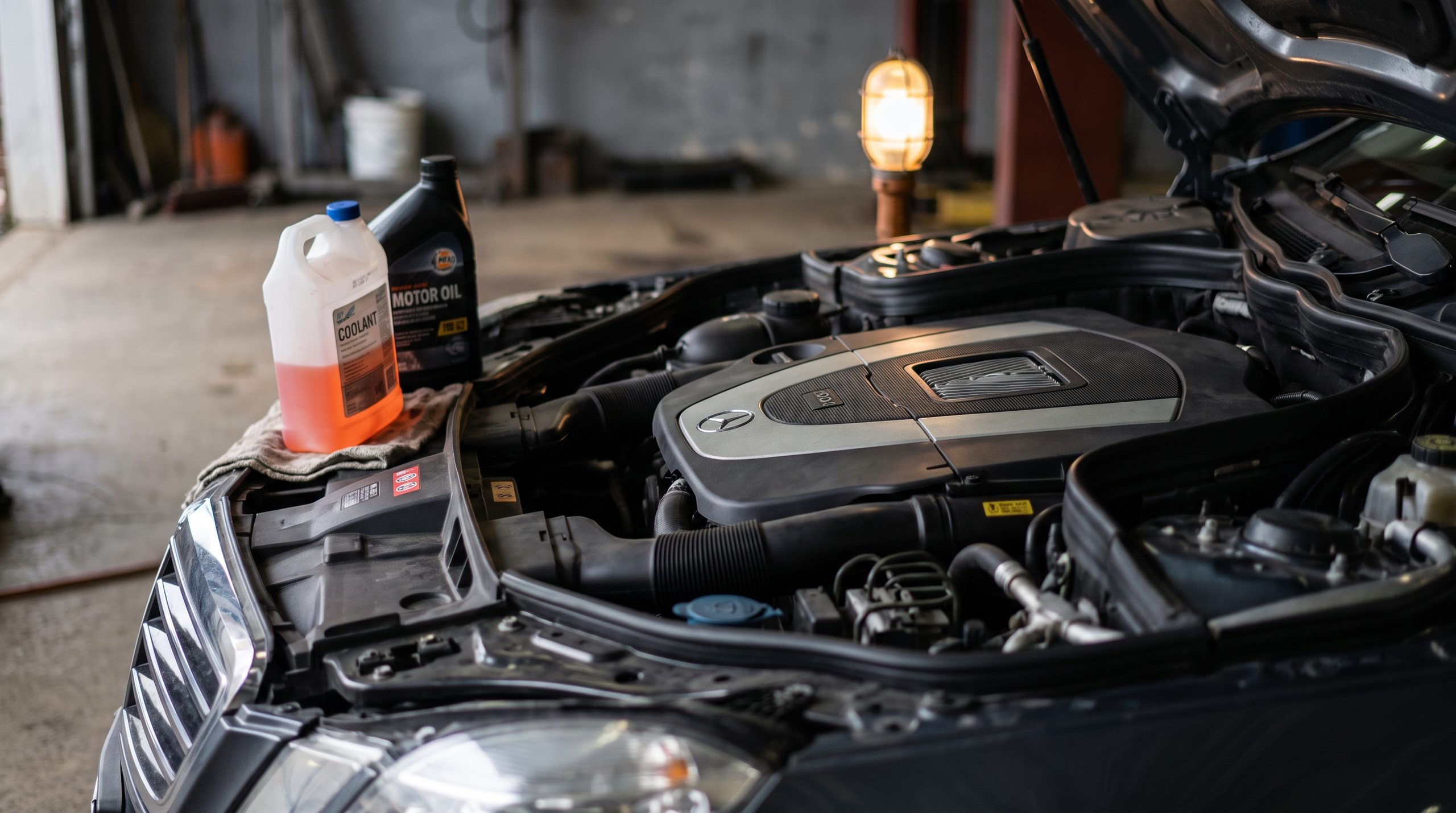
! [Mercedes E350 engine compartment with coolant and oil containers](https://media.xencolabs.com/media/mercedes%20e350%20coolant%20and%20oil%20type%20by%20year%20(w211%2C%20w212%2C%20w213-hero-441e769e52d.png)
Introduction

The Mercedes E350 coolant and oil type requirements differ across three chassis generations. The W211 generation ran from 2006 to 2009 in the U.S. market, the W212 from 2010 to 2016, and the W213 from 2017 forward. Each generation brought new engines, new coolant formulations, and revised oil approvals. The parts are not interchangeable, and neither are the fluids.
The E350 has been in production since 2006, and I have watched three generations of this platform come through the counter. The question is always the same: can I use what I have on the shelf, or does the bottle have to say something specific? The answer depends on the chassis code and the engine your car carries. Mercedes-Benz vehicles are engineered to operate with specialized coolant formulations that provide superior protection against corrosion, overheating, scale buildup, and freezing temperatures. The oil specification is just as strict—run a generic 5W-30 without the MB sheet approval and the variable timing solenoids clog first.
For more on how Mercedes oil approvals work across platforms, see Mercedes 229.5 Oil: Approval Requirements and Compatible Oils.
This article breaks down the correct Mercedes E350 coolant and oil type, capacities, and service intervals by chassis and model year. Always verify the coolant specification listed in the owner's manual or service documentation before adding or replacing coolant to ensure compatibility and prevent engine damage. The owner's manual is right about this.
What Happens When You Use the Wrong Mercedes E350 Coolant and Oil Type?
The question at the counter is always the same: what happens if I run the wrong oil? In an E350, the answer depends on the engine, but the pattern is the same across all three generations. Use a non-approved oil and the first thing that goes is the variable timing solenoid or the turbo bearing. I've watched shops chase low oil pressure codes on W212 E350s only to find sludge in the oil cooler passages — the engine was fed bulk 5W-30 without the MB 229.51 sheet approval.
What the Wrong Oil Does
The OM642 V6 diesel and the M276 V6 gasoline engines both demand low-SAPS formulations. Run a conventional 5W-30 or a diesel oil without the correct approval and ash accumulates in the oil cooler and variable cam phasers. The oil cooler seal on the OM642 is a known weak point; sludge formation accelerates the leak. On the M276, timing chain stretch shows up early when the oil film breaks down under heat. The approval printed on the bottle is not a suggestion — it is the minimum standard the engine was designed around.
Coolant Consequences
Mercedes coolant is phosphate-free and silicate-free by design. The factory fill is an ethylene-glycol base with organic acid inhibitors. Mix it with a conventional green coolant and the phosphate drops out of suspension; the water pump seal hardens and the heater core plugs. Top it with a generic orange coolant and the inhibitor package is diluted — corrosion starts at the aluminum head gasket surface. The right move is to flush it and refill with MB 325.0-approved coolant, not to top it with whatever is on the shelf. For more on coolant compatibility, see G12 vs G13 Coolant: Compatibility and Which to Use.
Why the Spec Matters
Every E350 engine has a different oil capacity and a different approval requirement. The W211 3.5L V6 takes MB 229.5; the W212 diesel takes 229.51; the W213 M276 takes 229.52 or 229.51 depending on the build date. Run the wrong spec and the warranty claim gets denied, but more importantly, the engine does not make it to 150,000 miles. The cheap way costs more when the timing chain goes at 80,000 because the oil could not hold film pressure at operating temperature. For more on the Mercedes 229.5 oil approval and what meets it, see the linked guide.
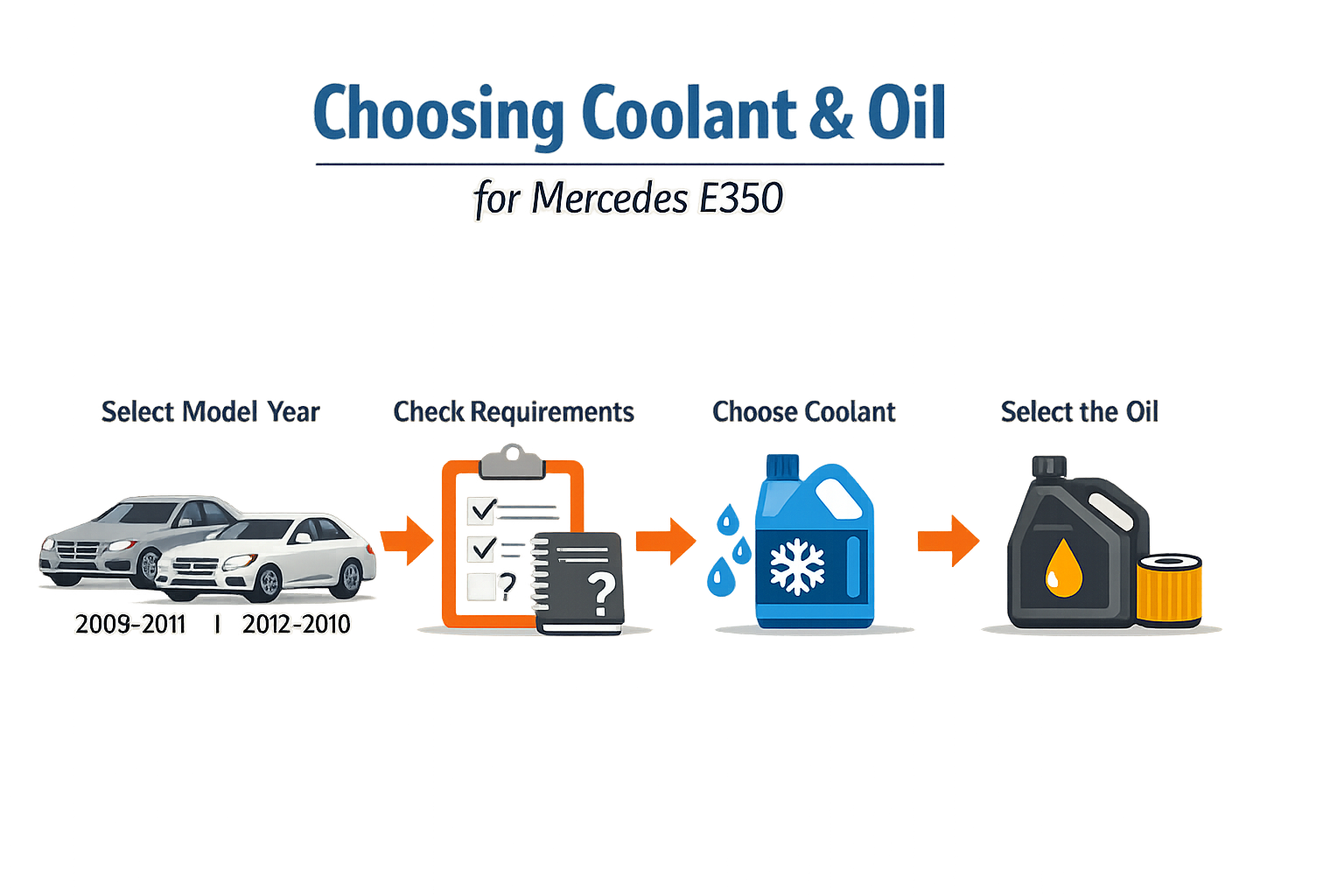
How to Select the Correct Mercedes E350 Coolant and Oil Type
Step 1
Identify your E350's chassis code and year
The E350 spans three generations: W211 (2003–2009), W212 (2009–2016), and W213 (2016–present). The chassis code is stamped on the door jamb sticker and appears in the owner's manual. The year alone is not enough — a 2009 can be either W211 or W212 depending on build date, and the oil spec changes between them.
Step 2
Match the engine code to the correct oil approval
For W212 E350 models with the M272 V6 (2009–2013), the oil must carry MB 229.5 approval. That means 5W-30 full synthetic, and the bottle has to say 229.5 on the back label. For W213 E300 models with the M274 four-cylinder (2016–2020), the spec steps up to MB 229.51, still 5W-30. The 2020-and-later W213 E300 with the M264 engine accepts either MB 229.51 or MB 229.6 — the latter is 0W-20, and mixing the two is the mistake that costs you a timing-chain adjuster.
Step 3
Verify oil capacity by engine and fuel type
Gasoline V6 models (M272, M276) take 6.9 quarts with the filter. Diesel V6 models (OM642) take 9.5 quarts for 2016, 8.5 quarts for 2013. Four-cylinder M274 and M264 engines take roughly 5.5–6.0 quarts. The owner's manual is right about this — the capacity printed there includes the filter, so you do not add extra. Run the engine, let it settle for five minutes, then top to the mark.
Step 4
Choose coolant by Mercedes specification, not color
Mercedes specifies MB 325.0 coolant for all E-Class models from W211 forward. The factory fill is blue, but the spec — not the color — is what matters. Aftermarket products that meet MB 325.0 will say so on the label. Do not mix coolant types; if you are topping off and do not know what is in the system, flush it and refill with a product approved to 325.0. The aluminum block and heads do not forgive glycol contamination.
Step 5
Cross-reference the approval on the product label
When you pick up a bottle, flip it over and look for the Mercedes-Benz sheet approval printed in the specs block. It will read "MB-Approval 229.5" or "Meets MB 229.51" depending on the oil. If the label says only "synthetic 5W-30" without the sheet number, it does not meet the spec, even if the viscosity matches. Mercedes 229.5 oil approval requirements explain how to read the label and what the approval actually tests.
Mercedes E350 Coolant and Oil Type by Generation
| Generation | Years | Engine | Oil Spec | Oil Capacity | Coolant Spec |
|---|---|---|---|---|---|
| W211 | 2006–2009 | 3.5L V6 (M272) | MB 229.5 | 6.9 qt | MB 325.0 |
| W212 | 2010–2016 | 3.5L V6 (M276) | MB 229.5 | 6.9 qt | MB 325.0 |
| W212 | 2013–2016 | 3.0L V6 diesel (OM642) | MB 229.51 | 8.5 qt | MB 325.0 |
| W213 | 2017–2020 | 2.0L I4 (M274) | MB 229.51 | 5.5–6.0 qt | MB 325.5 |
| W213 | 2020+ | 2.0L I4 (M264) | MB 229.51 or 229.6 | 5.5–6.0 qt | MB 325.5 |
Tips and Tricks for Maintaining Your E350
I've watched a lot of E350s come through the shop, and the ones that run past 200,000 miles all have one thing in common: the owner sticks to the service interval and uses the right fluid every time. The mistakes I see at the counter are predictable — mixing coolant types, topping off with the wrong oil, skipping the filter — and they all cost more to fix than they would have to prevent.
Check the Build Date Before You Order
The model year on the registration is not always the build date. A 2010 E350 built in late 2009 may take a different coolant spec than one built in mid-2010, especially across the W211-to-W212 transition. The build date is stamped on the driver's door jamb. If you are ordering oil or coolant for the first time, write down the build month and year, then cross-check the capacity and approval against that date. The parts catalog at the counter is organized by build date, not model year, for exactly this reason.
Run It, Then Top to the Mark
After an oil change, run the engine for two minutes, shut it off, wait five, then check the dipstick. The oil has to circulate through the filter and the variable timing actuators before the level settles. If you top it cold, you will overfill it, and overfilling a Mercedes V6 pushes oil past the valve-stem seals and into the intake. Top to the upper mark only after the engine has run and rested.
The Interval Is 10,000 Miles or 12 Months
Mercedes publishes a 15,500-mile service interval in some markets, but in my experience the oil starts breaking down past 10,000 miles in stop-and-go driving, especially on the M272 and M276 V6 engines. The variable cam adjusters are the first thing to suffer when the oil thins out. I tell customers 10,000 miles or 12 months, whichever comes first, and I have not seen a single cam-adjuster failure in an E350 that stuck to that schedule. The oil is cheap compared to the repair.
Mixing Is the Mistake
If you are topping off coolant, use the same spec that is already in the system. The W211 takes MB 325.0, the W212 and W213 take MB 325.5 or 325.6 depending on the year. Mixing 325.0 and 325.5 does not cause an immediate failure, but it changes the corrosion-inhibitor chemistry and the mixture will not protect the aluminium head and block the way a single spec does. If you do not know what is in there, flush it and fill it with the correct spec for your build date. Topping off with the wrong coolant is how you end up with a $4,000 head gasket at 80,000 miles.
The cheap way costs more — every time I have seen someone save $30 on oil or coolant, they spent $3,000 fixing what it damaged.
Use the Filter That Comes with the Oil
When you buy oil that meets the MB sheet approval, it usually comes with a filter that also meets the spec. Use that filter. The aftermarket filters that do not carry the MB approval often have a different bypass-valve pressure or a coarser media, and the engine-management system on the W212 and W213 measures oil pressure at idle to detect filter restriction. A cheap filter can throw a low-pressure code even when the oil level is correct, and then you are chasing a fault that does not exist. We sell both OEM and approved aftermarket filters at the counter, and I point customers to the one that matches the oil they are buying.
For more details on Mercedes 229.5 oil approval and compatible oils, check the approval printed on the bottle before you pour it in. If you work on other German platforms, BMW X5 oil type and coolant by generation follows a similar approval-based system.
Frequently asked questions
What Mercedes E350 coolant and oil type does my W211 require?
W211 E350 models (2006–2009) with the M272 3.5L V6 require MB 229.5 oil (5W-30 synthetic) at 6.9 quarts with filter, and MB 325.0 coolant. Check the door jamb for the build date to confirm the chassis generation.
Can I mix MB 325.0 and MB 325.5 coolant in my E350?
No. Mixing MB 325.0 and MB 325.5 changes the corrosion-inhibitor chemistry and reduces protection for the aluminum block and heads. If you do not know what is in the system, flush and refill with the correct spec for your build date.
What oil does a W212 E350 diesel take?
The W212 E350 diesel (OM642 3.0L V6, 2013–2016) requires MB 229.51 oil at 8.5 quarts with filter. Do not use MB 229.5 — the diesel engine needs the low-SAPS formulation in 229.51 to prevent ash buildup in the oil cooler and variable cam phasers.
How often should I change oil in a Mercedes E350?
Change oil every 10,000 miles or 12 months, whichever comes first. Mercedes publishes a 15,500-mile interval in some markets, but oil breaks down past 10,000 miles in stop-and-go driving, especially on M272 and M276 V6 engines.
Conclusion
The E350 is not forgiving about fluids. I've watched engines come into the shop with sludged oil galleries because someone ran a generic 5W-30 without the 229.51 or 229.52 sheet approval, and I've seen cooling systems fail early when the wrong coolant mixed with the factory fill. The bottle has to say the approval, and the year and chassis code have to match what the owner's manual calls for.
W211 models run 229.5 oil and blue coolant; W212 and W213 models take 229.51 or 229.52 oil depending on the build date, and the same blue coolant spec carries forward. Capacities vary by engine—V6 models hold less than the diesel V6, and the four-cylinder in the late W213 is different again. Check the build date, confirm the engine code, and buy fluid that prints the approval on the label. The cheap way costs more when the variable timing solenoids clog or the water pump seizes.
At the counter, the question is always whether a product meets the spec or just claims a viscosity grade. For the E350, viscosity is not enough—the additive package and the manufacturer's test data matter, and that is what the approval confirms. If you are not sure which oil or coolant your car takes, bring the VIN and we will look it up by engine code. The right fluid is not a preference; it is a requirement, and the aluminium block does not forgive mistakes.
For more detail on Mercedes oil approvals and what they mean mechanically, see our guide to Mercedes 229.5 Oil: Approval Requirements and Compatible Oils. Run the correct spec, change it on interval, and the E350 will go the distance.
Written by
Lee Shahin
Founder, European Wholesale Parts
Lee Shahin founded European Wholesale Parts in Pleasanton, California, after 18 years in the Mercedes-Benz and BMW parts trade. He came to the parts side from the shop floor: he opened a European repair shop in Northern California in the early 1990s, specialising in Mercedes-Benz and BMW, and grew it with his wife Laurie into a parts and delivery operation serving body shops and independent repair facilities across the region. Nearly two decades at the parts counter taught him where the expensive mistakes happen, and most of them are fluids: the wrong coolant in an aluminium block, an oil without the sheet approval the engine was designed for, a transmission topped with the wrong ATF. That is what he writes about here. Every article names the manufacturer specification by its exact designation, explains what the wrong fluid does mechanically, lists products that carry the approval, and gives the capacity and interval for the models and years the specification covers. When a reader needs a part sourced, the quote desk at European Wholesale Parts is where Lee and Laurie still answer the phone.