How to Match a DSG Transmission Service Kit to a Transmission Code
Learn how to match a DSG transmission service kit to a transmission code by decoding your VIN, locating the transmission label, and cross-referencing kit compatibility.
Introduction
I've watched people at the counter assume a universal DSG service kit will work across multiple VW and Audi models. It doesn't. The transmission code stamped on the gearbox housing determines which filter, gasket, and fluid specification you need, and mixing them is the mistake that turns a routine service into a comeback. A DQ250 and a DQ381 both sit behind the same engine in different model years, but the service kits are not interchangeable — the filter bolt pattern, the mechatronic screen, and the fluid approval are different.
The consequence of ordering the wrong kit is not just wasted time. Install a filter designed for a different transmission code and you risk starving the mechatronic unit or allowing debris past the screen. Use a fluid that doesn't meet the transmission's approval and the clutch pack slips under load or the solenoids stick. The transmission doesn't forgive it, and neither does the owner when the repair bill doubles.
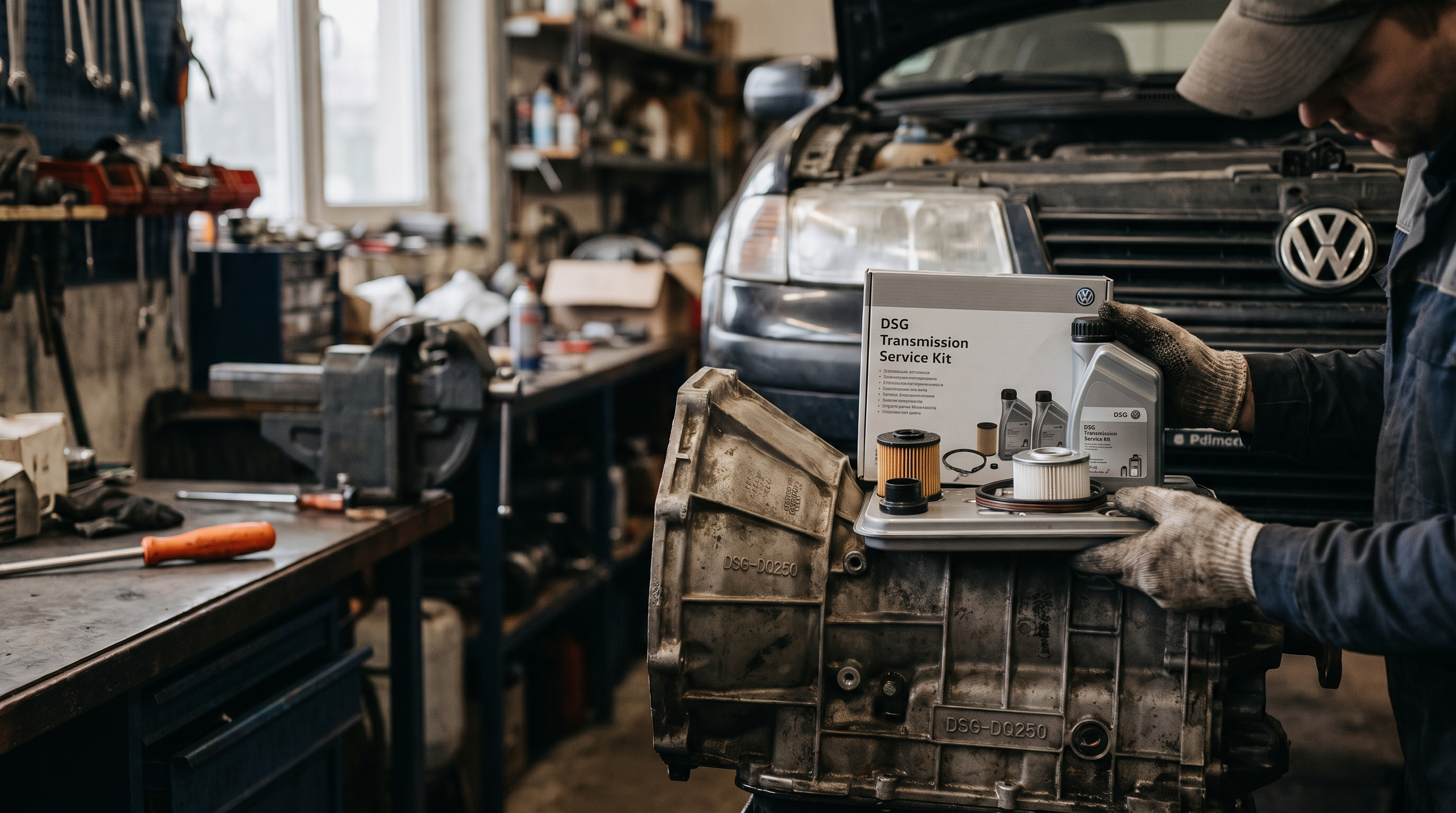
Before you purchase a DSG gearbox or service kit, confirm the gearbox code, engine, drivetrain, and old part photos to ensure compatibility. This is not a preference — it is a requirement. The VIN tells you what the factory installed, but the transmission label tells you what is actually in the car. If the gearbox was replaced before, the code might not match the build sheet, and the kit you order has to match what is there now.
The process starts with locating the transmission code on the gearbox housing, then cross-referencing that code against the manufacturer's parts list and the kit's compatibility chart. The catalog might list a single filter for multiple codes, but the factory parts list will reveal differences — a bypass valve, a longer pickup tube, a different gasket material — that are critical for proper function. This kind of cross-checking is essential to avoid costly mistakes and ensure the transmission runs as designed. For related fluid and parts matching, see DOT 4 vs. DOT 5.1: Choosing Brake Fluid for a European Car.
Problem Statement
I've watched mechanics order the wrong DSG service kit because they assumed all six-speed DSG boxes take the same parts. They don't. A DQ250 and a DQ381 both say "six-speed DSG" on the badge, but the filter, the fluid spec, and the drain-plug torque are different. Run the wrong fluid in a wet-clutch box and the clutch pack slips within five thousand miles. Use a dry-clutch filter on a wet-clutch transmission and the valve body starves.
The confusion starts with the way VW and Audi label transmissions. The build sticker on the transmission case shows a code—something like JXX or LHY—but the parts catalog groups kits by internal designation: DQ250, DQ200, DQ381, DQ500. If you don't know which internal code your transmission sticker maps to, you're guessing. And guessing costs: the wrong kit means a second drain, a second fill, and another filter you can't return because the seal is broken.
The durability of DSG transmission components is influenced by material quality, thermal management, and driving behavior. When you mismatch the service kit, you compromise thermal management first. The wrong filter restricts flow; the wrong fluid changes the friction coefficient the clutch pack was calibrated for. The transmission doesn't fail outright—it just starts slipping under load, or it hunts between gears at highway speed. By the time the fault code appears, the clutch has already glazed.
At the counter, the question is always the same: can I use this kit on my car? The answer depends on three things—the transmission code on the sticker, the internal DQ designation that code maps to, and whether your transmission is a dry-clutch or wet-clutch variant. Miss any one of those and the kit you buy is the wrong kit.
Solution Steps for Matching a DSG Transmission Service Kit
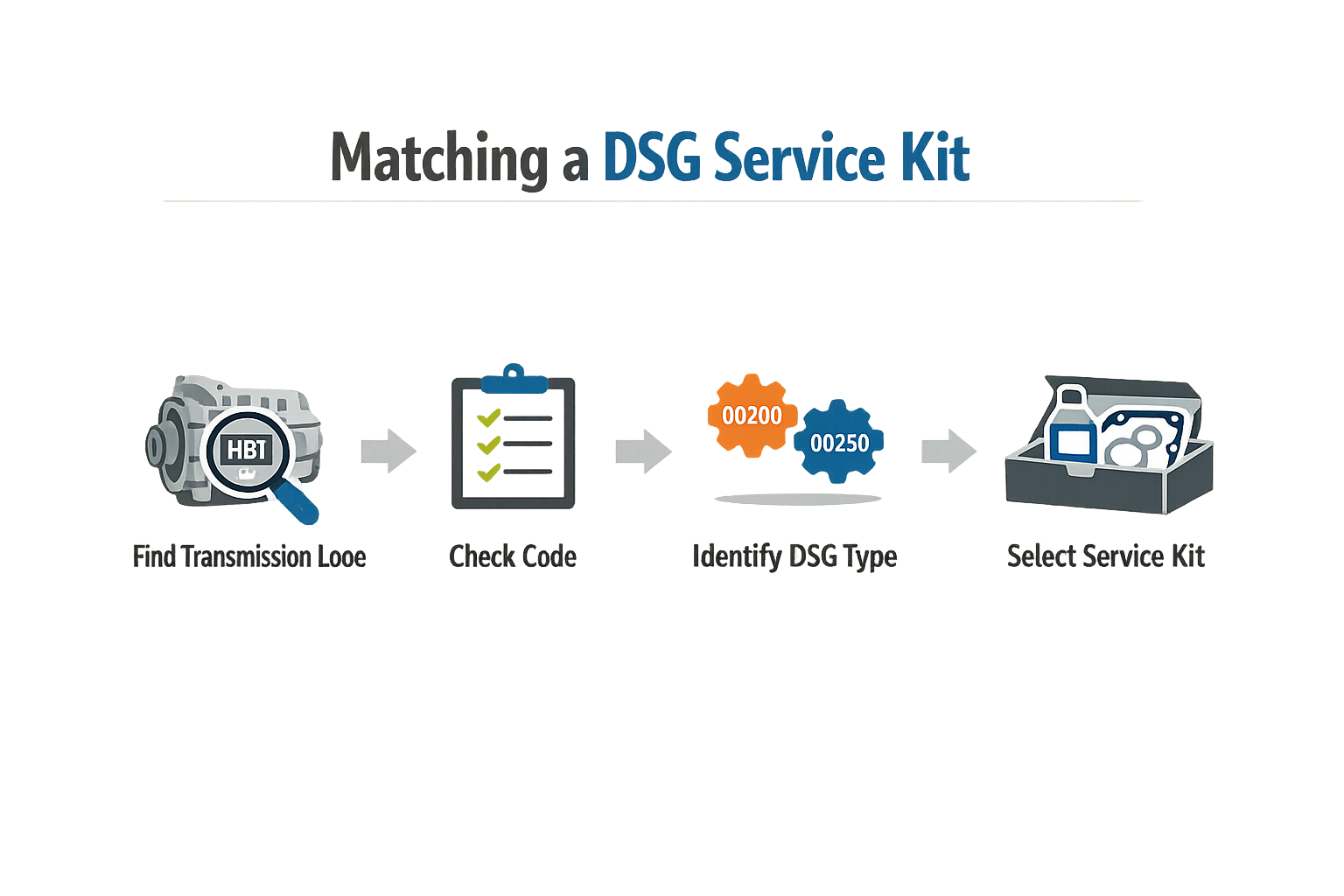
I walk through this process with customers at the counter every week. The transmission code is the only number that matters, and everything else — the VIN, the engine, the model year — exists to get you to that code. Once you have it, the service kit follows.
Step 1: Locate the Transmission Code on the Unit Label
Step 1
Find the transmission label
The transmission code is stamped on a label affixed to the transmission housing. On most VW and Audi DSG units, the label sits on the bell housing near the starter motor or on the top of the case. The code is typically three letters — examples include DQ250, DQ381, or MQ200 — followed by a production date and serial number. Write down the full code exactly as it appears.
If the transmission is still in the car and the label is not visible from above, you may need to access it from underneath on a lift. The label does not move, and it does not lie.
Step 2: Cross-Reference the Code with Your VIN and Drivetrain
Step 2
Decode the VIN and confirm drivetrain
Use the VIN to confirm the engine code, model year, and drivetrain configuration — front-wheel drive, all-wheel drive, or quattro. A Volkswagen Golf with the same model year and engine may use different DSG versions depending on drivetrain and market specification. The VIN gives you the context; the transmission code gives you the part number.
VIN decoders are available online, but the most reliable method is to reference the vehicle's build sticker or the original window sticker if available. Distributor catalogs and OE parts systems will ask for both the VIN and the transmission code to pull the correct service kit.
Step 3: Match the Transmission Code to the Correct DSG Service Kit
Step 3
Verify the service kit part number
With the transmission code in hand, cross-reference it against the manufacturer's parts catalog or an OE-supplier catalog. Each DSG variant — DQ250, DQ381, DQ500 — requires a specific service kit that includes the correct filter, pan gasket, drain plug seal, and fill plug seal. The kit part number must match the transmission code. Do not assume that a universal kit or a kit listed for a similar engine will work.
Before purchasing, confirm the gearbox code, engine, drivetrain, and review photos of the old unit if you are replacing a failed transmission. This ensures compatibility and prevents returns.
Step 4: Collect Supporting Information Before You Order
The transmission code alone is not always enough for the parts counter to guarantee fitment. Collect the following:
- Full VIN
- Transmission code from the unit label
- Engine code
- Drivetrain type (FWD, AWD, quattro)
- Photos of the old transmission label if the unit has been removed
- Scan report or fault codes if the transmission has thrown a code
This checklist eliminates guesswork. I have seen orders placed with incomplete information, and the result is always the same: the wrong kit ships, the job stalls, and the customer pays twice.
Step 5: Verify Fluid Specification and Capacity
Step 5
Confirm the fluid spec and fill volume
DSG transmissions require a specific fluid that meets VW/Audi approval G 052 182 A2 (for DQ250) or G 052 529 A2 (for DQ381 and DQ500). The service kit does not include fluid. Check the transmission code against the fluid specification and the fill capacity — typically between 5.5 and 7.0 liters depending on the variant. The bottle has to say the approval number. If it does not, do not run it.
For more on fluid specifications across European platforms, see DOT 4 vs. DOT 5.1: Choosing Brake Fluid for a European Car.
Tips and Tricks for Choosing the Right DSG Service Kit
At the counter, I watch people make the same mistake: they pick the cheapest kit or assume one size fits all DSG boxes. It doesn't. The transmission code determines the filter, the plug, and sometimes the pan gasket. Miss one and you're back in six months with a clogged valve body.
Use OEM or VW-Approved Parts Only
Run a non-approved filter and the mesh clogs faster than the factory part. The valve body doesn't forgive it. Stick to OEM kits or aftermarket suppliers that list the VW part number and the transmission codes the kit covers. If the box says "universal DSG," walk away.
Replace the Filter with Every Fluid Change
The filter traps clutch material and metal particles. Leave the old one in and you're just circulating contamination through fresh fluid. Replace it every 40,000–60,000 miles when you do the fluid. The interval is in the owner's manual, and it's not a suggestion.
Cross-Reference the Kit Against the Factory Parts List
Distributor catalogs sometimes lump kits together, but the factory parts list breaks them out by transmission code. I've seen kits that cover DQ250 and DQ500 listed as interchangeable when the drain plug thread pitch is different. Pull the VW ETKA or ELSA parts diagram for your transmission code and verify the kit contents match line by line.
The catalog might list one kit for three codes, but the factory list will show you the differences that matter — like a bypass valve or a revised gasket.
Check the Build Date and Regional Spec
GCC-spec vehicles and North American imports sometimes use different fluid capacities or filter part numbers even when the transmission code matches. The build date tells you which revision you have. If you're sourcing a kit for a car originally sold outside your region, verify the part number against the VIN, not just the transmission code.
Verify the Fluid Specification on the Bottle
The kit includes the filter and hardware, but you still need to buy the fluid separately in most cases. The bottle has to say G 052 182, G 052 512, or G 055 512 depending on your transmission. Don't top a G 052 182 box with G 055 512 — mixing is the mistake. Flush it or stick to the same spec.
For more on matching fluids to manufacturer approvals, see DOT 4 vs. DOT 5.1: Choosing Brake Fluid for a European Car.
Conclusion
Matching a DSG transmission service kit to a transmission code is not a preference — it's a requirement. The wrong filter or the wrong fluid causes erratic shifting first, then premature clutch wear, then a rebuild. I've watched customers bring in cars that needed a DQ250 kit but got a DQ200 kit instead, and the damage shows up in less than a year.
The transmission code is the only reliable identifier. It's stamped on the case, it's in the VIN decode, and it's what the parts catalog uses to pull the correct kit. Don't guess based on the model year or the engine code — VW and Audi put multiple DSG variants in the same chassis, and the service requirements are different.
Use OEM or VW-approved parts and fluids. The approval has to be printed on the bottle and listed in the kit's specification sheet. Generic fluids and aftermarket filters without the correct approvals lead to shifting faults and clutch slip, and the repair costs more than the service kit you saved money on.
When you source a kit, cross-reference the part number with the transmission code and the build date. Distributors list kits by application, but the factory parts list is more specific — it will show you whether your transmission needs a bypass valve in the filter or a specific pan gasket profile. That level of detail matters.
If you're working on a European platform and need to verify fluid specifications or service intervals, read our guide on DOT 4 vs. DOT 5.1: Choosing Brake Fluid for a European Car for the same spec-driven approach to another critical fluid system.
In my years at the counter, the pattern is clear: the right kit, matched to the transmission code, with the correct approval on every component, is what keeps a DSG running. Anything else is a shortcut that costs more later.
Learn how to match a DSG transmission service kit to a transmission code for optimal vehicle maintenance.
Written by
Lee Shahin
Founder, European Wholesale Parts
Lee Shahin founded European Wholesale Parts in Pleasanton, California, after 18 years in the Mercedes-Benz and BMW parts trade. He came to the parts side from the shop floor: he opened a European repair shop in Northern California in the early 1990s, specialising in Mercedes-Benz and BMW, and grew it with his wife Laurie into a parts and delivery operation serving body shops and independent repair facilities across the region. Nearly two decades at the parts counter taught him where the expensive mistakes happen, and most of them are fluids: the wrong coolant in an aluminium block, an oil without the sheet approval the engine was designed for, a transmission topped with the wrong ATF. That is what he writes about here. Every article names the manufacturer specification by its exact designation, explains what the wrong fluid does mechanically, lists products that carry the approval, and gives the capacity and interval for the models and years the specification covers. When a reader needs a part sourced, the quote desk at European Wholesale Parts is where Lee and Laurie still answer the phone.