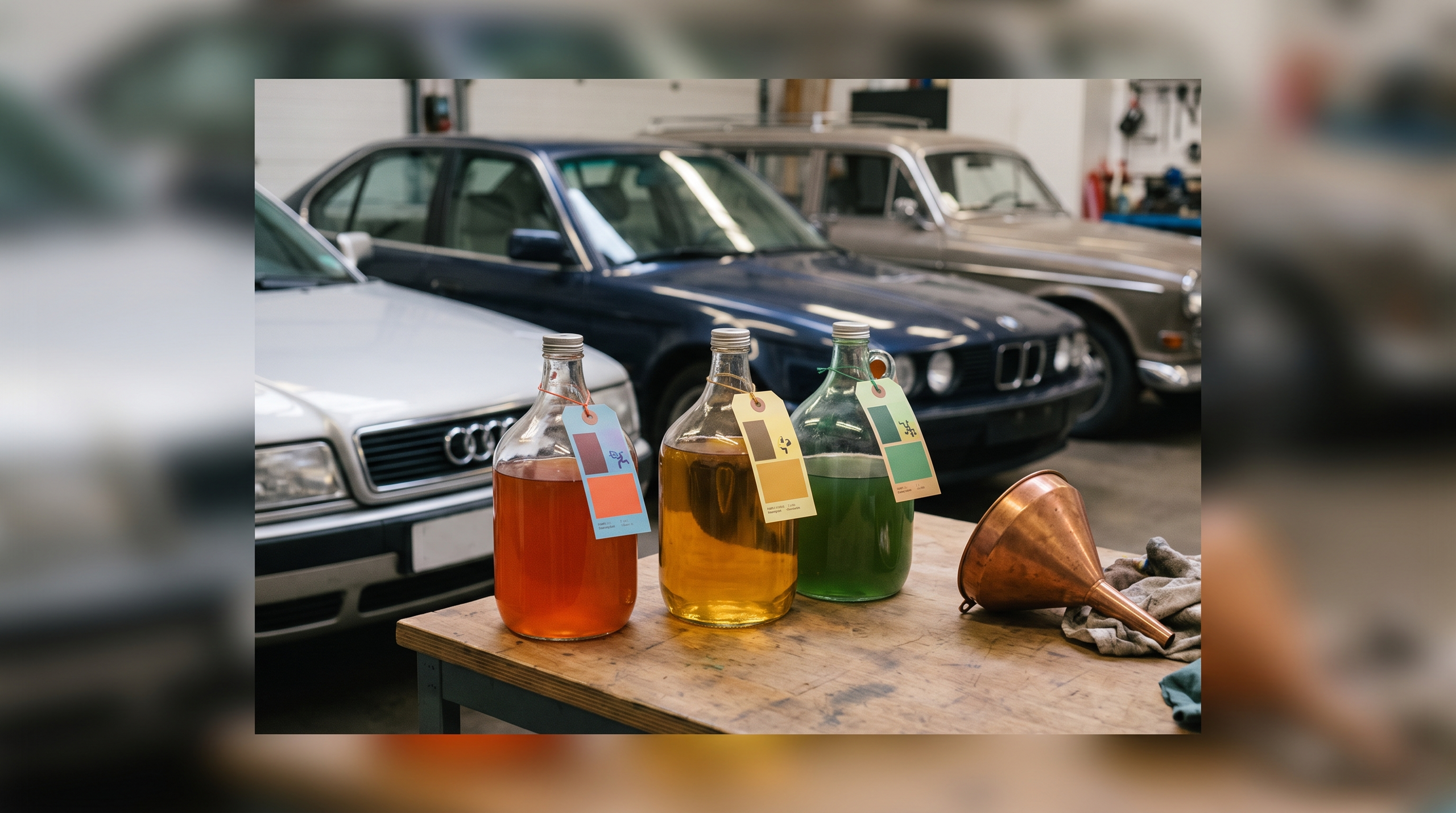
HOAT Coolant vs OAT vs IAT: What European Cars Require
Learn what HOAT coolant is and which European cars require it. Discover the differences among HOAT, OAT, and IAT coolants for proper vehicle maintenance.
Introduction to OAT Coolant and Its Importance
The question at the counter is always some version of the same thing: can I use what I have, or do I need what the manual says? With coolant, the manual is right. I have watched mechanics top off a BMW with universal green because it was on the shelf, then spend the next year chasing overheating and heater-core blockages that started the day the wrong coolant went in.
OAT coolant is Organic Acid Technology — a long-life formulation that uses organic acids instead of traditional silicates and phosphates to prevent corrosion. HOAT is Hybrid Organic Acid Technology, which adds a small amount of silicate back into an OAT base. IAT is Inorganic Additive Technology, the older chemistry that relies on silicates, phosphates, and shorter change intervals. European manufacturers use all three types across different platforms and build years, but they do not use them interchangeably.
The chemistry matters because aluminum does not forgive it. European engines run tight tolerances, small passages, and high coolant temperatures. An OAT coolant in a system designed for HOAT will not protect the water pump and thermostat housing the way the engineers intended. A HOAT coolant in an OAT system leaves silicate deposits in the heater core and radiator over time. The damage is slow, but it is cumulative, and it shows up as a cooling-system failure long after the wrong bottle went in.
This guide covers what OAT, HOAT, and IAT coolants are, which European cars require each type, and how to read the approval on the bottle to confirm you are putting in what the factory specified. The goal is not to explain coolant chemistry in detail — the goal is to give you the information you need to buy the right coolant, confirm it meets the spec, and avoid the mistakes that cost money later.
Learn about OAT coolant and what European cars require it. Discover the differences among OAT, HOAT, and IAT coolants.
What is OAT Coolant?
OAT stands for Organic Acid Technology. The coolant uses organic acids—usually sebacate, 2-ethylhexanoic acid, or similar carboxylates—as corrosion inhibitors instead of silicates or phosphates. The organic acids form a protective layer only where corrosion starts, not across every metal surface in the system. That selective action keeps the heat-transfer surfaces clean and extends the fluid's service life to five years or longer in most applications.
I've watched shops dump OAT into systems that call for a silicate coolant, and the aluminium pump housings pit within two years. OAT does not coat the metal preemptively; it waits for corrosion to begin, then reacts. In a system designed for it, that is efficient. In a system that expects a silicate barrier from day one, it is a liability.
Chemical Composition and How It Works
OAT coolant contains ethylene glycol or propylene glycol as the base antifreeze, water, and a package of organic acid salts. The acids are long-chain molecules that attach to corroding spots on aluminium, iron, and copper alloys. Once attached, they stop the electrochemical reaction that causes rust and pitting. Because the inhibitor depletes only where corrosion occurs, OAT lasts longer than older formulations that coat everything and wear out faster.
The absence of silicates and phosphates means OAT does not form the gel or scaling that clogs narrow passages in modern engines. European manufacturers use OAT in platforms with small-bore cooling channels and high-flow electric pumps, where any deposit restricts flow and raises operating temperature. The clean chemistry also prevents abrasive particles from wearing pump seals.
Service Life and Maintenance Intervals
OAT coolant typically carries a five-year or 150,000-mile service interval when used in the correct application. The long life comes from the slow depletion rate of organic acids. In contrast, IAT coolants with silicates need replacement every two to three years because the silicate drops out of suspension and the inhibitor package exhausts faster.
At the counter, the question is always whether the car was designed for OAT. If the factory fill was OAT and the system has been flushed properly at each service, you run it to the interval in the owner's manual. If someone topped it with a different chemistry, the mixture degrades faster and you treat it like a shorter-interval fluid. Mixing is the mistake that costs the interval.
Where OAT Coolant Excels
OAT performs well in high-temperature, high-flow systems with aluminium-intensive construction. The organic acids protect aluminium alloys without forming the silicate gel that can separate in hard water. In off-road vehicles, using OAT coolant helps maintain stable thermal transfer during low-speed rock crawling, preventing insulating deposits from forming.
The chemistry also suits diesel engines and turbocharged platforms where sustained high coolant temperatures would accelerate the breakdown of silicate-based inhibitors. European manufacturers specify OAT or OAT-hybrid formulations in most engines built after 2000 for these reasons.
What is HOAT Coolant?
HOAT stands for Hybrid Organic Acid Technology. It is a coolant formulation that combines organic acid inhibitors from OAT coolants with a small amount of inorganic silicate additives from traditional IAT coolants. The result is a hybrid that attempts to deliver long service life while adding extra protection against specific failure modes.
The silicate content in HOAT coolant is what sets it apart. That small percentage of silicate — typically around 500 ppm or less — provides a protective layer on aluminium and other metal surfaces. In diesel engines with wet sleeve cylinder liners, silicate helps guard against cavitation erosion, which is why you see HOAT specified in many heavy-duty applications. European manufacturers that use HOAT do so because the silicate layer offers immediate protection while the organic acids build their film over time.
How HOAT Differs from OAT and IAT
HOAT sits between OAT and IAT in both chemistry and service interval. OAT coolants contain no silicate and rely entirely on organic acids — they last longer but take time to form a protective layer. IAT coolants are silicate-heavy and protect immediately, but the silicate depletes quickly, requiring replacement every two to three years. HOAT gives you the fast-acting silicate protection up front and the long-lasting organic acid layer for the duration.
The trade-off is that HOAT is more formula-specific than pure OAT. You cannot mix HOAT coolants from different manufacturers and expect the silicate content to stay balanced. The bottle has to say it meets the specification your car requires — Mercedes G48, for example, or the older Ford WSS-M97B44-D used in some Volvo applications. If the approval is not printed on the label, it is not the right coolant, even if the color matches.
In European cars, HOAT shows up less frequently than OAT, but when it is specified, it is specified for a reason — usually because the engine design benefits from that silicate layer. Mixing HOAT with OAT dilutes the silicate, and mixing it with IAT overloads the silicate. Either way, the hybrid balance is lost, and the protection suffers.
What is IAT Coolant?
IAT stands for Inorganic Additive Technology. This is the green coolant you see in older cars — the traditional ethylene glycol mix with silicate and phosphate inhibitors. IAT was the standard for decades, but it has a short service life and it does not play well with aluminum.
The inhibitors in IAT coolant deplete fast. You are looking at a two-year or 30,000-mile change interval, whichever comes first. The silicates drop out of suspension and form a gel that clogs narrow passages in the radiator and heater core. The phosphates react with hard water and leave deposits on aluminum surfaces. In a modern European engine with tight tolerances and aluminum blocks, IAT coolant is a problem waiting to happen.
IAT vs OAT and HOAT
IAT coolant uses inorganic salts — silicates, phosphates, borates — to protect metal surfaces. OAT coolant uses organic acids instead, which last longer and do not drop out of suspension. HOAT coolant splits the difference: it uses organic acids as the base and adds a small amount of silicate for extra protection on aluminum and solder joints.
The practical difference is service life and compatibility. IAT lasts two years. OAT and HOAT last five years or more, depending on the formulation. IAT leaves deposits in aluminum engines. OAT and HOAT do not. If you run IAT in a car designed for OAT or HOAT, you are changing coolant more often and risking corrosion and blockages that the factory never designed for.
Where IAT Coolant Still Appears
IAT coolant is still sold because older American and Asian cars from the 1980s and 1990s used it. Some agricultural and industrial equipment still specifies it. But no European manufacturer has approved IAT for passenger cars built in the last twenty years. If your car is a 2000 or newer Mercedes, BMW, Audi, VW, Porsche or Volvo, the factory fill is OAT or HOAT, and that is what the system is designed to run.
I have watched customers bring in a car with a green coolant top-off and wonder why the heater core is plugged. The answer is always the same: the silicates dropped out and blocked the narrow tubes. The fix is a full flush and a refill with the correct OAT or HOAT coolant. The cheap way costs more.
Why OAT Coolant Matters in European Cars
European manufacturers engineer cooling systems around specific coolant chemistry, and OAT formulations dominate the spec sheets for VW, Audi, BMW and Mercedes-Benz models built in the last fifteen years. The factory fill is not a preference — it is a requirement tied to the metallurgy of the block, head and radiator. I have watched cars come back to the counter with heater-core leaks and corroded water-pump housings because someone topped the system with whatever was on the shelf. The aluminum does not forgive it.
What Happens When You Run the Wrong Coolant
Mixing IAT coolant into a system designed for OAT triggers accelerated corrosion at dissimilar-metal joints. The silicate inhibitors in IAT coolant form a glass-like coating inside the passages, and that coating breaks down under the higher operating temperatures European engines run. You see it first at the thermostat housing and the heater-core inlet — pitting that turns into seepage, then a full leak. The water pump follows. In my years at the counter, the pattern is always the same: someone adds green coolant to a G12evo or G13 system, drives it for six months, then comes in asking why the overflow tank is empty and the cabin smells like antifreeze.
HOAT coolant is closer to OAT in chemistry, but the added silicate package still creates problems in systems that were not designed for it. BMW and Mercedes-Benz cooling systems use thin-wall aluminum castings and plastic end-tanks on the radiator, and the silicate layer that HOAT deposits reduces heat transfer at those surfaces. The engine runs hotter, the electric fan cycles more often, and the plastic components age faster under the thermal stress. The consequence is not immediate failure — it is shortened service life across every component in the loop.
Why the Manufacturer Approval Is on the Bottle
The approval printed on the coolant bottle — VW/Audi G12evo, BMW coolant or Mercedes-Benz sheet approval 325.0 — tells you the formulation passed the manufacturer's corrosion and cavitation testing for the specific metals and operating conditions in that platform. The bottle has to say it. A product labeled "universal" or "works with all coolants" does not carry an OE approval, and that means it was not tested in the same loop. You cannot verify compatibility by color; VW G13 is purple, but so are some HOAT formulations that will wreck a G13 system.
The cheap way costs more — flushing a contaminated system and replacing a corroded water pump runs three times what the correct coolant cost in the first place.
When you check the build date and engine code on the door jamb, you can cross-reference the exact coolant spec the car left the factory with. For a 2015 Audi A4 with the EA888 engine, that is G13. For a 2018 BMW 340i, it is BMW coolant meeting the blue-dye specification. The owner's manual is right about this — follow it, and the system will run the full service interval without corrosion or pH drift. Ignore it, and you are replacing hoses, pumps and radiators on an accelerated schedule.
Coolant Requirements for Popular European Cars
Every European make has a specification printed in the owner's manual and on the expansion tank cap. The bottle you buy has to say it meets that spec, or you are guessing. I have watched mechanics pour the wrong coolant into a BMW because the color looked right; three months later the water pump seals failed and the heater core clogged. The approval matters more than the color.
Mercedes-Benz Coolant Specifications
Mercedes-Benz uses a blue OAT coolant across most of the current lineup. The approval is MB 325.0 for models built after 2014, and MB 310.0 for older platforms. The factory fill is typically a phosphate-free OAT formulation with a service life of ten years or 150,000 miles. Run a generic green IAT or orange HOAT in a modern Mercedes and the aluminum radiator corrodes from the inside; you will see brown flakes in the overflow tank before the temperature gauge moves.
For older W210 and W203 chassis built before 2007, some models shipped with a HOAT coolant meeting the older MB 325.5 spec. Check the build date on the door jamb and cross-reference the part number on the expansion tank cap. Mixing MB 325.0 and MB 325.5 is the mistake that costs you a radiator flush and a new thermostat housing.
BMW Coolant Requirements
BMW specifies a blue OAT coolant with a phosphate-free, silicate-free formulation. The current spec is simply labeled "BMW Coolant" or "BMW Blue" on OEM bottles, and aftermarket products that meet it will print the BMW approval on the label. E46, E90, and F30 3-Series all use the same coolant; so do X3, X5, and most Z4 models from 2000 forward.
The wrong coolant in a BMW shows up first at the electric water pump and the expansion tank. The pump impeller cavitates when silicates drop out of suspension, and the plastic tank cracks at the seam when phosphates attack the nylon. I have sold more expansion tanks to shops that topped off with the wrong coolant than to shops that ran the system dry.
Volkswagen and Audi Coolant Standards
VW and Audi use a progression of OAT coolants identified by G-number: G12, G12+, G12++, G13, and G40. Each G-number is a different formulation, and they are not all mixable. G12 is the original pink OAT used in late-1990s models. G12+ and G12++ are also OAT, with longer service intervals and improved aluminum protection. G13 is a purple OAT with a glycerin base instead of ethylene glycol, used in most models from 2008 forward. G40 is the newest spec for hybrid and electric platforms.
The critical rule is this: you can top G13 with G12++ in an emergency, but you cannot top G12++ with G13 without diluting the corrosion package. The owner's manual tells you which G-number your car takes; the expansion tank cap usually has a part number you can cross-reference. Run the wrong G-number and the water pump weeps, the heater core clogs, and the coolant turns brown in six months.
Porsche Coolant Specifications
Porsche specifies a pink OAT coolant for most water-cooled models, including 911 (996, 997, 991, 992), Boxster, Cayman, Cayenne, and Panamera. The approval is typically listed as "Porsche Coolant" or cross-referenced to a VW G12++ or G13 spec depending on the model year. Cayenne V8 models share coolant specs with Audi Q7 and VW Touareg from the same platform.
The 986 and 987 Boxster are sensitive to silicate coolant; the flat-six engine has long coolant passages and the thermostat housing is plastic. Run a HOAT or IAT formulation and the thermostat sticks, the overflow tank cracks, and you are pulling the engine to replace the coolant crossover pipe.
Volvo Coolant Requirements
Volvo uses a blue-green OAT coolant in P2 (S60, V70, XC70, XC90 from 2001–2014) and SPA platforms (S90, V90, XC60, XC90 from 2015 forward). The spec is Volvo coolant or a product that meets the Volvo approval printed on the bottle. Some aftermarket coolants meeting VW G13 or MB 325.0 also meet the Volvo spec, but check the approval list on the product data sheet.
Older 850, 940, and 960 models used a green IAT coolant; mixing IAT and OAT in a P2 Volvo creates a gel that blocks the heater core and coats the radiator fins. Flush it completely before switching coolant types.
| Make | Coolant Type | Specification | Color | Service Interval |
|---|---|---|---|---|
| Mercedes-Benz | OAT | MB 325.0 | Blue | 10 years/150k mi |
| BMW | OAT | BMW Blue | Blue | Lifetime/120k mi |
| VW/Audi | OAT | G12++, G13, G40 | Purple | 10 years/150k mi |
| Porsche | OAT | Porsche/G12++/G13 | Pink | 6 years/120k mi |
| Volvo | OAT | Volvo Blue-Green | Blue-Green | 10 years/150k mi |
What Happens When You Use the Wrong Coolant
The aluminum radiator, cylinder head, and water pump housing corrode first. Silicates in IAT coolant drop out of suspension and coat the passages; phosphates in HOAT attack the plastic expansion tank and thermostat housing. The heater core clogs, the coolant turns brown, and the temperature gauge climbs on the highway. By the time you see the warning light, the damage is done.
At the counter, I tell customers to check the bottle for the manufacturer approval before they buy. If the approval is not printed on the label, the product does not meet the spec, no matter what the color is or what the marketing copy says. The owner's manual is right about this.
How to Choose the Right Coolant for Your Vehicle
The owner's manual is right about this. Open it, find the coolant specification, and buy the product that has that approval printed on the bottle. Everything else is guessing.
Start with the Owner's Manual
Your manual lists the coolant by specification, not by color. A 2015 Audi A4 calls for G13. A 2010 BMW 335i calls for the blue coolant that meets BMW's own standard. A 2008 Mercedes C300 needs a product approved to MB 325.0. The specification is the requirement; the brand is your choice as long as the approval is on the label.
If you lost the manual, call the dealer parts counter with your VIN. They will tell you the spec. Write it down. That is what you buy.
Check the Build Date and Engine Code
Coolant specs change mid-generation. A W204 C-Class built before March 2014 takes MB 325.0. After that date, it takes MB 325.5. Same body, same engine family, different coolant. The build date is on the door jamb sticker. The engine code is stamped on the block or listed on the underhood emissions label. Both matter.
At the counter, I have watched people buy the wrong coolant because they assumed all E90 BMWs take the same fluid. They do not. The N52 and N54 engines have different coolant requirements, and the model year determines which formulation BMW specifies.
Read the Approval on the Bottle
The bottle has to say it meets the spec your car requires. If your Volkswagen needs G13 and the jug says "compatible with G13," that is not the same thing. Compatible means it will not gel if you top off an existing G13 system. It does not mean the product meets the VW standard or that you can use it for a full fill.
Look for the manufacturer approval printed on the back label or the data sheet. Pentosin, Ravenol, and Liqui Moly all publish which approvals their coolants carry. If the approval is not listed, do not use it.
When You Cannot Find the Exact Spec
If the approved product is not available and you need coolant now, use distilled water to top the system and get to a shop that stocks the correct fluid. Do not improvise with a different coolant type. The water dilutes the mix and drops the freeze point, but it will not cause the chemical reactions that a wrong additive package triggers.
For a full flush, wait until you have the right coolant. The system holds four to eight quarts depending on the model, and topping with water is a temporary fix, not a maintenance practice.
Buy from a Distributor That Knows the Spec
Parts stores that specialize in European makes stock the approved products and can cross-reference the spec to the bottle. Generic auto parts chains often carry only universal coolants, which do not meet manufacturer approvals. If the counter associate cannot tell you which approval is on the bottle, go somewhere else.
We sell both OEM and aftermarket coolants that carry the manufacturer sheet approvals. The OEM product is what the factory filled the car with. The aftermarket product meets the same spec and costs less. Either one works as long as the approval matches.
Step 1
Locate the specification
Open the owner's manual to the capacities and specifications section. Write down the exact coolant standard: G12, G13, MB 325.0, BMW blue, or whichever code is listed. If the manual is missing, call the dealer with your VIN.
Step 2
Verify the build date
Check the door jamb sticker for the production date. If your car was built near a specification change (common in 2014–2015 for many European makes), confirm which coolant the factory used from that date forward.
Step 3
Match the approval on the bottle
Buy a product that lists your car's spec as an approval, not as a compatibility claim. The approval must appear on the label or the technical data sheet published by the coolant manufacturer.
Step 4
Flush before switching types
If the existing coolant is a different formulation, drain and flush the system with distilled water before filling with the new product. Do not mix OAT, HOAT, and IAT chemistries.
Common Mistakes When Choosing Coolant
The most common mistake is mixing coolant types. I have watched customers top off a G13 Audi with a generic orange HOAT because both bottles looked the same color. The chemistry is incompatible. Mixing OAT and HOAT creates sludge that clogs radiator passages and reduces heat transfer efficiency. The engine runs hotter, the heater core plugs, and the water pump labors against the gel.
The second mistake is using color as the specification. Green does not mean IAT anymore, and orange does not mean one specific OAT standard. BMW blue is a phosphate-free OAT, but so is VW G13, and they are not the same formula. The bottle has to say the manufacturer approval — G12evo, G13, MB 325.0 — or it does not meet the spec. Color is packaging; the approval is the requirement.
Assuming Universal Coolant Works Everywhere
Bottles labeled "universal" or "works with all makes" are a gamble. Some meet multiple approvals and list them on the back. Most do not. If the label does not print the exact VW, BMW, or Mercedes approval your car requires, you are guessing. I have seen universal coolant work fine in a 2005 Jetta and destroy the water pump seals in a 2015 model because the additive package was wrong for the newer gasket materials.
Topping Off Instead of Flushing
Topping off with the wrong coolant dilutes the protection and starts the contamination. If you are not sure what is in the system, flush it and fill with the correct spec from empty. Topping a G12evo system with G13 might seem harmless because both are OAT, but the additive packages differ and the mix degrades faster than either one alone. The cheap way costs more when the radiator needs replacement at 60,000 miles instead of 120,000.
Ignoring the Build Date and Specification Changes
Manufacturers change coolant specs mid-generation. A 2010 BMW 335i takes a different coolant than a 2012 335i with the N55 engine. The build date determines the spec, not the model year alone. Check the owner's manual or the sticker under the hood. If the car was built after a certain month, the factory fill changed and so does the service requirement. Assuming all E90s take the same coolant is how you end up with the wrong bottle.
Relying on the Parts Store Recommendation
The parts-store lookup tool is only as good as the data in it. I have seen the system recommend G12 for a car that requires G13 because the database was not updated after a mid-year spec change. The counterperson means well, but the approval printed on the bottle is the final word. If it does not list your car's spec, do not buy it. The catalog is a starting point; the bottle is the proof.
Frequently Asked Questions about OAT Coolant
Can I mix OAT with HOAT or IAT coolant?
No. Mixing coolant types creates a chemical reaction that neutralizes the additive package in both. I've watched customers come back with clogged heater cores and corroded water pump housings after topping off OAT with the wrong fluid. The inhibitors fight each other instead of protecting the metal. If you need to top off and you're not sure what's in the system, flush it completely and refill with the correct spec. Topping with the wrong type costs more than a full drain and fill.
How do I know which coolant my European car needs?
Check the expansion tank cap or the owner's manual. Mercedes lists the spec right on the cap — MB 325.0 or MB 310.1, for example. BMW marks the reservoir with the coolant type. VW and Audi print the G-number on the tank or in the service booklet. If the markings are worn off, look up the model year and engine code in the factory service literature. The approval has to match what the manufacturer specifies; color is not a reliable guide.
What happens if I use the wrong coolant in my car?
The aluminum corrodes first. European engines use aluminum blocks and heads, and the wrong inhibitor package leaves the metal exposed. You'll see white sludge in the reservoir, then the water pump seals leak, then the heater core clogs. On a BMW, the thermostat housing cracks. On a Mercedes, the auxiliary water pump fails. The repair bill runs into thousands, and it starts with a five-dollar mistake at the parts counter.
How often should I change OAT coolant?
Most OAT coolants are rated for five years or 150,000 miles in European applications, but check the manufacturer's interval. BMW specifies lifetime fill on some models, but that means the life of the coolant, not the car — test it at 100,000 miles. Mercedes calls for replacement at ten years on newer models. VW and Audi list five years. The interval is in the service booklet; follow it. OAT doesn't wear out as fast as IAT, but it still breaks down, and testing strips are cheaper than a new radiator.
Can I use universal coolant in my European car?
Only if the bottle lists the manufacturer's approval. Universal coolants claim to meet multiple specs, but the approval has to be printed on the label. If it says it meets VW G13 or BMW standards, check the manufacturer's approved product list to confirm. I've seen universal coolants that meet no European spec at all — they're just dyed and bottled. The safe play is OEM coolant or an aftermarket product with the named approval on the data sheet.
Why is European coolant more expensive than domestic coolant?
The additive package costs more to formulate, and the approvals require testing and certification. A jug of G13 runs fifteen to twenty dollars; generic IAT is five. You're paying for the inhibitors that protect aluminum and magnesium alloys at higher operating temperatures. European engines run hotter and tighter tolerances than most domestic platforms, and the coolant chemistry reflects that. The price difference is the cost of not replacing a water pump at 60,000 miles.
What is the difference between concentrate and pre-mixed coolant?
Concentrate requires dilution with distilled water — typically 50/50, but check the bottle. Pre-mixed is ready to pour. I stock both at the counter. Concentrate is cheaper per gallon if you're doing a full system flush, and you control the mix ratio. Pre-mixed is faster and eliminates the risk of using tap water, which leaves mineral deposits in the cooling system. For a top-off, pre-mixed is the right call. For a flush, concentrate saves money if you have distilled water on hand.
How do I dispose of old coolant?
Take it to a hazardous waste collection site or an auto parts store that accepts used coolant. Do not pour it down the drain or onto the ground — ethylene glycol is toxic to animals and contaminates groundwater. Most municipalities have free drop-off days for household hazardous waste. Some quick-lube shops and dealerships accept used coolant from DIY customers. Store it in a sealed container labeled "used coolant" until you can dispose of it properly.
Conclusion: The Importance of Using the Correct Coolant
The right coolant is not a preference. It is a requirement. Run the wrong chemistry in a European car and the aluminum corrodes, the water pump seals leak, and the heater core clogs. I have watched shops flush systems twice because someone topped a G13 Audi with universal green. The second flush costs more than doing it right the first time.
OAT coolant protects the long-life aluminum and magnesium castings that Mercedes, BMW, Audi, VW, Porsche and Volvo use. HOAT coolant serves the same purpose in some applications, but the bottle has to say the manufacturer's approval. IAT coolant has no place in a modern European engine. The silicate drops out, the passages narrow, and the temperature climbs.
Check the build date and the engine code. The owner's manual is right about this. The approval printed on the bottle must match what the factory specifies. If it does not match, do not pour it. If you are unsure, bring the VIN to the counter. We sell both OEM and approved aftermarket coolant, and we can tell you the number.
The aluminum does not forgive mixing. Flush it, do not top it. Use the coolant the manufacturer approves, change it at the interval they specify, and the system will run the life of the car. That is the counter answer, and it is the only one that works.
Written by
Lee Shahin
Founder, European Wholesale Parts
Lee Shahin founded European Wholesale Parts after 18 years in the Mercedes-Benz and BMW parts trade in Northern California. He writes about fluid specifications and parts sourcing for European cars.