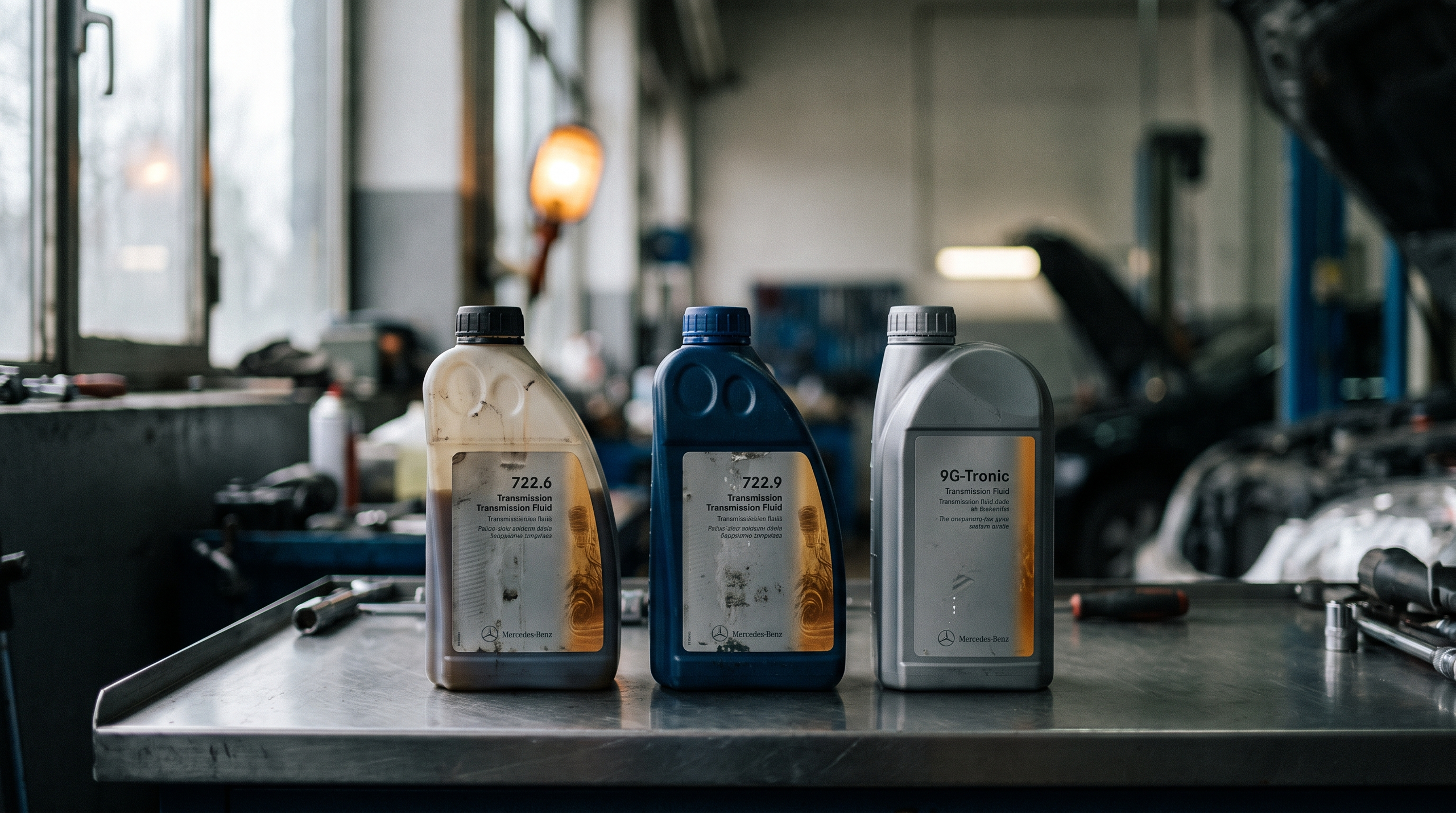
Mercedes-Benz Transmission Fluid: 722.6 vs 722.9 vs 9G-Tronic Specs
Mercedes-Benz Transmission Fluid is a family of hydraulic fluids engineered to precise viscosity indexes and shear stability requirements that vary by transmission generation.
What Is Mercedes-Benz Transmission Fluid and Why Does It Matter?
Mercedes-Benz Transmission Fluid is a family of hydraulic fluids engineered to precise viscosity indexes and shear stability requirements that vary by transmission generation. Each gearbox—the 722.6 five-speed, 722.9 seven-speed, and 9G-Tronic nine-speed—operates under different pressures, friction materials, and thermal loads, so Mercedes assigns each a specific MB 236.xx approval number. Using a fluid that meets the wrong approval damages clutch packs, causes erratic shifts, and shortens the service life of seals and valve bodies. After two decades sourcing OEM fluids for European makes, I've seen more transmission failures traced to the wrong MB approval than to any mechanical defect—owners assume all ATF is interchangeable, but Mercedes engineers these fluids to match the exact friction modifiers and additive packages each gearbox requires.
Transmission fluid serves three critical functions: it lubricates planetary gears and bearings, acts as the hydraulic medium that engages clutch packs, and regulates operating temperature by transferring heat to the cooler circuit. When viscosity or friction characteristics fall outside the transmission's design window, hydraulic timing shifts, clutch slip increases, and heat builds faster than the cooling system can manage. The MB 236.xx approval system ensures that every bottle of fluid delivers the shear stability, oxidation resistance, and friction profile the transmission was calibrated around—not what worked in a different gearbox two generations earlier.
This guide walks through the specific MB approvals for the 722.6, 722.9, and 9G-Tronic transmissions, explains why each requires a different fluid formula, and shows you how to decode your gearbox identification plate to select the correct product. For broader context on how Mercedes fluid approvals work across engine and transmission systems, see our article on Mercedes-Benz Engine Oil Approvals: MB 229.5, 229.51, 229.52. We'll also cover the consequences of cross-contamination, the role of friction modifiers in wet-clutch transmissions, and the service intervals that keep these gearboxes running past the warranty period.
Why Choosing the Wrong Mercedes-Benz Transmission Fluid Causes Failure
Mercedes-Benz transmission fluid specifications create confusion because the factory doesn't label transmissions with the fluid spec you need—they label them with internal codes like 722.6, 722.9, or 9G-Tronic. The owner's manual might say "use approved fluid," but it won't tell you whether that means MB 236.10, MB 236.14, MB 236.15, or MB 236.17. You're left cross-referencing model year, transmission code, and part-number lookups to find the right spec, and a single mistake means you're pouring the wrong friction modifier into a system that was engineered around a different one.
The stakes are higher than most people realize. MB 236.10 was designed for older 5-speed automatics with different clutch pack materials and shift logic. MB 236.17 targets newer 9-speed transmissions and fuel-efficiency-focused designs with tighter tolerances. If you pour 236.10 into a 9G-Tronic expecting it to work because "it's all ATF," you've just introduced a fluid with the wrong viscosity curve and additive package for that transmission's hydraulic map. The result is delayed shifts, harsh engagement, or premature clutch wear—consequences that show up thousands of miles later when the damage is already done.
The Mixing Problem
Mixing red and blue fluids—MB 236.14 and MB 236.15—creates immediate mechanical problems. These fluids use different dye systems, but more critically, they have different internal friction coefficients. When you blend them, you alter the torque converter's slip characteristics in ways the transmission control module wasn't programmed to handle. The result is torque converter slip under load, which feels like a slipping clutch in a manual: the engine revs but the car doesn't accelerate proportionally. That slip generates heat, and heat accelerates fluid breakdown, which compounds the problem.
The confusion isn't helped by aftermarket fluid manufacturers who print "meets MB 236.X" on the bottle without clarifying which transmissions that spec was written for. A fluid that meets MB 236.14 is approved for 722.6 and 722.9 transmissions, but it's not interchangeable with MB 236.17, which was formulated for 9G-Tronic and later designs. The approval number is not a compatibility chart—it's a pass/fail test for a specific transmission family. If you're working on a 2015 E-Class with a 9G-Tronic and you grab a bottle labeled MB 236.14 because it's "Mercedes approved," you've just failed to match the fluid to the transmission, even though both the fluid and the transmission are genuine Mercedes components.
For related fluid specifications across Mercedes-Benz systems, see Mercedes-Benz Engine Oil Approvals: MB 229.5, 229.51, 229.52 for the same approval-number logic applied to engine oils. If you maintain other European vehicles, similar precision matters for DOT 4 vs DOT 5.1 brake fluid and G12 vs G13 coolant selections.
How to Match Mercedes-Benz Transmission Fluid to Your Gearbox
Selecting the correct Mercedes-Benz Transmission Fluid requires a methodical approach that starts with your vehicle's documentation and ends with verified compatibility. The process is straightforward when you follow the right sequence.
Verify Your VIN and Transmission Code
Before purchasing any fluid, locate your vehicle identification number and transmission code. The VIN is stamped on the driver's side dashboard and door jamb; the transmission code appears on a metal tag affixed to the transmission housing or in your owner's manual service section. Cross-reference both against Mercedes-Benz's official fluid specification charts to identify the required MB-Approval number. This step eliminates guesswork and prevents costly mismatches.
Step 1
Locate transmission identification
Find the transmission code on the metal tag attached to your gearbox or in the vehicle service booklet. Common codes include 722.6 (5G-Tronic), 722.9 (7G-Tronic), and 725.0 (9G-Tronic). Record this code along with your full VIN before proceeding.
Step 2
Match code to MB-Approval specification
Use the transmission code to determine the required fluid approval. The 722.6 and early 722.9 units mandate MB 236.14, a red semi-synthetic ATF. Later 722.9 variants and all 9G-Tronic transmissions require MB 236.15 or MB 236.17, depending on model year and torque rating.
Step 3
Source fluid with verified approval
Purchase only fluids that explicitly list the required MB-Approval number on the container label. MB 236.14 is backward compatible with older MB 236.12 specifications, but never substitute a lower-spec fluid in a transmission requiring a higher approval. When in doubt, consult your dealership parts counter or a specialist familiar with Mercedes-Benz engine oil approvals and related fluid standards.
Understand Specification Differences
MB 236.14 serves the 5G-Tronic and early 7G-Tronic platforms with a formulation optimized for moderate torque and conventional shift logic. MB 236.15 and MB 236.17 are engineered for the increased thermal and mechanical demands of later 7G-Tronic and all 9G-Tronic units, which operate at higher line pressures and tighter tolerances. Using the wrong approval risks premature clutch wear, erratic shifts, and warranty denial.
Plan Service Intervals
Many models recommend a fluid change every 40,000 to 60,000 miles under normal driving conditions. Transmission specialists commonly advise service between 60,000 and 80,000 miles to maintain optimal gearbox health, especially in vehicles subjected to towing, frequent stop-and-go traffic, or high ambient temperatures. Establish a service schedule based on your driving profile and stick to it.
Tips and Tricks
Maintaining transmission fluid properly extends component life and prevents expensive failures. The interval matters more than the mileage number — degraded fluid loses its lubricating and hydraulic properties, placing significantly more stress on internal transmission components. When the factory says "lifetime fill," they mean the transmission's lifetime, not the car's; plan service before the fluid breaks down.
Check Your Service History Before You Buy
If you're evaluating a used Mercedes, ask for transmission service records. The 5-speed automatic (722.6) and early 7-speed automatic (722.9) benefit from fluid changes every 40,000 miles or 4 years. AMG models with the MCT transmission require fluid changes every 40,000 miles due to higher thermal loads. Missing these intervals means the next owner inherits worn clutch packs and valve-body deposits — problems that show up as harsh shifts or slipping before total failure.
Partial Fluid Changes Are Better Than Nothing
A drain-and-fill for the 9G-TRONIC replaces approximately 5 of the 9 total quarts of fluid. It's not a complete flush, but it's safer than a high-pressure machine that can dislodge debris into the valve body. Run the fresh fluid for 5,000 miles, then repeat the drain-and-fill; two cycles get you close to a full replacement without the risk. This approach works for any of the three transmissions covered here.
Use the Correct Fluid From the Start
Cross-contamination between MB 236.10 (722.6), MB 236.12 (722.9), and MB 236.14 (9G-TRONIC) creates unpredictable friction behavior. The clutch packs are designed for specific additive packages; mixing fluids means neither formula works correctly. If you're unsure what's in the pan, drop it, clean it, and refill with the correct spec. The labor cost is the same whether you guess or verify — verifying just costs one gasket.
For related European-car fluid standards, see our guide to Pentosin CHF 11S and power-steering specifications.
Conclusion
Choosing the right Mercedes-Benz Transmission Fluid for your 722.6, 722.9, or 9G-Tronic transmission is not a preference—it is a specification requirement. Using the wrong fluid or delaying service past the recommended interval introduces measurable risk to internal components. Degraded transmission fluid loses its lubricating and hydraulic properties, placing significantly more stress on internal transmission components.
Many models recommend a fluid change every 40,000 to 60,000 miles under normal driving conditions. Severe service—towing, high ambient temperatures, or sustained highway speeds—shortens that interval. The transmission does not warn you when fluid is degraded; it simply begins wearing faster. By the time shift quality changes, damage may already be accumulating.
When I source fluids for customer vehicles, I verify the MB sheet approval against the transmission code stamped on the case. The approval number must match exactly. Generic "synthetic ATF" marketed as universal does not meet the friction modifiers, viscosity stability, or shear resistance that Mercedes engineering validated. The cost difference between approved fluid and a replacement transmission is not a debate.
If you maintain other European vehicles, the same principle applies across platforms—BMW, Audi, and Volvo each publish their own fluid standards for good reason. For related guidance on maintaining critical systems, see our article on Mercedes-Benz Engine Oil Approvals: MB 229.5, 229.51, 229.52. Transmission longevity is a direct function of fluid quality and service adherence. Follow the spec, track the interval, and the transmission will outlast most other wear items on the vehicle.
Frequently asked questions
What happens if I use the wrong Mercedes-Benz Transmission Fluid?
Using the wrong MB approval causes clutch pack degradation, erratic shift timing, and torque converter slip because the friction modifiers and viscosity curve don't match the transmission's calibration.
Can I mix MB 236.14 and MB 236.15 transmission fluids?
No. Mixing these fluids alters friction coefficients and causes immediate torque converter slip. Always drain completely and refill with a single approved specification.
How often should I change Mercedes-Benz Transmission Fluid?
Most models benefit from service every 40,000 to 60,000 miles under normal conditions. Severe service—towing, high heat, stop-and-go traffic—requires changes closer to 40,000 miles.
Written by
Lee Shahin
Founder, European Wholesale Parts
Lee Shahin founded European Wholesale Parts in Pleasanton, California, after 18 years in the Mercedes-Benz and BMW parts trade. He came to the parts side from the shop floor: he opened a European repair shop in Northern California in the early 1990s, specialising in Mercedes-Benz and BMW, and grew it with his wife Laurie into a parts and delivery operation serving body shops and independent repair facilities across the region. Nearly two decades at the parts counter taught him where the expensive mistakes happen, and most of them are fluids: the wrong coolant in an aluminium block, an oil without the sheet approval the engine was designed for, a transmission topped with the wrong ATF. That is what he writes about here. Every article names the manufacturer specification by its exact designation, explains what the wrong fluid does mechanically, lists products that carry the approval, and gives the capacity and interval for the models and years the specification covers. When a reader needs a part sourced, the quote desk at European Wholesale Parts is where Lee and Laurie still answer the phone.