

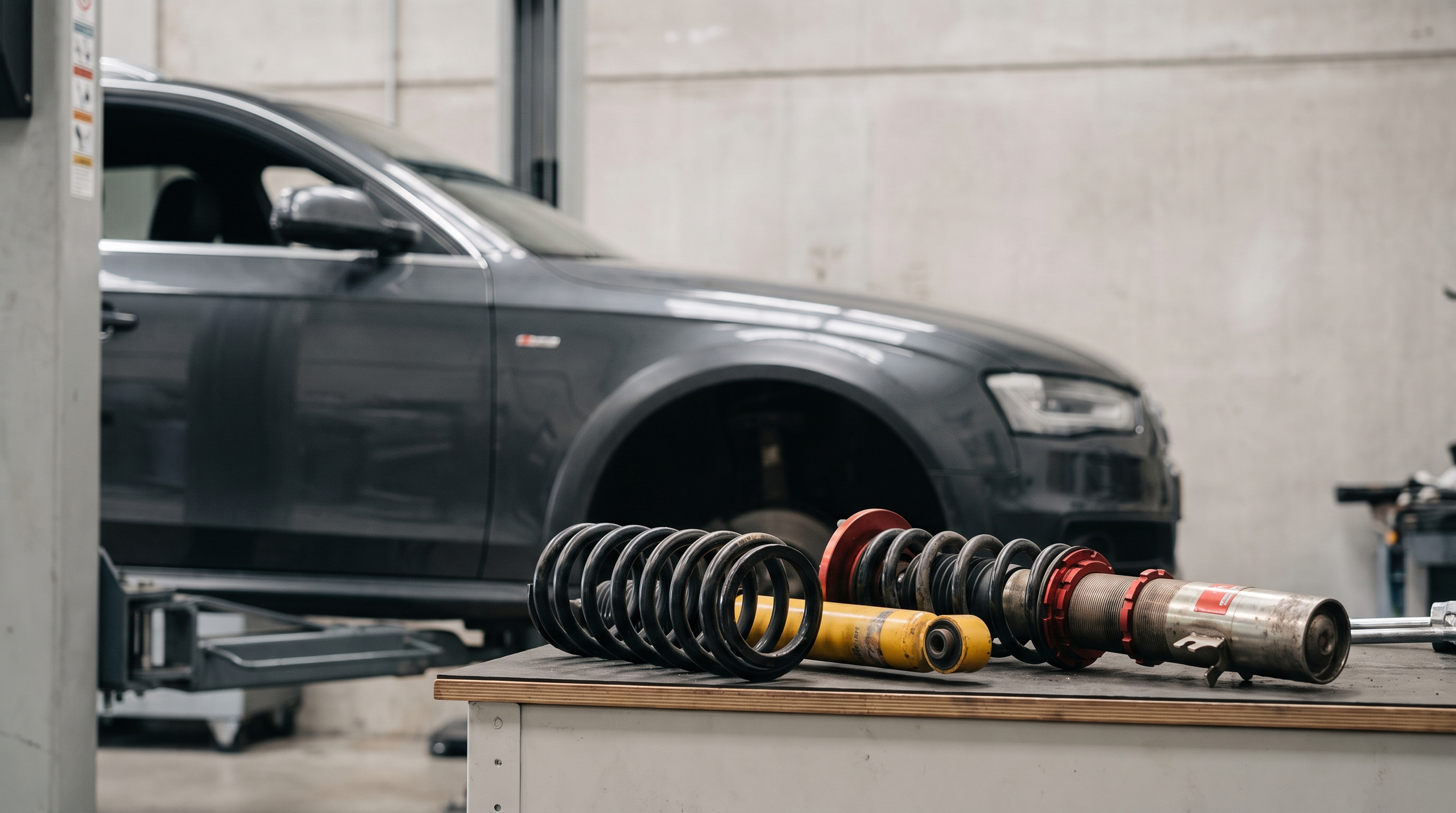
Lowering Springs vs Coilovers for European Daily Drivers
Compare lowering springs vs coilovers for European daily drivers. Learn ride quality, cost, and handling differences to choose the right suspension upgrade.
Introduction
I've watched this decision play out at the counter for years. A customer brings in a late-model Audi or BMW and asks whether to drop it with springs or go straight to coilovers. The answer is never about which one is "better"—it's about what the car does every day, what the suspension already looks like, and how much you want to spend on alignment and corner balancing afterward.
Why Lowering Springs vs Coilovers Matters for European Daily Drivers
European platforms—Mercedes, BMW, Audi, VW, Porsche, Volvo—are engineered with specific suspension geometry. Factory ride height is not arbitrary; it sets camber curves, roll center, and bump-steer characteristics. When you lower the car, you change those relationships. Lowering springs do it one way; coilovers do it another.
Lowering springs replace only the coil spring. The factory shock absorber stays. You get a fixed drop—usually one to one-and-a-half inches—and the shock has to control a spring rate it was not originally valved for. If the shocks are new or nearly new, this works. If they have 60,000 miles on them, the mismatch shows up as bouncing, poor damping, and faster wear on suspension bushings.
Coilovers replace the entire strut or shock-and-spring assembly. You get adjustable ride height, often adjustable damping, and a matched spring-and-shock package. The system is designed as a unit, so damping and spring rate are coordinated. The trade-off is cost, installation complexity, and the need for a proper alignment afterward—not the fifteen-minute toe-and-go some shops try to sell you, but a full corner-weight and geometry check.
What Happens When the Wrong Setup Goes In
Drop a set of lowering springs on a car with original shocks that have 80,000 miles, and the shocks cannot control the new spring rate. The car bounces over bumps, dives under braking, and the wheel bearings see impact loads they were not designed for. I've seen wheel bearings fail in under 10,000 miles on a setup like that.
Install coilovers and set them two inches lower than factory without adjusting camber and toe, and the tires wear on the inside edge in 5,000 miles. The ball joints see side loads outside their designed range. The CV boots tear because the axle angle is too steep. The parts bill comes back higher than the coilover kit cost.
For more on how European platforms require specific fluids and parts matched to their engineering, see Mercedes-Benz Engine Oil: MB 229.5, 229.51, and 229.52 Approvals—the same principle applies to suspension components.
The question is not which product is superior in the abstract. The question is which one your car's current condition supports, which one your driving pattern justifies, and which one you are willing to maintain correctly. That is what the rest of this article walks through.
Problem Statement
You want the car lower and you want it to handle better, but you also drive it every day. The question at the counter is always the same: lowering springs or coilovers? The answer depends on what you're willing to give up, because neither option gives you everything.
The Daily-Driver Dilemma
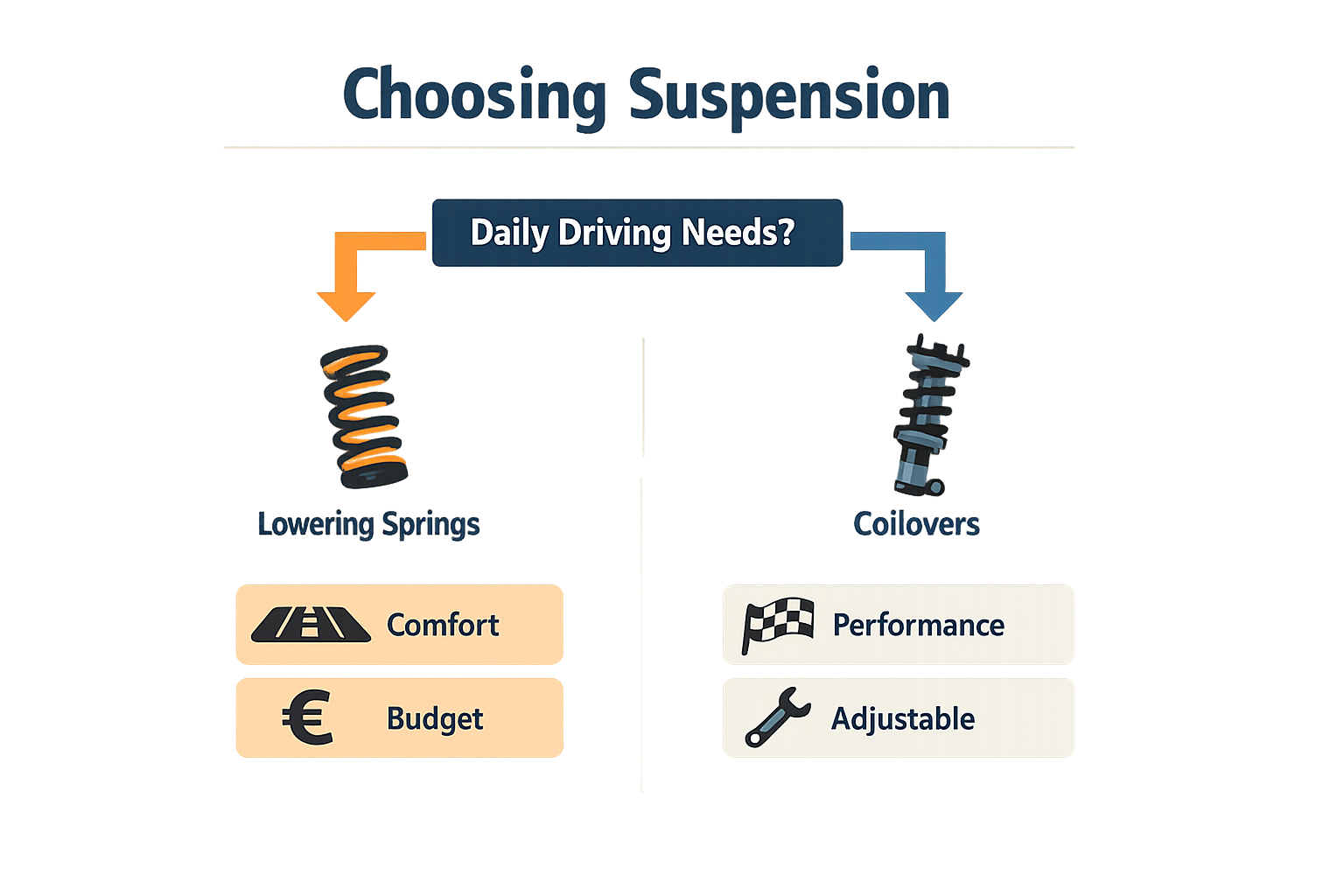
Lowering springs are cheaper and simpler to install — swap the springs, keep the factory dampers, and the car sits lower with a modest improvement in body control. The problem shows up when you hit a pothole or drive over expansion joints: the factory dampers weren't designed for the new spring rate, so the ride can feel sharp and uncontrolled. You also lose ground clearance, which means scraping on speed bumps and driveway aprons becomes part of your routine.
Coilovers solve the damping problem by giving you matched springs and adjustable dampers in one package. You can dial in ride height and damping to suit the car, and the performance improvement is real — reduced body roll, sharper turn-in, and better control at speed. The trade-off is cost, complexity, and a firmer ride that makes poor road surfaces feel harsher. If you're tracking the car or driving spirited back roads regularly, coilovers make sense. If you're commuting and running errands, the stiffness becomes a tax you pay every day.
What You're Actually Choosing Between
The decision comes down to three things: how much you're willing to spend, how much ride comfort you're willing to sacrifice, and whether you need adjustability. Lowering springs give you a moderate drop and a modest handling improvement at a lower price point, but the ride quality depends on how well the factory dampers tolerate the new springs. Coilovers give you full control over ride height and damping, but they cost more and require periodic maintenance — the dampers need rebuilding eventually, and the threaded collars can seize if you don't clean and grease them.
I've watched customers install lowering springs on a daily-driven E90 or B8 Audi and live with the result for years without complaint. I've also seen people install coilovers, drive the car for a month, and then dial the damping to the softest setting because the commute became unbearable. The right answer depends on your roads, your tolerance for a firm ride, and whether you're willing to adjust and maintain the suspension over time.
Solution Steps for Choosing Between Lowering Springs and Coilovers
I've watched too many people walk in with the wrong suspension already installed. They bought cheap coilovers because the price looked good, or they dropped springs on worn shocks and now the car rides like a shopping cart. Here is how to choose the right setup the first time.
Step 1: Define Your Actual Use Case
Step 1
Match the hardware to how you drive
Be honest about what you do with the car. Daily commute on rough city streets is not the same as weekend canyon runs. Coilovers give you adjustability and matched dampers for track use and spirited driving. Lowering springs work fine for daily driving where comfort matters more than lap times. If you never adjust anything, coilovers are overkill.
The performance difference is real. Coilovers are engineered as a complete system — spring rates, damper valving, and stroke all matched. Lowering springs go on your existing shocks, and those shocks were tuned for stock ride height. You get the drop, but the damping is compromised.
Step 2: Check Vehicle Compatibility and Shock Condition
Step 2
Inspect what you already have
Before you order anything, check the build date and the current shock condition. If your shocks are original and the car has 80,000 miles, they are done. Lowering springs on worn shocks will ride worse than stock. At that point, you are buying shocks anyway, so coilovers start to make sense on cost. If your shocks are fresh, springs are the cheaper path.
Step 3: Set a Realistic Budget and Factor in the Full Cost
Step 3
Add up the real number
Lowering springs run $200–$400 for a quality set. Installation is straightforward if your shocks are good. Coilovers start at $800 for entry-level and go past $2,000 for adjustable setups with remote reservoirs. Then add alignment — you will need it either way — and figure $150–$200. Cheap coilovers are a mistake; they blow seals, they clunk, and you replace them in a year.
The cheap way costs more. I have sold replacement coilovers to the same customer twice because the first set was a no-name brand that failed in 18 months. Buy once.
Step 4: Plan for Alignment and Maintenance Requirements
Step 4
Book the alignment before you install
Lowering the car changes camber, caster, and toe. The alignment is not optional. Some platforms need camber plates or adjustable control arms to get back into spec after a drop. Check what your car requires before the springs go in. Coilovers often include camber adjustment; springs do not.
Maintenance is different too. Coilovers need periodic inspection — check the damper seals, clean the threads, verify the lock collars are tight. Springs are install-and-forget unless a shock fails. If you do not want to touch the suspension again for five years, springs are the simpler choice.
Common Mistakes to Avoid
For more on choosing fluids and parts that meet the actual spec your car requires, see DOT 4 vs. DOT 5.1: Choosing Brake Fluid for a European Car.
Tips and Tricks for Installation and Maintenance
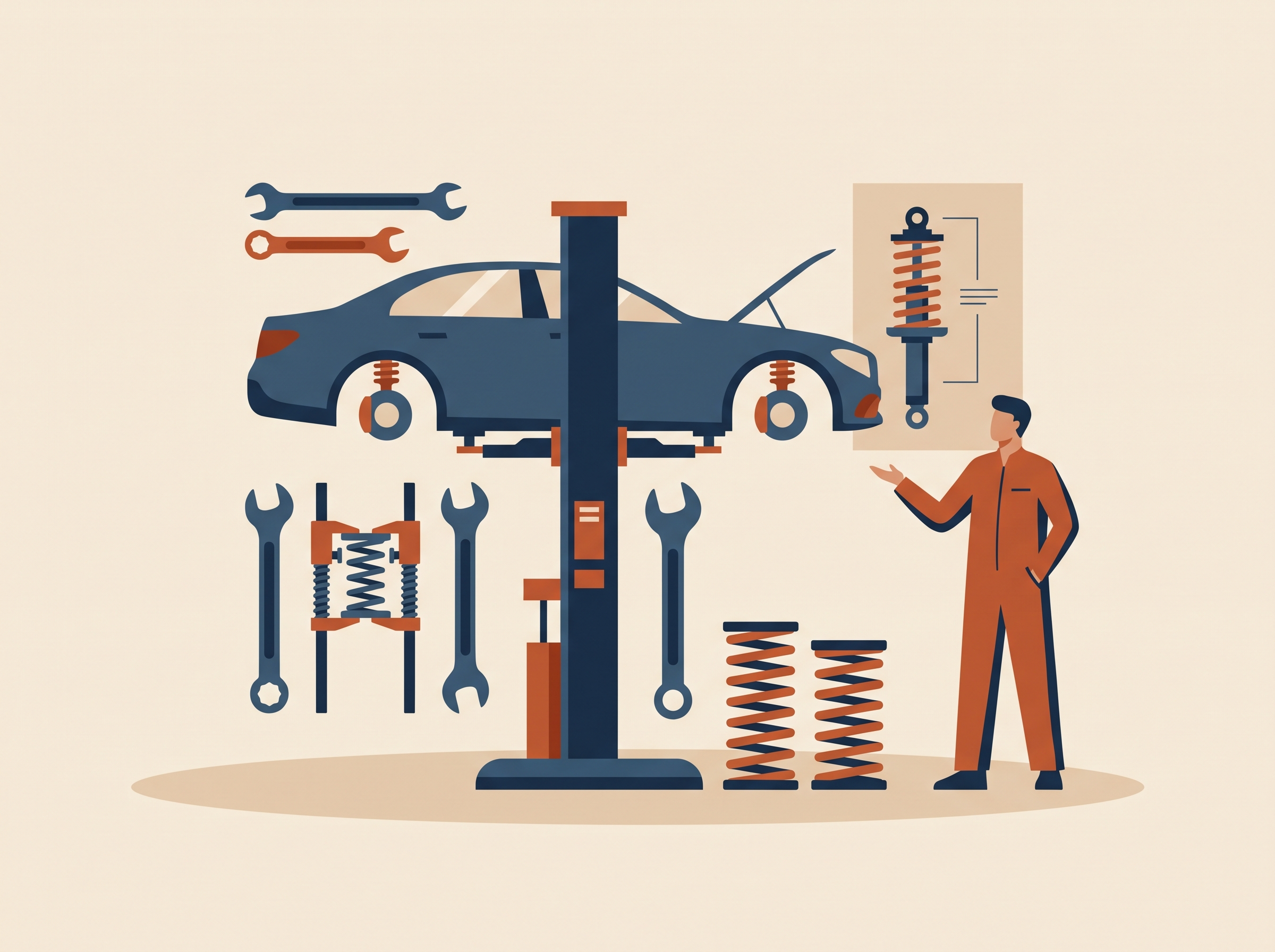
I've watched more than a few customers walk back through the door after a lowering job because they maxed out the drop on day one or skipped the alignment. The installation itself is straightforward if you follow the torque specs, but the mistakes happen before the car ever goes on the lift and in the weeks after it comes down.
Don't Max Out the Drop Immediately
With coilovers, you have adjustment range. Use it. Start conservative — maybe 20 mm lower than stock — and drive the car for a week. Check for rubbing, listen for bottoming, and feel how the ride quality sits with your commute. You can always go lower; you cannot un-scrape a fender liner or fix a cracked bumper mount after the fact.
Alignment Is Not Optional
Lowering changes camber, toe, and sometimes caster depending on how far you go. Factory alignment specs do not account for a 30 mm drop. Book the alignment before you install the springs or coilovers, not after you notice the inside edge of the tire wearing through. On most European platforms, camber adjustment requires aftermarket arms or bolts; know what your car needs before the install day.
Buy Application-Specific, Not Universal
Lowering springs are designed for specific vehicles, not sold as one-size-fits-all. A spring rated for an E90 325i will not work correctly on a 335i because the weight distribution and damper valving are different. Check the application chart by model, year, and engine code. The same rule applies to coilovers: a kit for a B8 A4 does not fit a B9, even if the thread pitch looks the same.
Torque Everything to Spec
Strut-top nuts, control-arm bolts, and shock-mount hardware all have torque values in the service manual. Use them. Suspension fasteners on European cars often require specific sequences — some tighten at ride height, others at full droop. If you guess, you will either strip threads in aluminum or leave a fastener loose enough to rattle. I keep a printed torque chart for every platform we service; it lives next to the alignment rack because that is where it gets used.
Inspect After the First 500 Miles
Check every fastener you touched. Springs settle, coilovers may need a quarter-turn adjustment, and alignment can shift as everything beds in. Look for rubbing marks on the inner fender, check tire wear, and listen for new noises. This is also when you will know if you need to adjust damping or ride height.
Maintenance Is Minimal but Not Zero
Lowering springs require no maintenance beyond what the OE suspension needed. Coilovers need periodic inspection of the adjustment collars and damper seals. If you drive through winter salt, rinse the threads and apply a light coat of anti-seize to the collars once a season. Seized collars turn a simple height adjustment into a parts replacement.
Conclusion
I've watched too many customers walk back through the door six months after a lowering-spring install, asking if coilovers would have been the smarter call. The answer depends entirely on what you're asking the suspension to do. If you want the car lower, the ride firmer, and the handling tighter without spending coilover money or dealing with coilover complexity, lowering springs deliver. They're a visual change first, a handling improvement second, and they work with your existing dampers until those dampers wear out. The install is straightforward, the parts cost is manageable, and the outcome is predictable.
Coilovers are the choice when you need control over ride height, when you plan to track the car, or when you're building toward future performance work. The adjustability means you set the car where you want it, not where the spring manufacturer decided. The damping is matched to the spring rate from the factory, so the ride quality stays consistent as you dial in the height. The cost is higher, the install takes longer, and you'll need an alignment afterward, but the platform is there for whatever comes next. If you're planning upgrades—wider wheels, stickier tires, brake work—coilovers let you tune the suspension to match. Lowering springs don't.
For the European daily driver that sees occasional spirited driving and needs to look right without a full suspension rebuild, lowering springs are the practical answer. For the car that will see track days, autocross, or a progression of performance mods, coilovers are the investment that pays off in flexibility. Both options work; the wrong choice is the one that doesn't match how you actually use the car. If you're unsure which fluids and service items your European platform requires after a suspension change, see our guide to DOT 4 vs. DOT 5.1 brake fluid to ensure compatibility with your braking system.
The decision comes down to budget, intended use, and whether you value adjustability over simplicity. Neither option is a mistake if it's the right fit for your driving. Choose based on what you need the suspension to do today and where you see the car in two years. The parts counter will still be here either way.
Written by
Lee Shahin
Founder, European Wholesale Parts
Lee Shahin founded European Wholesale Parts in Pleasanton, California, after 18 years in the Mercedes-Benz and BMW parts trade. He came to the parts side from the shop floor: he opened a European repair shop in Northern California in the early 1990s, specialising in Mercedes-Benz and BMW, and grew it with his wife Laurie into a parts and delivery operation serving body shops and independent repair facilities across the region. Nearly two decades at the parts counter taught him where the expensive mistakes happen, and most of them are fluids: the wrong coolant in an aluminium block, an oil without the sheet approval the engine was designed for, a transmission topped with the wrong ATF. That is what he writes about here. Every article names the manufacturer specification by its exact designation, explains what the wrong fluid does mechanically, lists products that carry the approval, and gives the capacity and interval for the models and years the specification covers. When a reader needs a part sourced, the quote desk at European Wholesale Parts is where Lee and Laurie still answer the phone.