BMW M340i Exhaust: Axle-Back vs Cat-Back Comparison
Explore the differences between axle-back and cat-back BMW M340i exhaust systems, focusing on sound, drone, and daily usability for your vehicle.
Introduction
A BMW M340i exhaust upgrade is one of the most common modifications for G20 chassis owners who want to hear the B58 engine work. I've watched M340i owners at the counter wrestle with the same question: axle-back or cat-back? The answer is not about preference — it is about what happens inside the cabin when you are two hours into a highway run and the drone sits right at cruising RPM. Many BMW M340i owners seek aftermarket modifications to improve engine sound and achieve a more aggressive tone, but the mechanical consequences of each system are different, and so is the daily cost.
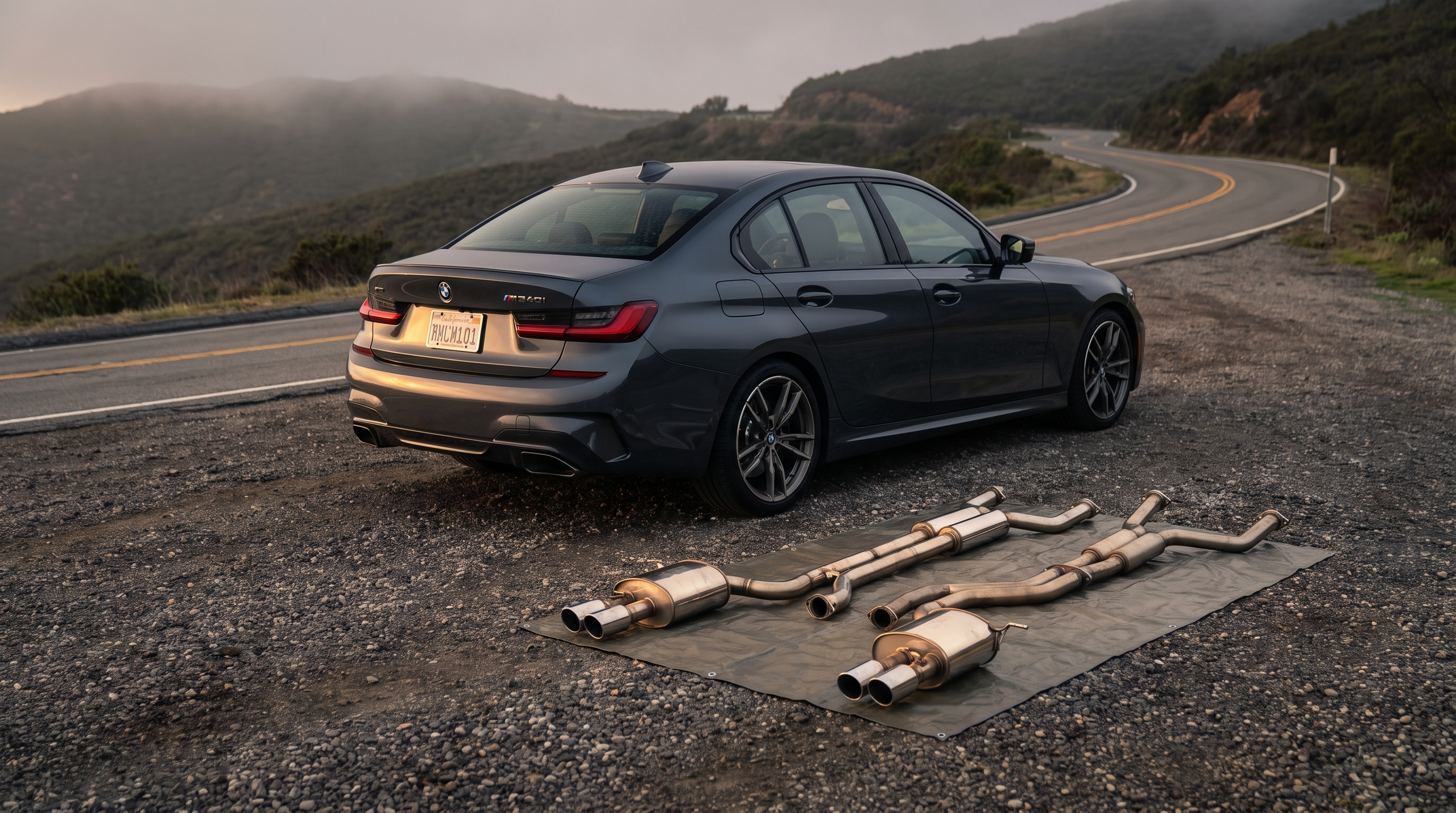
An axle-back replaces the rear muffler and tailpipes. A cat-back replaces the mid-pipes, resonator, muffler, and tailpipes — everything aft of the catalytic converter. The cat-back changes exhaust flow and backpressure across a longer section of the system, which means it alters sound at more RPM ranges and introduces drone in different parts of the cabin. The axle-back is quieter at cruise and louder under throttle, but it leaves the factory mid-section in place, so the tone is closer to stock.
The M340i's B58 engine responds to both, but the question is where you want the sound and where you do not. If you are looking for related guidance on BMW-specific service requirements, see our article on BMW Coolant and Cooling Parts: What to Check Before Ordering for fluid specifications that apply across the platform.
This comparison covers sound character, drone behavior, installation scope, and what each system does to the exhaust note during daily driving. The goal is to name the difference and show what it costs in cabin comfort.
Why Upgrade the BMW M340i Exhaust?
The stock M340i exhaust does what BMW designed it to do: it keeps the car quiet enough for daily commuting and passes emissions without complaint. Many owners report that the stock system muffles the engine's natural resonance, particularly at lower RPMs and during cruising. You hear the B58 when you're on it, but the rest of the time the car sounds like it's wearing earplugs. That's fine if you want a luxury sedan. It's less fine if you bought the M340i because you wanted to hear the straight-six work.
The question at the counter is always the same: axle-back or cat-back? The answer depends on what you're willing to live with. An axle-back replaces the rear mufflers and tailpipes — everything behind the rear axle. A cat-back replaces the mid-pipes, resonators, rear mufflers and tailpipes — everything behind the catalytic converters. More pipe replaced means more sound, more weight savings, and more drone. It also means more money and more installation time.
What You're Trading
An axle-back gives you sound at wide-open throttle and a cleaner look at the rear bumper. It leaves the factory resonators in place, so highway drone stays manageable. A cat-back removes those resonators. You get a louder, more aggressive tone across the RPM range, but you also get cabin noise on long highway runs that wears on you after the first hundred miles. Key considerations when upgrading your BMW M340i exhaust include compatibility with the model year, material quality (stainless steel), sound profile preference, and legal compliance with emissions regulations.
The other variable is cost. An axle-back runs $800 to $1,500 installed. A cat-back runs $1,800 to $3,500 installed, depending on the brand and whether the shop has done the job before. If you're not sure you want to live with the sound, start with the axle-back. You can always add the mid-pipes later if you want more volume. Going the other direction — buying a cat-back and then trying to quiet it down — means you've spent the money twice.
Axle-Back vs Cat-Back: BMW M340i Exhaust System Differences
I've watched customers walk into the shop with the same question: which BMW M340i exhaust gives me the sound I want without turning the cabin into a drone chamber? The answer depends on how much of the factory system you replace and what you're willing to live with on the highway. Here's how axle-back and cat-back systems differ in the real world.
What an Axle-Back System Replaces
An axle-back swaps only the rear mufflers and tips — everything from the rear axle to the bumper. The factory downpipes, catalytic converters, and mid-pipes stay in place. You get louder exhaust note at idle and under throttle, but the tone is still shaped by the stock cats and resonators upstream. Installation is straightforward: unbolt the factory rear section, bolt on the new one, and you're done in an hour.
The sound change is noticeable but not transformative. Expect a deeper rumble at startup and more presence when you open it up, but the B58 turbo inline-six still sounds muted compared to a naturally aspirated engine. Drone at highway speed depends entirely on the muffler design — some axle-backs add a low-frequency hum between 2,000 and 2,500 RPM that makes long drives tiresome.
What a Cat-Back System Replaces
A cat-back replaces everything from the catalytic converters back: mid-pipes, resonators, mufflers, and tips. You're changing the entire exhaust path after the turbo and cats. The result is a sharper, more aggressive tone with better flow and less backpressure. Cat-back systems can typically add 8–15 hp at the wheels, especially when paired with ECU tuning.
The Akrapovič Evolution Line for the M340i uses lightweight titanium construction and delivers a sharp, metallic exhaust crackle on overrun — the pops and burbles you hear when you lift off throttle in Sport mode. That crackle comes from eliminating the factory resonators, which smooth out the sound but also kill character. The trade-off is more cabin noise at all speeds, not just under load.
Step 1
Evaluate your daily drive
If your commute is mostly highway and you spend an hour a day at 70 mph, a cat-back with no resonators will drone. Look for systems that retain a center resonator or use Helmholtz chambers to cancel specific frequencies.
Step 2
Check local emissions rules
Cat-back systems don't touch the catalytic converters, so they're legal in most states. But if your state requires visual inspection of the exhaust, aftermarket mid-pipes with no resonators can flag you. Verify before you buy.
Step 3
Match the system to your tune
If you're running a Stage 1 or Stage 2 tune, a cat-back lets the engine breathe and makes the power curve feel smoother. An axle-back on a tuned car still bottlenecks at the factory mid-pipe, so you're leaving performance on the table.
Sound, Drone, and Daily Usability
Axle-back gives you 70 percent of the sound change for 40 percent of the cost. It's the right choice if you want a tasteful upgrade without altering the car's character. Cat-back gives you the full exhaust note and measurable power, but you're committing to a louder cabin and higher installation cost. If you want meaningful performance and sound changes, go cat-back. For subtle refinement and louder tone, axle-back may suffice.
Drone is the deal-breaker for most daily drivers. A well-designed cat-back with resonators will drone less than a cheap axle-back with straight-through mufflers. The material matters too — titanium systems weigh less and sound sharper, but stainless steel is durable and easier to find at the counter.
| System Type | Sound Change | Power Gain | Drone Risk | Install Time |
|---|---|---|---|---|
| Axle-back | Moderate | Minimal | Medium | 1 hour |
| Cat-back | Aggressive | 8–15 hp | High | 2–3 hours |
How Does BMW M340i Exhaust Drone Affect Daily Driving?
Drone frequency matters more than peak volume for daily use. Most aftermarket BMW M340i exhaust systems produce drone between 1,800 and 2,500 RPM — exactly where the B58 sits during highway cruising in eighth gear. A cat-back without resonators amplifies this frequency range and turns a two-hour drive into an endurance test. The sound bounces off the rear glass and pressurizes the cabin at a frequency that fatigues the inner ear.
Axle-back systems produce less drone because the factory mid-pipes and resonators remain in place to dampen those frequencies. If you spend more than 30 minutes a day at highway speeds, test-drive a car with the exact system you're considering before you buy. Sound clips recorded outside the car tell you nothing about what you'll hear inside.
Tips for Choosing the Right BMW M340i Exhaust
I've spent years at the counter watching customers come back after a BMW M340i exhaust install, and the ones who did their homework first never regret the choice. The ones who bought on sound clips alone sometimes do. Here is what separates a good decision from an expensive mistake.
Match the Exhaust to How You Actually Drive
If your M340i is a daily and you sit in traffic, drone matters more than peak sound. An axle-back keeps the factory midpipes and resonators, so highway cruise stays livable. A cat-back removes those dampers and the drone moves into the cabin around 2,000 RPM. I've seen customers swap back to stock after two weeks of commuting because the resonance made phone calls impossible. If you want meaningful performance and sound changes, go cat-back. For subtle refinement and a louder tone, axle-back may suffice.
Check Compatibility and Material Before You Order
Not every M340i exhaust fits every model year. The G20 platform had mid-cycle updates that changed hangers and sensor bungs, so a 2020 system may not bolt to a 2023 without adapters. When you call, give the build date and the last eight of the VIN — the parts desk needs both. Material matters too: stainless steel lasts, aluminized steel rusts through in five years if you drive in snow belt states. The cheap way costs more when you replace it twice.
For other BMW maintenance considerations, our guide on DOT 4 vs. DOT 5.1 brake fluid for European cars covers fluid specifications that apply to the M340i platform.
Listen in Person If You Can
Sound clips lie. A GoPro mounted under the bumper makes everything sound aggressive, and a cabin video with the windows down tells you nothing about drone. If a local shop or another owner has the system you want, go listen to it at idle and at highway speed with the windows up. The difference between a YouTube clip and the real cabin note has cost more customers more money than any other single mistake I've seen.
Frequently Asked Questions About BMW M340i Exhaust Systems
Which BMW M340i exhaust system is better for daily driving?
An axle-back system is better for daily driving if you want improved sound without excessive drone. It replaces only the rear mufflers and tailpipes, leaving factory resonators in place to dampen highway cruise frequencies. Cat-back systems produce more aggressive sound and 8–15 hp gains but introduce cabin drone between 1,800 and 2,500 RPM that can fatigue you on long commutes.
Does a cat-back BMW M340i exhaust add horsepower?
Cat-back systems typically add 8–15 hp at the wheels by reducing backpressure and improving exhaust flow from the catalytic converters rearward. The power gain is most noticeable when paired with ECU tuning. Axle-back systems produce minimal power gains because the factory mid-pipes remain a restriction point.
Will an aftermarket BMW M340i exhaust void my warranty?
Aftermarket exhaust systems do not automatically void your BMW warranty, but dealers can deny claims if they prove the modification caused the failure. Axle-back systems carry lower risk because they leave emissions equipment untouched. Cat-back systems are also legal in most states since they retain catalytic converters, but verify local regulations before installation.
How much does BMW M340i exhaust installation cost?
Axle-back installation costs $800 to $1,500 including parts and labor. Cat-back installation costs $1,800 to $3,500 depending on the brand and shop experience. Axle-back systems install in about one hour; cat-back systems require two to three hours due to the additional components being replaced.
Conclusion
I've watched a lot of M340i owners chase the sound they want, then walk it back when the drone hits on the highway. The choice between axle-back and cat-back comes down to how much change you need and how much cabin noise you'll tolerate daily. Axle-back gives you the tone shift without the midrange rasp; cat-back opens the whole system and brings 8–15 hp with it, especially if you tune the ECU after. Neither is wrong — one fits the commute, the other fits the track day.
If you're keeping the factory cats and downpipes, axle-back is the move. The install is straightforward, the sound is there when you want it, and the drone stays manageable. If you're already planning a tune or you want the full exhaust flow, cat-back makes sense, but test-drive a friend's car with the same setup first. The difference in cabin volume is real, and it doesn't go away.
The bottle has to say what the approval is; the exhaust has to match what you actually drive. Pick the system that fits your route, not the one that sounds good in a parking lot. For more on BMW-specific fluid requirements and OEM part sourcing, see our guide on BMW Coolant and Cooling Parts: What to Check Before Ordering.
Written by
Lee Shahin
Founder, European Wholesale Parts
Lee Shahin founded European Wholesale Parts in Pleasanton, California, after 18 years in the Mercedes-Benz and BMW parts trade. He came to the parts side from the shop floor: he opened a European repair shop in Northern California in the early 1990s, specialising in Mercedes-Benz and BMW, and grew it with his wife Laurie into a parts and delivery operation serving body shops and independent repair facilities across the region. Nearly two decades at the parts counter taught him where the expensive mistakes happen, and most of them are fluids: the wrong coolant in an aluminium block, an oil without the sheet approval the engine was designed for, a transmission topped with the wrong ATF. That is what he writes about here. Every article names the manufacturer specification by its exact designation, explains what the wrong fluid does mechanically, lists products that carry the approval, and gives the capacity and interval for the models and years the specification covers. When a reader needs a part sourced, the quote desk at European Wholesale Parts is where Lee and Laurie still answer the phone.