European Performance Parts: Aftermarket Upgrade Sourcing
Introduction
I've spent eighteen years at the parts counter for Mercedes-Benz and BMW, and the pattern is always the same: someone walks in with a part that claims universal compatibility, only to find it doesn't meet the manufacturer approval their engine requires. A filter might fit the threads, but if it's missing the bypass valve the factory specifies, oil pressure spikes under cold start and the variable timing solenoids take the hit first. The catalog says it fits; the engine says otherwise.
Sourcing aftermarket performance parts for European vehicles starts with understanding that compatibility is not the same as approval. The bottle has to say MB 229.51 or VW 504.00/507.00 — not "meets" or "equivalent to," but the actual sheet approval printed on the label. I founded European Wholesale Parts in Pleasanton, California, because too many enthusiasts were buying parts that fit but didn't meet the spec, and the engine paid for it later.
Performance upgrades only work when the base fluids and service items are correct. Run a generic 5W-30 in a 2015 Golf R without VW 504.00 approval and the low-speed pre-ignition protection isn't there — the piston crown cracks before you hear the knock. The same logic applies to brake fluid, coolant, and power-steering systems: the European makes specify a standard, and the aftermarket part has to meet it, not approximate it.
For more on ensuring compatibility with your specific European platform, see our BMW M340i Wheel Fitment: Diameter, Width, Offset, Tires guide.
The approved products are listed on manufacturer sheets, and the list is long — Fuchs Titan GT1 Longlife III, Pennzoil Platinum Euro LX, Mobil 1 ESP Formula — but what matters is the approval number, not the brand. PENTO HIGH PERFORMANCE II SAE 5W-40 meets MB 229.51 because FUCHS submitted it for testing and Mercedes printed the approval. That's the standard. Everything else is a claim.
This guide walks through how to verify approvals, cross-check distributor catalogs against factory parts lists, and source performance parts that meet the specification your engine requires. The wrong part costs more than the right one, and it costs it in repair hours, not dollars at checkout.
Problem Statement
The main issue when sourcing aftermarket parts for European vehicles is that most of what you see on the shelf does not carry the manufacturer approval the car actually requires. I've watched customers bring in oils labeled "synthetic 5W-30" that meet no VW or Mercedes sheet standard, brake pads that claim European fitment but have no TÜV or ECE mark, and filters that thread on but lack the bypass valve the factory part has. The bottle has to say the approval — not just the viscosity, not just "European formula," but the actual VW 504.00 or MB 229.51 number printed on the back label.
Specifications Are Not Suggestions
Compatibility is not about the part fitting physically; it is about whether the part meets the specification the manufacturer wrote into the service bulletin. A 2015 Golf R requires VW 504.00/507.00 oil. Run a generic 5W-30 without that approval and the high-pressure fuel pump wears first, then the cam followers. The VW technical service bulletin lists hundreds of approved products by brand and SAE class — Fuchs Titan GT1 Longlife III SAE 5W-30, Mobil 1 ESP X3 SAE 0W-40, Castrol EDGE M SAE 5W-40 — each carrying the 504.00 or 507.00 sheet number. If the oil you are holding does not appear on that list or does not print the approval on its own label, it is the wrong oil, regardless of what the counter associate says.
Quality issues compound when distributors sell universal or "equivalent" parts without publishing the test data that proves equivalence. The factory parts list might show two different filter part numbers for engines that share a block, differing only in bypass-valve pressure or filter-medium micron rating. The aftermarket catalog consolidates them into one SKU and calls it universal fitment. Install the consolidated part on the engine that needs the higher-pressure valve and you risk oil starvation at cold start. This is not a preference — it is a mechanical requirement, and the cheap way costs more when the cam carrier has to come off.
Real-World Consequences
When the wrong fluid goes in, the damage is not always immediate, but it is predictable. Mix a G12 coolant with G13 in a 2016 A4 and the hybrid organic acid technology destabilizes; you will see sediment in the expansion tank within six months and corroded heater-core tubes within two years. The Audi-approved G13 list is published in the owner's manual and in ELSA, the factory electronic parts catalog — products like Pentosin Pentofrost A3 or Fuchs Maintain Fricofin S carry the G13 spec on the bottle. Anything else is mixing, and mixing is the mistake.
For more guidance on ensuring compatibility when working on European platforms, see our Motive Power Bleeder European Car Compatibility Guide, which covers the tooling and fluid specifications that apply across multiple makes.
Solution Steps for Sourcing Performance Parts
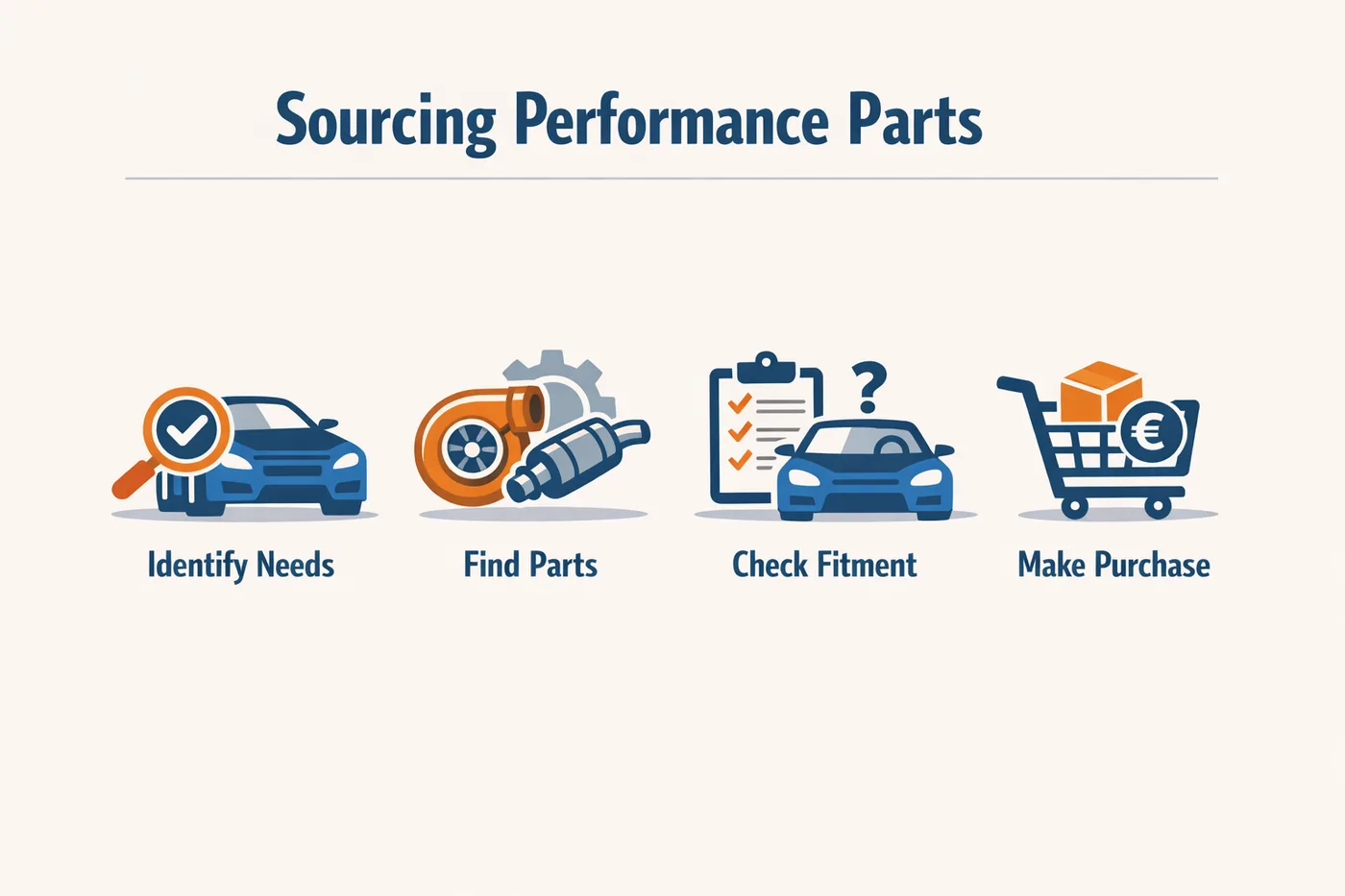
I've spent years at the counter watching people buy parts that don't meet the spec their car actually needs. The process starts with the approval, not the brand name on the box. Here's how to source parts that work.
Step 1: Identify the Required Specification
Step 1
Find the factory approval
Check your owner's manual or the factory service bulletin for the exact specification. For engine oil, this might be VW 504.00/507.00 or MB 229.51. For brake fluid, it's DOT 4 Low Viscosity or DOT 5.1. The spec is printed in the manual, not optional.
The build date matters. A 2015 Golf R takes 502.00 oil; a 2016 takes 504.00/507.00. Same car, different spec, and the wrong one costs you a turbo. Look up your VIN or check the engine code on the cam cover.
Step 2: Cross-Reference Approved Products
Step 2
Match the approval to the product
The bottle has to say the spec. If you need VW 504.00/507.00, the label must print those numbers. A product that meets ACEA C3 is not the same thing—ACEA is a performance category, not a manufacturer approval.
Manufacturer approval lists are public. VW publishes a list of oils that meet 504.00/507.00; BMW does the same for Longlife-04. I keep printed copies at the counter because customers bring in bottles that claim "meets all European specs" and the approval isn't on the VW list. If it's not on the list, it's not approved, regardless of what the marketing says.
Step 3: Verify Part Numbers and Fitment
Step 3
Check the factory parts catalog
Use ETKA for VW/Audi, ETK for BMW, or the Mercedes EPC. Enter your VIN and pull the part number for the component you're replacing. The catalog shows supersessions—if the old number is discontinued, it lists the replacement.
Aftermarket catalogs sometimes list one part number across multiple platforms. The factory catalog is more specific. A single air filter might cover three engines in the aftermarket book, but the factory list shows different part numbers because one has a bypass valve and the others don't. When you're looking at lowering springs or coilovers for European daily drivers, the same principle applies—check the factory fitment data, not just the marketing claim.
The parts catalog also lists fasteners, bolts and hardware. When you order a part, check ETKA for the associated hardware kit. Stretch bolts are one-time-use; if the catalog specifies them, order new ones with the part.
Step 4: Source from Verified Distributors
Step 4
Buy from a distributor who stocks OE-supplier brands
OE suppliers—the companies that make parts for the assembly line—sell the same parts through the aftermarket under their own label. Bosch, Mahle, Hengst, Mann+Hummel, Sachs and Lemförder are examples. The part is identical; the box is different.
I source from distributors who stock these lines because the part meets the factory spec without the dealer markup. The distributor catalog cross-references the OE part number to the supplier's aftermarket number. You get the same part, same warranty, lower price.
Avoid vendors who don't list the OE cross-reference or the country of manufacture. If the listing says "OE quality" but doesn't name the supplier or print the spec, you're guessing.
Step 5: Confirm Compatibility with Emission and Safety Systems
Step 5
Check emission compliance
Euro 4, 5 and 6 engines have exhaust after-treatment systems—catalytic converters and Diesel Particulate Filters. The oil, coolant and fuel additives you use affect these systems. Sulfur and Phosphorus inhibit catalyst operation; Sulfated Ash clogs the DPF.
When you're sourcing fluids, the spec accounts for this. An oil that meets VW 507.00 has low Sulfated Ash content specifically for DPF-equipped diesels. A generic 5W-30 might meet the viscosity grade, but if it's not 507.00, it will clog the filter and trigger regeneration cycles that shorten engine life.
The same applies to brake components and exhaust parts. If your car has ABS and ESC, the brake pads and rotors must meet the friction coefficient the system expects. The factory service bulletin lists this; the aftermarket part data sheet should too.
Tips and Tricks for Successful Upgrades
I've watched hundreds of enthusiasts walk into the counter with a part number and a hope that it fits. The ones who get it right do three things before they order: they check the factory parts bulletin, they verify the approval on the bottle, and they confirm the part supersession chain. The ones who guess pay twice.
Cross-Reference the Factory Parts System First
ETKA and the manufacturer's parts database are not suggestions. They are the source of truth for supersessions, running changes, and which part number applies to which build date. A catalog might list one filter for three engines, but the factory system will show you that two of those engines got a bypass-valve change midyear and the universal part no longer works. Always check with your Parts Department and ETKA for the latest information and parts bulletins before you commit to an aftermarket supplier.
Match the Approval to the Engine Code
Oil is the clearest example. Euro 4, 5, and 6 engines are fitted with sensitive exhaust gas after-treatment systems, and the wrong lubricant inhibits their operation. Sulfur and phosphorus poison catalytic converters; sulfated ash clogs diesel particulate filters. The bottle has to say the approval your engine requires — not a similar one, not a generic equivalent, the exact sheet number. For VW and Audi, that means checking whether your engine calls for VW 502.00, 504.00, or 507.00. For BMW, it is LL-01 or LL-04. The approval is printed on the back label; if it is not there, the oil does not meet it.
Products like Fuchs Titan GT1 FLEX 3 and Pentosin Pento High Performance II carry multiple manufacturer approvals and work across a range of European platforms, but only when the approval list matches your engine code. I have seen mechanics run a 5W-40 that meets one standard into an engine that requires another, and the variable timing solenoids clog first.
Verify Fitment for Suspension and Brake Components
Lowering springs and coilovers are not universal by chassis. The same platform can have different spring rates, damper valving, and mounting hardware depending on the engine, the drive layout, and the factory suspension option. A G20 330i and a G20 M340i share a platform, but the spring perches, the damper stroke, and the wheel-speed sensor routing are different. The catalog will tell you it fits; the install will tell you it does not. Cross-check the part number against the VIN decoder and the factory service manual before you order. For brake upgrades, the same rule applies: caliper brackets, rotor hat dimensions, and wheel clearance vary by wheel diameter and brake package, and the fitment chart is not optional.
The catalog might say it fits; the factory parts list will tell you if it actually does.
Plan for the Maintenance Interval the Upgrade Requires
Aftermarket performance parts often carry shorter service intervals than OE components. A high-flow air filter needs cleaning every 15,000 miles; a performance brake pad generates more dust and wears faster than the factory organic compound; a limited-slip differential requires a specific friction-modifier additive and a fluid change every 30,000 miles instead of lifetime fill. The part works, but only if you maintain it on the schedule it requires. I have seen customers install a performance clutch and then run the factory fluid past its thermal limit, and the engagement becomes unpredictable. Read the installation sheet, note the service interval, and set a reminder. The upgrade is not maintenance-free just because it is new.
For suspension components, check the torque specifications in the factory service manual and retorque the hardware after the first 500 miles. Coilover lock rings settle; control-arm bushings seat; and what felt tight at install is no longer tight after the first few heat cycles. If you skip the retorque, the alignment drifts and the handling gets worse, not better.
Keep the Paperwork and the Part Numbers
When you source a part, keep the invoice, the part number, and the manufacturer's data sheet. If the part fails or the fitment is wrong, you need the paper trail to process a return or a warranty claim. More importantly, if you sell the car or hand it to another shop, the next person needs to know what is installed and what it requires. I have seen cars come in with aftermarket coilovers that no one can identify because the owner lost the box and the shop that installed them is gone. The dampers need a rebuild, but without a part number, there is no way to order the service kit. The paperwork is not optional.
For more guidance on selecting components that balance performance and daily drivability, see our comparison of lowering springs vs coilovers for European daily drivers.
Conclusion
Sourcing European performance parts comes down to three things: the part number, the approval it meets, and the supplier you trust to deliver what the catalog says. I've spent years watching enthusiasts chase the cheapest price, only to return when the part doesn't fit or the warranty claim gets denied because the component wasn't OE-approved. The catalog might show one filter across six engine codes, but the factory parts list reveals a bypass valve difference that matters. That's why I founded European Wholesale Parts in Pleasanton, California — to connect you with verified suppliers who cross-check distributor catalogs against manufacturer specifications before they ship.
When you're upgrading a BMW, Mercedes, Audi, or Porsche, the part has to meet the sheet approval printed in the owner's manual. A performance air filter or upgraded brake pad might promise gains, but if it doesn't carry the manufacturer's approval code, you're running a part the factory didn't test in that chassis. The wrong specification doesn't just void warranty coverage — it changes how the engine or braking system behaves under load. Check the build date, verify the part number, and confirm the approval is on the bottle or the box. The cheap way costs more when the repair comes back.
For practical guidance on specific upgrades, see our BMW M340i Lowering Springs vs Coilovers for Daily Driving comparison. Whether you're sourcing fluids, filters, or performance components, the principle stays the same: name the spec, find what meets it, and buy from a supplier whose paper trail you'd hand an auditor without flinching. That's how you source European performance parts that work.
Explore how to source European performance parts for aftermarket upgrades effectively.
Written by
Lee Shahin
Founder, European Wholesale Parts
Lee Shahin founded European Wholesale Parts in Pleasanton, California, after 18 years in the Mercedes-Benz and BMW parts trade. He came to the parts side from the shop floor: he opened a European repair shop in Northern California in the early 1990s, specialising in Mercedes-Benz and BMW, and grew it with his wife Laurie into a parts and delivery operation serving body shops and independent repair facilities across the region. Nearly two decades at the parts counter taught him where the expensive mistakes happen, and most of them are fluids: the wrong coolant in an aluminium block, an oil without the sheet approval the engine was designed for, a transmission topped with the wrong ATF. That is what he writes about here. Every article names the manufacturer specification by its exact designation, explains what the wrong fluid does mechanically, lists products that carry the approval, and gives the capacity and interval for the models and years the specification covers. When a reader needs a part sourced, the quote desk at European Wholesale Parts is where Lee and Laurie still answer the phone.