

Used Auto Parts: Used European Auto Parts: Quality Assessment
Learn how to assess and source quality used auto parts, specifically used European auto parts, to ensure reliable performance and fit for your vehicle.
Introduction
I have watched the same mistake at the counter for eighteen years: someone brings in a used alternator that fits the bracket, but the voltage regulator inside is wrong for the car's CAN bus. It starts, it charges, and two weeks later the battery monitoring module throws a fault. The part physically fit. It did not meet the specification. That is the difference between a catalog match and a correct part.
When you source used European auto parts, the manufacturer approval is not a suggestion. Mercedes-Benz MB 229.5 oil is not interchangeable with a generic 5W-30, and a used oil jug with no approval sheet printed on it is a jug you leave on the shelf. The same logic applies to every component: the part number, the build date, the approval marking. If those do not align with what the factory specified, the part is wrong even when it bolts in.
Why Quality Assessment Matters for Used European Auto Parts
A used part from a European vehicle carries the same specification requirements as a new one. The difference is that you cannot see the service history, the storage conditions, or the reason it came off the donor car. Used cooling system hoses may look clean but can have internal delamination from the wrong coolant. The hose fit. It held pressure for a month. Then it let go, and the engine overheated.
The ACEA Oil Sequences define the minimum quality level for self-certification to EELQMS and presentation to ACEA members, which means even a used oil container must show that it met the standard when it was filled. Individual manufacturers add their own requirements on top of ACEA, and those are the approvals you check first. A used part is only as good as the specification it meets, and if you cannot verify that specification, you cannot verify the part.
Reconciling a distributor catalog fitment against the manufacturer specification is where most mistakes happen. The catalog might list one filter for both engines, but the factory parts list does not, and the difference is the bypass valve. The used parts market does not fix that problem—it makes it worse, because the part might have come from the other engine in the first place.
For more on ensuring compatibility across European platforms, see the BMW Scan Tools by Chassis and Function: Which Tool Fits Your Model guide.
Problem Statement
The first challenge with used European auto parts is that the catalog fitment does not tell you what you need to know. I have watched people buy the wrong alternator three times because the listing said it fit, and it did fit — physically. But the amperage was different, the regulator logic was different, and the charging profile was wrong for the car's ECU. The bolt pattern and the connector matched, so the catalog called it compatible. The car disagreed.
The second challenge is that European parts carry approvals and specifications that do not transfer when a part comes out of a donor car. A water pump from a 2015 328i might look identical to the one from a 2016, but BMW changed the impeller design mid-year and the part number is different. The old pump works until it does not, and then you are pulling it again. There is no visual inspection that catches that.
Compatibility Is Not the Same as Fitment
Fitment means it bolts on. Compatibility means it works the way the car expects. A used turbocharger from a salvage yard might mount to your N54 engine, but if the actuator calibration is different or the wastegate arm is bent, you will chase boost codes until you replace it. The problem is not always obvious at installation — it shows up later, under load, when the part cannot meet the demand the ECU is programing for.
Warranty and traceability add another layer. When you source a used part, you lose the chain of custody. You do not know if it was removed because the car was totaled or because the part failed. Audi and BMW warranty claims are subject to review, and if a used part causes a failure in an adjacent system, the manufacturer will not cover it. Customers may save two hundred dollars on a used fuel pump but could spend two thousand fixing the injectors it damaged when it failed.
The third challenge is condition assessment. A used oil cooler might not leak on the bench, but the internal baffles could be clogged with sludge. A used ABS module might pass a static test but fail under thermal cycling. These are not problems you can see, and most salvage yards do not have the diagnostic equipment to test modules the way the car will test them. For critical systems — ABS, airbags, fuel delivery — the risk is not worth the savings.
Model-Specific Requirements Complicate Sourcing
European platforms change specifications mid-production in ways that American cars do not. BMW ran three different coolant formulations across the E46 generation, and mixing them causes precipitate that clogs the heater core. Audi changed the DSG service interval and the approved fluid between model years on the same transmission code. A used part from the wrong year might fit and run, but it will not run correctly, and the damage is cumulative.
The ETKA and EPC catalogs are the only reliable source for this information. Aftermarket listings aggregate data from multiple sources and do not always catch the engineering changes. If you are sourcing a used part, cross-check the donor car's build date and option codes against the factory parts system. The five minutes it takes to verify the part number will save you from pulling the same job twice.
For more on ensuring component compatibility across European platforms, see our BMW Scan Tools by Chassis and Function guide.
Solution Steps for Quality Assessment
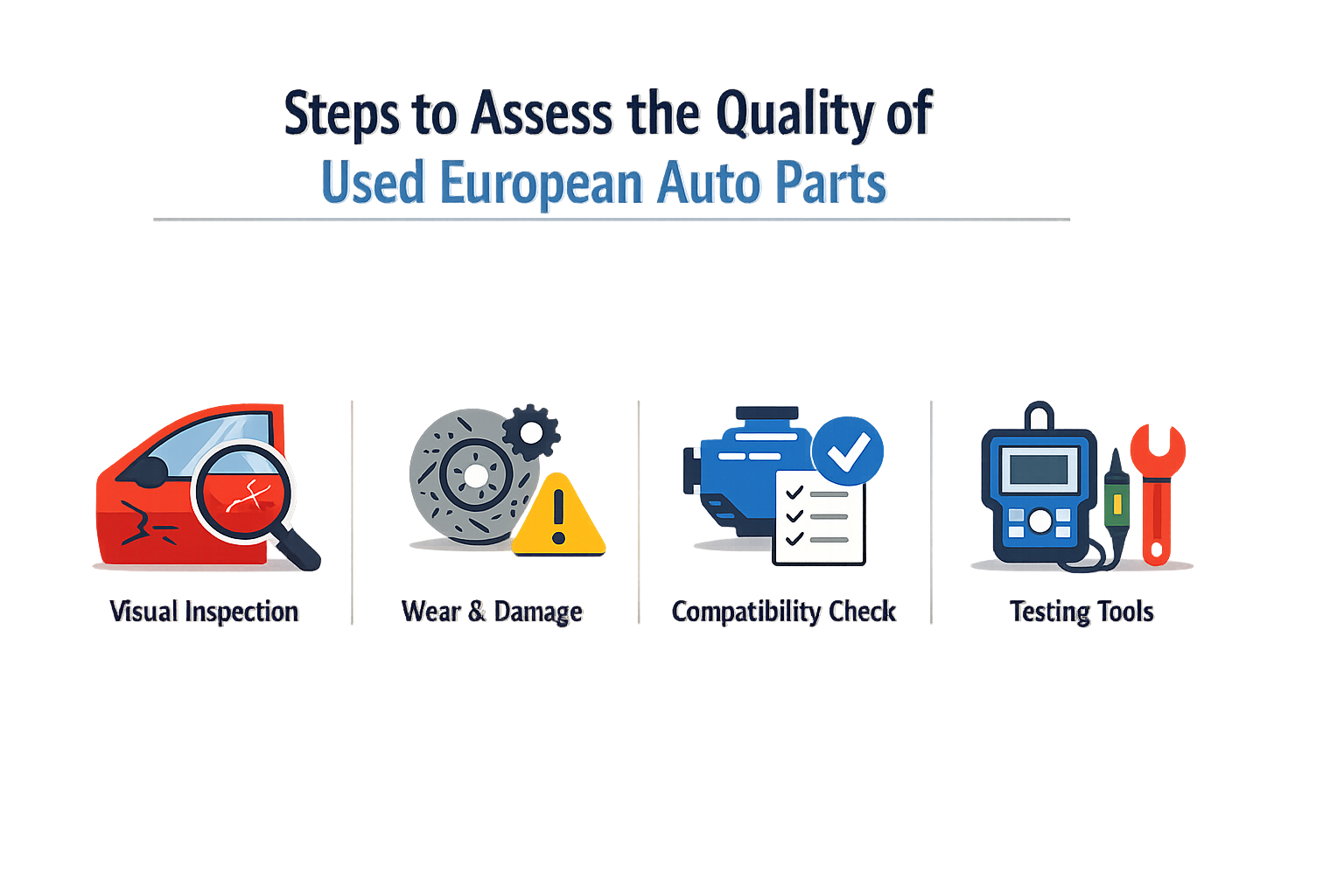
I reconcile a distributor catalog fitment against the manufacturer specification every time I source a used part. The catalog might list one filter for both engines, but the factory parts list does not, and the difference is the bypass valve. That cross-check is not optional.
Step 1: Verify the Part Number Against the Factory List
Pull the OE part number from the vehicle's parts catalog or service manual. A used part must carry that exact number or a documented supersession. If the seller cannot produce the OE number or a cross-reference to it, walk away.
The number is the spec. A used alternator for a 2015 E350 is not interchangeable with one from a 2016 if the part numbers differ, even when the engines look identical. The regulator voltage or the mounting ears changed, and the car will not charge correctly or the bracket will not line up.
Step 2: Check Manufacturer Approvals for Fluids and Wear Items
When sourcing used or refurbished components that involve fluids—power steering pumps, transmissions, differentials—verify that any fluid included or required meets the manufacturer's sheet approval. For example, a used ZF 8-speed transmission from a BMW must be filled with fluid meeting BMW Longlife approval or the equivalent ATF specification printed in the service manual.
A Cayenne transfer case might fail because someone topped it with generic 75W-90 instead of a product meeting Porsche's spec. The clutch packs could glaze, the case could overheat, and the repair cost more than buying the correct fluid in the first place.
Step 3: Inspect Physical Condition and Wear Indicators
Used parts must be visually clean and free of cracks, corrosion, or impact damage. For rotating components—alternators, starters, AC compressors—check the pulley for wobble and the shaft for radial play. For suspension parts, inspect bushings and ball joint boots; if the rubber is torn or the grease is black, the part is already worn out.
Brake calipers are a common mistake. A used caliper might look fine, but if the piston seal is old or the bore is scored, it will leak or seize within weeks. Always ask for the build date or the vehicle's mileage when the part was removed. A caliper off a 60,000-mile car is worth considering; one from a 150,000-mile car is not.
Step 4: Cross-Check Compatibility by Engine Code and Build Date
European manufacturers change specifications mid-year, and the VIN alone does not tell you which variant you have. A 2012 C300 could have the M276 or the older M272 engine depending on the build date, and the oil pan, timing cover, and accessory brackets are different.
For more guidance on compatibility and sourcing decisions for European platforms, see our BMW Scan Tools by Chassis and Function article.
Locate the engine code on the vehicle data plate or in the service manual. Cross-reference that code against the used part's application list. If the seller lists fitment by year and model only, verify it yourself using the factory parts catalog.
Technicians may install the wrong thermostat because the parts-store system said it fit. The engine overheated because the opening temperature was 10 degrees lower than the ECU expected, and the fuel trim went rich. The catalog was wrong, and the engine code would have caught it.
Step 5: Request Documentation and Service History
A quality used part comes with documentation: the VIN it was removed from, the mileage at removal, and ideally a photo of the part still installed in the donor vehicle. Salvage yards that track this information are worth paying more for. If the seller cannot or will not provide it, the part's history is unknown, and so is its remaining service life.
For high-value components—turbos, ECUs, instrument clusters—request a warranty in writing. A 30- or 60-day warranty tells you the seller has confidence the part works. No warranty means they do not know, and you are assuming all the risk.
Tips and Tricks for Sourcing Used Parts
Many people skip the verification step and end up with a part that looks right but doesn't fit. When sourcing used European auto parts, the catalog fitment is a starting point, not the final word. Cross-check it against the factory parts list by VIN or build date. The catalog might say one alternator covers three model years, but the factory list splits them by engine code, and the pulley diameter is different. That difference matters.
Check ETKA and Manufacturer Databases First
Before you buy anything, verify the part number in ETKA for VW and Audi or the equivalent manufacturer database for BMW and Mercedes. All part and service references are subject to change, and a supersession can mean the used part you're looking at was replaced for a reason — usually a failure pattern the factory documented. If the number you pull from a salvage listing doesn't match the current active part or its documented predecessor, walk away.
Use Forums and Classifieds With Caution
Forums and classifieds can be useful for finding listings and getting a sense of what's available, but treat the technical claims with skepticism. More bad information can be found in forum posts than in any other single place. Someone will say a part interchanges when it doesn't, or they'll claim a generic part meets a spec without the sheet approval to back it up. Use these platforms to locate parts and gauge pricing, but verify every fitment claim independently.
When a seller lists a part as "fits all E46," ask for the specific part number and the donor VIN. If they can't provide both, you're guessing. The same applies to fluid-contact parts like thermostats and coolant flanges — the material and the bypass design changed mid-production on a lot of platforms, and the wrong one will cause a fault code or a leak within a month.
The catalog might list one filter for both engines, but the factory parts list does not, and the difference is in the bypass valve.
Inspect the Part Before You Install It
Once you have the part in hand, inspect it against the factory specification. For electrical components, check the connector pin count and the part number molded into the housing. For mechanical parts, measure the critical dimensions — bore diameter, mounting-hole spacing, shaft length. A used throttle body may be off by two millimeters in the bore, leading to a poor seal.
If the part has a fluid passage or a seal surface, check for corrosion, cracks and warping. Aluminum castings from European makes do not forgive corrosion — once it starts, it doesn't stop, and you'll be replacing the part again in six months. A used part that shows pitting in the coolant passage is not a bargain; it's a liability.
For more on ensuring compatibility when working with European systems, see our guide on Motive Power Bleeder European Car Compatibility.
Conclusion
I have watched the same mistakes repeat for eighteen years at the counter: someone brings in a universal coolant jug and asks why the heater stopped working. The conversation is always the same. The part was cheap, the fit looked right, and now the repair costs more than the car is worth. Quality assessment and sourcing for used European auto parts is not about preference — it is about matching the manufacturer specification to what you actually install.
The process comes down to three checkpoints: verify the part number against the factory parts list, inspect for physical damage and contamination, and confirm that any fluid or consumable meets the printed approval. When you skip one, you pay for it later. A used alternator that fits the bracket but outputs 120 amps instead of 180 will run the car until the battery dies at a stoplight. A used radiator with the wrong coolant residue will corrode the new water pump in six months. The catalog fitment is a starting point, not a guarantee.
For practical sourcing advice and compatibility checks on European platforms, see our guide on Motive Power Bleeder European Car Compatibility. The same cross-checking discipline applies whether you are sourcing a used part or a new tool.
The European automotive sector employs 3.4 million people in manufacturing alone and generates over 7% of the EU's GDP. That scale means parts move through multiple hands before they reach your shop, and every hand introduces risk. The only defense is documentation: match the part to the specification, photograph the condition, and keep the invoice. When the part fails, you will need all three.
Quality in used parts is not subjective. It is a function of correct identification, verifiable condition, and manufacturer compliance. Get those three right and the part works. Miss one and it does not matter how good the price was.
Related reading
Sources(18)
- LIQUI MOLY
- ACEA (2023)
- Audi Technical Service Bulletin (NHTSA ODI)
- Motul technical data sheet (2022)
- LIQUI MOLY
- LIQUI MOLY
- Pelican Parts Technical Articles
- Volkswagen Technical Bulletin 17-19-01 (NHTSA ODI)
- Porsche Technical Bulletin (NHTSA ODI)
- Motul technical data sheet (2021)
- LIQUI MOLY
- Mercedes-Benz Operating Fluids (2026)
- LIQUI MOLY
- BMW of North America maintenance booklet
- Pelican Parts Technical Articles
- Pelican Parts Technical Articles
- Pelican Parts Technical Articles
- Pentosin product data sheet (CRP Automotive)
Written by
Lee Shahin
Founder, European Wholesale Parts
Lee Shahin founded European Wholesale Parts in Pleasanton, California, after 18 years in the Mercedes-Benz and BMW parts trade. He came to the parts side from the shop floor: he opened a European repair shop in Northern California in the early 1990s, specialising in Mercedes-Benz and BMW, and grew it with his wife Laurie into a parts and delivery operation serving body shops and independent repair facilities across the region. Nearly two decades at the parts counter taught him where the expensive mistakes happen, and most of them are fluids: the wrong coolant in an aluminium block, an oil without the sheet approval the engine was designed for, a transmission topped with the wrong ATF. That is what he writes about here. Every article names the manufacturer specification by its exact designation, explains what the wrong fluid does mechanically, lists products that carry the approval, and gives the capacity and interval for the models and years the specification covers. When a reader needs a part sourced, the quote desk at European Wholesale Parts is where Lee and Laurie still answer the phone.