
Audi Parts Procurement Europe: Sourcing Genuine Components
Audi parts procurement Europe strategies for sourcing genuine components through authorized dealers, online platforms, and local suppliers.
Introduction
Audi parts procurement Europe requires starting with the part number the factory assigned to your specific build. That number lives in ETKA, the electronic parts catalog Audi and VW share, and it changes when the engineering changes. A control arm for a 2015 A4 is not the same as the one for a 2017, even when the model name is identical. The part that fits depends on the production date, the engine code, the transmission type, and sometimes the market the car was originally sold in. If you order by model year alone, you're guessing.
I've watched too many Audi jobs stall at the counter because the part that arrived wasn't the part the car needed. The number on the box matched the number on the invoice, but the component inside was a copy, or it was genuine but superseded, or it was the right part for a different model year. In Europe the procurement landscape is tighter than in the US — authorized dealer networks, OE suppliers with strict distribution agreements, and a used-parts market that runs on chassis codes and VIN-specific lookups. You can't guess.
The stakes are higher than inconvenience. A counterfeit sensor can throw the wrong data to the ECU and put the car into limp mode. A copied suspension mount can separate under load. An aftermarket brake rotor without the OE metallurgy can warp in three heat cycles. Genuine components carry the manufacturer's approval and the liability that comes with it. Copies do not.
In this guide I'll walk you through the procurement process for Audi parts in Europe, from identifying the correct component to choosing a supplier that stocks genuine inventory. You'll learn how to read a part number, verify that a component meets the factory specification, and avoid the common mistakes that turn a simple repair into a multi-week ordeal. If you're working on an Audi, whether it's a B8 A4 or a C7 A6, the part has to be right the first time. Here's how to make that happen.
For related guidance on European vehicle maintenance, see our BMW Scan Tools by Chassis and Function for diagnostic tool selection across platforms.
The Challenge of Sourcing Audi Parts
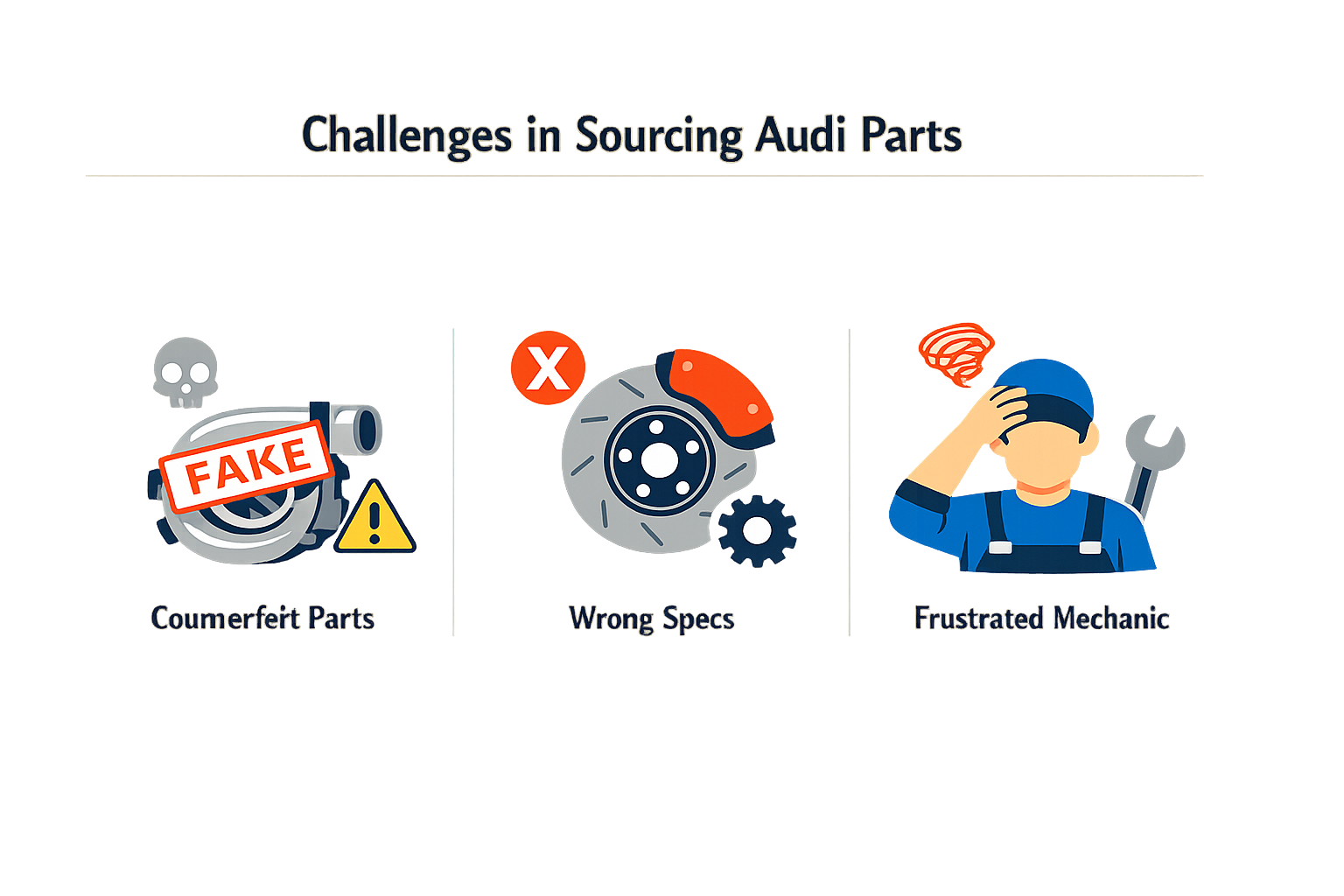
The first problem is that the part number changes. I've watched shops order what they thought was the right control arm only to find out Audi superseded it two months ago. The second problem is that the part you ordered might not be the part you need — even when the number matches — because Audi changed the design mid-year and the catalog doesn't tell you which build date the new one fits.
Counterfeit components are the third issue. A fake MAF sensor or knock sensor will throw the same code as a real one when it fails, but it fails faster and takes other parts with it. The bottle has to say it meets the spec, the box has to have the OE supplier's name on it, and the price has to make sense — if it's half what the dealer charges, it's not the same part.
Incorrect Specifications and Reference Drift
Audi's own service information tells you to check ETKA before you order because the bulletin you're reading might be outdated. The parts department has access to the current catalog; you don't. That gap is where the wrong part gets ordered. A shop will pull a number from a TSB, the part arrives, and it doesn't fit because the TSB was written for an earlier production run.
The same thing happens with fasteners and hardware. ETKA lists the bolts, clips and screws by repair operation, and they change when the part changes. Order the control arm without checking ETKA for the current hardware kit and you're missing half of what you need to finish the job. For more on ensuring compatibility across European platforms, the same cross-reference discipline applies.
The catalog is live; the bulletin is a snapshot. Always verify the part number against the current ETKA listing before you place the order.
Why Wrong Parts Cost More Than the Right Ones
A wrong part doesn't just sit on the shelf. It delays the repair, the customer waits longer, and the shop eats the labor to swap it. The cheap way — ordering without verification — costs more because you pay twice: once for the part that doesn't fit and once for the one that does. Shops that checked the build date and the current ETKA listing before they ordered spent less on parts than the ones who didn't.
How Do You Source Genuine Audi Parts in Europe?
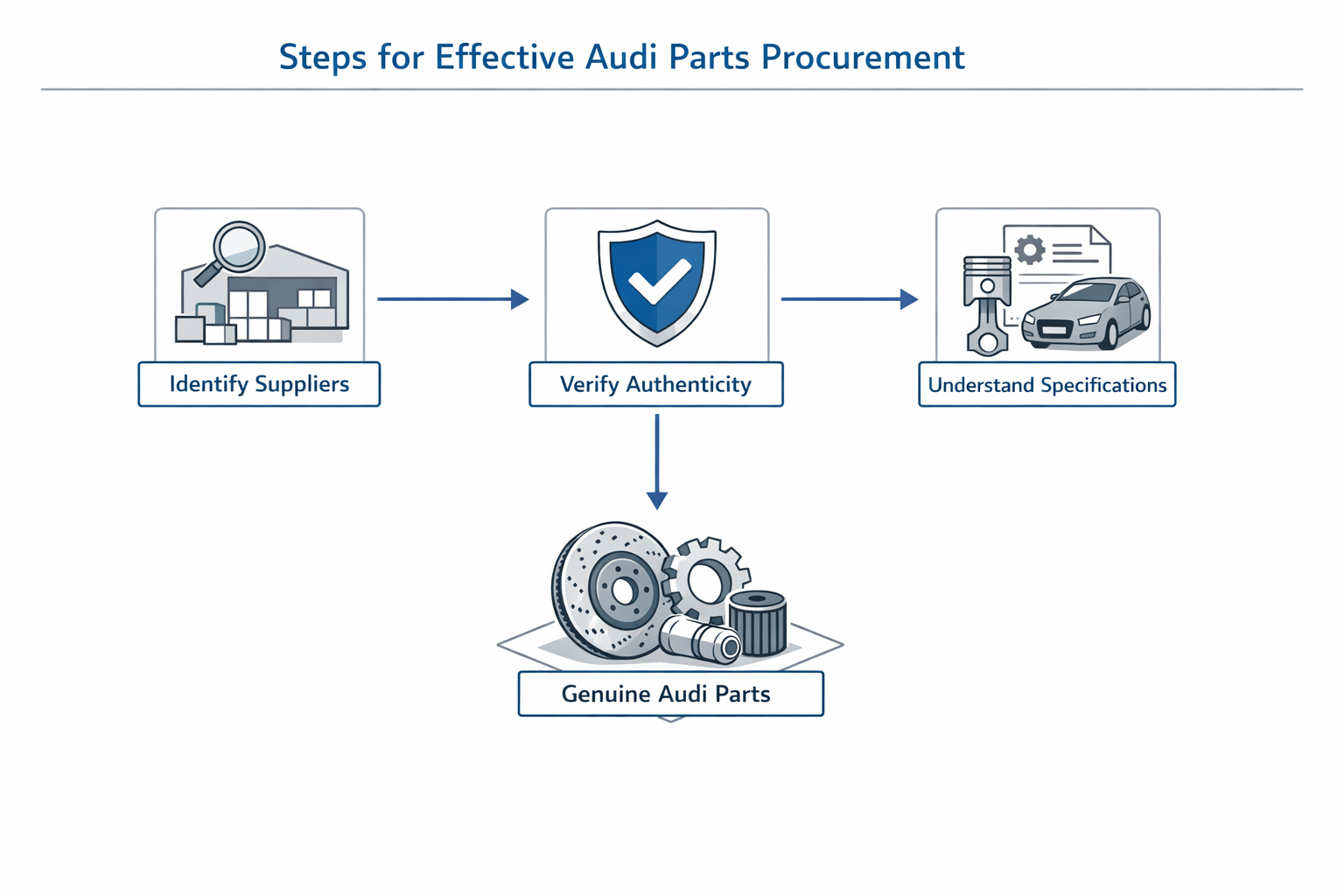
Audi parts procurement Europe starts with a verification system that removes guesswork. The parts you source are only as good as the system you use to verify them. I've watched too many shops order what they think is the right component, only to find out mid-job that the part number doesn't match the build date or the spec has changed. Here is the process that works.
ETKA is Audi's electronic parts catalog, and it is the only source that accounts for running changes, superseded part numbers, and model-year-specific variations. Your parts department has access; use it. The catalog will tell you if a part number has been replaced, if a fastener requires replacement during installation, and whether your VIN falls within a specific production range. Never order from a generic cross-reference without checking ETKA first — the wrong part costs more than the time it takes to verify.
Once the part arrives, read what is printed on it. For fluids, the bottle has to say the Audi approval — G12evo for coolant introduced in MY19, or the specific oil standard the engine requires. For mechanical components, verify the part number stamped or etched on the part matches the ETKA listing and your invoice. If the numbers don't align, stop. The wrong specification does damage you won't see until the warranty period ends.
Audi specifies which bolts, nuts, and screws require replacement during a repair, and those callouts are in the repair manual, not the parts invoice. After you have the primary component, pull the manual section for that job and note every fastener flagged as single-use. Then order them from ETKA as a separate line. Reusing a torque-to-yield bolt because it looks fine is how you end up with a comeback.
Audi runs multiple engine codes within the same chassis and model year, and the parts are not interchangeable. The 2015 A3 2.0 TDI with engine code CRUA, for example, must use G13 coolant — it cannot run G12evo like other model years. The only way to know which specification your car requires is to check the engine code against the ETKA listing and the applicable technical service bulletin. Assumptions here cost you the job.
For related diagnostic and service procedures on European platforms, see our BMW Scan Tools by Chassis and Function guide, which covers the same principle: match the tool to the specific chassis and build date, not the badge.
The part number on the invoice means nothing if it doesn't match what ETKA says your VIN needs.
When you follow this sequence — ETKA first, specification verification second, fastener cross-check third, engine-code confirmation fourth — you eliminate the variables that cause parts returns and incorrect installations. The system works because it removes guesswork.
What Are the Best Practices for Audi Parts Procurement Europe?
I've watched too many customers walk in with the wrong coolant because they didn't check the part number on the bottle. The part number is everything. For Audi, the coolant spec changed across model years — 2019 and newer vehicles take G12evo (part number G-12E-050-1G-DSP), and the e-tron takes nothing else. Model year 2018 and older use G13 (part number G-A13-774-1G-DSP). The color tells you what's in the system, but the part number tells you what to order.
Verify the Part Number Before You Buy
When you're sourcing parts in Europe, the ETKA catalog is the reference. Always cross-check with your parts department or ETKA for the latest part bulletins before placing an order. Audi updates specifications constantly — what worked last year may not be current. If the supplier can't show you the part number that matches ETKA, don't order it.
Understand Warranty Requirements
Claims are subject to review or audit by Audi Warranty. That means every part you install has to meet the factory specification, not just close to it. Run the wrong coolant — even if it's "compatible" — and the warranty claim gets rejected when the system fails. The same applies to engine oil: the approval has to be printed on the container, and it has to match the standard in the owner's manual.
For oils, some listings you'll find in European catalogs aren't available in the North American market. Refer to ELSA to select the appropriate oil for each vehicle and engine combination. The wrong viscosity or approval voids coverage, and Audi tracks this.
Use Local Resources for Current Specifications
Parts and service references change. What's listed in a 2022 technical bulletin may be superseded by a 2023 revision. Always check with your local Audi parts department and the current repair manuals for the latest information. Fasteners, bolts, nuts and screws are listed as "see ETKA" because the specifications vary by repair and model — there's no universal kit.
If you're working on brake systems or suspension, tools like the Motive Power Bleeder can simplify fluid changes, but the fluid itself still has to meet the Audi specification. The tool doesn't change the requirement. For brake component selection on European platforms, see our guide on ceramic vs semi-metallic brake pads for material considerations that complement parts procurement.
The part number is the only proof that matters when Audi Warranty audits the claim.
Cross-Reference Before Mixing Fluids
Audi coolants have evolved — G11, G12 and G12+ were replaced by improved versions, then G12++ was introduced in 2005, G13 in 2008, and G12evo in 2019. Mixing is allowed in some cases, but only if you know which coolants are compatible. The technical bulletins spell this out by model year and engine. If you're topping off, identify the factory fill by color first, then confirm the part number before adding anything.
Modern Audi engines make higher demands on coolant chemistry. The factory fill is designed not to require changing, but that only holds if you don't contaminate it with the wrong product. When in doubt, flush it and fill with the correct spec.
Conclusion
I've watched shops chase aftermarket Audi parts for years, and the pattern is always the same: the cheap route costs more. Sourcing genuine components through authorized channels keeps warranty coverage intact and avoids the mechanical consequences of counterfeit parts. When a claim goes to Audi Warranty for review, the part number on the invoice matters—run a non-genuine part and the claim gets denied, leaving you with the full repair bill.
The steps are straightforward: verify the part number in ETKA, confirm availability through your dealer or authorized distributor, and check that fasteners and consumables are included or ordered separately. For Audi parts procurement Europe, the same rules apply whether you're sourcing locally or importing—genuine parts carry the manufacturer backing, and that backing disappears the moment you substitute.
If you're working on other European platforms and need guidance on sourcing OEM components or understanding manufacturer specifications, see our guide on BMW scan tools by chassis and function for diagnostic requirements that complement parts procurement. The counter lesson is simple: buy the part the factory specifies, install it per the repair manual, and the car runs as designed.
FAQ
What is Audi parts procurement Europe?Audi parts procurement Europe is the process of sourcing genuine Audi components through authorized dealer networks, OE suppliers, and verified distributors across European markets, ensuring parts meet factory specifications and carry proper warranty backing.
How do I verify a genuine Audi part in Europe?Check the part number against ETKA, the official Audi electronic parts catalog, and verify the number stamped on the component matches your invoice and the factory specification for your VIN, build date, and engine code.
Why does the part number matter for Audi parts procurement Europe?Audi updates part numbers when engineering changes occur, and the same model year can require different parts based on production date, engine code, or market. Ordering by model year alone leads to incorrect parts and failed installations.
Can I mix Audi coolant types?Some Audi coolants are compatible, but only specific combinations. G12evo works across most model years, but mixing G11 with G12++ or G13 causes contamination. Always verify compatibility in the technical bulletins before mixing.
Where should I buy Audi parts in Europe?Source parts through authorized Audi dealers or verified OE suppliers that provide ETKA-verified part numbers. Avoid suppliers that cannot show the exact part number match or offer prices significantly below dealer cost.
Sources(10)
- ECS Tuning Blog
- ECS Tuning Blog
- Audi Technical Service Bulletin (NHTSA ODI)
- Volkswagen Technical Bulletin 17-19-01 (NHTSA ODI)
- Audi Technical Service Bulletin (NHTSA ODI)
- ACEA (2023)
- Audi Technical Service Bulletin (NHTSA ODI)
- BMW of North America maintenance booklet
- Pelican Parts Technical Articles
- Pelican Parts Technical Articles
Written by
Lee Shahin
Founder, European Wholesale Parts
Lee Shahin founded European Wholesale Parts in Pleasanton, California, after 18 years in the Mercedes-Benz and BMW parts trade. He came to the parts side from the shop floor: he opened a European repair shop in Northern California in the early 1990s, specialising in Mercedes-Benz and BMW, and grew it with his wife Laurie into a parts and delivery operation serving body shops and independent repair facilities across the region. Nearly two decades at the parts counter taught him where the expensive mistakes happen, and most of them are fluids: the wrong coolant in an aluminium block, an oil without the sheet approval the engine was designed for, a transmission topped with the wrong ATF. That is what he writes about here. Every article names the manufacturer specification by its exact designation, explains what the wrong fluid does mechanically, lists products that carry the approval, and gives the capacity and interval for the models and years the specification covers. When a reader needs a part sourced, the quote desk at European Wholesale Parts is where Lee and Laurie still answer the phone.