
Mazda Parts in Europe: Cross-Border Sourcing Options
Introduction
I've spent years at the counter cross-referencing distributor catalogs with factory parts lists, and the first thing I learned is this: the part number is the contract. For European makes like Mercedes and BMW, I know the approval structure — MB 229.5 oil, LL-04 spec, G13 coolant. Mazda operates in the same European market, but the distribution model is different. You're not chasing a sheet approval; you're chasing availability across borders, and that means understanding which warehouses stock what and where they will ship it.
Mazda's European footprint is smaller than the German trio, so parts sourcing becomes a question of knowing which countries maintain deep inventory and which rely on central distribution. A brake rotor for a CX-5 might be in stock in the UK and France but require a special order in Finland. The sales area matters — not every distributor serves every region, and cross-border shipping within the EU does not mean universal availability. I've watched mechanics order a part from a catalog that listed it as available, only to find out the warehouse only ships domestically.
The challenge is not just finding the part. It's finding it at a price that makes sense, from a source that will deliver it within a reasonable window, and confirming that the part number matches what the car actually requires. For ceramic vs semi-metallic brake pads, the material choice matters, but the fitment and the distributor's willingness to ship across borders matter just as much. This article walks through the cross-border options for sourcing Mazda parts in Europe — where to look, what to verify, and how to avoid the delays that come from assuming availability.
Problem Statement
I've watched Mazda owners in Europe hit the same wall: the part they need isn't stocked locally, the cross-border shipping estimate is vague, and the catalog description doesn't say whether it's OEM or a pattern part with a different spec. The distribution network for Mazda parts in Europe is fragmented compared to what you see with the big German makes, so availability varies sharply by country and the cost swings with it.
The first issue is inventory depth. A dealer in Germany might stock common service items for the CX-5 and Mazda3, but anything model-specific or older than five years often shows a lead time measured in weeks. Independent suppliers carry aftermarket alternatives, but the part number alone doesn't tell you if the friction material, the bearing preload, or the valve spring rate matches the factory piece. I've seen owners order a "compatible" clutch kit only to find the pressure plate doesn't mate cleanly with the flywheel because the supplier listed a generic application range instead of the actual Mazda part spec.
Cost becomes the second problem when you source across borders. A brake rotor listed at one price in Poland might carry a 20% VAT adjustment and a customs processing fee if you're ordering from the UK post-Brexit, and the final landed cost ends up higher than the local dealer's quote. Shipping within the EU is smoother, but lead times still depend on whether the warehouse is in the same VAT zone and whether the supplier actually has the part in stock or is dropshipping from a third location. The advertised price is rarely the price you pay.
Specifications and Compatibility
The third issue is specifications, and this is where the wrong part costs more than money. Mazda publishes specific approvals for fluids, filters, and wear items, but not every aftermarket supplier prints those approvals on the product page or the bottle. An oil filter might fit the threads and the gasket diameter, but if it doesn't have the correct bypass valve opening pressure, you're running partial filtration at cold start. The same applies to brake fluid: DOT 4 is not one spec, and Mazda specifies a minimum dry boiling point that some budget DOT 4 fluids don't meet. The catalog says "fits 2015 Mazda6," but it doesn't say whether it meets the factory spec, and that's the part that matters when the ABS modulator is cycling pressure 50 times a second.
Understanding which specification your car actually requires is the step most owners skip, and it's the step that determines whether the cheaper cross-border part is a bargain or a liability. The sales area and availability data in supplier catalogs can help you map where a given part is distributed, but that data is only useful if you've already confirmed the part meets the Mazda spec for your model and year. I cross-reference the distributor listing with the factory parts list before I order anything, and I recommend you do the same — the five minutes it takes to verify the spec saves the week it takes to return the wrong part and order again.
How to Source Mazda Parts Across European Borders
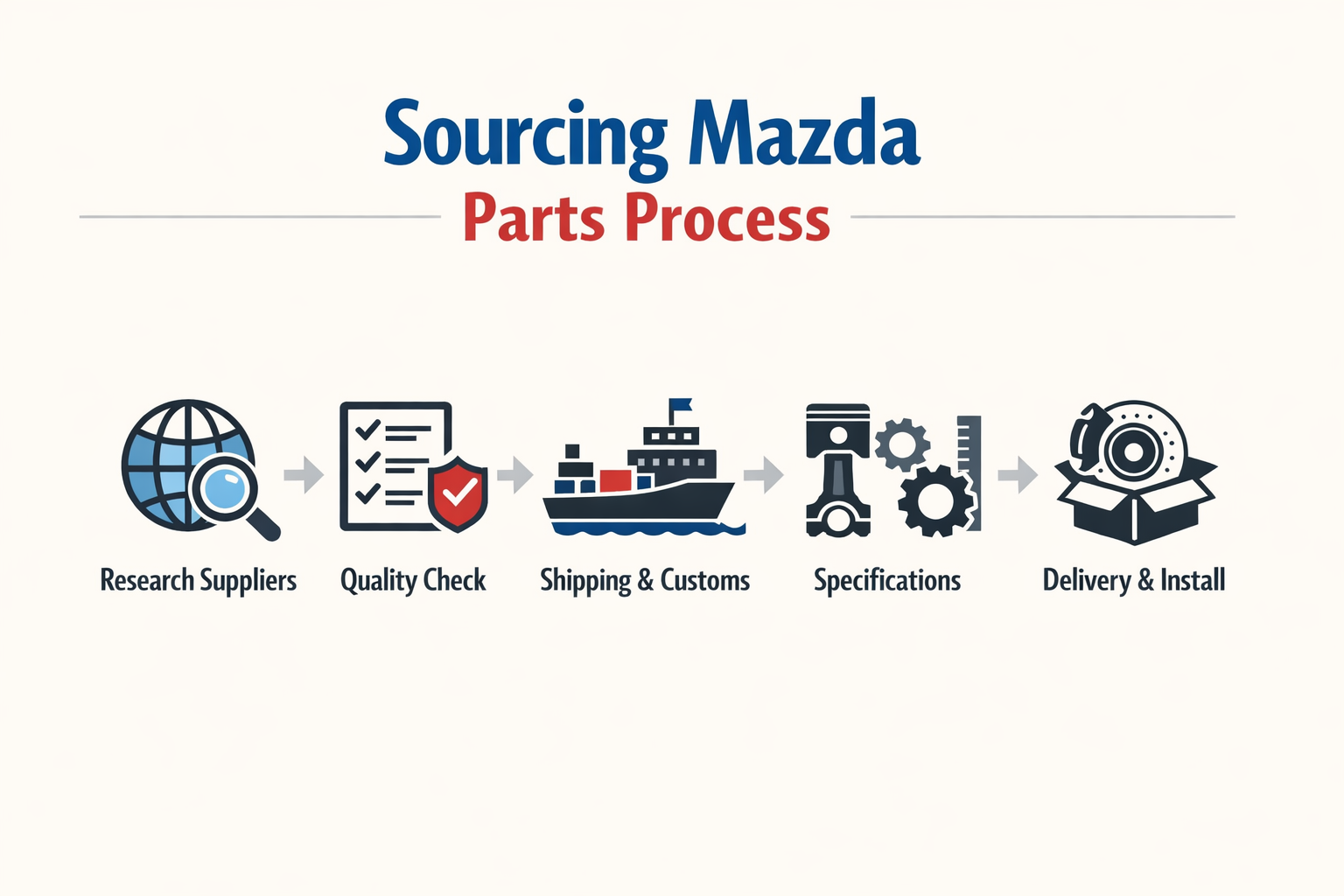
I've spent years at the counter cross-referencing distributor catalogs with manufacturer specifications, and the process for sourcing Mazda parts in Europe follows the same discipline I apply to Mercedes-Benz and BMW. The bottle has to say what the spec sheet requires, and the part number on the catalog has to match the factory parts list. Here's how to work through it systematically.
Step 1
Identify the exact specification
Start with the part number from your owner's manual or the factory service bulletin. For fluids, you need the manufacturer approval printed on the bottle — not just the viscosity grade. A 5W-30 without the right sheet approval will clog variable timing solenoids or starve the turbo feed. For hard parts, the part number tells you whether you're looking at an OEM piece, an OE-supplier equivalent, or an aftermarket substitute. Don't assume compatibility by description alone.
Step 2
Cross-reference distributor catalogs
Once you have the specification, check multiple distributor catalogs to see who stocks the part and where they're located. European distributors often carry regional variants of the same part, and the catalog will show you the principal supplier and the country of origin. For example, AD Parts in Spain lists several engine oils with different approvals — AD SC3 5W30 appears on both MB 229.51 and MB 229.52 sheets, but you need to confirm which approval your Mazda specification cross-references to. The catalog is not a guarantee; it's a starting point.
Step 3
Verify the approval on the product data sheet
Before you order, pull the product data sheet from the manufacturer's website or the distributor's technical library. The approval you need must be listed explicitly — not implied, not "meets or exceeds," but printed as an approved product. I've seen cases where a catalog lists a part as compatible, but the data sheet reveals a critical difference like a bypass valve that isn't on the factory spec. This step catches those discrepancies before the part arrives.
Step 4
Confirm cross-border shipping and customs
If you're ordering from another EU country, verify that the distributor ships to your location and whether they handle customs documentation. Most EU distributors ship freely within the union, but some specialty items require additional paperwork or incur VAT adjustments at the border. For non-EU sourcing, expect delays and tariff costs — the cheap way costs more when the part sits in customs for two weeks.
Locating Reputable Suppliers Across Borders
Reputable suppliers publish their approvals openly and provide batch traceability. LUKOIL Lubricants Europe in Austria, Neste Markkinointi in Finland, and Eurol in the Netherlands all maintain transparent approval lists and ship throughout the EU. I verify suppliers the same way I verify parts: the approval has to be on the manufacturer's official sheet, and the supplier has to provide documentation that ties the batch to that approval. If a supplier won't give you a data sheet or a batch number, walk away.
For hard parts, OE-supplier networks like Bosch, Continental, and ZF maintain distributor relationships across Europe. These suppliers manufacture the parts that go into OEM assemblies, and their aftermarket catalogs often list the same part under a different number. Cross-referencing the OE supplier's part number with the OEM number confirms you're getting the same piece without the OEM markup. The BMW Scan Tools by Chassis and Function article demonstrates a similar approach for diagnostic tools — matching the tool's capability to the chassis requirement.
| Supplier Type | Approval Transparency | Cross-Border Shipping | Price Point |
|---|---|---|---|
| OEM Distributor | Full factory documentation | EU-wide, VAT-adjusted | Highest |
| OE Supplier Network | Manufacturer approval sheets | EU-wide, standard shipping | Mid-range |
| Aftermarket Catalog | Variable; verify batch data | Regional; confirm coverage | Lowest |
Understanding Specifications and Avoiding Mismatches
The specification is not a suggestion. When a Mazda calls for a fluid with a specific approval, that approval defines the additive package, the friction modifiers, and the thermal stability the transmission or engine requires. Mixing is the mistake — topping a G13 coolant with a G12 creates a precipitate that clogs the heater core. Running a 5W-40 without the C3 approval in a DPF-equipped engine loads the filter with ash and triggers a regen cycle that won't complete.
I've watched techs pour the wrong fluid because the viscosity matched, and the repair cost more than the car was worth. The bottle has to say the approval, and the approval has to match the factory spec. If the catalog lists two products with the same viscosity but different approvals, they are not interchangeable — one meets the spec, the other doesn't.
Tips and Tricks for Efficient Sourcing
I've spent years at the counter reconciling what a catalog says with what the factory actually specifies, and the same discipline applies when you're sourcing Mazda parts across Europe. The trick is to verify every specification before you commit to a purchase, especially when you're ordering from a distributor in another country where returns cost time and money.
Cross-Reference the Part Number with Multiple Catalogs
Never trust a single listing. Pull the Mazda OEM part number from your service manual or the parts diagram on the manufacturer's site, then cross-reference it in at least two distributor catalogs. I've caught discrepancies where one catalog shows a filter with a bypass valve and another shows the same number without one — the difference matters when the engine is running. If the numbers don't match across sources, call the distributor and ask them to confirm the specification directly with their warehouse.
Check the Bottle for the Approval
When you're sourcing fluids or filters, the approval printed on the product is the only proof that matters. A catalog description might say "meets Mazda specifications," but unless the approval number is stamped on the bottle or the filter canister, you're guessing. For example, if a Mazda model requires a specific viscosity grade or additive package, the product data sheet should list that approval explicitly. I always tell customers: if the approval isn't on the label, don't run it.
Verify Shipping Restrictions and Customs Documentation
Some parts — especially fluids, batteries, and items with electronic components — face shipping restrictions when crossing EU borders or moving between the EU and non-EU countries. Before you place an order, confirm with the supplier that they can legally ship the part to your location and that they'll provide the correct customs paperwork. I've seen orders held at the border because the commercial invoice didn't match the declared value or the HS code was wrong. Ask the supplier to include the part number, country of origin, and HS code on the invoice — it saves you from delays and unexpected fees.
Know When to Pay More for OEM
Aftermarket parts can save money, but not every component tolerates a substitute. For Mazda-specific sensors, electronic modules, and anything that interfaces with the ECU, I recommend sticking with OEM or an OE-supplier part that carries the same approval. The cheap way costs more when the part doesn't communicate correctly with the car's systems and you're paying for diagnostics and a second replacement. If the part is mechanical and the specifications are clear — like a brake pad with a known friction coefficient — then a quality aftermarket option is fine, but verify the spec first.
Build a Relationship with One Reliable Distributor
Once you find a distributor who ships on time, provides accurate part data, and handles returns without drama, stay with them. A good relationship means they'll flag a backorder before you place the order, suggest an OE-equivalent when the OEM part is discontinued, and prioritize your shipment when inventory is tight. I've worked with the same suppliers for years because they know what I need and they don't waste my time with parts that don't meet the spec.
Conclusion
Sourcing Mazda parts in Europe comes down to knowing where the distributors are and what the part number actually covers. The cross-border network is there — AD Parts in Spain, Neste in Finland, EUROLUB in Germany — but you still have to match the specification to the car. A part approval printed on a bottle or a catalog entry is only useful if it lines up with what the engine code requires.
I've spent years at the counter reconciling what a distributor catalog says with what the factory parts list shows, and the same discipline applies here. The cheapest source is the one that ships the right part the first time, with the approval visible on the label. If you skip that step, you pay twice — once for the wrong part, once for the right one.
When you're working on European makes, the BMW Scan Tools by Chassis and Function: Which Tool Fits Your Model principle applies across brands: match the tool to the platform, match the part to the specification, and verify before you install. Mazda parts sourcing is no different. Find the distributor, check the part number, confirm the approval, and run it. That's the sequence, and it works every time.
Frequently asked questions
What is sourcing Mazda parts in Europe?
Sourcing Mazda parts in Europe is the process of locating, verifying, and purchasing OEM or aftermarket components through cross-border distribution networks, matching part numbers and specifications to your vehicle's requirements while navigating regional inventory, VAT zones, and shipping restrictions.
How do I verify a Mazda part meets factory specifications?
Pull the product data sheet from the manufacturer or distributor and confirm the approval number matches the specification in your service manual. The approval must be printed explicitly on the bottle or part packaging — "meets or exceeds" claims without a listed approval are not sufficient.
Can I order Mazda parts from another EU country?
Yes, most EU distributors ship cross-border, but availability and shipping policies vary. Confirm the supplier ships to your location, handles VAT adjustments, and provides customs documentation if required. Some specialty items face shipping restrictions or require additional paperwork.
Are aftermarket Mazda parts safe to use?
Aftermarket parts are safe when they meet the factory specification. For mechanical components with clear specs, quality aftermarket options work fine. For sensors, electronic modules, and ECU-interfaced parts, stick with OEM or OE-supplier equivalents that carry the same approval to avoid communication errors and system faults.
Written by
Lee Shahin
Founder, European Wholesale Parts
Lee Shahin founded European Wholesale Parts in Pleasanton, California, after 18 years in the Mercedes-Benz and BMW parts trade. He came to the parts side from the shop floor: he opened a European repair shop in Northern California in the early 1990s, specialising in Mercedes-Benz and BMW, and grew it with his wife Laurie into a parts and delivery operation serving body shops and independent repair facilities across the region. Nearly two decades at the parts counter taught him where the expensive mistakes happen, and most of them are fluids: the wrong coolant in an aluminium block, an oil without the sheet approval the engine was designed for, a transmission topped with the wrong ATF. That is what he writes about here. Every article names the manufacturer specification by its exact designation, explains what the wrong fluid does mechanically, lists products that carry the approval, and gives the capacity and interval for the models and years the specification covers. When a reader needs a part sourced, the quote desk at European Wholesale Parts is where Lee and Laurie still answer the phone.