

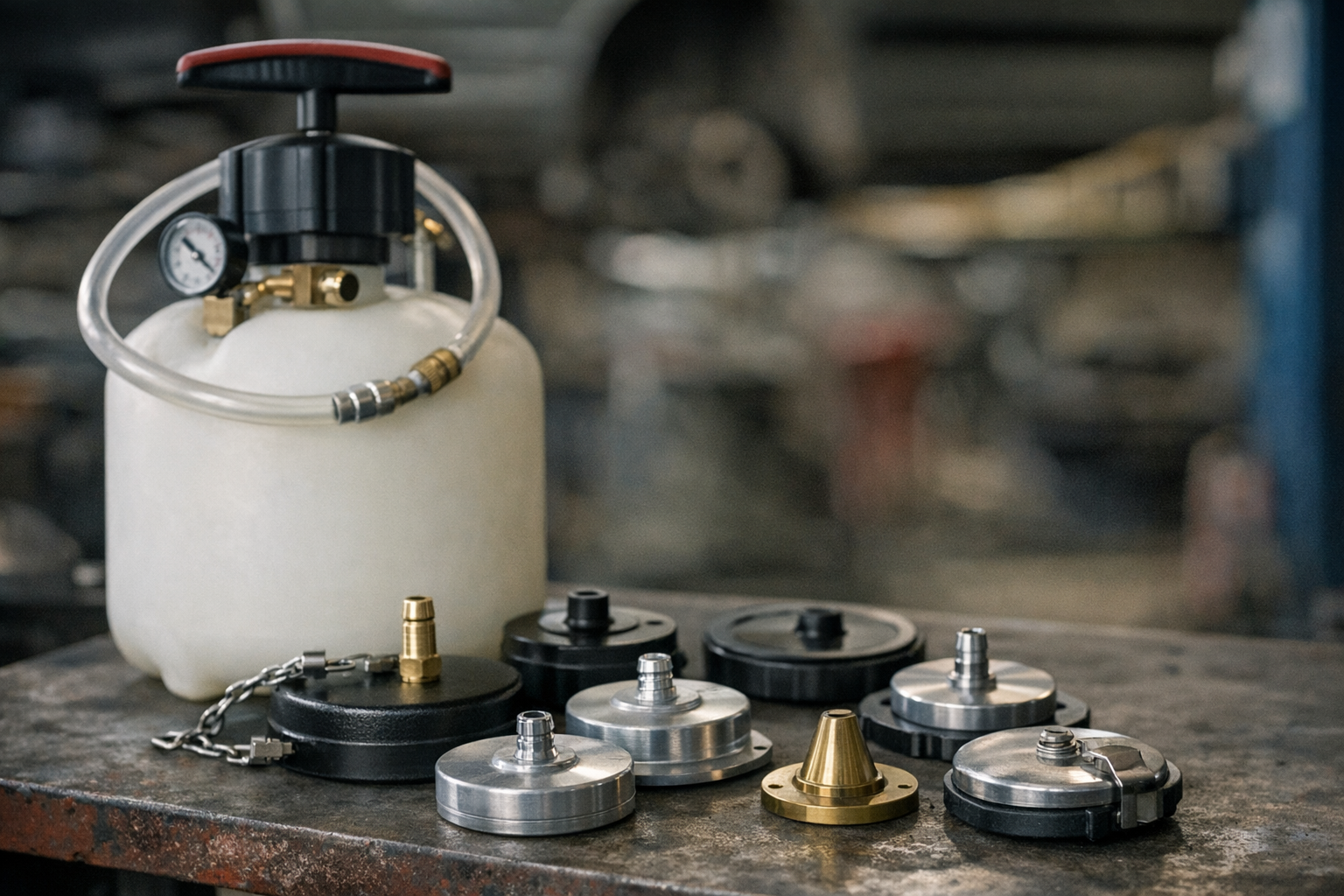
Motive Power Bleeder European Car Compatibility Guide
Motive Power Bleeder European car compatibility guide covering brake bleeding adapters for BMW, Mercedes, Audi, VW, and other European vehicles.
Introduction
Motive Power Bleeder European car compatibility depends entirely on the adapter. I've watched more brake bleeds fail from adapter mismatch than from any other single mistake. The Motive Power Bleeder works — when the adapter seals. European reservoirs use metric threads, different cap diameters, and varying neck heights. A BMW cap does not fit a Mercedes reservoir. An Audi cap does not fit a Porsche. The adapter is not a preference; it is a requirement.
The base Motive unit pressurizes brake fluid and forces it through the system while you open bleeder screws at each caliper. Pressure keeps air from being sucked back through the master cylinder. But if the reservoir cap adapter does not seal, you pump air into the system instead of pushing it out. The result is a pedal that still feels soft and a second bleed that should not have been necessary.
European manufacturers specify reservoir designs by platform and generation. A 2015 F30 BMW uses a different cap than an E90. A W204 Mercedes reservoir is not the same as a W205. The adapter has to match the threads, the diameter, and the gasket surface. Ceramic vs semi-metallic brake pad selection matters for stopping performance, but the adapter fit determines whether the bleed works at all.
Motive sells adapters by make and sometimes by model range. The part number printed on the adapter package tells you what it fits. If the package says BMW E46/E90/F30, check your build date and chassis code before you buy. If it says universal European, check the thread pitch and cap diameter in the product description. Universal means it fits multiple reservoirs with the same dimensions — it does not mean it fits everything.
The sections that follow cover the common compatibility issues by make, the adapter numbers that fit specific platforms, and what happens when you force the wrong cap onto a European reservoir. The goal is a sealed system, a firm pedal, and no wasted fluid.
What Causes Motive Power Bleeder European Car Compatibility Issues?
I've watched techs walk into the shop with a Motive bleeder and the wrong adapter, then spend twenty minutes figuring out why the cap won't seal. The problem is simple: European reservoir caps are not universal, and the Motive kit you bought for your F-150 does not fit your E90.
The base issue is thread pitch and cap diameter. Mercedes-Benz, BMW, Audi, VW and Porsche each use different reservoir neck dimensions, and some models within the same brand have two or three variants depending on the brake system. A 2015 F30 328i takes a different adapter than a 2018 G20 330i, even though both are 3 Series. The Motive universal kit ships with a handful of common domestic adapters; the European ones are sold separately, and you have to match the adapter number to the exact reservoir on your car.
The second problem is fluid specification. European makes require DOT 4 Low Viscosity fluid — Mercedes calls it MB 331.0, BMW and VW publish their own sheets — and the Motive bleeder itself is agnostic to fluid type, but the adapter material matters. Some older Motive caps used rubber seals that swell in synthetic fluid; the current adapters use EPDM or silicone, but if you bought a used bleeder at a swap meet, check the seal before you pressurize it. A swollen seal leaks, and a leaking cap means you're pumping air into the system instead of bleeding it out.
The third issue is pressure. Motive bleeders run at 15–20 psi, which is fine for most European cars, but some models with electronic parking brakes or integrated ABS pump modules require a scan tool to open the bleed valves before you pressurize the system. The Motive unit can't command those valves; it only supplies pressure. If you don't cycle the valves with the tool first, you're bleeding the calipers but not the module, and the pedal stays soft. For BMW-specific diagnostics, see our BMW scan tools by chassis and function guide.
The final problem is parts availability. The European adapter set is not stocked at every auto parts counter in North America. You order it direct from Motive or through a distributor, and if you're doing a same-day brake job, you don't have time to wait for shipping. That's why I keep the BMW, Mercedes and VW adapters on the shelf — the demand is there, and the techs who need them need them now.
Solution Steps
I've sold a lot of Motive bleeders over the years, and the setup is the same every time: match the adapter to the reservoir cap, check the pressure, bleed the system. The steps below work for BMW, Mercedes, Audi, VW, Porsche and Volvo — the tool is universal, the adapter is not.
Step 1: Identify Your Reservoir Cap Type
Pull the cap off the brake fluid reservoir and look at the threads. European makes use three main patterns: the round threaded cap (most BMWs and older Mercedes), the bayonet-twist cap (newer Mercedes, some Audis), and the snap-on cap (VW, Audi, some Volvos). The Motive adapter you need is determined entirely by which cap your car has, not by the make or model. If you have the factory cap in front of you, the adapter that threads or locks onto it is the one you order.
Step 1
Identify your reservoir cap type
Remove the brake fluid reservoir cap and inspect the attachment method. Round threads, bayonet tabs, or snap clips tell you which Motive adapter fits. The cap itself is the specification — not the year or the badge.
Step 2: Select the Correct Motive Adapter
Motive sells adapters by cap type, and the part numbers are on their catalog and on the package. The most common for European cars: the 1120 adapter (round thread, fits most BMWs and older Mercedes), the 1119 (bayonet, fits newer Mercedes and some Audis), and the 1104 (universal snap-fit, works on many VW and Audi models). If you're not sure, bring the cap to the counter or check the Motive fit guide online. The adapter must seal completely — a loose fit means air in the system and a second bleed.
Step 2
Select the correct Motive adapter
Match your cap type to the Motive adapter number. Common European fits: 1120 for round-thread BMW/Mercedes, 1119 for bayonet Mercedes/Audi, 1104 for snap-on VW/Audi. The adapter must thread or lock positively with no wobble.
Step 3: Prepare the Bleeder and Fill the Reservoir
Fill the Motive tank with fresh DOT 4 brake fluid to the fill line — about two quarts is typical. Thread the adapter onto the tank cap, then attach it to the reservoir. Pump the Motive bleeder to 15 PSI and hold it there. If the pressure drops, the adapter is not sealing or there is a crack in the reservoir. Fix the seal before you open a bleeder screw. The system must hold pressure with all bleeders closed.
Step 3
Prepare the bleeder and fill the reservoir
Fill the Motive tank with DOT 4 fluid, attach the adapter to the reservoir, and pump to 15 PSI. Confirm the system holds pressure with all bleeders closed. A pressure drop means a bad seal or a reservoir crack.
Step 4: Bleed the System in the Correct Sequence
Open the bleeder screw farthest from the master cylinder first — usually the right rear on European cars, but check the service manual for your chassis. Crack the screw a half-turn, let the fluid run until it is bubble-free, then close it. Move to the next farthest corner and repeat. The Motive bleeder maintains pressure the entire time, so the pedal never goes soft and air never gets pulled back in. When all four corners run clear, top the reservoir to the max mark and you are done.
Step 4
Bleed the system in sequence
Start at the farthest bleeder (typically right rear), open it a half-turn, and let fluid run until clear. Close it, move to the next farthest corner, and repeat. The Motive holds pressure throughout — no pedal pumping required.
Motive Power Bleeder European Car Compatibility Across Common Models
| Make | Common Cap Type | Typical Motive Adapter | Notes |
|---|---|---|---|
| BMW (E46, E90, F30) | Round thread | 1120 | Same cap across most 3-series |
| Mercedes (W204, W212) | Bayonet | 1119 | Newer models use twist-lock |
| Audi (B8, B9) | Snap-on or bayonet | 1104 or 1119 | Check your specific chassis |
| VW (Mk6, Mk7 GTI) | Snap-on | 1104 | Universal fit for most VWs |
| Porsche (997, 991) | Round thread | 1120 | Same as BMW pattern |
| Volvo (P2, SPA) | Snap-on | 1104 | Consistent across platforms |
For drilled vs slotted rotors and brake system upgrades, the bleeding procedure and adapter requirements remain the same regardless of rotor type.
Tips and Tricks
I've watched people waste fluid and time because they skipped the obvious checks. The engine has to be cold — not warm, cold — and the car has to be level. If you're on a slope, the bleeder won't pull evenly and you'll chase air pockets for an hour. Park flat, wait until the radiator is cool to the touch, then start.
Pressure matters more than you think. Most Motive units run 15–18 psi, which is fine for BMWs and Audis, but some Porsches with ABS modules don't like pressure above 12 psi during the bleed cycle. Check your reservoir cap for a pressure rating; if it says 1.4 bar or less, dial the Motive back. The cap will tell you what it can handle.
Run the sequence caliper by caliper, furthest from the master first. On a rear-wheel-drive BMW, that's right rear, left rear, right front, left front. On an Audi with the master on the left, it's right rear, left rear, left front, right front. The manual is right about this — don't improvise the order or you'll trap air in the lines.
The cheap way costs more: if you're already under the car, do all four corners and don't leave old fluid in the system.
When fluid runs clear at a caliper, close the bleeder before you release pressure on the Motive. If you drop pressure first, the system sucks air back through the threads. It's a small thing, but it's the difference between a clean bleed and starting over.
For cars with electronic parking brakes — most BMWs from 2006 on, Audis with EPB — you need a scan tool to retract the rear calipers before you bleed. The pistons won't move without the command, and the bleeder valve won't clear the old fluid. Budget the tool time or the job stops halfway.
Top the reservoir as you go. If it runs dry mid-bleed, you've introduced air and you're back to square one. I keep a bottle next to the Motive and check the level after every caliper. It takes ten seconds and it saves the whole job.
If you're working on a Porsche or a Volvo with a bleeder valve on the cooling system, don't confuse it with the brake bleeder. The cooling valve is usually on the engine tray or the radiator neck, and it's there for coolant air purging, not brake fluid. The Motive doesn't touch it.
One last thing: when you're done, run the pedal a few times with the engine off, then start it and check the pedal feel. If it's soft, there's still air in the ABS module and you need to cycle the pump with a scan tool. The Motive gets you 90 percent of the way there, but the module holds the last 10 percent on most European platforms.
Conclusion
I've watched too many shops buy the Motive kit, crack the lid on the wrong reservoir, and then call it a bad bleeder when the adapter doesn't seal. The tool works, but only when you match the cap to the car. A BMW needs the bayonet adapter, a Mercedes needs the round threaded cap, and an Audi needs the square reservoir fitting — use the wrong one and you're pumping air, not fluid, and the pedal never firms up.
The adapter is not a preference; it's a requirement. The Motive Power Bleeder itself is universal, but European brake reservoirs are not. Buy the base kit, identify your reservoir shape by year and platform, and order the correct cap before you crack a bleach valve. If you're bleeding more than one make at the counter, keep the full adapter set on hand — mixing caps between jobs is how you crack a reservoir neck and turn a fifteen-minute bleed into a parts order.
The fluid spec matters as much as the cap. Mercedes takes DOT 4 Low Viscosity (MB 331.0), BMW runs DOT 4 or DOT 4 Low Viscosity depending on the ABS module, and mixing them during a bleed contaminates the system. Use the Motive to push the old fluid out completely, not to top off a half-empty reservoir with a different spec. If you're not sure what's in there, flush it — don't guess.
For more guidance on brake system maintenance for European platforms, see our Ceramic vs Semi-Metallic Brake Pads: Key Differences for European Cars article. The right adapter, the right fluid, and the right bleed sequence are the only things between you and a firm pedal — skip one and you're doing it twice.
FAQ
Which Motive Power Bleeder adapter fits my BMW?Most BMWs (E46, E90, F30) use the Motive 1120 round-thread adapter. Check your reservoir cap type before ordering — newer G-series models may use a different pattern.
Does the Motive Power Bleeder work on Mercedes-Benz?Yes, but you need the correct adapter. Older Mercedes (W204, W211) typically use the 1120 round-thread, while newer models (W205, W213) use the 1119 bayonet adapter.
Can I use a Motive Power Bleeder on Audi and VW?Yes. Most VW and Audi models use either the 1104 snap-on adapter or the 1119 bayonet. Remove your reservoir cap and match the attachment style to the correct Motive adapter number.
Why won't my Motive bleeder hold pressure on my European car?A pressure drop means the adapter is not sealing. Check that you have the correct adapter for your reservoir cap type, inspect the gasket for damage, and verify the reservoir neck is not cracked.
Do I need a scan tool to bleed brakes with a Motive on a BMW?For BMWs with electronic parking brakes (2006+), you need a scan tool to retract the rear calipers before bleeding. The Motive supplies pressure but cannot command the EPB actuators.
Sources(16)
- Audi Technical Service Bulletin (NHTSA ODI)
- Audi Technical Service Bulletin (NHTSA ODI)
- ECS Tuning Blog
- Volkswagen Technical Bulletin 17-19-01 (NHTSA ODI)
- BMW of North America maintenance booklet
- Pelican Parts Technical Articles
- Motul technical data sheet (2022)
- LIQUI MOLY
- Pelican Parts Technical Articles
- Pelican Parts Technical Articles
- Motul technical data sheet (2021)
- Pelican Parts Technical Articles
- Pelican Parts Technical Articles
- pelican-mini-coolant-change (practitioner_guidance)
- pelican-porsche-991-coolant-flush (practitioner_guidance)
- motul-8100-x-clean-5w-40 (official_specs)
Written by
Lee Shahin
Founder, European Wholesale Parts
Lee Shahin founded European Wholesale Parts in Pleasanton, California, after 18 years in the Mercedes-Benz and BMW parts trade. He came to the parts side from the shop floor: he opened a European repair shop in Northern California in the early 1990s, specialising in Mercedes-Benz and BMW, and grew it with his wife Laurie into a parts and delivery operation serving body shops and independent repair facilities across the region. Nearly two decades at the parts counter taught him where the expensive mistakes happen, and most of them are fluids: the wrong coolant in an aluminium block, an oil without the sheet approval the engine was designed for, a transmission topped with the wrong ATF. That is what he writes about here. Every article names the manufacturer specification by its exact designation, explains what the wrong fluid does mechanically, lists products that carry the approval, and gives the capacity and interval for the models and years the specification covers. When a reader needs a part sourced, the quote desk at European Wholesale Parts is where Lee and Laurie still answer the phone.