
Where to Buy Authentic BMW Parts in Europe: Sourcing Guide
Learn where to buy authentic BMW parts in Europe with this sourcing guide, covering OEM suppliers, authorized dealers, and verified aftermarket options.
Introduction
Where to Source Authentic BMW Parts Europe: The Real Challenge
Authentic BMW parts Europe sourcing starts with one question: does the supplier hold authorization to sell genuine BMW components, or are they repackaging third-party alternatives under vague marketing? The question is always the same: can I use the cheaper one? For a BMW, the answer hinges on whether the part meets the factory specification, not whether it bolts on. A generic oil filter might thread into an N55 engine, but if it doesn't hold 25 microns at operating pressure, the variable valve timing solenoids clog first. The bottle has to say LL-04, or the engine doesn't care that you saved twelve euros.
European sourcing adds a second layer: knowing which suppliers hold authorization to sell genuine BMW components and which are repackaging third-party alternatives under vague marketing. The part number on the box must match the part number in the BMW Electronic Parts Catalog for your chassis and build date. When it doesn't, you're guessing.
The Real Cost of the Wrong Part
A counterfeit BMW part doesn't announce itself. It arrives in packaging that mimics the original, carries a label that looks official, and installs without resistance. The failure comes later — a water pump that leaks at 30,000 km, a control arm bushing that separates under load, a sensor that throws intermittent codes the scan tool can't explain. Customers often return multiple times for the same repair because the first two parts were knockoffs sold as genuine.
The financial cost is measurable: labor to remove the failed part, diagnostics to confirm the fault, and the price of the correct component. The operational cost is harder to quantify — a car off the road, a missed appointment, a warranty claim denied because the service record lists an unapproved part. For more on BMW-specific component compatibility, see our guide to BMW Coolant and Cooling Parts: What to Check Before Ordering.
What This Guide Covers
This guide walks through the sourcing process for authentic BMW parts Europe: how to verify a supplier's authorization, how to read a BMW part number, how to cross-reference OEM and OE-supplier alternatives, and what the approval codes on service items actually mean. It covers the distributor channels that supply independent shops, the traps in online marketplaces, and the documentation you need to prove a part is genuine when a claim arises. The goal is to eliminate guesswork and give you a process that works every time.
What Makes Authentic BMW Parts Europe Sourcing Difficult?
The first problem is the part itself: you order what you think is genuine, the box arrives with a BMW roundel printed on it, and six months later the thermostat housing cracks or the sensor throws a code. This happens at the counter more times than can be counted. The housing wasn't OEM; it was a third-party copy packaged to look like the real thing. By the time the failure shows up, the return window is closed and the labor bill is on you.
The second problem is compatibility. BMW reuses part numbers across platforms and then supersedes them mid-production without changing the catalog listing. A water pump listed for an E90 328i might fit three different engine codes, but only one of those codes uses the updated impeller. If you cross-reference the part number in ETKA or a distributor catalog and don't check the build date or the VIN range, you get a pump that bolts on but doesn't flow right. The engine overheats, the customer comes back, and you're pulling it again.
The third problem is sourcing in Europe specifically. The supply chain splits between authorized BMW dealers, independent distributors carrying OE-supplier parts, and a gray market of reboxed and relabeled components that may or may not meet the original specification. A part sold as "OEM equivalent" might use different seals, different metallurgy, or a different tolerance — and none of that shows up until it fails. When you're sourcing from a distributor, the catalog might list a part as OEM when it's actually an aftermarket substitute that meets some of the spec but not all of it.
The fourth problem is the approval itself. BMW specifies certain parts by a technical approval or a material standard — brake fluid that meets DOT 4 Low Viscosity, oil that carries LL-01 or LL-04, coolant that's blue and phosphate-free. The bottle or the box has to say it. If the part or fluid doesn't carry the printed approval, it's not equivalent no matter what the counter tells you. Shops running generic 5W-30 in an N55 because it was cheaper have experienced Valvetronic motor failures at 60,000 miles. The oil didn't have the LL-01 sheet, the additives were wrong, and the cam timing solenoids clogged. That's a $4,000 repair that started with a $30 oil change.
For more on BMW-specific fluid approvals and what the wrong specification does to the engine, see BMW Coolant and Cooling Parts: What to Check Before Ordering.
The final problem is documentation. When you order from an authorized dealer, you get an invoice with the part number, the VIN it was checked against, and a warranty that traces back to BMW AG. When you order from an independent distributor or an online marketplace, you might get a packing slip with a generic description and no way to verify the part's origin. If the part fails and you need to file a warranty claim, you need that documentation. Without it, you're arguing with the supplier about whether the part was genuine in the first place.
How to Find Authentic BMW Parts Europe Suppliers
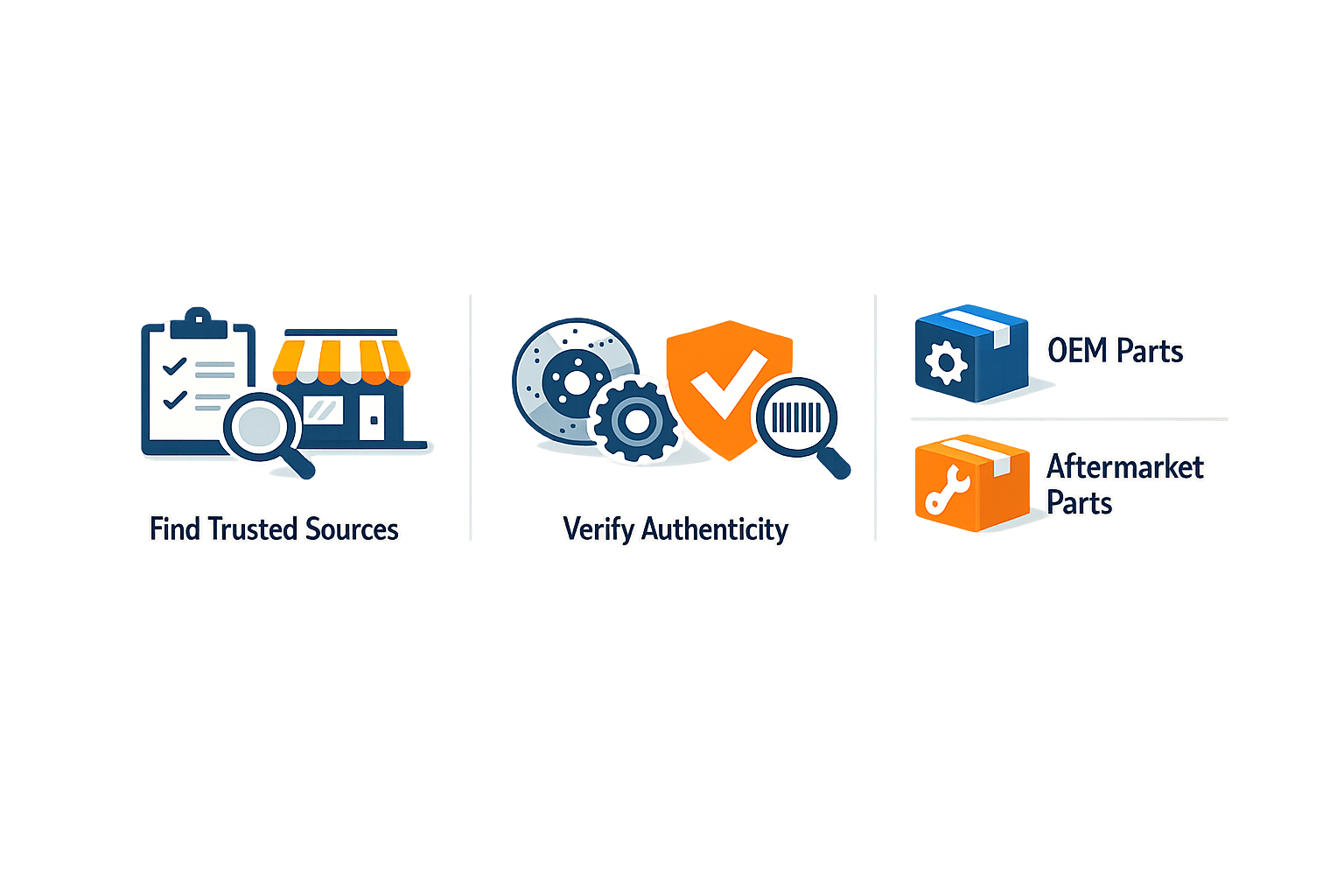
Authentic BMW parts Europe suppliers fall into three categories: authorized BMW dealers, OE-supplier distributors (Mahle, Bosch, Continental), and verified independent channels. Too many customers walk in with the wrong part because they skipped the verification step. Here is how to source authentic BMW parts without the guesswork.
Before you order anything, pull the Electronic Parts Catalog (ETKA for VW/Audi platforms, or the BMW equivalent). The catalog gives you the exact part number, supersessions, and which chassis codes it fits. The part number on the catalog is what you cross-reference against the supplier's listing. If the supplier's number doesn't match, stop.
Authentic BMW parts come through authorized dealer networks or OE-supplier distributors. At the counter, it is checked whether a supplier has direct access to BMW's distribution system. If they do, the part arrives in BMW packaging with the correct labels and lot codes. If they source from secondary markets, the provenance gets murky fast.
When the part arrives, the number stamped on the component must match the catalog and the box. BMW OE parts carry specific fonts, label formats, and security features on the packaging. Counterfeit filters may have close-but-wrong numbers — off by one digit, different prefix. The genuine part has the approval printed on it; the knockoff doesn't.
Where to Find Authentic BMW Parts Europe: Authorized Channels
Authorized BMW dealers remain the most reliable source. They pull directly from BMW's logistics network, and the part comes with traceability. The trade-off is price — dealer markup is real.
OE-supplier distributors are the next tier. These are companies like Mahle, Bosch, or Continental supplying the same components that go into the factory build. The part meets BMW's spec because it was made to that spec. You pay less than dealer pricing, but you need to verify the distributor's credentials.
Online forums and classified sections can surface used OE parts, but provenance is harder to confirm. Forum sellers may move genuine take-offs from low-mileage Euro cars, but they may also sell junk. If you go this route, demand photos of the part number and packaging, and cross-check against the catalog before money changes hands.
For BMW coolant and cooling system components, the same verification applies: the bottle or component must carry the BMW approval. Generic coolant without the spec sheet causes heater-core fouling and pump-seal failure.
The part number on the catalog is what you cross-reference against the supplier's listing — if it doesn't match, stop.
Tips and Tricks for Purchasing BMW Parts
Years at the counter have shown that many mistakes with BMW parts come down to not reading what's printed on the bottle or the box. The approval has to be there — on the label, in the data sheet, somewhere you can point to when the engine starts acting up. For oil, that means BMW Longlife LL-01 or LL-04 depending on your engine. For coolant, it means the blue BMW-spec antifreeze, not the universal green stuff that causes silicate gel precipitation and clogs the heater core. The bottle has to say it; if it doesn't, don't run it.
Check the Part Number Against the Build Date
BMW revises parts mid-production, and the part number on the old catalog page might not fit your actual car. Cross-reference the VIN or build date before you order, especially for filters, sensors and anything emissions-related. People may order an oil filter that fit three different engines in the E90 range, only to find out the factory parts list specifies a different one for their engine code. The distributor catalog is a starting point, not the final word.
Don't Mix Coolant Formulations
BMW factory antifreeze is formulated without phosphates or nitrites to prevent the green goo that forms when you mix hard water with the wrong concentrate. Topping off with a generic coolant is the mistake — even a small amount of the wrong formulation triggers the reaction. Flush it and fill it with the BMW blue coolant, part number 82-14-0-031-133, or an approved equivalent that lists the BMW spec on the bottle. Mixing is what kills the system, not the age of the coolant.
Change Oil Every 5,000 Miles, Not at the Interval Light
The factory interval is longer than the oil actually lasts under real driving. A recommendation is 5,000 miles with the filter, using an oil that carries the LL-01 or LL-04 approval printed on it. The extended intervals assume perfect conditions and synthetic that stays stable for 10,000 miles; most driving isn't perfect, and most oil breaks down faster than the marketing says. Run it 5,000, then top to the mark if you're a quart low before the next change.
Use OE-Supplier Parts When OEM Is Unavailable
Mann, Mahle, Bosch and Hengst supply BMW's factories, and their parts carry the same engineering specs as the ones in the blue-and-white box. The part number on the Mahle filter cross-references to the BMW number, and the approval is the same. Both are sold; the OE-supplier version costs less and the quality is identical because it's the same part, different box. BMW Coolant and Cooling Parts: What to Check Before Ordering covers the coolant side of this in more detail.
Read the Data Sheet Before You Buy
The approval has to be on the product's own data sheet, not just the retailer's description. People have bought oil that the listing claimed was LL-04, only to find the bottle didn't carry the BMW sheet approval. The manufacturer's published approval list is the source of truth; if the product isn't on that list and the data sheet doesn't show the approval, it's not approved no matter what the ad says. Check the build date, check the approval, then buy it.
Conclusion
The authentic-parts question comes up at the counter consistently: the bottle has to say what the factory says, the part number has to match the build date, and the approval printed on it has to be on BMW's list. When you source authentic BMW parts Europe, you're not paying for a badge — you're buying the specification that keeps the variable timing solenoids clean, the cooling system from corroding, and the warranty claim from getting denied.
The cheap way costs more. A universal coolant without the BMW approval eats the water pump seals. A filter without the right bypass-valve spring starves the bearings on cold starts. An oil that says "meets BMW Longlife" but doesn't carry LL-04 on the data sheet leaves you with a sludged VANOS at 80,000 miles. The factory fill is the factory fill for a reason, and mixing is the mistake that turns a $60 service into a $4,000 engine.
When you cross-reference the distributor catalog with the ETK parts list, check the build date and the engine code — same spec, different name, and the wrong one still damages the car. The owner's manual is right about this. If you're ordering from a European supplier, ask for the approval sheet before the invoice goes through. If they can't produce it, don't order the part. For more detail on how BMW specifications work across different systems, see our guide on BMW Coolant and Cooling Parts: What to Check Before Ordering.
Authentic BMW parts Europe come from OE suppliers who print the approval on the box, authorized dealers who cross-reference the VIN, and distributors who stock the factory part number. For related BMW maintenance, our guides on BMW Scan Tools by Chassis and Function and BMW M340i Lowering Springs vs Coilovers for Daily Driving provide additional platform-specific guidance. Everything else is a guess, and the aluminium doesn't forgive it.
Related reading
VW Parts: Volkswagen Parts Sourcing: A Guide to European Suppliers
Sources(13)
- BMW of North America maintenance booklet
- Pelican Parts Technical Articles
- ECS Tuning Blog
- LIQUI MOLY
- Motul technical data sheet (2022)
- ECS Tuning Blog
- Volkswagen Technical Bulletin 17-19-01 (NHTSA ODI)
- Pelican Parts Technical Articles
- ACEA (2023)
- Pelican Parts Technical Articles
- Audi Technical Service Bulletin (NHTSA ODI)
- Audi Technical Service Bulletin (NHTSA ODI)
- Pelican Parts Technical Articles
Written by
Lee Shahin
Founder, European Wholesale Parts
Lee Shahin founded European Wholesale Parts in Pleasanton, California, after 18 years in the Mercedes-Benz and BMW parts trade. He came to the parts side from the shop floor: he opened a European repair shop in Northern California in the early 1990s, specialising in Mercedes-Benz and BMW, and grew it with his wife Laurie into a parts and delivery operation serving body shops and independent repair facilities across the region. Nearly two decades at the parts counter taught him where the expensive mistakes happen, and most of them are fluids: the wrong coolant in an aluminium block, an oil without the sheet approval the engine was designed for, a transmission topped with the wrong ATF. That is what he writes about here. Every article names the manufacturer specification by its exact designation, explains what the wrong fluid does mechanically, lists products that carry the approval, and gives the capacity and interval for the models and years the specification covers. When a reader needs a part sourced, the quote desk at European Wholesale Parts is where Lee and Laurie still answer the phone.