
BMW M340i Lowering Springs vs Coilovers for Daily Driving
Compare BMW M340i lowering springs and coilovers for daily driving, covering ride quality, handling, installation complexity, and long-term maintenance costs.
Introduction
I have watched the same pattern at the counter for years: M340i owners ask for lowering springs, then return six months later asking if coilovers would have been smarter. The question is never about stance alone. It is about whether you are willing to trade ride compliance for adjustability, and whether the roads you drive every day forgive a stiffer setup. A lowering spring is a fixed-height replacement coil that drops the car and works with your factory dampers. A coilover is a matched spring-and-shock assembly that lets you dial ride height and, on some units, damping stiffness. The M340i's adaptive dampers complicate the choice further — springs preserve some factory logic, while coilovers bypass it entirely.
The decision hinges on three things: how much adjustment you need, how often you are willing to realign the car, and what the install looks like in your driveway or at a shop. Lowering springs bolt in with basic hand tools and reuse the OE shocks; coilovers require a full corner teardown and, depending on the kit, specialty spanners for preload and damping adjustments. On paper, coilovers offer more control. In practice, most daily drivers set the height once and never touch the damping again, which raises the question of whether you are paying for features you will not use.
This comparison walks through ride quality, handling changes, installation requirements, and the maintenance each system demands over the life of the car. For more on maintaining your BMW's cooling system, see BMW Coolant and Cooling Parts: What to Check Before Ordering. By the end, you will know which setup matches your driving pattern and whether the extra cost of coilovers delivers enough value to justify the complexity.
Problem Statement
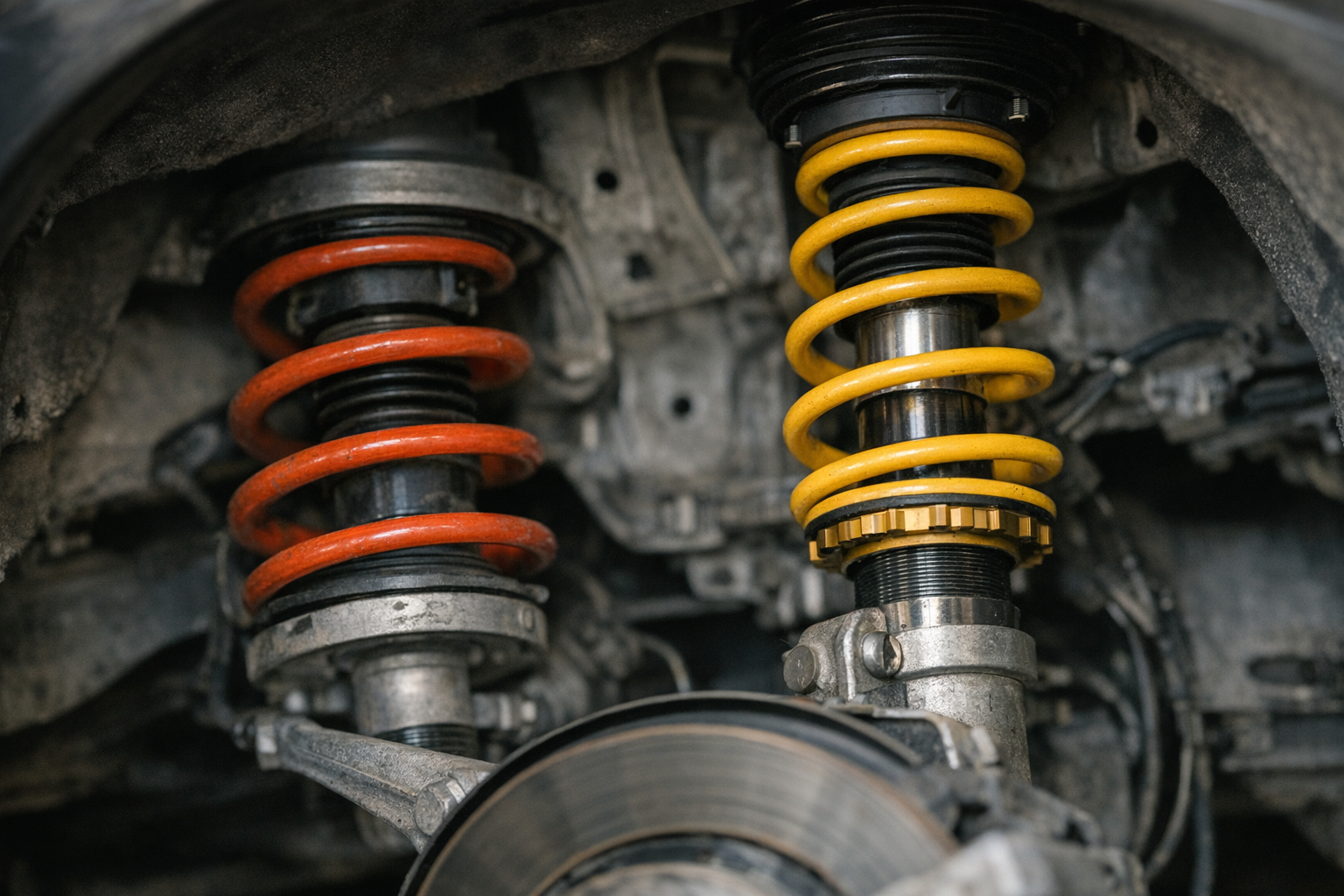
The question I hear at the counter is always the same: do I need coilovers or will springs do the job? For a G20 M340i that sees daily commuting, the answer hinges on what you're willing to give up and what you can't compromise on. Springs drop the car and keep the factory dampers; coilovers replace the entire strut assembly and let you dial in height and damping. One is a bolt-on that works with what BMW engineered. The other is a complete suspension redesign.
The Setup Flexibility Gap
Coilovers give you adjustability that springs can't match. You set the ride height exactly where you want it, then tune the damper stiffness to match the spring rate and the roads you drive. Lowering springs come in one height and one rate — you install them on the factory shocks and that's the setup you get. If the drop is too aggressive or the spring rate fights the damper valving, you're stuck until you buy a different set. For daily driving, that lack of fine-tuning is the first problem.
Comfort vs. Control Trade-Off
The M340i weighs 1670 kg, and that mass amplifies every suspension choice. Lowering springs on factory dampers often create a mismatch — the springs are stiffer than stock, but the dampers weren't valved to control that rate. The result is a choppy ride over expansion joints and a floaty rebound on highway dips. Coilovers, when properly matched, control the spring through the full stroke. But if you set the damping too stiff for daily use, every pothole becomes a crash and long highway runs turn into endurance tests. The problem is finding the middle: enough control to handle the drop, but not so much that the car beats you up on the commute.
Installation and Long-Term Maintenance Complexity
Springs go on in an afternoon with basic tools and spring compressors. Coilovers require a full strut removal, and if the car has adaptive dampers or electronic ride control, you're also dealing with coding and sensor compatibility. Once installed, coilovers need periodic inspection — threaded collars seize if they're not cleaned and greased, and adjustable dampers can leak if the seals aren't maintained. Springs, once they're in, don't require ongoing attention beyond checking the factory shock for leaks. For a daily driver, the time and cost of keeping coilovers dialed in is the hidden expense that doesn't show up on the initial invoice.
For more on maintaining BMW-specific systems, see BMW Coolant and Cooling Parts: What to Check Before Ordering.
Solution Steps
Step 1: Define Your Daily Driving Priorities
Start by writing down what matters most in your daily routine. If you drive smooth highways and want a lower stance without changing ride quality, lowering springs fit that use case. If you hit rough pavement, need adjustability for different loads, or want to fine-tune damping for spirited weekend drives, coilovers give you that control. The M340i's factory suspension is already competent, so the question is whether you're solving a handling problem or a visual one.
I've watched too many customers buy coilovers for a car that never sees a track, then complain about the ride six months later. Be honest about how you actually use the car.
Step 2: Assess Installation Complexity and Cost
Lowering springs bolt onto your existing struts and shocks. The install is straightforward: pull the old springs, compress the new ones, reassemble. You keep the original dampers, which means you're not replacing wear items that still have life. Coilovers replace the entire strut assembly—spring, damper, and mount—so the labor is more involved and the parts cost is higher.
Step 1
Evaluate your existing suspension
Before ordering anything, check the condition of your current shocks and struts. If they're worn, coilovers make sense because you're replacing them anyway. If they're fresh, lowering springs preserve that investment.
Step 2
Factor in alignment requirements
Both options will change your suspension geometry and require a full alignment afterward. Budget for it. The M340i's camber and toe settings are critical for tire wear and handling, and you can't skip this step.
Step 3: Match the Product to Your Comfort Threshold
Lowering springs work with the factory dampers, which were tuned for the original spring rates. Drop the car an inch and the dampers are still doing their job in the middle of their travel range. Go too aggressive with spring rates or drop height and you're asking the stock dampers to control a setup they weren't designed for—the ride gets choppy and the dampers wear faster.
Coilovers let you match spring rates to damping, which is the advantage. You can dial in a setup that's firm but controlled, or soft and compliant, depending on the adjustability range. The trade-off is complexity: more adjustments mean more decisions, and if you set them wrong, the ride suffers.
Step 4: Consider Long-Term Maintenance
Lowering springs don't add maintenance. You install them and forget them. Coilovers have adjustable dampers, threaded bodies, and more moving parts. Those threads can corrode if you're in a salt state, and the adjustment collars need periodic cleaning. Rebuilds are possible on quality coilovers, but that's another cost down the line.
If you're keeping the car long-term and want the ability to refresh the suspension without replacing everything, rebuildable coilovers make sense. If you just want a lower stance and no ongoing fuss, springs are the simpler path.
Step 5: Test Your Decision Against Real-World Use
Before you commit, think through a week of driving. Do you scrape on driveway aprons now? A lower stance makes that worse. Do you carry passengers or cargo regularly? Coilovers let you stiffen the rear to compensate; springs don't. Do you drive in winter with snow tires? Less ride height means less clearance.
The right choice depends on whether you value adjustability and control over simplicity and cost. For a daily-driven M340i, lowering springs work when you want a predetermined stance and you're happy with the factory damping character. Coilovers work when you want to tune the car's behavior and you're willing to pay for that flexibility.
For more on maintaining your BMW's cooling system, see BMW Coolant and Cooling Parts: What to Check Before Ordering.
Tips and Tricks
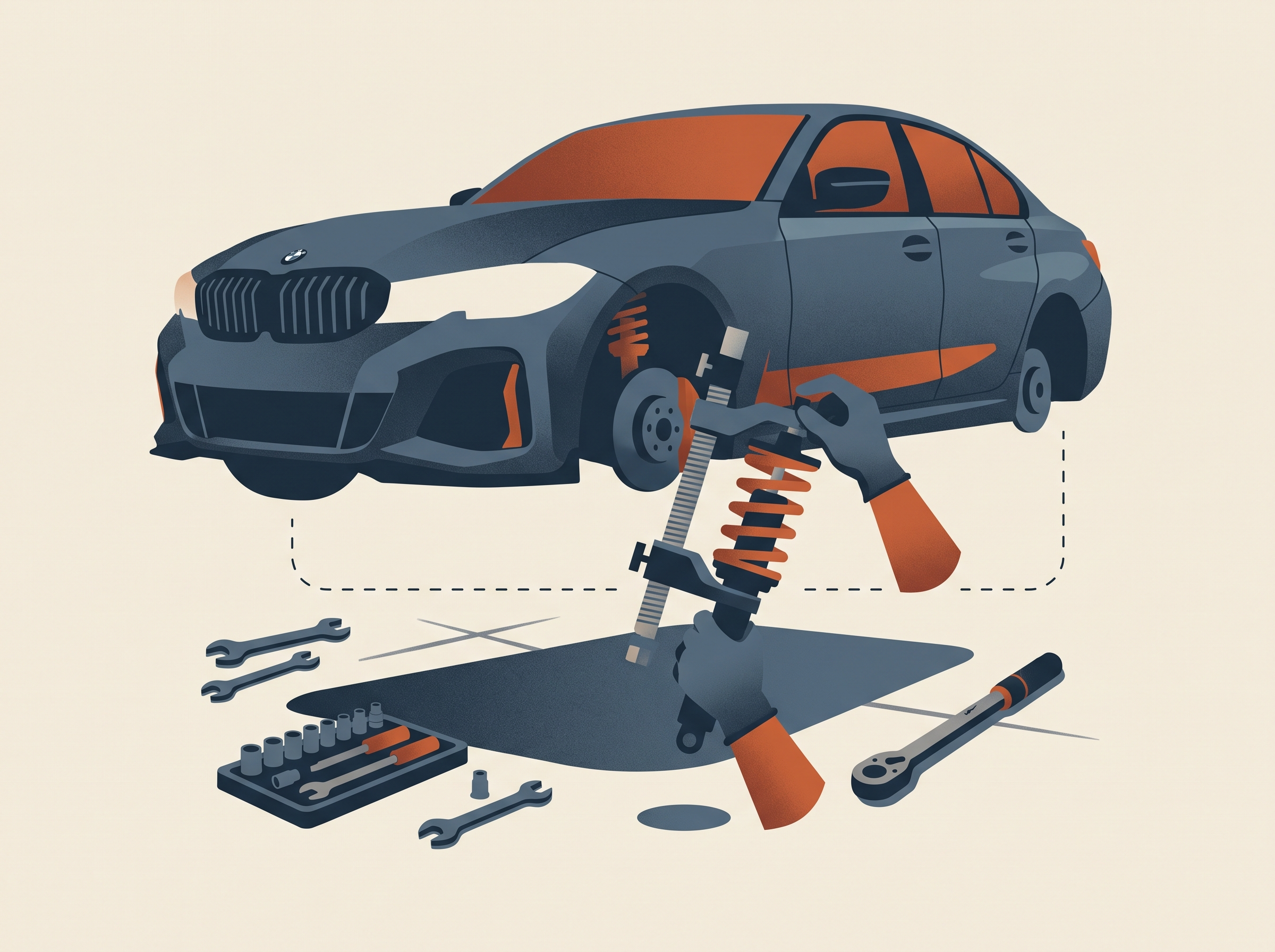
I've watched too many M340i owners order parts without checking what their actual driving looks like. The question is not which setup sounds better — it's which one you'll live with every morning when the car's cold and the street has a pothole.
Match the Setup to Your Real Route
If your commute includes speed bumps, gravel driveways, or winter salt, lowering springs keep the factory dampers and their predictable wear pattern. Coilovers give you adjustment, but they also give you maintenance — seals, threaded bodies, and more points where corrosion starts. Daily drivers often benefit from lowering springs because the ride stays closer to stock and you're not chasing settings every season.
Know What You're Buying Before the Box Arrives
Lowering springs for the 2020–2024 G20 M340i come from BC Racing, Air Lift Performance, Tein, Fortune Auto, and KW Suspension. Each brand publishes a drop spec — usually 0.8 to 1.5 inches front and rear. Check the number before you order, not after. The box will also tell you whether the spring works with the factory damper or requires a specific shock; mixing the wrong combination gives you a harsh ride and early damper failure.
Coilovers ship with matched springs and dampers, so compatibility is built in. The trade-off is cost and the assumption that you'll actually use the adjustment. If you set them once and forget them, you paid for features you don't touch.
Installation and Alignment Are Not Optional
Both setups change the suspension geometry, so a four-wheel alignment is required after install — not recommended, required. Camber, caster, and toe all shift when you lower the car, and running misaligned wears the inside edge of the tire in under five thousand miles. I've seen brand-new Michelin Pilot Sport 4S tires corded on the inside because the owner skipped the alignment to save a hundred dollars.
Step 1
Verify fitment and drop height
Confirm the spring or coilover kit lists your exact model year and drivetrain. The G20 M340i xDrive has different spring rates than the RWD model, and mixing them changes handling balance.
Step 2
Plan for alignment immediately after install
Book the alignment appointment before the parts arrive. Driving the car to "settle" the springs first is a mistake — you're wearing the tires unevenly while the suspension finds its new ride height.
Step 3
Inspect the OEM dampers if keeping them
If you're installing lowering springs on the factory shocks, check for oil leaks and listen for clunking before you start. A worn damper will fail faster under a stiffer spring, and you'll be back under the car in six months.
Brands and Specs You Can Actually Verify
The parts-counter question is always the same: does the box say it fits my car? For the M340i, that means checking the product sheet for G20 chassis code, 2020–2024 model years, and whether it's xDrive or RWD. Spring rates are published in pounds per inch or newtons per millimeter — if the brand won't tell you the rate, don't buy it.
Lowering springs reduce wheel gap and tighten cornering characteristics by dropping the center of gravity. That's the mechanical benefit. The aesthetic benefit is the more aggressive stance, but the stance doesn't matter if the spring rate is wrong for the damper.
For more on maintaining your BMW's cooling system and ensuring long-term reliability, see BMW Coolant and Cooling Parts: What to Check Before Ordering.
Conclusion
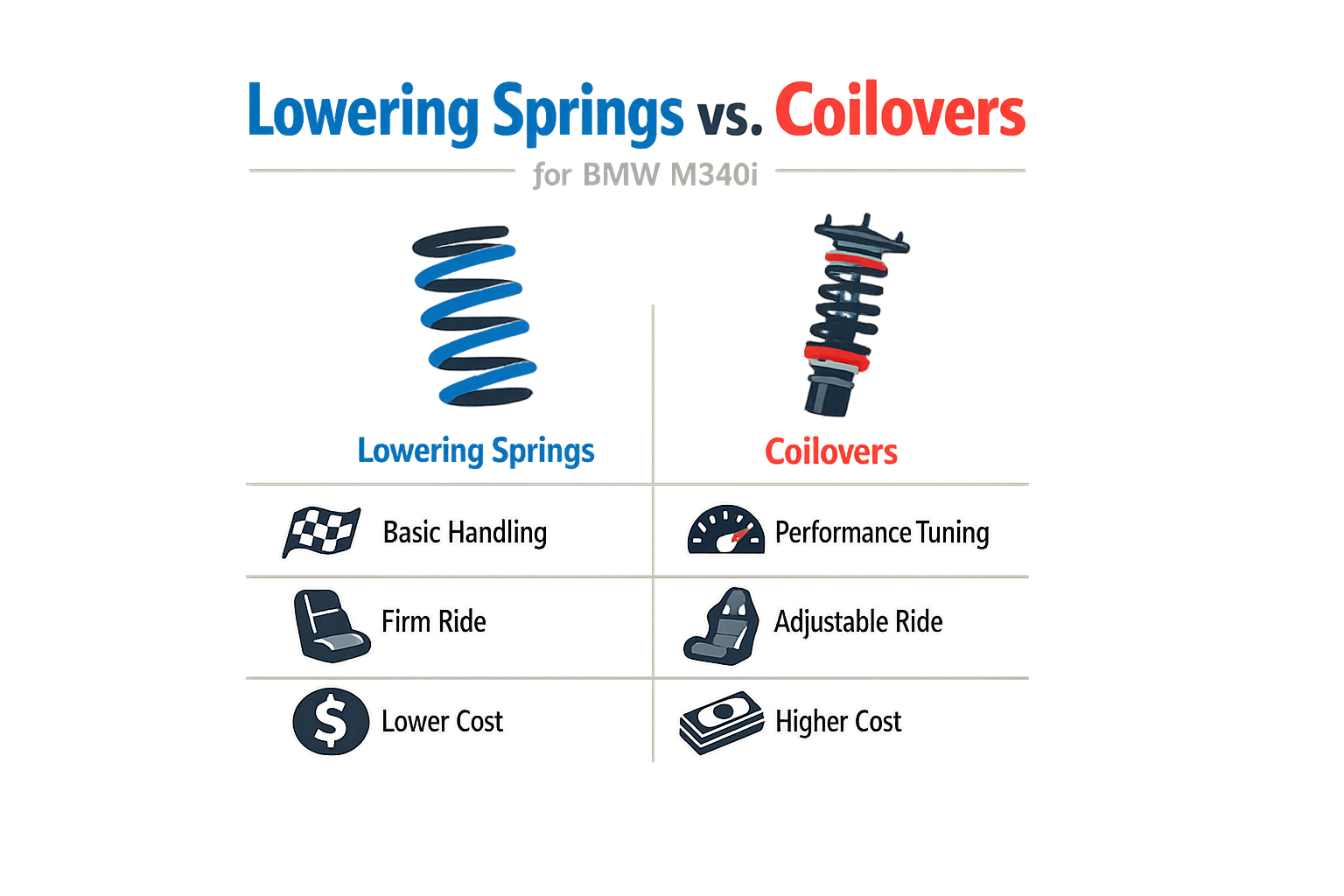
I've watched the same question come across the counter for years: springs or coilovers for a daily M340i? The answer is always the same — it depends on what you can live with. Lowering springs keep the factory dampers, drop the ride height one to one-and-a-half inches, and cost less than half what a coilover kit runs. You get better cornering, a tighter stance, and you keep most of the OEM ride quality. The trade is simple: you cannot adjust anything after installation, and if the drop is wrong or the dampers wear early under the stiffer spring rate, you replace parts to fix it.
Coilovers give you control — ride height, damping, and sometimes compression and rebound independently. You dial the car in for your roads, your driving, and your tolerance for firmness. The cost is higher up front, the install is more involved, and maintenance is real: pillow-ball mounts need greasing, height collars need checking, and dampers rebuild or replace on a schedule. For daily driving on broken pavement, coilovers can be set soft enough to match or beat springs, but only if you buy adjustable damping and spend the time setting it correctly.
The M340i's adaptive dampers complicate both paths. Lowering springs on adaptive suspension can throw fault codes or limit damper travel; coilovers typically replace the adaptive system entirely, which means you lose the comfort mode but gain manual control. Check the kit's compatibility with your build date and suspension option code before you order — the wrong kit does not install, and returns cost you time and labour.
Neither option fixes poor alignment or worn bushings, and both expose those problems faster than stock suspension. If your control-arm bushings are original and the car has forty thousand miles, replace them with the springs or coilovers — the new ride height will amplify any slop in the suspension, and you will feel it in steering response and tyre wear. The BMW Coolant and Cooling Parts: What to Check Before Ordering principle applies here too: inspect the whole system before you change one part, because the new part will show you what the old parts are doing wrong.
For daily driving, lowering springs are the safer bet unless you have specific needs that justify coilovers. The factory dampers are engineered for the platform, the ride quality stays predictable, and the cost is manageable. Coilovers are the tool when you need adjustability or when you are building the car for track use and street compromise. Both work; the question is what you are willing to maintain and what you expect the car to do.
Explore the differences between BMW M340i lowering springs and coilovers for daily driving, focusing on performance, comfort, and practicality.
Written by
Lee Shahin
Founder, European Wholesale Parts
Lee Shahin founded European Wholesale Parts in Pleasanton, California, after 18 years in the Mercedes-Benz and BMW parts trade. He came to the parts side from the shop floor: he opened a European repair shop in Northern California in the early 1990s, specialising in Mercedes-Benz and BMW, and grew it with his wife Laurie into a parts and delivery operation serving body shops and independent repair facilities across the region. Nearly two decades at the parts counter taught him where the expensive mistakes happen, and most of them are fluids: the wrong coolant in an aluminium block, an oil without the sheet approval the engine was designed for, a transmission topped with the wrong ATF. That is what he writes about here. Every article names the manufacturer specification by its exact designation, explains what the wrong fluid does mechanically, lists products that carry the approval, and gives the capacity and interval for the models and years the specification covers. When a reader needs a part sourced, the quote desk at European Wholesale Parts is where Lee and Laurie still answer the phone.