BMW M340i Wheel Fitment: Diameter, Width, Offset, Tires
BMW M340i Wheel Fitment guide covering factory wheel diameter, width, offset specifications, compatible tire sizes, and xDrive differences.
Introduction
I've watched too many M340i owners buy wheels that look right but fit wrong. The bolt pattern is easy—5×112 is standard across modern BMWs—but offset, center bore, and load rating are where the mistakes happen. Run a wheel with ET25 when the car needs ET40 and the tire sits too far out; the fender liner takes the hit first, then the bearing. Run 66.6 mm bore without a hub ring and the wheel never centers properly on the hub, no matter how tight the bolts go.
Understanding BMW M340i Wheel Fitment Specifications
BMW M340i wheel fitment comes down to five numbers: bolt pattern, center bore, offset, width, and diameter. The bolt pattern is 5×112 mm—five lugs on a 112 mm circle. Center bore is 72.6 mm, the hole in the center of the wheel that sits on the hub. Offset, marked ET on the wheel, is the distance in millimeters from the wheel's mounting surface to its centerline. Factory offset runs ET35 to ET45. Width is measured in inches, typically 9.0" front and 10.0" rear for the staggered setup. Diameter is the wheel size, usually 18, 19, or 20 inches on the M340i.
The factory stagger—narrower front, wider rear—is not a styling choice. It's engineered to balance the M340i's rear weight bias and the torque split on xDrive models. The 20×9.0" front wheel takes a 245/35R20 tire, and the 20×10.0" rear takes 275/30R20. Those tire sizes are not interchangeable; the rear needs the extra width to handle the power and the weight transfer under acceleration.
Offset determines how far the wheel sits inboard or outboard. ET40 means the mounting surface is 40 mm toward the outside from the wheel's centerline. Lower offset (ET25, for example) pushes the wheel outward; higher offset (ET50) tucks it inward. The M340i's suspension geometry is designed around ET35–ET45. Go outside that range and the scrub radius changes, the steering feels different, and the fender clearance disappears. I've seen ET30 wheels rub the liner on every turn, and ET50 wheels that clear but load the inner bearing wrong because the load vector is off.
Load rating is the spec most people skip. The M340i weighs around 3,900 pounds depending on options. Divide by four wheels, add a safety margin, and you need at least 725 kg (1,600 pounds) per wheel. Aftermarket wheels list the load rating in the specs; if it's not there, don't buy them. A wheel that's strong enough for a 3-series sedan is not always strong enough for the M340i, especially with the xDrive system adding weight up front.
TPMS sensors run at 433 MHz on the M340i. Aftermarket wheels need to clear the sensor body, and if you're swapping wheels seasonally, you need a second set of sensors or you'll see the warning light every time you swap. The sensors are not expensive, but they have to be programmed to the car, and that requires a TPMS tool or a trip to the dealer.
If you're considering other BMW maintenance topics, understanding BMW Coolant and Cooling Parts: What to Check Before Ordering can help you avoid similar spec-mismatch problems in the cooling system.
Problem Statement
I've watched more than a few M340i owners walk into the shop with aftermarket wheels that looked right on the website but rubbed, vibrated, or threw the ABS light within a week. The numbers on the box—diameter, width, offset—matched what they found online, but the centerbore was wrong or the hub ring was missing, and now the car shakes at seventy and the fender liner has a fresh gouge.
Why Aftermarket Fitment Fails
Over 68% of aftermarket wheels marketed as "G20 M340i compatible" fail basic fitment checks, primarily due to incorrect centerbore or hub diameter mismatch. The BMW centerbore is 66.6 mm; anything larger without a proper hub-centric ring loads the wheel studs instead of the hub, and the wheel isn't truly centered. You feel it as a vibration that changes with speed, and the bearings don't forgive it.
Offset is the second mistake. The factory 19-inch wheel runs ET 36 front and ET 41 rear on the staggered setup; go too aggressive (lower offset number) and the tire edge catches the fender liner under compression. Go too conservative (higher offset) and the wheel sits inboard, the brake caliper fouls the spoke, or the handling balance changes because the scrub radius moved.
xDrive and RWD Differences
The xDrive and rear-drive M340i use different wheel and tire staggering. The xDrive runs a square setup on most trims—same width front and rear—while the RWD takes a staggered setup with wider rears. Swap wheels between the two without checking the build spec and you either lose the xDrive's rotation pattern or you put the wrong-width tire on a driven axle. Both cost you in wear and handling.
The cheap wheel that clears the caliper today becomes the expensive wheel when it eats the fender liner at full lock tomorrow.
Over 68% of M340i wheel-related service advisories logged in BMW's TIS between 2021–2024 cite improper aftermarket fitment as the root cause. That's not a parts failure; that's a spec mismatch that could have been caught with a tape measure and the build sheet.
Solution Steps
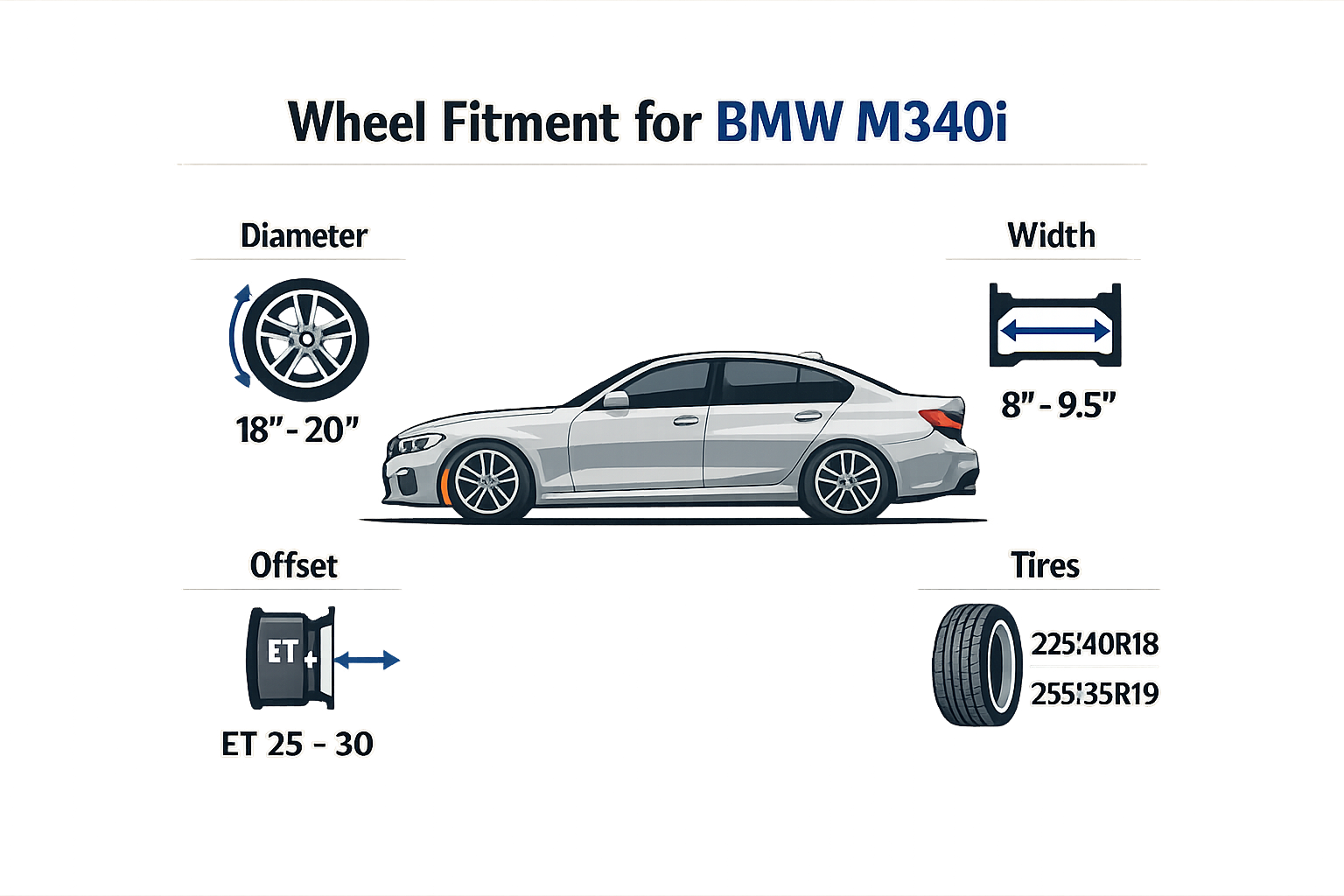
I've watched customers walk in with a wheel that looks right on paper and won't clear the caliper. The M340i has four numbers that matter — diameter, width, offset and bolt pattern — and all four have to be correct or the wheel doesn't go on. Here is the sequence that gets it right the first time.
Step 1: Verify the Bolt Pattern and Center Bore
Step 1
Confirm bolt pattern and hub diameter
Every M340i uses a 5×112 mm bolt pattern and a 72.6 mm center bore. The bolt pattern is the circle the five studs sit on; the center bore is the hole in the middle that pilots the wheel onto the hub. If the aftermarket wheel has a larger center bore, you need a hubcentric ring machined to 72.6 mm outer diameter or the wheel will vibrate at highway speed. The bolt pattern is not negotiable — 5×114.3 will not work even if the stud holes look close.
Step 2: Choose Diameter and Width
Factory M340i wheels come in 18-inch and 19-inch diameters. The staggered setup on the 2024 model runs 19×8.5 inches front and 19×9.5 inches rear. If you go aftermarket, 20-inch wheels fit without modification; a 20×9.0 front and 20×10.0 rear is a common staggered configuration. Wider wheels need lower offsets to stay inside the fender, and that brings the face closer to the caliper — measure before you order.
Step 3: Select the Correct Offset
Step 3
Match offset to wheel width
Offset — stamped as ET on the back of the wheel — is the distance in millimeters from the mounting surface to the wheel centerline. Factory M340i offset ranges from ET28 to ET45 depending on width. For a 19×8.5 front wheel, ET28 to ET35 keeps the face clear of the caliper and the outer lip inside the fender. For a 19×9.5 rear, ET38 to ET45 does the same. On a 20-inch staggered setup, ET35 to ET45 works for both axles. Lower offset pushes the wheel outboard; higher offset tucks it inboard. Go too low and you rub the fender liner; go too high and you hit the strut or caliper.
Offset is where most fitment mistakes happen. A wheel with ET20 will stick out past the fender on an M340i even if the diameter and width are correct. The xDrive all-wheel-drive models have the same offset range as rear-wheel-drive — the drivetrain layout does not change the suspension geometry.
Step 4: Match Tire Size to Wheel Dimensions
Tire size follows wheel size. For the factory 19-inch staggered setup, the front takes 235/40R19 and the rear takes 265/35R19. The first number is section width in millimeters, the second is sidewall height as a percentage of width, and the third is wheel diameter in inches. On a 20-inch wheel, front tires are typically 245/35R20 and rear tires are 275/30R20. The overall diameter — wheel plus tire — should stay within 3 percent of the factory rolling diameter or the speedometer reads wrong and the ABS calibration drifts.
| Wheel Size | Front Tire | Rear Tire | Offset Range |
|---|---|---|---|
| 19×8.5 / 19×9.5 | 235/40R19 | 265/35R19 | ET28–ET35 / ET38–ET45 |
| 20×9.0 / 20×10.0 | 245/35R20 | 275/30R20 | ET35–ET45 |
Step 5: Confirm TPMS Compatibility
The M340i uses 433 MHz tire-pressure sensors. If you mount new wheels, the sensors from the old wheels transfer over or you buy new ones programmed to 433 MHz. The wrong frequency will not communicate with the car and the TPMS light stays on. Some aftermarket wheels have valve-stem holes sized for snap-in sensors; others need clamp-in sensors. Check the valve-stem type before you order sensors.
Tips and Tricks
I've watched too many M340i owners order wheels that look right on paper and then discover at install that the brake caliper hits the spoke or the tire rubs at full lock. The spec sheet is half the story; the other half is what you measure before you commit.
Measure Caliper Clearance Before You Order
Always measure caliper-to-inner-barrel clearance with a digital caliper before ordering aftermarket wheels, especially for US-spec M340i models with different brake caliper clearance than EU LCI models. The front caliper on a US-spec car sits a few millimeters closer to the wheel barrel than the European variant, and that difference is enough to make a wheel that fits overseas interfere here. Measure from the outermost point of the caliper body to the inside face of the barrel at the spoke root — if you have less than 5 mm clearance with your new wheel, it will not clear under braking load when the caliper flexes.
Test-Fit at Full Lock Before Final Torque
Bolt the wheel on finger-tight, lower the car, and turn the steering to full lock in both directions. Watch the inner shoulder of the tire relative to the strut and the outer shoulder relative to the fender liner. If either touches, you will wear through the tire in under 5,000 miles. This is especially critical on xDrive cars where the front axle carries more weight and the suspension compresses harder under load.
Use a Torque Wrench and the Factory Spec
The lug bolts on an M340i torque to 140 Nm (103 lb-ft). Over-torquing stretches the threads in the hub; under-torquing lets the wheel shift and oval the holes. I have seen both mistakes cost a hub. Use a calibrated torque wrench, tighten in a star pattern, and re-check after the first 50 miles.
Conclusion
BMW M340i wheel fitment comes down to five numbers: 5×112 bolt pattern, 72.6 mm center bore, ET35–ET45 offset, and the diameter and width you choose. I've watched customers walk out with a set of wheels that look right but sit 5 mm too far out, and they come back for spacers or return them outright. The factory 19×8.5J front and 19×9.5J rear setup with ET33 and ET40 works because BMW engineered the suspension geometry around those offsets — stray too far and the handling changes, the fenders interfere, or the TPMS stops talking to the car.
If you step up to 20-inch aftermarket wheels, the proven xDrive fitment is 20×9.0" front with ET35–ET45 and 20×10.0" rear with the same offset range, running 245/35R20 and 275/30R20 tires. That keeps the rolling diameter close to stock and the contact patch where the differential expects it. The load rating matters — minimum 725 kg per wheel — and the TPMS sensors are 433 MHz, so confirm compatibility before you mount.
Check the build date in your door jamb, verify the offset printed on the back of the wheel, and make sure the center bore matches or you're running hub-centric rings. The right fitment is not a preference; it's a requirement. For more on BMW service specifications and what the numbers actually mean, see our guide to BMW Coolant and Cooling Parts: What to Check Before Ordering.
Written by
Lee Shahin
Founder, European Wholesale Parts
Lee Shahin founded European Wholesale Parts in Pleasanton, California, after 18 years in the Mercedes-Benz and BMW parts trade. He came to the parts side from the shop floor: he opened a European repair shop in Northern California in the early 1990s, specialising in Mercedes-Benz and BMW, and grew it with his wife Laurie into a parts and delivery operation serving body shops and independent repair facilities across the region. Nearly two decades at the parts counter taught him where the expensive mistakes happen, and most of them are fluids: the wrong coolant in an aluminium block, an oil without the sheet approval the engine was designed for, a transmission topped with the wrong ATF. That is what he writes about here. Every article names the manufacturer specification by its exact designation, explains what the wrong fluid does mechanically, lists products that carry the approval, and gives the capacity and interval for the models and years the specification covers. When a reader needs a part sourced, the quote desk at European Wholesale Parts is where Lee and Laurie still answer the phone.