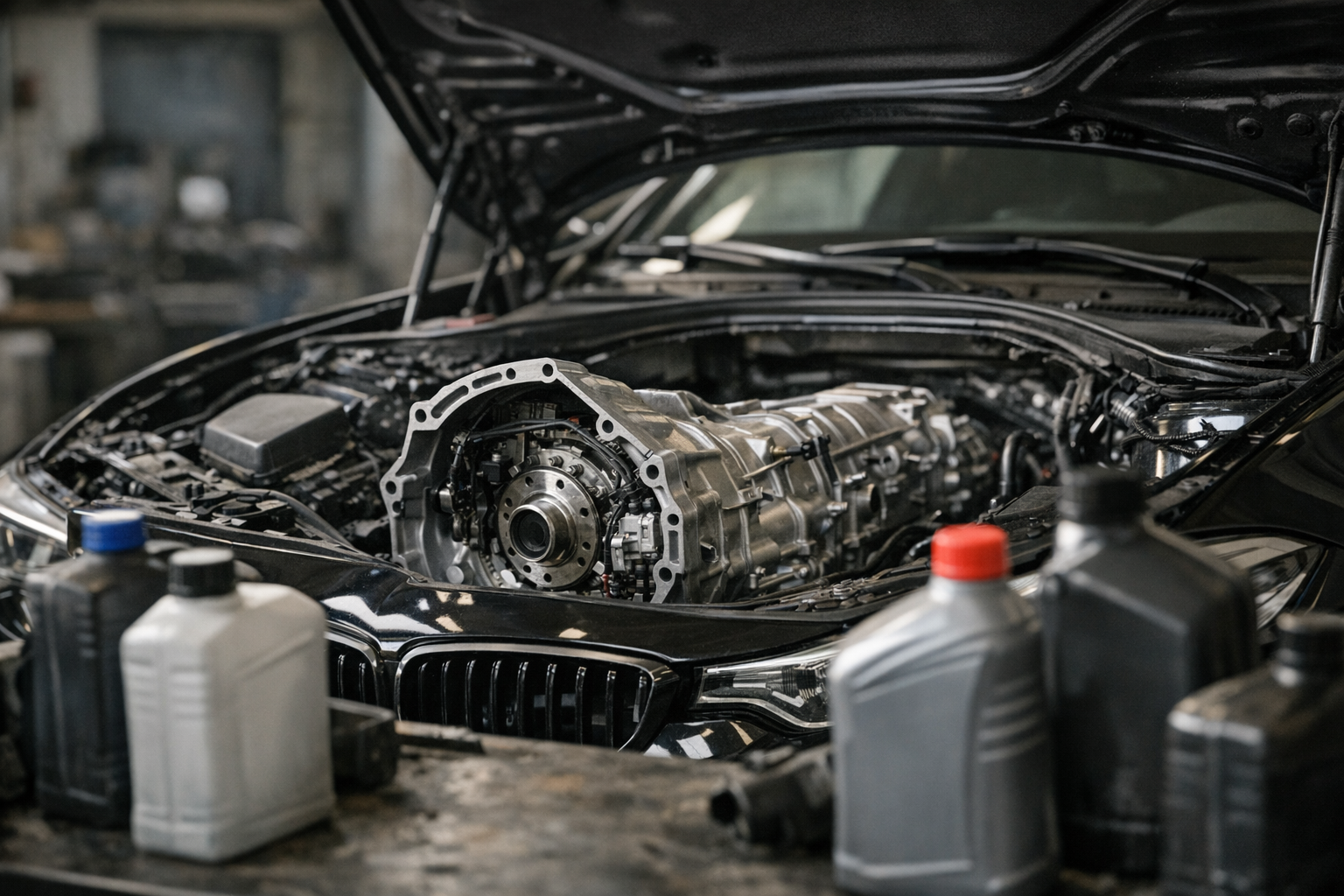
BMW Transmission Fluid Specs: ZF, GM, and DCT Explained
Learn about BMW transmission fluid specs including ZF 6HP/8HP, GM, and DCT fluids to ensure proper maintenance and performance for your vehicle.
Introduction
BMW transmission fluid specs vary by transmission type, not by model name. A ZF 8HP requires BMW ATF 8, while a ZF 6HP needs BMW ATF 3+. The transmission manufacturer and gear count determine which fluid specification your BMW requires. A 2015 328i with the ZF 8HP takes a different fluid than a 2010 328i with the ZF 6HP, even though both are 3-series cars.
I've spent nearly two decades at the parts counter, and the question I hear most often about BMW transmissions is whether one fluid works in all of them. It does not. BMW specifies different fluids based on the transmission manufacturer, the number of gears, and the model year. The bottle has to say it meets the BMW specification for your transmission, or you are running the wrong fluid.
BMW does not make this simple. The same model can have three different transmissions depending on the engine and build date, and each transmission has its own spec. The transmission type determines the fluid, not the model name. I've watched shops top off a ZF 8HP with generic Dexron because they assumed all automatics take the same thing, and the car came back with shift flare and limp mode within two thousand miles.
The consequences of using the wrong fluid are not subtle. ZF Lifeguard fluids are formulated for specific clutch packs and valve-body tolerances. Run a ZF 8HP on ATF 3+ and the clutches slip because the friction modifiers are wrong. Run a DCT on automatic transmission fluid and the dual-clutch engagement goes soft, then harsh, then you are replacing the mechatronic unit. The spec is not a preference; it is a requirement, and the transmission does not forgive the mistake.
This article covers the BMW transmission fluid specs you need to know: what the ZF 6HP and 8HP require, what the GM transmissions take, what the DCT needs, and how to read the approval on the bottle. If you are looking for guidance on other European transmission systems, see Audi and VW Transmission Fluid: Specs for DSG, Tiptronic, S tronic. I will also explain capacities, change intervals, and what happens mechanically when the wrong fluid goes in. By the end, you will know which fluid your BMW transmission requires and where to find the spec.
What Are BMW Transmission Fluid Specs and Why Do They Matter?
BMW transmission fluid specs define the chemical composition, viscosity range, and friction characteristics required for each transmission type. These specifications ensure proper clutch engagement, valve-body operation, and component lubrication. Using fluid that does not meet the correct BMW transmission fluid specs causes measurable damage to internal components.
The wrong fluid destroys a BMW transmission in ways you don't see until the damage is done. A customer brings in a 2011 335i with the ZF 6HP, complaining of harsh shifts. The dipstick shows red fluid — someone topped it with generic ATF. The valve body is already scored, and the clutch packs are slipping. That's $4,000 in parts and labor because the bottle didn't say what the transmission required.
What Happens When You Use the Wrong Fluid
BMW transmissions are engineered around specific friction modifiers and viscosity curves. The ZF 6HP and 8HP units need fluid that meets ZF LifeguardFluid 6 or 8 specifications. Run Dexron VI or a universal ATF, and the clutch material swells or hardens. Shift quality degrades first — you'll feel it hunt between gears or flare on the 2-3 upshift. Then the solenoids start sticking because the wrong fluid leaves varnish on the valve body. By the time the transmission slips under load, the friction discs are glazed and the pump is cavitating.
The GM 6L45 and 6L50 transmissions in older BMWs are just as particular. They take Dexron VI, not the ZF fluid, and mixing the two is the mistake I see most often. The DCT is worse: it requires a dual-clutch-specific fluid with a narrow viscosity band. Pour in the ZF stuff and the clutch actuators can't modulate pressure correctly. You'll get shudder on takeoff and eventually the clutch won't release cleanly.
The "Lifetime Fill" Myth
BMW calls the ZF 8HP fluid "lifetime," but that's a marketing term, not a mechanical reality. The fluid oxidizes, the additives deplete, and metal particles accumulate in the pan. I've pulled 8HP pans at 80,000 miles and found a quarter-inch of sludge. The fluid was black and smelled burnt. The transmission still shifted, but the clutch clearances were already out of spec. Change it at 60,000 miles with the correct LifeguardFluid 8, and the unit will run another 100,000. Skip it, and you're on borrowed time.
The same applies to the DCT. BMW doesn't publish a service interval, but the fluid breaks down under the heat and pressure of a dual-clutch system. At the counter, I tell customers to change it every 40,000 miles if they want the transmission to last. The fluid is expensive, but it's cheaper than a $6,000 mechatronic unit.
How Do You Choose the Right BMW Transmission Fluid Specs?
The bottle has to say the right thing, or you are guessing. Here is how I walk through it at the counter when someone needs transmission fluid for a BMW.
Step 1: Identify the Transmission Type
Open the owner's manual or check the build sheet. The transmission code tells you whether you have a ZF 6HP, ZF 8HP, GM, or DCT unit. The fluid spec is tied to the transmission, not the model year alone. A 2015 328i with the ZF 8HP takes a different fluid than the same car with a manual.
Step 1
Find the transmission code
Look at the driver's door jamb or the service booklet. The code is usually a three- or four-character string. If you do not have it, call the dealer parts desk with your VIN — they will tell you the transmission type in thirty seconds.
Step 2: Match the Fluid to the Transmission Spec
Once you know the transmission, match it to the approved fluid. ZF 6HP and 8HP units require ZF Lifeguard 6 or Lifeguard 8. The 8HP70, common in many BMWs, takes MOPAR ZF 8&9 Speed ATF or Valvoline MaxLife ATF as an acceptable alternative. GM transmissions use Dexron VI. DCT units require a specific DCT fluid — do not substitute.
I have seen shops try to use a generic Dexron in a ZF 8HP because the color looked right. The valve body started sticking within five thousand miles. The spec is not a preference — it is a mechanical requirement.
Step 3: Verify the Approval on the Bottle
The fluid container must list the BMW or ZF approval. For ZF transmissions, look for "ZF TE-ML" followed by the number. For GM units, "Dexron VI" is printed on the front. If the bottle does not name the approval, do not buy it. I cross-check distributor catalogs with manufacturer data to confirm the fluid meets the spec before I sell it.
For additional guidance on fluid specifications across European platforms, see Audi and VW Transmission Fluid: Specs for DSG, Tiptronic, S tronic. BMW owners may also need to reference BMW Power Steering Fluid: Pentosin CHF 11S vs ATF by Model for complete fluid maintenance.
Step 4: Check the Capacity and Change Interval
The capacity varies by transmission and model. The ZF 8HP70 holds between seven and nine quarts depending on whether you are doing a drain-and-fill or a full flush. The change interval under normal driving is sixty thousand to ninety thousand miles. Severe conditions — towing, track use, stop-and-go city driving — cut that to thirty thousand to forty-five thousand miles.
| Transmission | Fluid Type | Capacity (quarts) | Change Interval (miles) |
|---|---|---|---|
| ZF 6HP | Lifeguard 6 | 7–9 | 60,000–90,000 |
| ZF 8HP | Lifeguard 8 | 7–9 | 60,000–90,000 |
| GM | Dexron VI | 6–8 | 60,000–90,000 |
| DCT | DCT Fluid | 1.5–2 | 30,000–45,000 |
Drain and fill gets you about half the old fluid out. A full flush with a machine replaces nearly all of it, but the machine has to be set to the correct pressure or you risk damaging the valve body.
Step 5: Use the Filter That Matches the Fluid Change
If you are changing the fluid, change the filter and the pan gasket. The filter traps debris that would otherwise recirculate. On ZF transmissions, the filter is inside the pan. On GM units, it is a cartridge. The part number is specific to the transmission — using the wrong filter means it will not seat correctly, and you will have a leak or a pressure drop.
I have watched techs reuse a pan gasket to save fifteen dollars, then spend two hours chasing a drip. The gasket is a one-time part. Replace it.
Tips and Tricks for Maintaining BMW Transmission Fluid
I've watched shops learn the hard way that skipping the temperature check costs them a comeback. The fluid expands when it heats up, and the dipstick or fill-plug level is meaningless unless the transmission is at operating temperature — around 104°F for most BMW automatics. Run the car, cycle through the gears, then check it hot. Checking it cold gives you a false low reading, and topping it off then means you overfill it once it warms up. The valve body doesn't forgive that.
Service Intervals by Transmission Type
The ZF 6HP19 gets a fluid change every 60,000 miles or six years, whichever comes first. The 8HP — the eight-speed in everything from the F30 3-series to the G05 X5 — runs 50,000 to 60,000 miles between services. DCT fluid is shorter: 30,000 to 50,000 miles depending on how the car is driven. The manual says lifetime fill on some boxes; in my years at the counter, I've seen what happens when you believe that. The fluid degrades from heat and friction, the clutch packs shed material into it, and by 80,000 miles the shifts are sloppy and the mechatronic faults start.
The Right Way to Change It
Drop the pan, replace the filter if the transmission has one, refill to the correct capacity, then run the car to temperature and top to the mark. Some boxes have a level plug with a standpipe; fluid drains out when it's full. Don't guess. The ZF 8HP takes about seven liters on a drain-and-fill; a flush takes more, but most independents do the drain because it's predictable and you're not forcing new fluid through a valve body that's seen 100,000 miles of the old stuff.
For more on European fluid requirements, see our guide to Audi and VW Transmission Fluid: Specs for DSG, Tiptronic, S tronic.
What Happens When You Skip It
The first thing you notice is the shift quality. The box hunts between gears, or it bangs into second from a stop. Then the mechatronic throws a code — pressure solenoid, shift solenoid, something expensive. By the time the customer brings it in, the fluid is dark and smells burnt, and the damage is done. I've sold plenty of reman boxes to people who thought lifetime fill meant what it said.
Frequently Asked Questions About BMW Transmission Fluid Specs
What BMW transmission fluid specs does a ZF 8HP require?
The ZF 8HP requires ZF LifeguardFluid 8 or an equivalent fluid that meets the ZF TE-ML specification printed on the bottle. MOPAR ZF 8&9 Speed ATF and Valvoline MaxLife ATF are approved alternatives for most 8HP applications.
Can I use Dexron VI in a BMW ZF transmission?
No. Dexron VI is formulated for GM transmissions, not ZF units. Using Dexron VI in a ZF 6HP or 8HP causes clutch slip, valve-body varnish, and eventual transmission failure because the friction modifiers and viscosity curve do not match the ZF specification.
How often should I change BMW transmission fluid?
ZF 6HP and 8HP transmissions should have fluid changed every 60,000 to 90,000 miles under normal driving. DCT transmissions require service every 30,000 to 50,000 miles. Severe driving conditions — towing, track use, stop-and-go traffic — shorten the interval to 30,000 to 45,000 miles.
What happens if I use the wrong transmission fluid in my BMW?
Using the wrong fluid causes clutch material to swell or harden, valve bodies to varnish, and solenoids to stick. Shift quality degrades first, followed by slipping under load, fault codes, and eventual internal component failure requiring a rebuild or replacement.
Conclusion
The bottle has to say the right thing. For ZF 6HP transmissions, that is Lifeguard 6; for ZF 8HP, it is Lifeguard 8. For GM 6L45/6L50, you need Dexron VI. For DCT, you need the fluid that carries the BMW approval for your transmission variant. Run the wrong one and the shift quality goes first, then the clutches or valve body. At the counter, I have watched shops pull the pan after someone topped a ZF with generic fluid — the aluminum does not forgive it.
Regular fluid changes extend transmission life because heat, friction and contamination degrade the fluid over time. The ZF 8HP should see fresh fluid every 50,000 to 60,000 miles. The GM units follow a similar interval. DCT fluid breaks down faster under hard use; check the service bulletin for your model. Flush it on schedule, do not wait for the shift to feel wrong.
In my years at the counter, I have seen the same pattern: the cheap way costs more. A $200 fluid service now saves a $5,000 transmission rebuild later. The approved fluid is not a preference, it is a requirement. The owner's manual is right about this. If you are not sure which spec your car needs, check the build date and the transmission code on the data plate. We sell both OEM and approved aftermarket fluid; here is the number, and the approval is printed on it.
For more on European fluid specifications and approved products, see our guide on Audi and VW Transmission Fluid: Specs for DSG, Tiptronic, S tronic.
Written by
Lee Shahin
Founder, European Wholesale Parts
Lee Shahin founded European Wholesale Parts in Pleasanton, California, after 18 years in the Mercedes-Benz and BMW parts trade. He came to the parts side from the shop floor: he opened a European repair shop in Northern California in the early 1990s, specialising in Mercedes-Benz and BMW, and grew it with his wife Laurie into a parts and delivery operation serving body shops and independent repair facilities across the region. Nearly two decades at the parts counter taught him where the expensive mistakes happen, and most of them are fluids: the wrong coolant in an aluminium block, an oil without the sheet approval the engine was designed for, a transmission topped with the wrong ATF. That is what he writes about here. Every article names the manufacturer specification by its exact designation, explains what the wrong fluid does mechanically, lists products that carry the approval, and gives the capacity and interval for the models and years the specification covers. When a reader needs a part sourced, the quote desk at European Wholesale Parts is where Lee and Laurie still answer the phone.