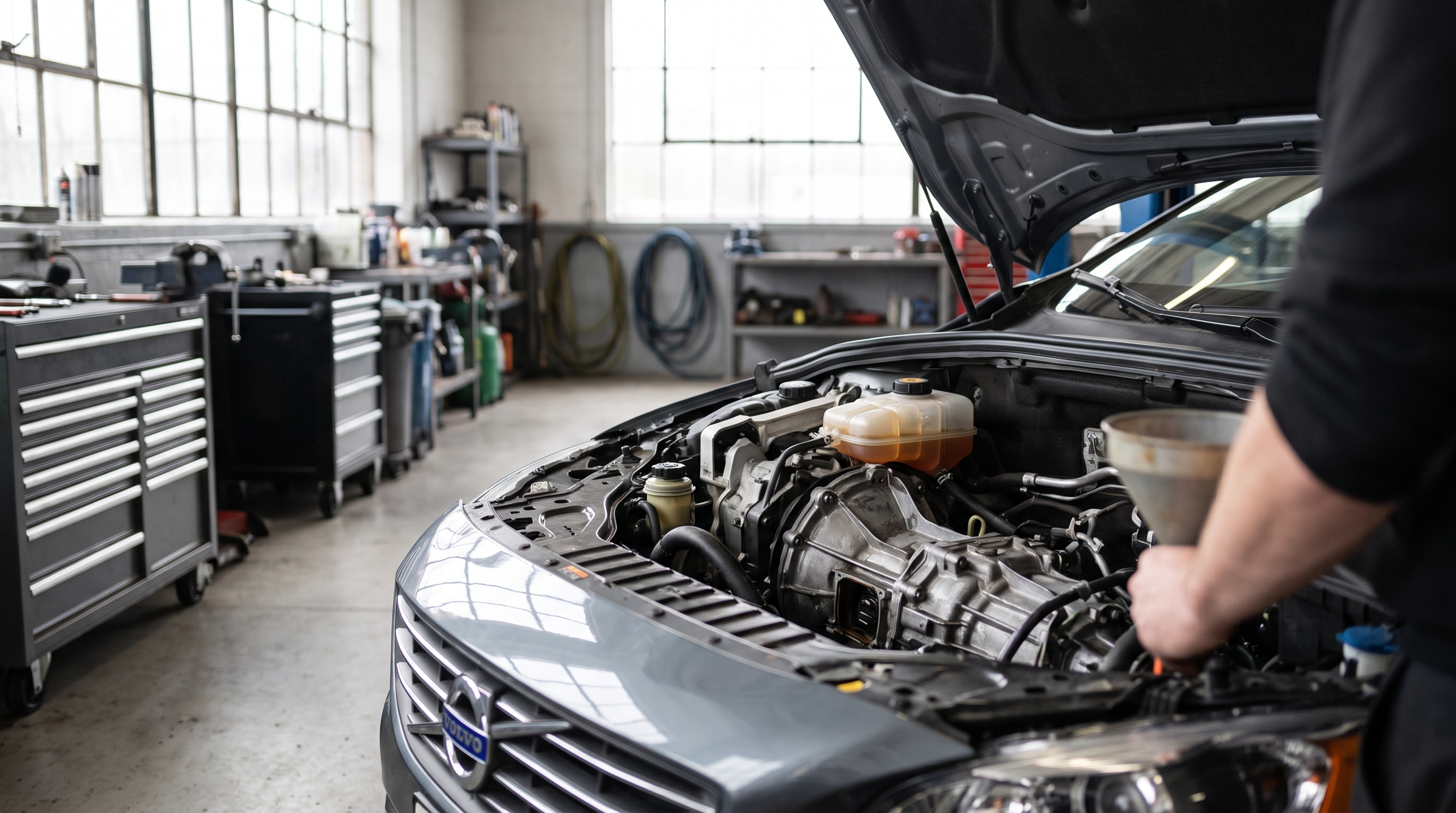
Volvo Transmission Fluid by Model: S60, S80, XC90 Guide
Find the correct Volvo transmission fluid and power steering fluid specifications by model and year for S60, S80, XC90, and other models.
Introduction
Volvo transmission fluid is a platform-specific requirement, not a universal product. A 2008 S60 with a five-speed automatic takes Dexron-III fluid under Volvo spec 1161540. Run a generic ATF without that number on the bottle and the valve body starts sticking within 20,000 miles. I have watched it happen at the counter: a customer saves eight dollars on fluid, then pays two thousand to rebuild the transmission. The approval is not a suggestion.
Why Volvo Fluid Specifications Matter
Volvo engineers spec fluids to match the tolerances, operating temperatures, and material compatibility of each transmission and steering system. The P2 platform S60, V70, and XC90 models use one set of requirements; the SPA platform S90 and XC90 II use another. The fluid that works in a 2005 XC70 will destroy a 2018 XC60 if the two specs do not overlap. The transmission does not care what the label says about "European vehicles" — it cares whether the additive package matches the clutch friction material and whether the viscosity holds at 240°F under load.
Power steering fluid is the same story. Older Volvos with hydraulic racks take ATF; newer ones take synthetic hydraulic fluid like Pentosin CHF 11S or CHF 202. These fluids maintain viscosity across a wide temperature range and resist foaming under high pressure. Pour ATF into a system that requires CHF 11S and the seals swell, the rack leaks, and the pump whines. The repair is not covered because the wrong fluid is considered owner negligence.
For related fluid requirements in other European makes, see the Audi VW Power Steering Brake Fluid Requirements Guide.
What This Guide Covers
This article lists the correct transmission and power steering fluid specifications for Volvo S60, S80, V70, XC60, XC70, and XC90 models by year and platform. It explains which products carry the required Volvo approval, what happens mechanically when the wrong fluid goes in, and how to read the spec number on the bottle. The goal is to get the right fluid into the car the first time, with no guessing and no comebacks.
What Happens When You Use the Wrong Volvo Transmission Fluid?
I've watched plenty of owners top off power steering with whatever red fluid is on the shelf, or pour Dexron into a transmission that calls for something else. The Volvo doesn't complain right away, but the damage starts immediately. The wrong fluid changes viscosity under heat, and in a hydraulic system that operates at precise pressure, that shift in thickness translates to sluggish response, noise, and accelerated wear on seals and pumps. In transmissions, the wrong additive package attacks clutch material or leaves varnish on solenoid screens. By the time the shift quality degrades or the steering whines, the internal parts have already been running in the wrong chemistry for thousands of miles.
Badge Confusion and Catalog Errors
The 'T5' and 'T6' badges on the S60 can represent completely different engines and transmissions depending on the model year, leading to potential catalog errors. A 2012 T5 is a turbocharged inline-five with one transmission; a 2015 T5 is a turbocharged inline-four with a different box entirely. If you order by badge alone, you get the wrong part. The build date and the VIN are the only reliable identifiers, and even then the parts catalog can list three different fluids for what looks like the same model year. I've seen techs drain a transmission, crack open the bottle that the system said was right, and find out mid-fill that the approval doesn't match the sticker on the pan. At that point, the choice is either flush it again or run it and hope—neither is good.
Power Steering Service Gaps
Some Volvo platforms have no power steering fluid check in the maintenance schedule at all. The S40, V50, C70, and C30 models do not require a power steering fluid check, which leads owners to assume the system is sealed and never needs attention. It isn't sealed; it's just not on the interval chart. When the pump starts to whine or the rack develops a leak, the fluid level is already low and the system has been cavitating. By then, replacing the fluid won't undo the scoring inside the pump, and the repair cost jumps from a bottle and fifteen minutes to a pump, rack, and lines. On the models that do list a check interval, the fluid level should be verified at specific mileage points, but most owners skip it because the reservoir is buried and the cap is a pain to reach.
Warranty and Liability
Volvo's warranty language ties coverage to the use of approved fluids. If a transmission fails and the service history shows a generic fill or a non-approved product, the claim gets denied. The dealer pulls a sample, sends it to the lab, and the report comes back showing the wrong viscosity or additive concentration. At that point, the repair is on the owner, and a transmission replacement runs five figures. Independent shops face the same liability: if you fill a car with the wrong fluid and it comes back with a failed component, the customer expects you to cover it. The only defense is documentation—fluid approval numbers, part numbers, and a paper trail that shows you used what the manual specified. Without that, you're paying for the repair whether the fluid caused it or not.
How to Select the Correct Volvo Transmission Fluid
The owner's manual is the only place to start. Volvo prints the transmission fluid spec and the power-steering fluid spec in the maintenance section, usually by model year and engine code. I've watched too many people walk in with a bottle that says "universal" and no manual to check it against. The bottle has to match what the book says, not what the parts-store shelf recommends.
Step 1
Locate your owner's manual and build date
Find the owner's manual in the glovebox or download the PDF from Volvo's owner portal using your VIN. Check the build date on the driver's door jamb — it matters because mid-year changes happen. The transmission and power-steering specs are in the capacities and fluids section, usually listed by engine and transmission code.
Step 2
Identify the transmission by code
Volvo uses different transmissions across platforms and years. The P3 S60, for example, has two: the TF-80SC six-speed automatic for five-cylinder and SI6 engines, and the TG-81SC eight-speed automatic for VEA four-cylinder engines. The fluid spec changes with the transmission, not just the model name. Look for the transmission code on the build sticker or in the service records.
Step 3
Cross-reference the fluid specification
Once you have the transmission code, match it to the fluid spec Volvo lists. For most P2 and P3 platforms, the spec is either Volvo 1161540 (older TF-80SC) or Aisin ATF-WS (newer eight-speed units). Power-steering fluid is typically Pentosin CHF 11S for hydraulic systems, but electric power-assist models after 2015 don't use fluid at all. Write down the spec and the capacity before you order.
Step 4
Verify the product meets the named approval
The bottle has to say the Volvo spec or the equivalent OE approval on the label. Generic "synthetic ATF" or "multi-vehicle" formulations do not meet Volvo's requirements unless the approval is printed. I sell both OEM Volvo-branded fluid and aftermarket products that carry the same approval — same spec, different supplier. Check the data sheet if the label is unclear.
If you're working on a DSG or S tronic platform from the VW/Audi family, the process is identical but the specs are different. For those, see our guide on Audi and VW Transmission Fluid: Specs for DSG, Tiptronic, S tronic.
Tips and Tricks
I have watched the same mistakes at the counter for years. The biggest one is buying the fluid before checking what the car actually takes. The second biggest is assuming that because two Volvos look similar, they use the same fluid. They do not. The build date, the transmission type, and sometimes the market determine the spec, and guessing costs you a second trip or a damaged transmission.
Check the Build Date and Transmission Code
The owner's manual lists the fluid by transmission type, not by model year alone. A 2010 S80 with a TF-80SC takes a different fluid than a 2010 S80 with an AW55-51SN. The transmission code is on a tag on the transmission itself or in the service history. If you do not have that, call the dealer parts counter with the VIN. They will tell you the transmission type in thirty seconds. Do not guess.
The Approval Has to Be on the Bottle
Volvo specifies synthetic hydraulic fluids like Pentosin CHF 11S and CHF 202 for power steering on most P2 and later platforms. These fluids maintain viscosity across a wide temperature range, which is why Volvo specifies them. The approval or the Volvo part number equivalent has to be printed on the product data sheet or the bottle itself. If it says "compatible with" or "suitable for," that is not an approval. Walk away.
High-Mileage Vehicles Need Attention
If your Volvo has over 100,000 miles, the Volvo transmission fluid and power steering fluid are both aging. High-mileage transmission fluids like Valvoline MaxLife ATF provide enhanced protection against seal hardening and leaks, but only if they meet the Volvo specification for your transmission. Check the fluid level at regular intervals—Volvo recommends checking power steering fluid at specific mileage points, and low fluid accelerates wear on the pump.
Where to Source the Correct Fluid
OEM Volvo fluid is available from the dealer, but aftermarket products that meet the same spec are available from European parts distributors. Pentosin CHF 11S is stocked by most independent shops that work on European cars. For transmission fluid, brands like Aisin, Mobil and Valvoline publish which Volvo specs their products meet. Read the product data sheet, not the marketing copy. The spec has to match exactly.
For more on synthetic hydraulic fluids used across European platforms, see BMW Power Steering Fluid: Pentosin CHF 11S vs ATF by Model. If you need to service other fluid systems on your Volvo, our Volvo Antifreeze: The Blue-Green Volvo Spec and Approved Products guide covers coolant requirements.
Common Mistakes to Avoid
Do not top off the power steering reservoir with generic ATF unless the manual specifically allows it. Do not assume that because a fluid works in a VW or BMW it works in a Volvo—the specs are different. Do not ignore a leak and keep topping off; find the leak, fix it, then flush and refill with the correct fluid. And do not trust a quick-lube place to know the difference between a TF-80SC and an AW55-51SN. Bring the spec sheet or do it yourself.
Conclusion
The right fluid is not a preference. It is a requirement. I have watched too many Volvos come back to the counter with slipping transmissions or groaning power-steering pumps because someone topped off with the wrong bottle. The spec is on the cap, the approval is on the label, and the consequence is mechanical when you ignore either one.
Volvo transmission fluid requirements are platform-specific. P2 cars take one thing, SPA takes another, and the older 940s and 850s use Dexron-III variants that are still available but harder to find at chain stores. Power-steering fluid follows the same rule: Pentosin CHF 11S for most hydraulic racks, ATF for some older electro-hydraulic systems, and nothing else. Mixing is the mistake that costs the most.
At the counter, the question is always the same: can I use what I have in the garage? The answer depends on whether the bottle says what your car requires. If it does not, do not run it. Flush it, do not top it. The aluminum and the seals do not forgive it.
For a deeper look at power-steering fluid requirements across European platforms, including Pentosin CHF 11S specifications, see our guide on Audi VW Power Steering Brake Fluid Requirements. The same principles apply: the spec is the spec, and the wrong fluid is expensive.
Written by
Lee Shahin
Founder, European Wholesale Parts
Lee Shahin founded European Wholesale Parts in Pleasanton, California, after 18 years in the Mercedes-Benz and BMW parts trade. He came to the parts side from the shop floor: he opened a European repair shop in Northern California in the early 1990s, specialising in Mercedes-Benz and BMW, and grew it with his wife Laurie into a parts and delivery operation serving body shops and independent repair facilities across the region. Nearly two decades at the parts counter taught him where the expensive mistakes happen, and most of them are fluids: the wrong coolant in an aluminium block, an oil without the sheet approval the engine was designed for, a transmission topped with the wrong ATF. That is what he writes about here. Every article names the manufacturer specification by its exact designation, explains what the wrong fluid does mechanically, lists products that carry the approval, and gives the capacity and interval for the models and years the specification covers. When a reader needs a part sourced, the quote desk at European Wholesale Parts is where Lee and Laurie still answer the phone.