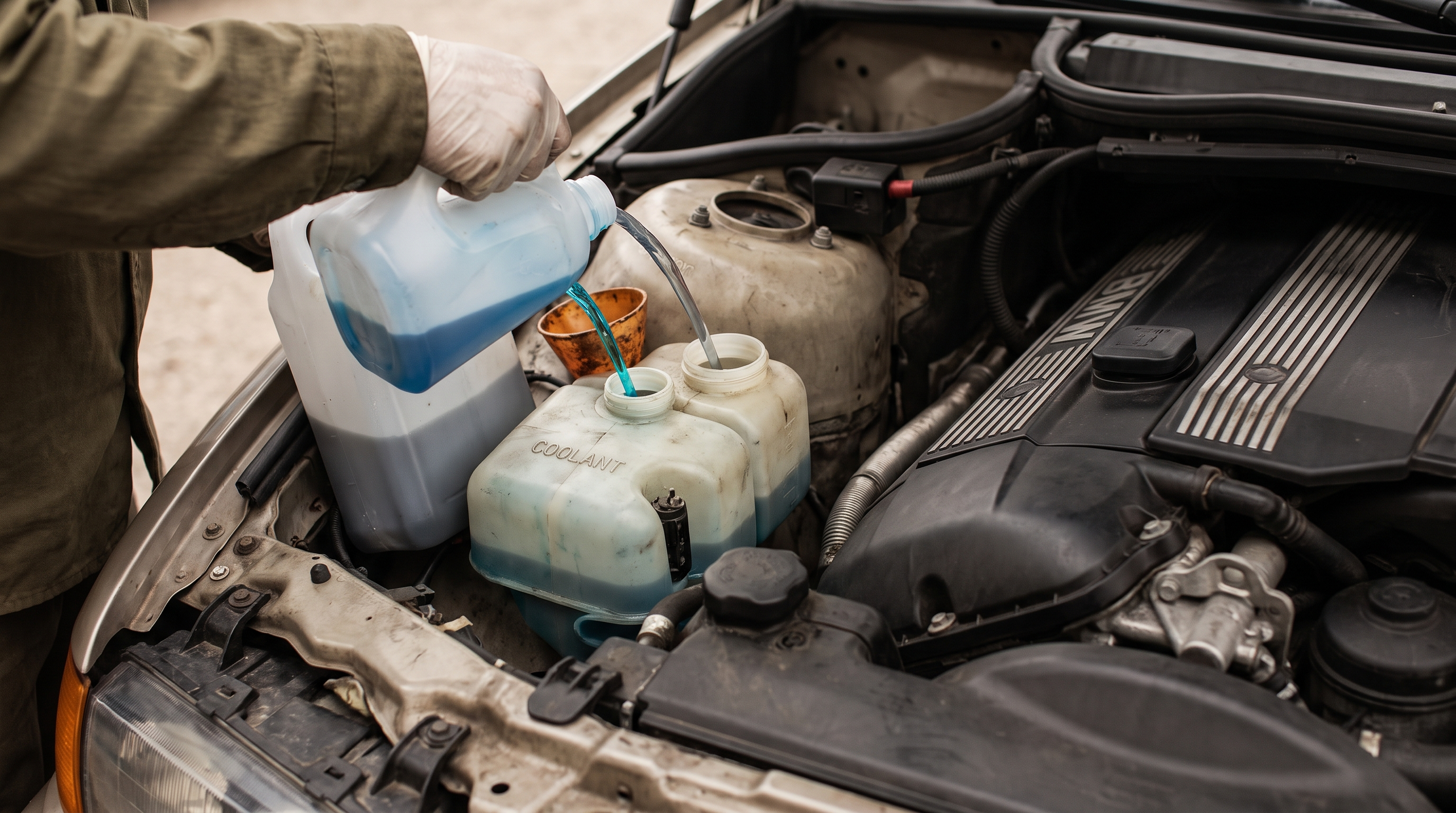
BMW Antifreeze: Current Grey Spec and the Blue It Replaced
Explore BMW antifreeze specifications, focusing on the current grey spec (BMW GS 94000) and the blue it replaced. Learn about compatibility and performance.
Introduction to BMW Coolant Specifications
I've watched the same question come up at the counter for years: can I use any blue coolant in my BMW? The answer is no, and the reason is the spec printed on the bottle. BMW antifreeze is not a color; it is a phosphate-free, nitrite-free, ethylene-glycol-based HOAT (Hybrid Organic Acid Technology) formula that meets a named approval. The blue coolant most people remember carried the N 600 69.0 spec, and it worked in BMWs built through the mid-2010s. Around 2018, BMW switched to a grey coolant under the GS 94000 specification, and that is what the factory fills today. The two are not interchangeable by color alone—what matters is whether the product meets the spec your engine requires.
In my years at the counter, the most common mistake is assuming any blue antifreeze will work. Universal coolants and generic Prestone bottles do not carry BMW's approval, and the chemical difference shows up in the cooling system within months. The phosphate-free requirement exists because BMW uses aluminum heads and blocks; phosphates form scale on aluminum surfaces, restrict flow, and cause localized overheating. The factory moved to grey coolant not because blue was bad, but because the new formula extends service intervals and improves compatibility with newer gasket materials. If you are topping off a system that still has blue in it, you need to know whether your car's build date falls before or after the spec change—mixing the two is the mistake that costs more than draining and refilling with the correct one.
This guide covers what BMW antifreeze is, why the spec matters, how to identify the right product, and what happens when the wrong one goes in. The bottle has to say either N 600 69.0 or GS 94000, depending on your model year, and the approval is printed on the label. If it is not there, do not run it. For detailed information on the older blue specification, see our article on BMW Antifreeze: Understanding Blue Coolant Spec N 600 69.0.
Explore BMW antifreeze specifications, focusing on the current grey spec (BMW GS 94000) and the blue it replaced. Learn about compatibility and performance.
What is BMW Antifreeze?
BMW antifreeze is a phosphate- and nitrite-free, ethylene-glycol-based HOAT coolant. HOAT stands for Hybrid Organic Acid Technology, and it is the chemistry BMW specifies for corrosion protection across aluminum, steel, and copper alloys in the cooling system. The factory fill is typically blue or grey depending on model year, and the bottle has to say it meets BMW's specification — the color alone does not tell you what is inside.
The Job It Does
Coolant transfers heat from the engine block and cylinder head to the radiator, where air pulls the heat out. It also raises the boiling point above water's 212°F and lowers the freezing point below 32°F, so the system works in summer heat and winter cold without vapor lock or ice expansion. The corrosion inhibitors in the HOAT package protect the water pump, thermostat housing, and heater core from pitting and electrolysis.
HOAT Chemistry and What It Protects
HOAT combines organic acids with a small amount of inorganic inhibitors. The organic acids form a protective film on metal surfaces; the inorganic additives handle aluminum specifically. BMW's specification excludes phosphates and nitrites because those compounds leave deposits in the narrow channels of the electric water pump and the heater valve. A phosphate-free formula keeps those passages open.
The blue dye is a tracer, not the active ingredient. I have seen generic blue coolant on the counter that is not HOAT and does not meet the BMW sheet. The approval printed on the bottle is what matters, and if it is not there, the coolant does not belong in the car. For more on BMW's blue coolant specification, see BMW Antifreeze: Understanding Blue Coolant Spec N 600 69.0.
Why BMW Antifreeze Specifications Matter
I've watched engines come apart because someone ran the wrong coolant, and the pattern is always the same: corrosion starts in the water pump housing, spreads to the radiator end tanks, and by the time you see the leak, the damage is done. BMW specifies nitrate-free and phosphate-free coolant for a reason — the cooling system is built around aluminum components that do not forgive the wrong chemistry. Run a generic green coolant with phosphates and the aluminum oxidizes from the inside. The pump seizes, the thermostat housing cracks, and you are looking at a four-figure repair that started with a ten-dollar mistake at the parts store.
The spec is not a preference. Pre-2018 models require G48 coolant, which meets the older blue standard. From 2019 forward, BMW moved to HT-12, the grey coolant that replaced it. These are not interchangeable by color or brand — the approval has to be on the bottle, and the bottle has to match the year and engine code in the owner's manual. Mixing is the mistake that costs the most, because you dilute the corrosion inhibitors and end up with a solution that protects nothing.
The consequences show up in stages. First, the heater core starts to clog — you lose cabin heat in winter. Then the water pump bearing corrodes and the pulley wobbles. Finally, the radiator end tanks crack at the crimp, and coolant goes everywhere. I have seen this sequence play out on E90s, F30s, and G20s when someone topped off with the wrong fluid or flushed the system with a universal product that did not carry the BMW sheet approval. The cheap way costs more, every time.
If you are not sure which coolant your car takes, check the build date and the engine code on the VIN sticker. The BMW blue coolant spec N 600 69.0 covered everything before the 2019 changeover; after that, it is HT-12 or nothing. The bottle has to say it meets the spec, and the parts counter has to confirm it before you pour it in. That is the only way to keep the aluminum intact and the system sealed. For other European cooling systems, our Volvo antifreeze guide and Porsche Cayenne coolant specs cover similar phosphate-free requirements.
How to Identify the Correct BMW Antifreeze
The build date determines which BMW antifreeze your car takes. Models built in 2018 and earlier use G48 blue-green coolant; models from 2019 onward require the grey HT-12. The year on your title is not the build date — check the sticker on the driver's door jamb or the plate under the hood. I've watched customers buy the wrong bottle because they went by model year instead of the actual build month.
Check the Door Jamb First
The door jamb sticker lists the build date as month and year. If it says 11/18 or earlier, you need G48. If it says 01/19 or later, you need HT-12. The color in the reservoir right now does not override this — someone may have topped it with the wrong fluid already, and mixing is the mistake that leads to a flush.
Read the Approval on the Bottle
When you are looking at a non-OEM coolant, the bottle has to say it meets or exceeds BMW specifications. For G48, look for explicit mention of the G48 standard or a statement that it is approved for BMW vehicles using that spec. Generic "universal" coolant that lists ten different makes in small print does not meet the requirement. At the counter, we sell products that name the BMW approval on the front label — if it is buried in the fine print or missing entirely, do not run it.
Capacities and Part Numbers by Platform
Capacity varies by engine and whether the car has an auxiliary heater. The E90 3-series with the N52 engine takes roughly 8.5 liters; the F30 with the N20 takes closer to 7 liters. The BMW oil filter guide covers engine codes across platforms, and the same logic applies to coolant — know your engine code, then verify the capacity in the service data. BMW part numbers for the OEM coolant are different for concentrate and pre-mixed; the concentrate is diluted 50/50 with distilled water, and the pre-mixed goes in as-is.
The build date, not the model year, is what the parts system uses to pull the correct coolant spec.
If you are ordering aftermarket, confirm the product explicitly states compatibility with your build year and spec. The approved list changes, and a bottle that was correct in 2017 may not meet the current HT-12 requirement. The owner's manual is right about this — it lists the spec by build period, and that is the number you cross-check against the product data sheet.
Best Practices for Using BMW Antifreeze
The 50/50 mix is not a suggestion — it is the ratio BMW engineered the system around. Run pure concentrate and you lose heat transfer; run too much water and you lose corrosion inhibitors. I have watched shops top off a system with straight water because the customer was low, and six months later the thermostat housing is pitted. The aluminum does not forgive it.
Always Use a 50/50 Mix with Distilled Water
BMW antifreeze concentrate must be mixed 50/50 with distilled or deionized water. Tap water introduces minerals that plate out on heat-exchange surfaces and clog the heater core. The 50/50 ratio balances freeze protection, boiling point and corrosion control — deviate from it and one of those three fails first. If you are topping off, use premixed coolant or measure the concentrate and distilled water separately; do not guess the ratio by eye.
Check the Build Date and Specification Before You Buy
The bottle has to say BMW GS 94000 or the older N 600 69.0 if you are servicing a car that originally took blue. The approval printed on the label is the only proof the formulation passed BMW's lab tests. I have seen universal coolants marketed as "safe for all European cars" that list no manufacturer approval at all — those are not safe, they are cheap. Cross-check the product data sheet against the BMW blue coolant spec if you are working on an older platform; for 2018-forward models, verify GS 94000.
Flush the System When You Change Specifications
If you are moving from blue to grey, or if the coolant in the system is more than ten years old, flush it. A simple drain-and-fill leaves 20–30% of the old fluid in the block and heater circuit. Run distilled water through the system, drain it, then fill with the correct 50/50 mix. The cheap way — topping off old coolant with new — costs more when the mixed inhibitors drop out and clog the expansion tank sensor.
Do Not Top Off with the Wrong Spec
If the car is low and you do not have the correct BMW antifreeze, do not top it off with what is on the shelf. Drive to a supplier that stocks the right product or order it. Topping off with a non-approved coolant to "get by" introduces a chemistry that was never tested in that engine, and the first thing it attacks is the water pump seal. I have sold more water pumps to people who topped off with the wrong coolant than to people who ran the system dry.
Common Mistakes When Choosing BMW Antifreeze
The biggest mistake I see at the counter is someone holding a bottle of blue coolant and asking if it will work in their BMW because the old stuff was blue. Color means nothing. The bottle has to say it meets the BMW specification — N 600 69.0 for the old blue or GS 94000 for the current grey. If the approval is not printed on the label, it does not go in the car.
Assuming Any Blue Coolant Is Compatible
BMW's blue coolant uses a specific HOAT chemistry with no phosphates. Generic blue antifreeze from the parts store is usually a silicate formula that will not protect the aluminum in a BMW cooling system. I have watched customers bring back a car three months later with a weeping water pump because they topped it with the wrong blue. The damage starts immediately — you just do not see it until the gasket fails or the radiator end tank cracks.
If you need to top off an older BMW still running blue, use a product that states N 600 69.0 on the bottle. If you are doing a full flush and the car is compatible with the grey spec, switch to GS 94000 and flush it completely. Mixing is the mistake that costs the most.
Ignoring the Specification on the Bottle
The second error is buying based on the brand name or the price without checking the approval. A bottle might say "European vehicles" or "import cars," but if it does not list the BMW GS 94000 approval, it is not approved. The manufacturer's approval list is the only document that matters, and aftermarket suppliers publish their approvals in the product data sheet.
When you are at the parts counter, ask to see the spec sheet or look for the approval printed on the back label. If the counterperson cannot show you the BMW approval in writing, do not buy it. This is not a preference — it is a requirement. The aluminium in the engine block and the radiator does not forgive the wrong coolant.
Mixing Old Blue with New Grey
Some customers top off a grey system with leftover blue because they have half a jug in the garage. The two formulas are not compatible. The inhibitor packages react, and you lose the corrosion protection in both. If you are switching from blue to grey, flush the system completely — drain it, fill it with distilled water, run the engine to operating temperature, drain it again, then fill with the grey coolant mixed to the correct ratio.
If you are not sure which coolant is in the car, check the expansion tank and the service records. The grey coolant is lighter in color and slightly translucent. The blue is opaque and darker. When in doubt, flush it and start clean with the current spec.
Buying Based on Price Alone
The cheap universal coolant costs less at the register, but it costs more when the water pump fails early or the heater core clogs. I have sold both OEM and approved aftermarket coolant for years, and the price difference is small compared to the repair bill. A gallon of approved coolant runs $20 to $30. A water pump replacement on a BMW runs $800 to $1,200 in labor and parts.
If you want to save money, buy an approved aftermarket product — Zerex, Pentosin and RAVENOL all make coolants with the GS 94000 approval printed on the bottle. You do not have to buy the BMW-branded jug, but you do have to buy a product that meets the spec. For more on BMW's blue coolant specification, see our detailed guide on N 600 69.0.
Not Checking the Build Date of the Vehicle
The final mistake is assuming all BMWs take the same coolant. The grey GS 94000 spec was introduced around 2018, and older models still require the blue N 600 69.0. The owner's manual and the service booklet list the correct specification by model year and engine code. If you are working on a 2015 335i, it takes blue. If you are working on a 2020 330i, it takes grey. The build date determines the spec, not the model name.
When you are ordering coolant, give the parts counter the last seven of the VIN and let them verify the specification. That is the only way to be sure you are getting the right product for the exact car in front of you.
Frequently Asked Questions About BMW Antifreeze
Can I mix the blue and grey BMW antifreeze?
No. The blue coolant is an ethylene-glycol phosphate formula, and the grey is a phosphate-free silicate hybrid. Mix them and you get a precipitate that clogs the heater core and the radiator neck. I have watched this exact failure twice at the counter — the owner topped the grey system with leftover blue, and three months later the heat stopped working. Flush the system, fill it with one spec, and leave it alone.
What happens if I use a generic blue antifreeze instead of BMW spec?
The bottle has to say N 600 69.0 or the OE part number. A generic blue from the auto-parts shelf is usually a universal formula without the corrosion inhibitors BMW specifies for the aluminium block and head. The water pump seals degrade first, then the heater-core tubes pit. The damage is slow but it is real, and by the time you see a leak the aluminium is already compromised.
Which aftermarket coolants meet the BMW grey spec?
Valvoline HT-12 and Pentosin NF are both approved for the grey GS 94000 standard. Zerex G-48 by Valvoline meets the older blue N 600 69.0 spec. Check the approval printed on the bottle before you buy it — the color means nothing, and the name on the front is marketing. The data sheet on the back is the only document that matters.
How often should I change BMW antifreeze?
The factory interval for the grey coolant is ten years or 150,000 miles, whichever comes first. The blue was five years or 60,000 miles. The owner's manual is right about this — do not extend the interval because the fluid still looks clean. The corrosion inhibitors deplete on a schedule, and once they are gone the aluminium starts to oxidize whether you see it or not.
Can I use Comma Xstream G48 or Castrol Radicool SF in my BMW?
Comma Xstream G48 and Castrol Radicool SF are both phosphate-based formulas compatible with the older blue BMW spec. They work in pre-2018 models that originally took N 600 69.0. Do not use them in a car that came with the grey coolant — the phosphate will react with the silicate inhibitors already in the system, and you will get the same clog problem as mixing blue and grey directly.
Do I need to flush the system when switching from blue to grey?
Yes. The blue and grey formulas are not compatible, so any residual blue in the block or the heater lines will contaminate the grey fill. Flush with distilled water until the drain runs clear, then fill with the grey coolant to the cold mark. Run the engine to operating temperature with the cap off, top to the mark again, and close it. The cheap way costs more — a partial flush leaves enough blue behind to start the precipitation reaction.
Where can I find the coolant spec for my specific BMW model?
The owner's manual lists the spec by model year and engine code. If you do not have the manual, the parts department at a BMW dealer can pull the spec from the VIN. At the counter I always check the build date on the door jamb — 2018 and later is grey, earlier is blue, but there are overlap-year exceptions on certain platforms. Do not guess; the wrong spec will damage the engine even if the color looks right.
Conclusion on BMW Antifreeze Specifications
The bottle has to say BMW GS 94000 or the old N 600 69.0 — that is the whole decision. I have watched people at the counter try to save a few dollars with a generic blue coolant, and the mistake costs them a water pump or a thermostat housing six months later. The aluminum does not forgive it. BMW specifies nitrate-free and phosphate-free formulations for a reason, and mixing is the mistake that turns a simple top-off into a full flush.
For pre-2018 models, the blue coolant that meets N 600 69.0 is correct; for 2019 and newer, the grey HT-12 spec is what the factory fills. Check the build date and the owner's manual — the manual is right about this. If you are not sure which year your car is, the parts department can pull it by VIN. Do not guess.
The approved products are not hard to find if you know where to look. Zerex G48 meets the blue spec, and Pentosin and BASF both make grey coolant that carries the GS 94000 approval printed on the label. We sell both at the counter, and I always tell people to buy the concentrate and mix it themselves — the premix is convenient, but you pay for water. Run the concentrate at 50/50 with distilled water, then top to the mark.
If you are working on a cooling system and need to cross-reference filters or other service items, our BMW oil filter guide covers which filter fits which engine by build year and engine code. The same attention to specification applies — not a preference, a requirement. For other European brands, see our guides on DOT 4 vs DOT 5.1 brake fluid and Audi Q5 and Q7 oil types.
In my years at the counter, the question is always the same: can I use the orange stuff, or the green stuff, or whatever is on sale? The answer is no. The cheap way costs more when the housing cracks or the pump seals fail. Use what the sheet says, flush it when the interval comes, and the system will run for two hundred thousand miles without drama.
Written by
Lee Shahin
Founder, European Wholesale Parts
Lee Shahin founded European Wholesale Parts in Pleasanton, California, after 18 years in the Mercedes-Benz and BMW parts trade. He came to the parts side from the shop floor: he opened a European repair shop in Northern California in the early 1990s, specialising in Mercedes-Benz and BMW, and grew it with his wife Laurie into a parts and delivery operation serving body shops and independent repair facilities across the region. Nearly two decades at the parts counter taught him where the expensive mistakes happen, and most of them are fluids: the wrong coolant in an aluminium block, an oil without the sheet approval the engine was designed for, a transmission topped with the wrong ATF. That is what he writes about here. Every article names the manufacturer specification by its exact designation, explains what the wrong fluid does mechanically, lists products that carry the approval, and gives the capacity and interval for the models and years the specification covers. When a reader needs a part sourced, the quote desk at European Wholesale Parts is where Lee and Laurie still answer the phone.