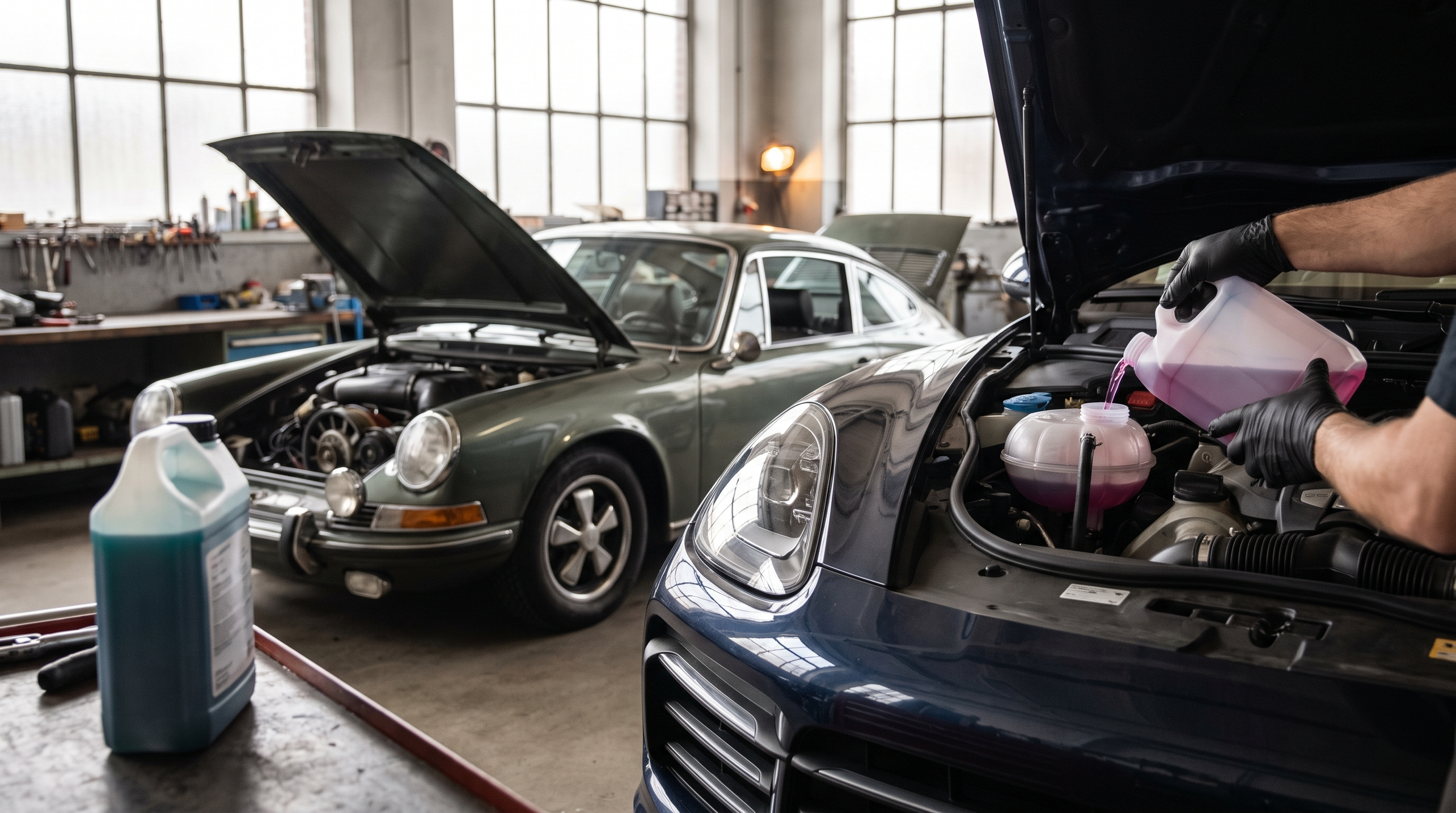
Porsche Cayenne Coolant Specs, Colors, and Approved Products
Porsche Cayenne coolant specifications, approved colors, and manufacturer-listed products by model year and engine to maintain optimal cooling system performance.
Introduction to Porsche Cayenne Coolant
I've watched more than one Cayenne owner walk up to the counter with a jug of universal coolant, confident it will work because the color looks right. It won't. Porsche coolant specifications are tied to the alloy composition in the block and heads, and the wrong formula accelerates galvanic corrosion at the water-pump housing and thermostat neck. The Cayenne platform spans three generations and a dozen engine variants, and the coolant requirement shifts with the build date and the powerplant under the hood.
The question is always the same: can I use what I have left over from another car? The answer depends on whether the approval printed on the bottle matches what Porsche publishes for your specific engine code. A 2008 Cayenne S with the 4.8L V8 takes a different coolant than a 2015 Cayenne Diesel, and a 2020 Cayenne Turbo with the 4.0L twin-turbo V8 requires a third formulation entirely. This is not a preference — it is a metallurgical requirement, and the cooling system does not forgive shortcuts.
This guide walks through the Porsche Cayenne coolant specifications by model year and engine, the approved products that meet each standard, and what happens mechanically when the wrong fluid goes in. If you need to understand how coolant chemistry applies across European platforms, see HOAT Coolant vs OAT vs IAT: What European Cars Require. For the Cayenne, everything hinges on reading the build date, checking the engine code, and matching the approval on the bottle to the factory specification.
Explore Porsche coolant specifications, colors, and approved products for various models to ensure optimal engine performance.
What is Porsche Coolant?
Porsche coolant is a phosphate- and silicate-free HOAT formula engineered for aluminum engines and high-performance cooling systems. The bottle has to say HOAT — hybrid organic acid technology — and the approval printed on it must match what the factory fill called for. In my years at the counter, I've watched shops bring in pink coolant assuming all pink is the same; it is not. Porsche specifies OAT or HOAT depending on the model year, and the chemistry difference is not cosmetic.
The Cayenne from 2003 forward typically runs pink OAT antifreeze in the UK market and Pentosin SF or OEM Porsche pink-to-purple HOAT in North America. The color tells you nothing about the approval; check the build date and the owner's manual. If the manual says G12++, the bottle must say G12++. If it says G13, run G13. Mixing is the mistake that costs you a radiator flush and sometimes more.
Why the Formula Matters for Aluminum Engines
Aluminum does not forgive phosphate or silicate contamination. Traditional green coolant — IAT — contains both, and it plates out on aluminum surfaces under heat. The Cayenne's engine block, cylinder heads and radiator are aluminum. Run the wrong coolant and the thermal transfer drops; the engine runs hot even when the system is full. The factory moved to OAT and HOAT formulas because they do not deposit, and they protect aluminum for longer intervals.
HOAT adds a small amount of silicate back in for older gasket and seal materials, but it is balanced to stay in suspension. OAT has none. Both are phosphate-free. If you are topping off, use the same spec that is already in the system. If you do not know what is in there, flush it and fill with the approved product. For more on how HOAT coolant vs OAT vs IAT formulations differ across European platforms, the chemistry and approval structure are covered in detail.
What the Bottle Must Say
The approval is on the label. Pentosin SF meets VW G12++ and Porsche's internal spec for pink coolant. The OEM Porsche product — part number varies by year — is the same formula in a Porsche-branded bottle. If the bottle does not list the approval, do not run it. Generic "European vehicle" coolant without a named spec is not a substitute; it may be pink, but the additive package is unknown and the aluminum protection is not guaranteed.
Capacity and concentration matter too. The Cayenne takes between 9 and 11 liters depending on engine and year, and the mix ratio is 50/50 coolant to distilled water. Pre-mixed is easier and eliminates the risk of the wrong ratio. Concentrated coolant must be diluted; running it straight does not improve protection and it raises the freeze point.
Why Porsche Coolant Specifications Matter
I've watched owners walk in with a jug of the wrong coolant and ask if it matters. It does. The specification printed on the bottle determines whether the cooling system protects the engine or corrodes it from the inside. Porsche approves specific formulations because the metals, gaskets and water pump in a Cayenne's cooling system require chemistry that generic antifreeze does not deliver.
Mixing automotive antifreeze of different formulas causes chemical incompatibilities that reduce the cooling system's protection and may cause damage over time. The corrosion inhibitors in one type can react with those in another, forming sludge that clogs narrow passages and drops the protection the coolant is supposed to provide. A 2012 Cayenne S with the 4.8 V8 runs G12++ coolant; top it with a silicate-based universal formula and the water pump seals start to weep within months.
What Happens When You Use the Wrong Coolant
The first consequence is corrosion protection drops. Porsche specifies phosphate-free OAT or Si-OAT coolants because the aluminum components in the engine and radiator corrode rapidly when exposed to phosphates or the wrong inhibitor package. The second consequence is sludge formation. When incompatible coolants mix, the additives precipitate into a gel that settles in the radiator and blocks the heater core. The third consequence is shortened service life — the coolant degrades faster and requires replacement well before the factory interval.
The approved coolant is not a preference; it is a requirement. The bottle has to say it meets the Porsche specification or carry the VW/Audi TL 774 approval that Porsche accepts. If it does not, it does not belong in the engine. Use Porsche-approved coolant or a compatible phosphate-free coolant mixed with distilled water at the ratio the manual specifies — usually 50/50 — to maintain optimal engine performance and avoid the repair cost that follows when you guess.
For more on how European manufacturers specify cooling system chemistry, see HOAT Coolant vs OAT vs IAT: What European Cars Require.
How to Identify the Right Porsche Coolant
The owner's manual is right about this: check the build date, then match the coolant to the specification Porsche published for that model year and engine. I've watched too many people at the counter pick by color alone, and color is not the spec. A pink bottle and a red bottle can both be G12++, or they can be entirely different chemistries. The approval printed on the bottle has to say what Porsche requires, or you're guessing.
Start with the VIN and Model Year
Your Cayenne's VIN tells you the model year and the engine code. The coolant spec changed across generations — early 955 Cayennes used a different formulation than the 958 or E3 platforms. The manual lists the spec by engine; if you don't have the manual, the parts counter can pull it by VIN. Don't assume a 2008 and a 2019 take the same coolant just because they're both Cayennes.
Read the Bottle
The bottle has to carry the manufacturer approval, not just a claim that it "meets" or "exceeds" the spec. Porsche approves specific products, and the approval number — typically a TL number or a reference to VW/Audi G-standards that Porsche shares — must be on the label. If the bottle says "suitable for" but doesn't list an approval, it's not approved. HOAT coolant vs OAT vs IAT: What European Cars Require covers the chemistry differences and why the approval matters more than the additive type.
Cross-Reference the Part Number
If you're buying from a Porsche dealer, the part number on the bottle is already approved. If you're sourcing aftermarket, cross-reference the product's data sheet against the Porsche-approved list. In the UK, Comma XStream G30 and Triple QX Red OAT are common approved brands for certain Cayenne models, but you still verify the spec matches your engine. The brand is less important than the approval it carries.
Don't Mix
Mixing is the mistake. If you're topping off and the system already has coolant in it, you need the same spec, not just the same color. If you don't know what's in there, flush it. Running two different coolants creates a hybrid chemistry that Porsche never tested, and the additives can precipitate or lose effectiveness. Top to the mark with the correct product, or drain and refill with a known spec.
Porsche Coolant Specifications by Model
The Cayenne's coolant specification depends on the model year and the engine under the hood. I've watched too many owners pour in whatever pink fluid they find at the parts store, assuming color alone tells you what you need. It doesn't. The approval has to be on the bottle, and the approval has to match what Porsche lists for your specific engine code and build date.
Cayenne First Generation (2003–2010)
The first-generation Cayenne — the 955 and 957 chassis — takes a pink OAT (Organic Acid Technology) antifreeze. In the UK and European markets, this is typically the factory fill, and it's what the system was designed around. The coolant must meet Porsche's internal approval for long-life OAT formulations, which means silicate-free and phosphate-free chemistry. If you're running a V6, V8, or the turbo variants, the spec is the same across the range for this generation.
Capacity varies by engine: the 3.2 V6 holds approximately 11.5 liters, the 4.5 V8 holds around 13 liters, and the turbo models are in the same range as the naturally aspirated V8. Check the build date — early 2003 models sometimes shipped with a different factory fill than the later 2007+ units, and mixing is the mistake that shortens the interval.
Cayenne Second Generation (2011–2018)
The second-generation Cayenne — the 958 chassis — continues with pink OAT coolant, but Porsche tightened the approval requirements. The 3.0 supercharged V6, the 3.6 V6, the 4.8 V8, and the diesel variants all specify the same long-life OAT formulation. The bottle has to say it meets the Porsche approval or list the VW/Audi G12++ or G13 equivalent, which share the same base chemistry.
Capacity for the 3.0 supercharged V6 is approximately 12 liters; the 4.8 V8 holds around 14 liters. The diesel models (3.0 TDI) hold roughly 13 liters. Don't top it with a generic pink fluid — the aluminum heads and the plastic expansion tank don't forgive it. Flush it if you're unsure what's in there, then fill to the mark with an approved product.
Cayenne Third Generation (2018–Present)
The third-generation Cayenne — the 9YA chassis — uses the same pink OAT coolant as the second generation, but the system capacity and the service interval have changed slightly depending on the engine. The 3.0 turbocharged V6 (both the base and the S variant) holds approximately 11 liters. The 4.0 twin-turbo V8 in the Turbo models holds around 13 liters. The hybrid variants add complexity because the cooling system serves both the engine and the battery pack, but the coolant spec itself remains the same pink OAT formulation.
If you're running a 2019 or newer Cayenne, the owner's manual is right about this: use only coolant that lists the Porsche approval or the G12++ / G13 equivalent. The variable-displacement water pump and the electronically controlled thermostat are sensitive to the coolant's conductivity and pH, and the wrong fluid throws off the engine management's temperature control.
Other Porsche Models
The 911, Boxster, Cayman, and Panamera follow similar rules. The air-cooled 911s (pre-1998) obviously don't apply here, but the water-cooled 996, 997, 991, and 992 generations all specify pink OAT coolant with the same approval as the Cayenne. The Boxster and Cayman (986, 987, 981, 718) use the same spec. The Panamera (970, 971) uses pink OAT across all engine variants — V6, V8, and hybrid.
Capacities vary by model and engine, but the approval is consistent: long-life OAT, silicate-free, phosphate-free, and listed on the bottle. If you're sourcing parts for multiple Porsche platforms, understanding HOAT coolant vs OAT vs IAT requirements helps you stock the right products and avoid the costly mistakes that come from mixing chemistries.
Approved Porsche Coolant Products
The bottle has to say it meets the spec. I've watched customers walk out with the wrong coolant because they picked by color or price instead of reading the approval printed on it. Porsche doesn't publish a long list of approved brands the way Mercedes does with their sheet approvals, but the requirement is the same: the product must state it meets the standard your Cayenne requires.
What to Look For on the Bottle
The data sheet or the bottle itself must list compatibility with Porsche specifications. For most Cayenne models, that means a phosphate-free coolant that matches the VW/Audi G12++ or G13 standard. The approved product will state "meets VW TL 774 G" or "Porsche-approved" directly on the label. If it doesn't say it, don't run it.
Mixing is the mistake. If your system has G12++ and you top it with a generic phosphate-bearing coolant, the phosphates drop out and clog the small passages in the expansion tank and radiator. Flush it or stick with what's already in there.
Products That Meet the Specification
In the UK market, Comma XStream G30 and Triple QX Red OAT coolant are listed as Porsche-compatible products. Both are phosphate-free and meet the organic acid technology (OAT) standard Porsche requires. At the counter, I verify the approval on the product's own literature before I sell it, and I recommend you do the same.
For North American customers, Pentosin Pentofrost A3 is a common option that meets VW TL 774 G and works in Cayenne applications that specify G12++. The bottle will say "VW/Audi/Porsche approved" if it's legitimate. We sell both OEM Porsche coolant and Pentosin; the spec is the same, the price is different.
OEM vs. Aftermarket
Porsche's own coolant carries the part number and meets the spec by definition. Aftermarket products that state the same approval number are functionally identical if the manufacturer is reputable. The OEM product is the safe choice when you can't verify the aftermarket bottle's data sheet, but it's not a performance difference — it's a documentation difference.
If you're sourcing from a distributor catalog, cross-reference the product's listed approvals with the VW TL 774 standard and the model year of your Cayenne. The catalog will show which applications the product covers. For more on understanding coolant formulations across European platforms, see HOAT Coolant vs OAT vs IAT: What European Cars Require.
Common Mistakes with Porsche Coolant
The first mistake is topping off with the wrong color. I've watched owners walk to the counter with a bottle of orange or green coolant because it was on the shelf, then ask if it will work in a Cayenne. The answer is no if the bottle does not list the VW/Audi G12++, G13 or Porsche-approved spec. The color tells you nothing about the chemistry; the approval printed on the label is what matters.
Mixing coolants is the second mistake. A 2008 Cayenne S came through the shop with a pink-and-green mix in the expansion tank. The owner had topped it twice with whatever was nearby. The result was a clogged heater core and a coolant pump that failed six months early. If you cannot confirm the existing coolant matches the new bottle's approval, flush the system and refill from empty. Do not guess.
Ignoring Low-Coolant Warnings
A persistent low-coolant warning is not a topping problem; it is a leak. On 2011–2015 Cayennes, the expansion tank cracks at the seam, and on earlier models the coolant pump seals weep. Topping off every week masks the real issue until the engine overheats. When the dash light comes on, check for visible leaks at hoses, the water pump and the tank itself before adding fluid. If the level drops again within a few days, the system needs a pressure test, not another jug of coolant.
Leaks in extreme heat accelerate damage. A slow drip from a radiator or hose connection becomes a stream when ambient temperature climbs, and by the time the temp gauge moves, the aluminum block is already stressed. I have seen head gaskets fail on Cayennes that ran low for a single highway trip in summer. The repair cost is ten times what a hose or tank replacement would have been.
Using Universal or Generic Coolant
Universal coolant is not universal for Porsche. The bottle may say it works in all makes, but unless it lists G12++ or G13 approval, it does not meet the Cayenne's spec. I have seen shops use a generic pink coolant in a 2013 Cayenne Diesel, then deal with corrosion in the EGR cooler eighteen months later. The EGR cooler is an aluminum casting with tight passages; the wrong inhibitor chemistry pits the metal and blocks flow.
Some universal formulas claim compatibility by listing multiple colors. That is marketing, not engineering. The Cayenne's cooling system is designed around a specific OAT or Si-OAT additive package, and a product that tries to cover every spec covers none of them properly. For more on coolant chemistry and what European platforms require, see HOAT Coolant vs OAT vs IAT: What European Cars Require.
Overfilling the Expansion Tank
The expansion tank has a cold-fill line and a hot-fill line. Filling to the hot line when the engine is cold leaves no room for thermal expansion, and the excess vents through the pressure cap or cracks the tank. I have replaced tanks on Cayennes where the owner filled to the brim thinking more coolant was safer. It is not. Fill to the cold line, run the engine to operating temperature with the cap off to burp air, then top to the cold mark and stop.
Frequently Asked Questions about Porsche Coolant
What does the "Check Coolant Level" warning mean on my Cayenne?
The warning means the system detected low coolant or a problem with coolant circulation or measurement. When the light comes on, the engine is at risk of overheating. Check the expansion tank first — if the level is below the MIN mark with the engine cold, you need to add coolant. If the tank is full and the warning persists, the sensor or pump may have failed.
Can I top off my Porsche Cayenne with any coolant?
No. The bottle has to say it meets the Porsche specification for your model year and engine. A 2011 Cayenne S with the 4.8L V8 takes G12++ (VW TL 774-G), while a 2019 Cayenne with the 3.0L turbo takes G13 (VW TL 774-J). Topping G13 with G12++ dilutes the additive package and changes the corrosion inhibitor chemistry. If you are not sure what is in the system, drain and refill with the correct spec.
How often should I change the coolant in my Cayenne?
Porsche specifies coolant service intervals by model year and engine code. Most Cayenne models call for a coolant change at 6 years or 120,000 miles, whichever comes first. The interval applies to the factory fill; if you flush the system during a repair, the clock resets. Check your owner's manual or the service booklet for the exact interval — some early Cayenne models had shorter intervals.
What happens if I mix G12++ and G13 coolant?
Mixing is the mistake. G12++ is a silicate-free HOAT with one additive package; G13 is a glycerin-based HOAT with a different one. When you mix them, the inhibitors interact and the mixture does not meet either specification. The result is reduced corrosion protection and potential damage to the water pump seals and aluminum components. If you mixed coolants, flush the system completely and refill with the correct spec.
Why does my Cayenne keep showing a low coolant warning even after I top it off?
Frequent low coolant warnings usually mean a leak in the cooling system. Check the expansion tank cap, hoses, radiator and water pump for visible leaks. If the coolant is disappearing without visible drips, the head gasket may be leaking internally. A Porsche specialist can pressure-test the system and check for combustion gases in the coolant. Do not ignore repeated warnings — running low on coolant warps the heads.
Can I use universal coolant in my Porsche Cayenne?
Not unless the bottle lists the Porsche-required VW specification. Universal coolants are blended to meet multiple specs, but the approval has to be printed on the label. If the bottle says "compatible with all makes" but does not list VW TL 774-G or TL 774-J, it is not approved. The cheap way costs more when the water pump fails early.
Where can I find the coolant specification for my specific Cayenne model?
The owner's manual lists the coolant spec by model year and engine. If you do not have the manual, the parts department at a Porsche dealer can look it up by VIN. You can also cross-reference the engine code in a distributor catalog — the spec is tied to the engine, not just the model name. For a detailed breakdown of HOAT coolant vs OAT vs IAT specifications, see our guide on what European cars require.
Conclusion: Ensuring Optimal Performance with the Right Porsche Coolant
The coolant specification printed on the bottle is not a suggestion. Run the wrong one in a Cayenne and the aluminum heads corrode, the water pump seals fail, and the heater core clogs. I have watched shops flush systems twice because someone topped a G12evo car with universal green, and the bill always lands harder than the cost of the right product up front.
Check your build date, find the engine code, and match the approval to what Porsche lists for that year. The 955 Cayenne takes G12++ through most of its run; the 958 switches to G13 or G40 depending on the model year. The 9YA uses G40 across the board. Mixing is the mistake that costs you the radiator, not the coolant itself. If the system has the wrong fill, flush it completely before you top it with the correct product.
Monthly checks matter, especially on the S Hybrid and Turbo models where cooling demand is higher. On any 955 or 958, inspect the system at 80,000 km and consider replacing the coolant pipes before they split. The plastic does not forgive heat cycles, and a roadside failure is always more expensive than a scheduled service.
I have spent years at the counter watching people walk in with the wrong bottle, and the conversation is always the same: the cheap way costs more. Cross-reference the distributor catalog with the manufacturer approval, buy the product that says it on the label, and run it at the interval Porsche specifies. The aluminum does not forgive shortcuts, and neither does the repair bill when the system fails.
For additional guidance on European cooling system requirements, see HOAT Coolant vs OAT vs IAT: What European Cars Require.
Written by
Lee Shahin
Founder, European Wholesale Parts
Lee Shahin founded European Wholesale Parts in Pleasanton, California, after 18 years in the Mercedes-Benz and BMW parts trade. He came to the parts side from the shop floor: he opened a European repair shop in Northern California in the early 1990s, specialising in Mercedes-Benz and BMW, and grew it with his wife Laurie into a parts and delivery operation serving body shops and independent repair facilities across the region. Nearly two decades at the parts counter taught him where the expensive mistakes happen, and most of them are fluids: the wrong coolant in an aluminium block, an oil without the sheet approval the engine was designed for, a transmission topped with the wrong ATF. That is what he writes about here. Every article names the manufacturer specification by its exact designation, explains what the wrong fluid does mechanically, lists products that carry the approval, and gives the capacity and interval for the models and years the specification covers. When a reader needs a part sourced, the quote desk at European Wholesale Parts is where Lee and Laurie still answer the phone.