

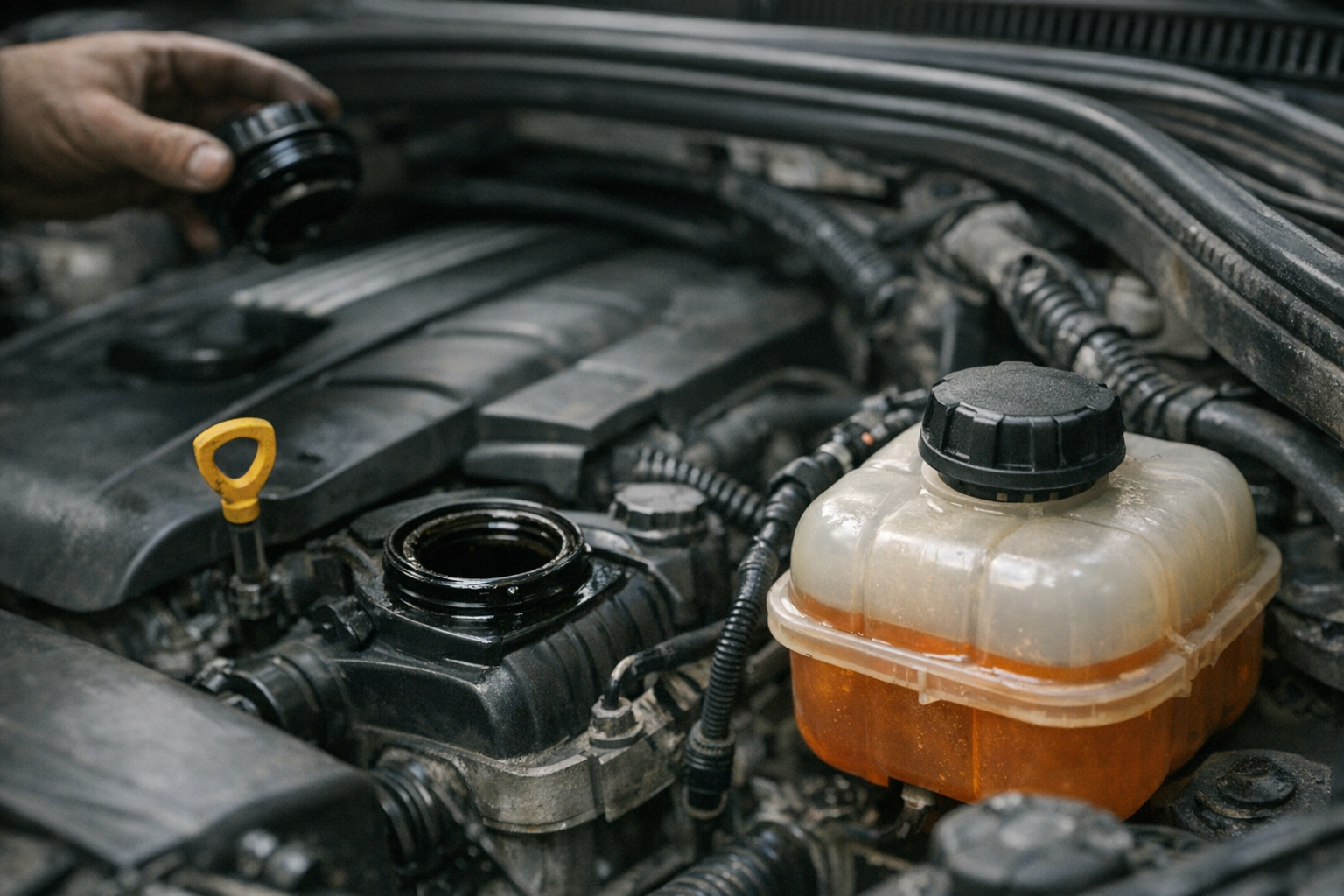
BMW X5 Oil Type and Coolant by Generation (E53-G05)
The BMW X5 oil type and coolant specifications change with each generation, and I've watched shops make the same mistake: they assume a 5W-30 is a 5W-30, or that all BMW coolant is blue.
Introduction
The BMW X5 oil type and coolant specifications change with each generation, and I've watched shops make the same mistake: they assume a 5W-30 is a 5W-30, or that all BMW coolant is blue. The approval printed on the bottle is not a suggestion. When you run oil that lacks the BMW Longlife approval the engine was designed for, the variable valve timing solenoids clog first, then the VANOS actuators seize. The same holds for coolant — mixing G48 with the later HOAT formulations accelerates corrosion in the aluminum block and heads, and the damage shows up after the warranty expires.
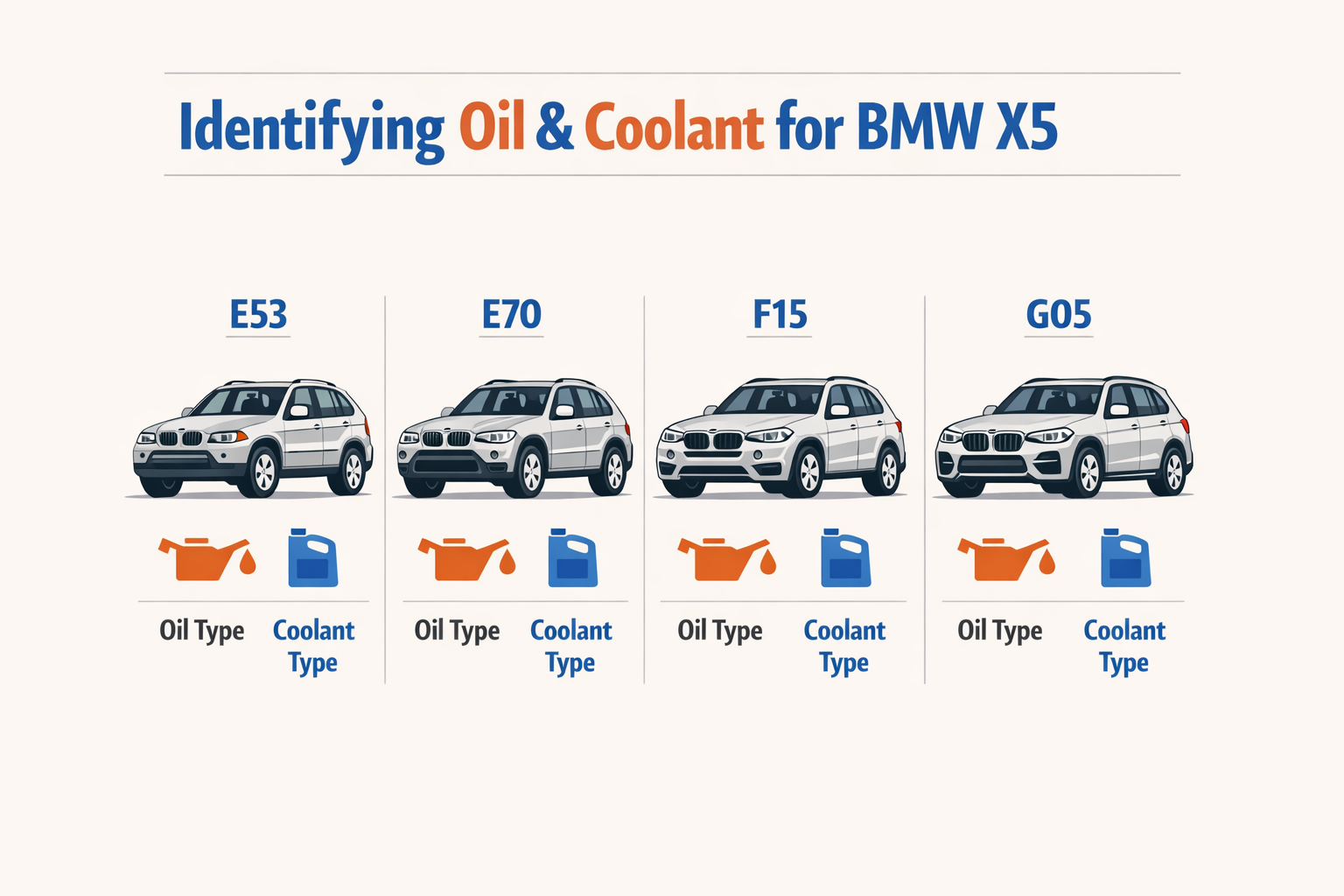
Each X5 generation — E53 from 2000 to 2006, E70 from 2007 to 2013, F15 from 2014 to 2018, and G05 from 2019 forward — uses a different combination of engine codes, oil approvals, and coolant formulations. The E70 and later platforms introduced BMW LL-01 for naturally aspirated inline-six engines and LL-04 for turbocharged variants, and the capacities, intervals, and approved products are not interchangeable. At the counter, the question is always the same: can I use what I have on the shelf? The answer depends on whether the bottle meets the spec the engine requires, and whether you are willing to flush the system or risk mixing.
This guide breaks down the BMW LL-01 oil specification and coolant requirements for each X5 generation by engine code, with the capacities, intervals, and approved products that meet the factory standard. The cheap way costs more when the timing chain stretches or the water pump corrodes, and the factory fill is the baseline — not a preference, a requirement.
Problem Statement

The X5 spans four generations and two decades. Each one has different oil approvals and coolant specifications. Run the wrong oil and you clog the variable valve timing. Mix the wrong coolant and you corrode the aluminium in the radiator and block. The counter question is always the same: can I use what I have? The answer depends on the generation, the engine code, and what the bottle says.
The Oil Approval Is Not a Suggestion
BMW publishes Longlife approvals for a reason. LL-01 and LL-04 are not interchangeable, and neither one is a catch-all. The E53 and early E70 engines take LL-01. Later engines require LL-04 for diesel particulate filter compatibility. Some newer G05 engines specify thin-film oils like 0W-12, which meet a newer approval but raise durability questions in warmer climates. I have watched owners run generic 5W-30 without the sheet approval, and the first thing that fails is the VANOS solenoid. The screen clogs, the timing goes soft, and the engine stumbles cold. The oil looked fine; the approval was missing.
Coolant Mixing Is the Mistake
BMW specifies blue coolant across all X5 generations: G11, G12, or G13 depending on the year. The formulations are not compatible with each other or with universal green coolant. Mixing them creates a sludge that blocks the heater core and clogs the thermostat housing. The system holds pressure but does not transfer heat. I have seen it twice: the gauge stays normal, the cabin blows cold, and the overflow tank has brown foam. Flush it, do not top it. The 50/50 mix with distilled water is not optional; tap water leaves mineral deposits on the water pump impeller.
The cheap way costs more when the radiator has to come out because someone topped off G12 with G13.
Thin Oil and Engine Longevity
The G05 generation introduced 0W-12 as a factory fill for some engines. It meets the fuel economy mandate but raises questions about long-term wear, especially in hot climates. The oil film is thinner at operating temperature, and the bearing clearances are the same. Some operators run 0W-30 or 5W-30 LL-01 instead, accepting the fuel economy penalty for the thicker film. The owner's manual lists 0W-12; the counter stocks both. Which one you run depends on whether you trust the factory interval or plan to keep the truck past 150,000 miles. For more on BMW LL-01 oil specifications and approved products, see the linked guide.
Solution Steps
Step 1: Identify Your X5 Generation and Engine Code
The first thing you do is open the driver's door and read the VIN sticker. The tenth digit tells you the model year. Cross-reference that with the generation: E53 is 2000–2006, E70 is 2007–2013, F15 is 2014–2018, and G05 is 2019 and newer. Then check the engine code. It is on a sticker under the hood or in the service booklet. The oil spec changes by engine, not just by year.
Step 1
Locate VIN and engine code
Check the door jamb sticker for the VIN and model year. Find the engine code under the hood or in your service records. The code is usually a letter-number combination like N52, N55, or B58. Write it down.
Step 2: Match the Engine Code to the Correct BMW Longlife Approval
BMW publishes a Longlife oil approval list. The two you see most are LL-01 and LL-04. LL-01 is for older engines that run longer intervals on conventional drain schedules. LL-04 is for engines with diesel particulate filters or gasoline direct injection that need low-ash formulations. The 2025 X5 sDrive40i and xDrive40i take 6.9 quarts of SAE 0W-20 synthetic. The M60i with the 4.4L twin-turbo V8 takes 11.3 quarts of SAE 0W-30. The bottle has to say the approval. If it does not list LL-01 or LL-04 on the back label, it is not approved no matter what the viscosity reads.
For a detailed breakdown of what BMW LL-01 oil means and which products carry the approval, see our LL-01 guide.
Step 3: Check the Coolant Type and Capacity
BMW coolant is blue and meets a specific inhibitor chemistry. The 2024 X5 uses HT-12 coolant with a 6.5-quart capacity and a 120,000-mile change interval. Older X5 generations may use different formulations, but the bottle will say whether it meets BMW's spec. Do not mix coolant types. If you top off a system that already has blue coolant, use the same formulation. Mixing HT-12 with an older G48-based product changes the inhibitor balance and shortens the service life.
Step 2
Verify coolant spec on the bottle
Look for the BMW approval number printed on the coolant jug. It should match the spec in your owner's manual or service booklet. If the bottle does not list a BMW part number or approval, do not use it.
Step 4: Source the Correct Products
Once you have the approval and capacity, order the oil and coolant. At the counter, I pull up the engine code and cross-reference it with the distributor catalog. The catalog lists every approved product by part number. If you are ordering online, verify that the product page shows the BMW Longlife approval in the specifications section. Do not rely on generic viscosity matches. The approval is what matters.
Step 3
Order by approval, not by brand
Use the BMW Longlife approval number to search. Multiple brands meet LL-01 and LL-04. Pick the one that lists the approval on the data sheet and fits your budget. The factory fill is not the only option, but it is always correct.
Tips and Tricks
The interval in the owner's manual is 10,000 miles or 12 months, whichever comes first. I've watched customers stretch that to 15,000 because the computer said so, and the variable timing solenoids start chattering by 80,000 miles. The oil doesn't stop lubricating at 10,001 miles, but the additives that keep sludge suspended break down, and that's what clogs the small passages in a BMW engine. Run it to the mark the book gives you, not the one the dash suggests when it's in economy mode.
Check the Approval, Not the Brand
The bottle has to say LL-01 or LL-04 on the back label. The brand name on the front doesn't matter; the approval printed on it does. I've sold Mobil 1, Castrol, Liqui Moly and Pennzoil to X5 owners, and they all work as long as the sheet approval matches the engine code. A 0W-30 that meets LL-01 is not the same as a 0W-30 that doesn't, even if the viscosity looks identical. The approval means the oil passed BMW's oxidation, sludge and wear tests for that platform, and no amount of marketing changes that.
Coolant: Don't Mix, Flush It
BMW coolant is blue, and it's a nitrite-free HOAT formulation. The system holds about 2.6 gallons on most X5 models, but topping off with the wrong coolant is worse than running it a quart low. If the previous owner put in generic green or orange coolant, flush the system and refill with the correct blue coolant that meets the BMW spec. Mixing is the mistake that corrodes the water pump seals and clogs the heater core, and I've seen both happen within 20,000 miles of a bad top-off.
Oil Level: Run It, Then Top to the Mark
Check the oil level on the dipstick or the iDrive screen after the engine has run for two minutes and then sat for five. The level moves when the oil is cold versus hot, and BMW engines are sensitive to overfill. If the level is between the MIN and MAX marks, leave it. If it's at MIN, add half a quart, run the engine, and check again. Overfilling by a quart puts pressure on the rear main seal, and that's a job you don't want to pay for.
Use the Build Date, Not the Model Year
The E70 X5 built in late 2006 for the 2007 model year uses the same oil spec as the 2008, but a 2013 built in July uses a different spec than one built in November. The build date is on the door jamb sticker, and that's what determines the engine code and the approval. I've had customers bring in a 2007 that actually needed 2006 specs because the build date was early, and the parts catalog confirmed it. The model year is shorthand; the build date is the rule.
Conclusion
The BMW X5 oil type and coolant specification is not a preference — it is a requirement. The bottle has to say LL-01, LL-01 FE, or LL-22 FE++ for the G05, and the coolant has to meet the blue BMW spec. Run the wrong oil and the variable valve timing solenoids clog first; run the wrong coolant and the aluminum block doesn't forgive it. I've watched owners assume any synthetic 5W-30 will work, and I've sold the parts to fix what happens when it doesn't.
Check the build date, check the engine code, and match the approval to the year. The 2024 and newer models take 0W-20 with LL-22 FE++; earlier G05s take LL-01 FE. The E53, E70, and F15 take LL-01, and the capacity changes with the engine — 6.5 liters for the inline-six, up to 10.75 liters for the S68 V8. The owner's manual is right about this.
Flush the coolant on the interval BMW publishes, and don't top it with the orange stuff. Mixing is the mistake. The cheap way costs more when the water pump fails or the head gasket goes. At the counter, the question is always the same: can I use what I have? If the approval isn't printed on it, the answer is no. For more on BMW fluid approvals and how to read the bottle, see our guide to BMW LL-01 Oil: Specification Meaning and Approved Oils.
Run the right spec, change it on time, and the X5 will run. That is the deal.
Learn about the BMW X5 oil type and coolant specifications for each generation: E53, E70, F15, and G05.
Related reading
Ceramic vs Semi-Metallic Brake Pads: Key Differences for European Cars
Written by
Lee Shahin
Founder, European Wholesale Parts
Lee Shahin founded European Wholesale Parts in Pleasanton, California, after 18 years in the Mercedes-Benz and BMW parts trade. He came to the parts side from the shop floor: he opened a European repair shop in Northern California in the early 1990s, specialising in Mercedes-Benz and BMW, and grew it with his wife Laurie into a parts and delivery operation serving body shops and independent repair facilities across the region. Nearly two decades at the parts counter taught him where the expensive mistakes happen, and most of them are fluids: the wrong coolant in an aluminium block, an oil without the sheet approval the engine was designed for, a transmission topped with the wrong ATF. That is what he writes about here. Every article names the manufacturer specification by its exact designation, explains what the wrong fluid does mechanically, lists products that carry the approval, and gives the capacity and interval for the models and years the specification covers. When a reader needs a part sourced, the quote desk at European Wholesale Parts is where Lee and Laurie still answer the phone.