

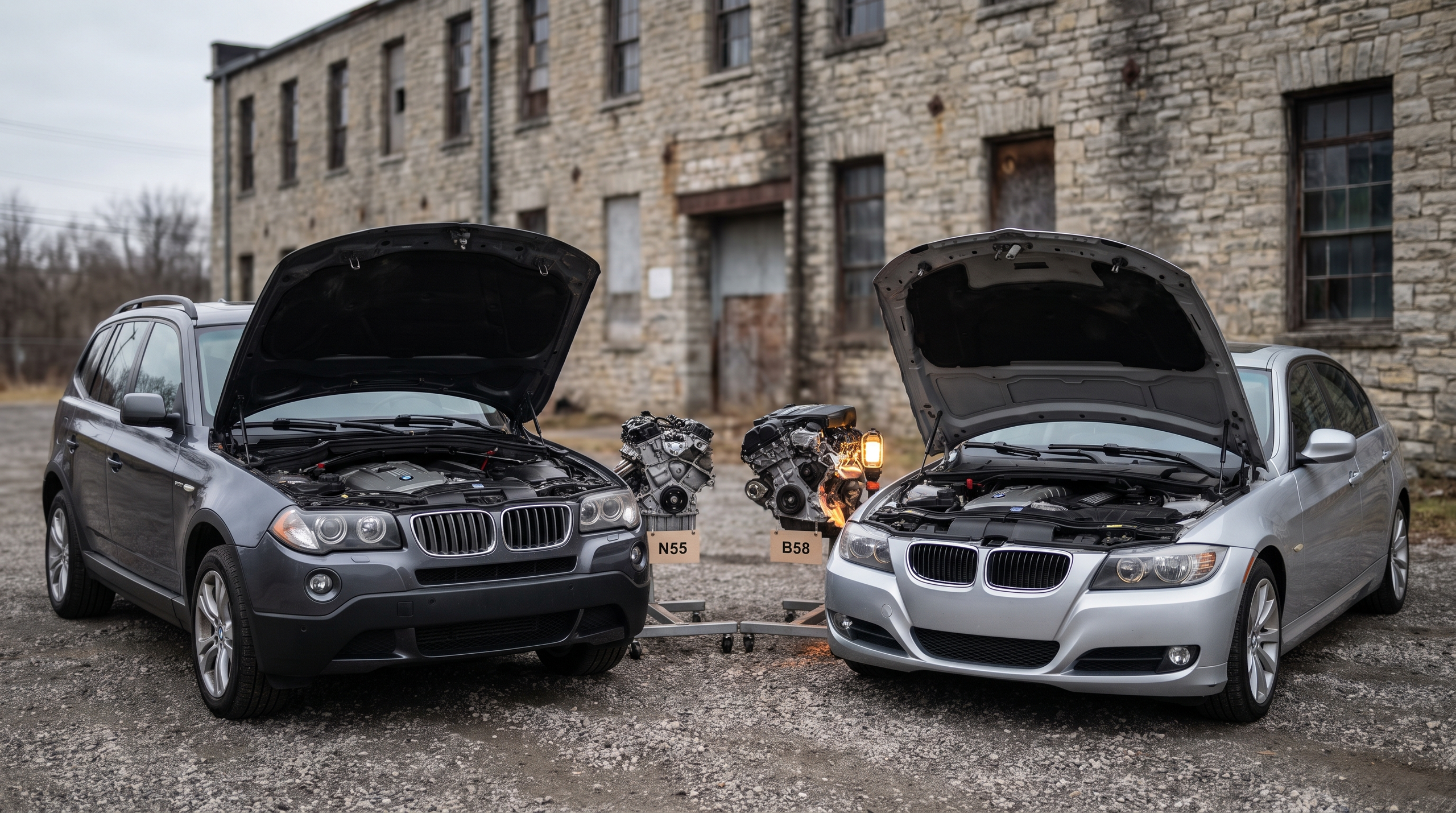
BMW X3 and 335i Oil Type: N52, N54, N55, B58 Engines
BMW X3 and 335i oil type specifications for N52, N54, N55, and B58 engines. Includes viscosity grades, capacities, and approved oil standards for each engine.
Introduction to BMW Engine Codes
I have watched the same mistake at the counter for years: someone walks in with a 335i, asks for 5W-30, and assumes any synthetic bottle will do. It will not. BMW engines are spec-driven, not viscosity-driven, and the approval on the bottle is what protects the variable valve timing solenoids, the turbo bearings, and the catalytic converter. The X3 and 335i share several engine codes across their production runs — N52, N54, N55, and B58 — and each one has a different oil requirement tied to its build date and emissions hardware.
The BMW X3 oil type depends on the engine, model year, and BMW specification required for the vehicle. Choosing the correct oil is crucial for lubrication, thermal stability, and engine protection. The 335i follows the same logic: the engine code determines the spec, and the spec determines which bottles you can legally run. BMW recommends using full synthetic oil that meets its approved specifications, such as BMW Longlife-01, Longlife-04, or Longlife-17 FE+.
Why Engine Codes Matter
BMW does not publish oil specs by model name. They publish them by engine code, because the same model year can carry two different engines depending on the production month or the market. A 2011 335i with an N54 takes LL-01; a 2011 335i with an N55 also takes LL-01 as the base US spec, but LL-04 is an approved alternative. The build date on the door jamb tells you which engine you have, and the engine code tells you which approval the oil must carry.
The N52 is a naturally aspirated inline-six that ran from 2005 to 2015 in the X3 and other platforms. It requires LL-01 and 5W-30 viscosity. The N54 and N55 are both turbocharged inline-sixes; the N54 ran from 2006 to 2013, and the N55 from 2009 to 2016. Both specify LL-01 as the base US approval, with LL-04 and LL-01 FE as BMW-approved alternatives. The B58, introduced in 2016, is the current turbocharged inline-six and runs LL-17 FE+ (0W-20) in the US market. In the EU, the B58 may run LL-01 or LL-04 5W-30, but the US spec is LL-17 FE+.
If you need to cross-reference BMW coolant specifications for the same platforms, the approval logic is identical: the spec on the bottle must match the factory requirement, and the model name alone does not tell you which spec that is.
What the Approval Means
The Longlife approval is a performance standard that BMW tests in-house. It covers oxidation stability, deposit control, friction modifiers, and compatibility with emissions hardware. LL-01 is the original high-SAPS (sulfated ash, phosphorus, sulfur) approval for engines without diesel particulate filters. LL-04 is a mid-SAPS approval developed for diesel engines with DPFs, but it is also approved for certain gasoline engines where BMW lists it. LL-17 FE+ is a low-viscosity, fuel-economy approval introduced for the B58 and other modern platforms.
The approval is printed on the back label of the bottle, usually in a box that says "Meets BMW Longlife-01" or "Approved to BMW LL-04." If the approval is not there, the oil does not meet the spec, regardless of the viscosity or the brand. At the counter, I check the back label first, then the viscosity, then the capacity. The order matters, because the approval is the gate: if it is missing, the rest is irrelevant.
N52 Engine: Oil Type and Capacity
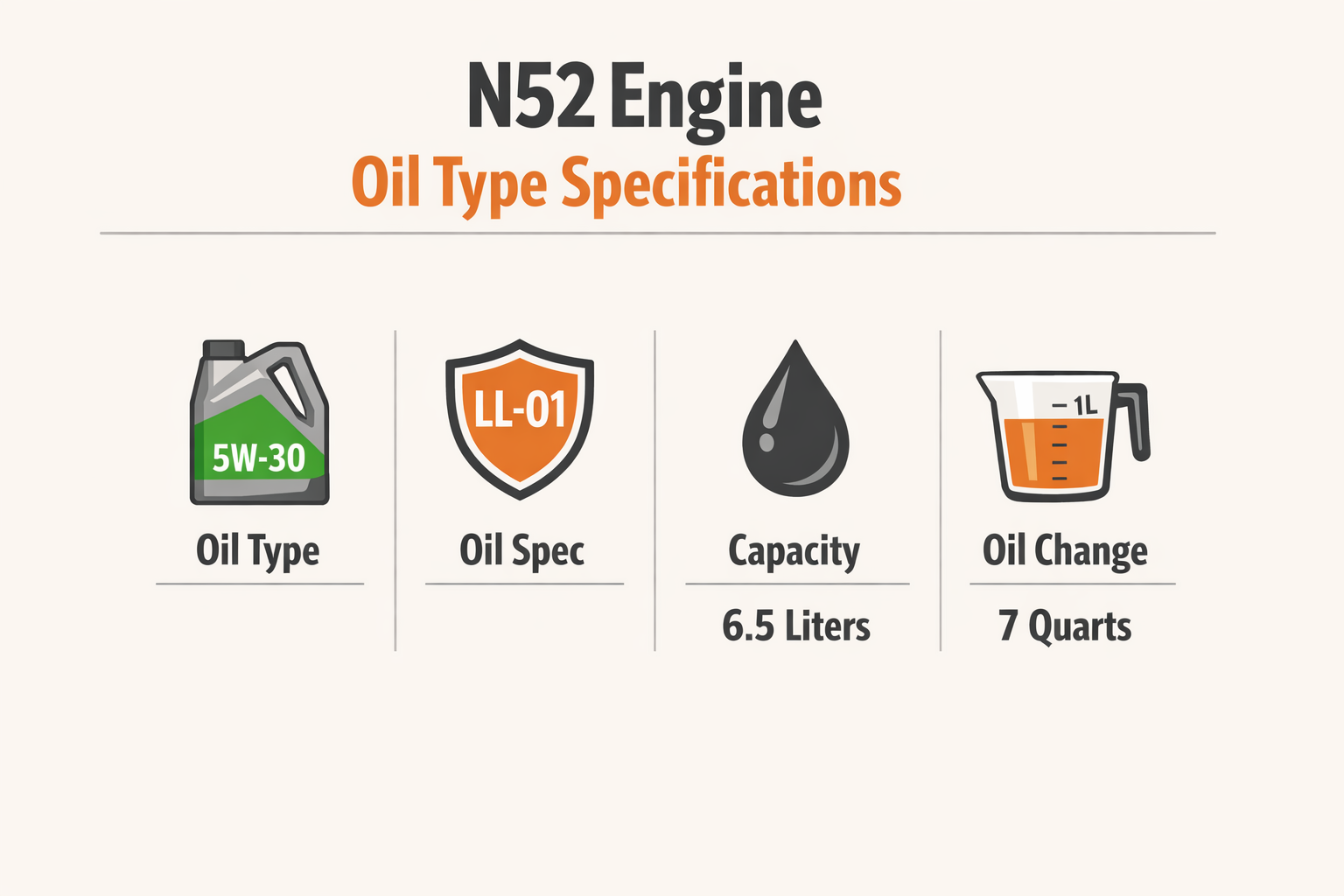
The N52 takes BMW LL-01 oil, 5W-30 viscosity. That approval has to be printed on the bottle — the viscosity alone does not tell you whether the additive package meets the specification. I have watched techs grab a generic 5W-30 off the shelf and pour it into an N52, and six months later the Valvetronic motor starts hunting because the oil film is not holding up under the eccentric shaft load.
What LL-01 Means and Where to Find It
LL-01 is BMW's approval for gasoline engines without a diesel particulate filter. The N52 ran from 2005 to 2015 in the 325i, 328i, 330i, X3, X5, and Z4. The approval appears on the back label of the oil bottle, usually in a block of manufacturer certifications. If the bottle does not say LL-01, it is not approved, regardless of what the viscosity or marketing copy claims.
The N52 oil capacity is 6.9 quarts with the filter. Some earlier N52 variants in the E90 and E60 chassis hold 6.5 quarts; the build date and engine suffix determine the exact figure, so check the dipstick tube or the capacity sticker under the hood. When you are at the counter and the customer says "328i," the first question is the year — 2007 through 2011 is N52, and the capacity is consistent at 6.9 quarts for those applications.
Common N52 Applications
The N52 appeared in multiple displacements: 2.5-liter (N52B25), 3.0-liter (N52B30), and a few 2.8-liter variants. The oil specification is the same across all of them — LL-01, 5W-30 — but the capacity varies slightly by block. The 3.0-liter N52B30 in the E90 335i (2006 only, before the N54 took over mid-year) and the E83 X3 3.0si uses 6.9 quarts. The 2.5-liter in the 325i and 525i uses 6.5 quarts.
If you are working on an X3 from 2007 to 2010 with the naturally aspirated inline-six, that is an N52. The turbocharged X3 models from 2011 onward switched to the N55, which we cover in a later section. The oil approval changed with that engine, so confirming the engine code before ordering oil is not optional.
The dipstick and the capacity sticker are right more often than the year and model alone — always check both before you drain.
For related European fluid specifications and approvals, see our guide on Mercedes-Benz Engine Oil: MB 229.5, 229.51, and 229.52 Approvals.
N54 Engine: Oil Type and Capacity
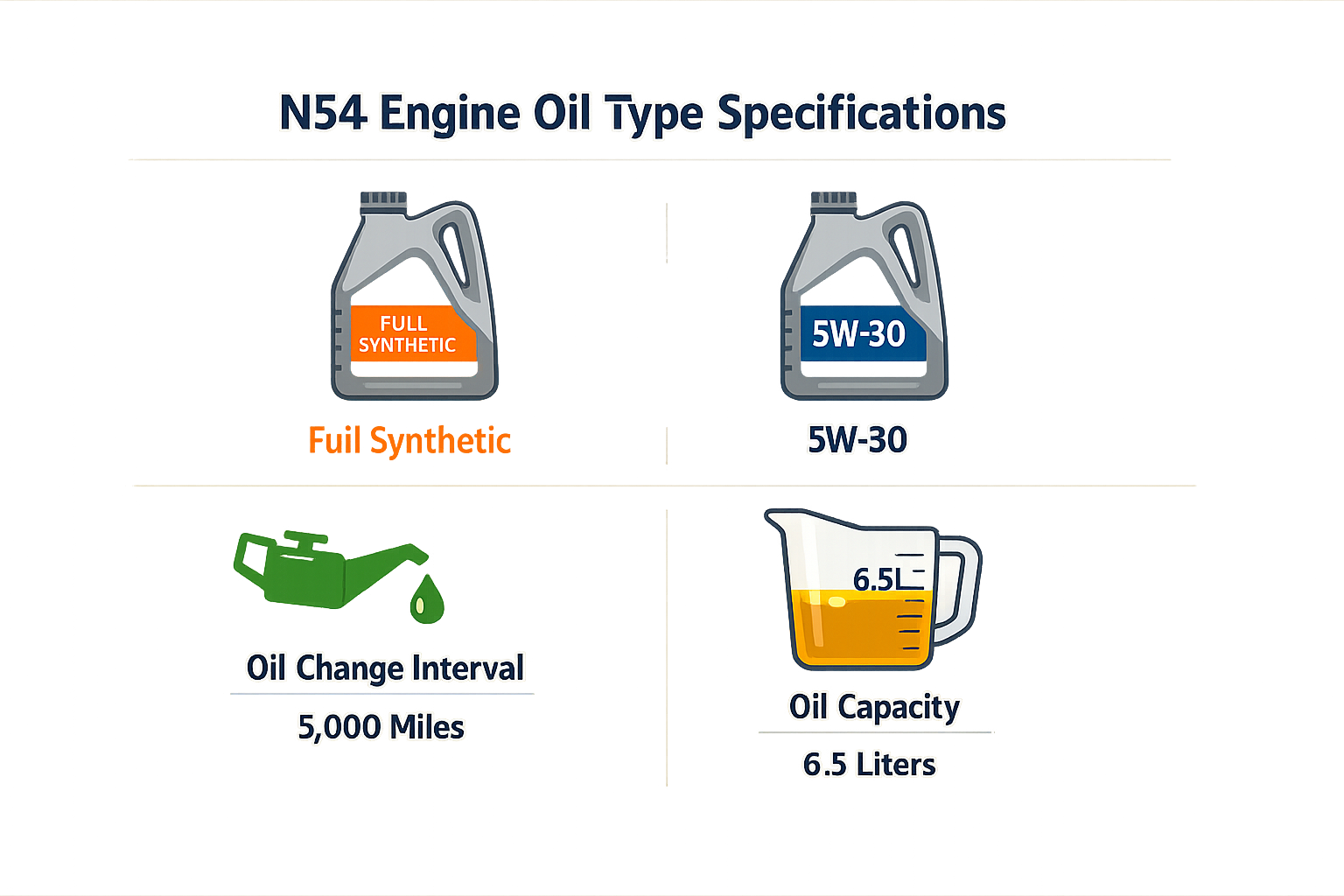
The N54 twin-turbo inline-six ran from 2006 through 2013 in the 335i, 135i, and some X6 models. I've watched more N54 owners chase high-pressure fuel-pump failures and turbo-seal leaks than any other single BMW platform, and the oil you run matters because the turbos live on it. BMW specifies LL-01 as the base approval in the US — that means 5W-30 viscosity. LL-04 and LL-01 FE are also BMW-approved options for the N54, so you have choices, but the approval printed on the bottle is what counts.
Approved Oil Specifications
LL-01 is the standard. Any 5W-30 that carries the BMW LL-01 sheet approval will meet the factory requirement. LL-04 is a lower-ash spec originally intended for European diesel particulate filters, but BMW lists it as an approved alternative for the N54 gasoline engine as well. LL-01 FE is a fuel-economy variant, also approved. Do not assume that a generic 5W-30 without the LL-01 approval will work — the HTHS viscosity, additive package, and evaporation limits are different, and the variable valve-timing solenoids and turbo bearings do not forgive it.
Oil Capacity and Service Interval
The N54 holds approximately 6.5 quarts with the filter. BMW's Condition Based Service system calculates the interval based on fuel quality, cold starts, and operating conditions, but the traditional 10,000-mile or one-year guideline still applies if you are not running the CBS monitor. I always recommend changing the filter at every oil service — the turbo oil-return path runs through it, and a restricted filter means oil backs up in the turbos. Use an OE or OE-supplier filter with the correct bypass-valve pressure rating; the cheap ones do not hold the same specs.
The turbos live on clean oil — run the interval too long or skip the filter, and the seals weep first.
Common Applications
The N54 powered the E90, E91, and E92 335i from 2007 to 2010, the E82 135i from 2008 to 2010, and the E71 X6 xDrive35i from 2009 to 2010. All of these applications use the same oil specification and capacity. If you are working on a 2011-2013 335i, check the build date — BMW began phasing in the N55 single-turbo engine during the 2011 model year, and the two engines require the same LL-01 approval but have different capacities and slightly different service procedures.
For more on BMW-specific fluid approvals and what happens when you mix specs, see our guide on BMW Coolant and Cooling Parts: What to Check Before Ordering.
N55 Engine: Oil Type and Capacity
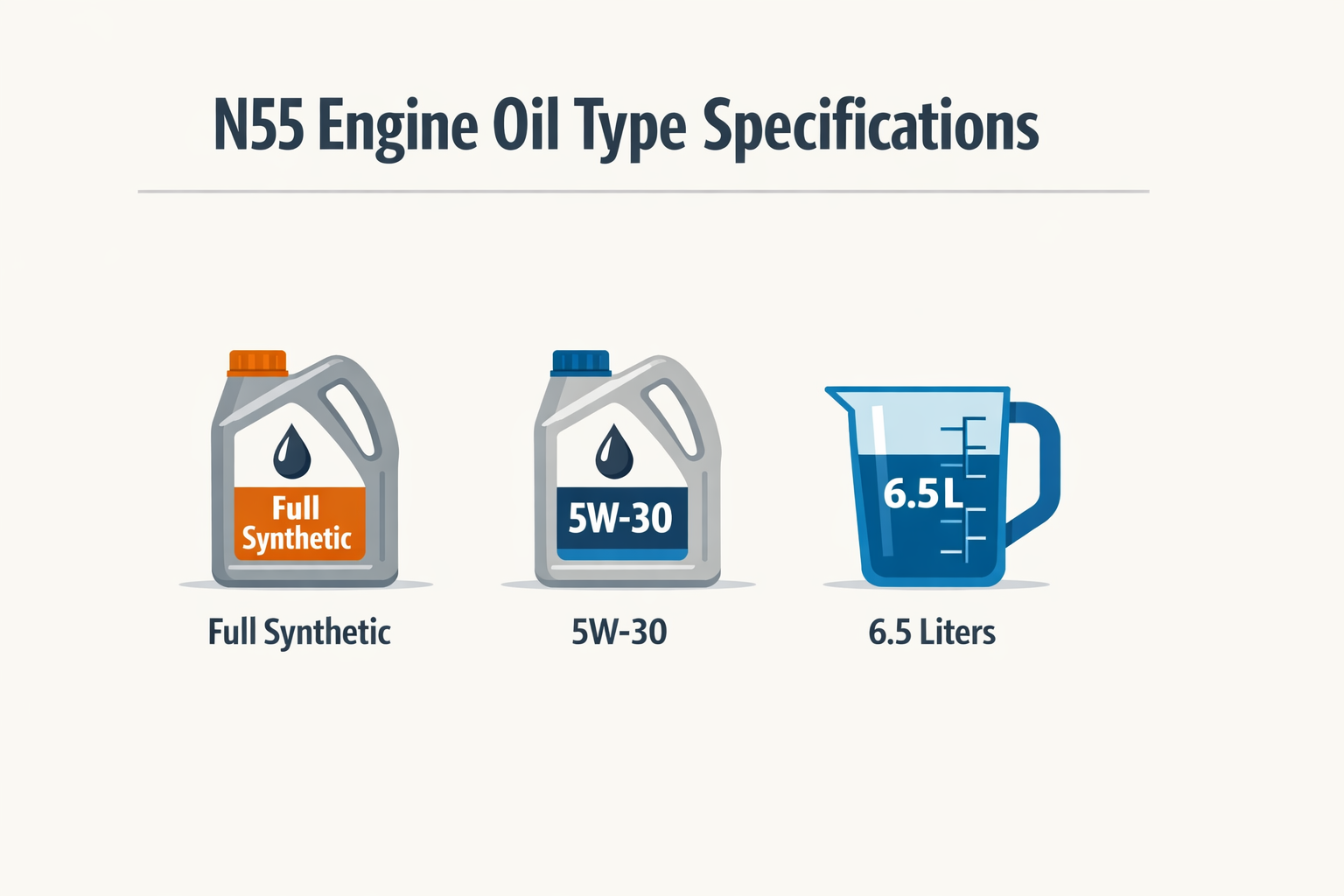
The N55 (2009–2016) runs the same base oil spec as the N54 it replaced: BMW LL-01, 5W-30 viscosity. I've sold hundreds of oil changes for these engines, and the approval printed on the bottle is what matters — the brand is secondary.
BMW X3 and 335i Oil Type for N55
LL-01 is the standard US specification. LL-04 and LL-01 FE are also BMW-approved options for the N55, so any of those approvals will work. Do not treat LL-04 as required — it is an approved alternative, not a replacement for LL-01. The bottle must carry one of those three approvals.
Capacity is 6.5 quarts with the filter for most N55 applications, including the 335i and many X3 models. Always run the oil change with a new filter — the filter is part of the service, not optional.
Common N55 Applications
The N55 powered the 2011–2016 335i, 2011–2013 X3 xDrive35i, and a range of other 3, 5, and X-series models through 2016. The single-turbo architecture made it more reliable than the twin-turbo N54, but the oil spec did not change. If you are running a generic 5W-30 without an LL-01, LL-04, or LL-01 FE approval, the variable valve timing components will eventually clog — the same consequence as the N54.
The N55 uses the same LL-01 base spec as the N54 — the single turbo changed the engine, not the oil requirement.
For detailed guidance on other European engine oil approvals and how they compare, see Mercedes-Benz Engine Oil: MB 229.5, 229.51, and 229.52 Approvals.
Check your build date and engine code before ordering. The N55 was phased out as the B58 arrived in 2016, and the B58 runs a different spec in the US market — covered in the next section.
B58 Engine: Oil Type and Capacity
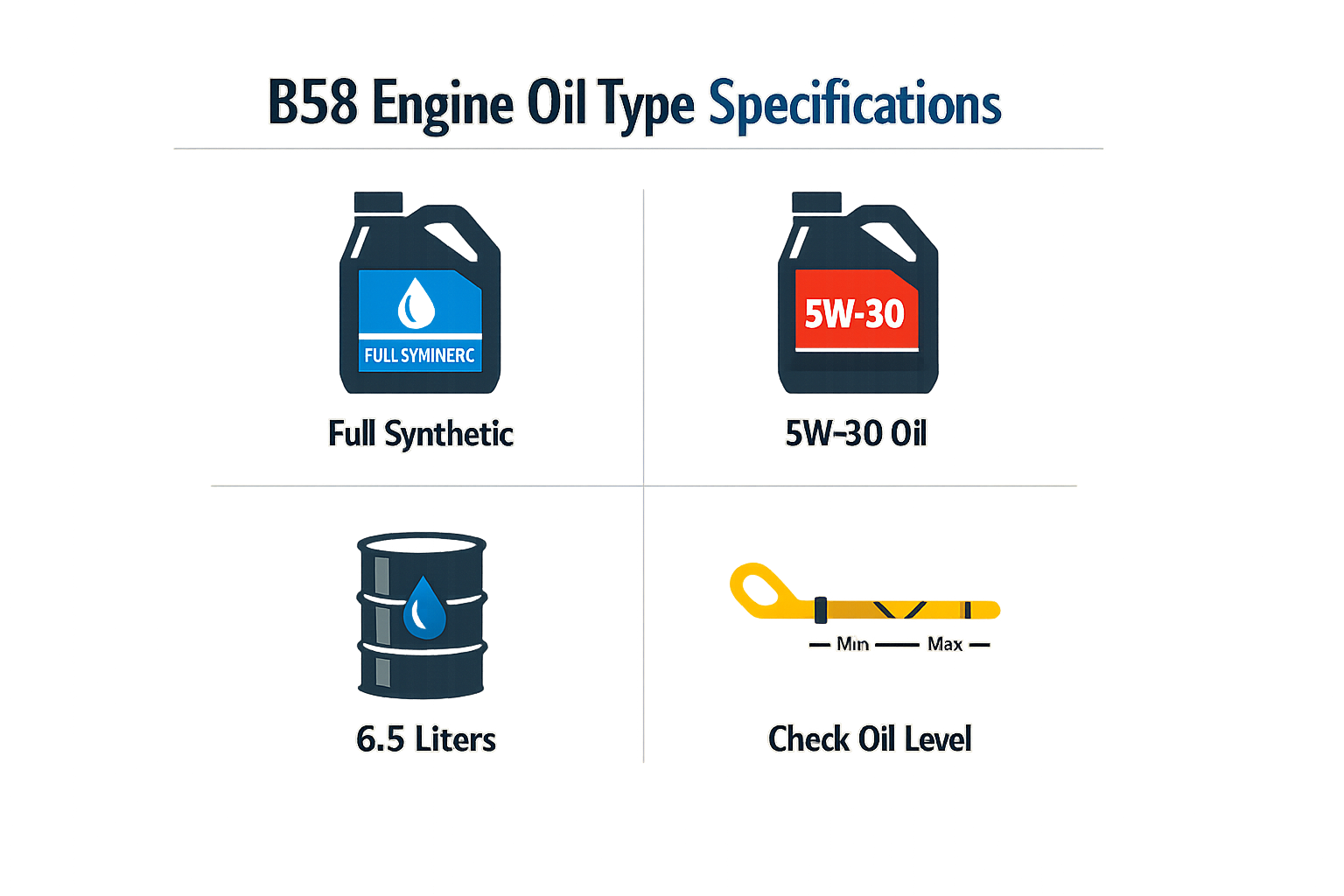
The B58 is BMW's current modular inline-six, and it runs a different oil spec than the N55 it replaced. In the US, the B58 (2016-present) requires LL-17 FE+ 0W-20. That is the current low-viscosity specification for this engine. You will see LL-12FE mentioned in older service literature — that is an older low-viscosity spec that LL-17 FE+ superseded. The approval printed on the bottle has to say LL-17 FE+.
BMW X3 and 335i Oil Type for B58 Applications
The B58 powers the X3 M40i (2018+) and the 340i (2016-2018, replaced by the M340i in 2020). The factory fill is 0W-20 full-synthetic meeting LL-17 FE+. In European markets, some B58 variants run LL-01 or LL-04 5W-30 — check the build date and the market the car was originally sold in. For US-spec cars, 0W-20 LL-17 FE+ is what the manual calls for and what the variable valve timing and turbo oil-feed passages are sized for.
Oil capacity for the B58 is approximately 6.9 quarts with the filter. Run it, let it settle for five minutes, then top to the mark on the dipstick. The interval is 10,000 miles or one year under the factory Condition-Based Service schedule, but many owners on extended highway use or track days cut that to 7,500 miles. I have watched B58 owners try to run a generic 5W-30 because it was what they had on the shelf — the low-oil light came on early, and the variable timing threw adaptation faults. The 0W-20 viscosity is not a fuel-economy gimmick; it is sized to the bearing clearances and the oil-pump pressure curve.
The 0W-20 viscosity is not a fuel-economy gimmick; it is sized to the bearing clearances and the oil-pump pressure curve.
When you order oil for a B58, verify the LL-17 FE+ approval on the product data sheet or the back label. Mixing LL-17 FE+ with LL-04 or LL-01 in an emergency top-up will not grenade the engine, but do not make it a habit — flush it at the next service and return to the specified 0W-20. The wrong viscosity changes the valve-timing response and the turbo oil-feed rate, and the adaptation maps cannot fully compensate.
Conclusion
I've watched too many BMW owners walk into the shop with sludged timing solenoids or worn cam lobes because they ran whatever was on sale at the big-box store. The approval printed on the bottle is not a suggestion — it's the difference between an engine that runs 200,000 miles and one that needs a rebuild at 80,000. The N52 takes LL-01 5W-30, the N54 and N55 run LL-01 as the base spec with LL-04 as an approved alternative, and the B58 in the US requires LL-17 FE+ 0W-20. Those are manufacturer requirements, not preferences.
The wrong oil does real damage. Run a generic 5W-30 without the LL-01 approval in an N54 and the variable timing solenoids clog first. Use an older LL-01 in a 2018 B58 when the build date calls for LL-17 FE+ and you're outside the viscosity envelope the engine was calibrated for. The oil capacity matters too — the N52 holds 6.9 quarts, the N54 and N55 take 6.5, and the B58 needs 5.8 to 6.9 depending on the filter. Overfill it and you aerate the oil; underfill it and you starve the bearings on hard cornering.
Check your build date, find the engine code on the valve cover or the door jamb sticker, and buy oil with the approval printed on it. If you're not sure which spec your car needs, the owner's manual is right about this — it lists the approval by model year and engine. Don't mix approvals, don't top off LL-17 FE+ with LL-01, and don't assume that because two bottles say "synthetic 5W-30" they're interchangeable. The chemistry is different and the additive packages are different. Run the right oil, change it on interval, and the engine will outlast the chassis. For more guidance on European fluid specifications and how to read manufacturer approvals, see our article on Mercedes-Benz Engine Oil: MB 229.5, 229.51, and 229.52 Approvals.
Related reading
Ceramic vs Semi-Metallic Brake Pads: Key Differences for European Cars
Written by
Lee Shahin
Founder, European Wholesale Parts
Lee Shahin founded European Wholesale Parts in Pleasanton, California, after 18 years in the Mercedes-Benz and BMW parts trade. He came to the parts side from the shop floor: he opened a European repair shop in Northern California in the early 1990s, specialising in Mercedes-Benz and BMW, and grew it with his wife Laurie into a parts and delivery operation serving body shops and independent repair facilities across the region. Nearly two decades at the parts counter taught him where the expensive mistakes happen, and most of them are fluids: the wrong coolant in an aluminium block, an oil without the sheet approval the engine was designed for, a transmission topped with the wrong ATF. That is what he writes about here. Every article names the manufacturer specification by its exact designation, explains what the wrong fluid does mechanically, lists products that carry the approval, and gives the capacity and interval for the models and years the specification covers. When a reader needs a part sourced, the quote desk at European Wholesale Parts is where Lee and Laurie still answer the phone.