
BMW M340i Intake vs Tune: Which Upgrade Should Come First?
Explore whether to upgrade your BMW M340i with an intake or tune first. Understand the benefits and risks of each BMW M340i Intake vs Tune option.
Introduction
Understanding the BMW M340i Intake vs Tune Decision
I've watched this question come up at the counter more times than I can count: should you put an intake on your M340i first, or go straight to a tune? The B58 engine in the M340i has strong tuning potential and handles modifications well, but the order you choose matters more than most people think. An intake changes airflow and sound; a tune changes fuel, timing, and boost. Do them in the wrong sequence and you can end up with a check-engine light or a car that runs leaner than it should.
The appeal of an intake is immediate—you hear it, you feel the throttle response sharpen, and the install is straightforward. Consumer interest in M340i intakes is heavily driven by sound improvements and throttle response enhancements. But an intake alone adds minimal horsepower on a stock tune because the factory ECU isn't programmed to take advantage of the increased airflow. You get the sound, but you leave power on the table.
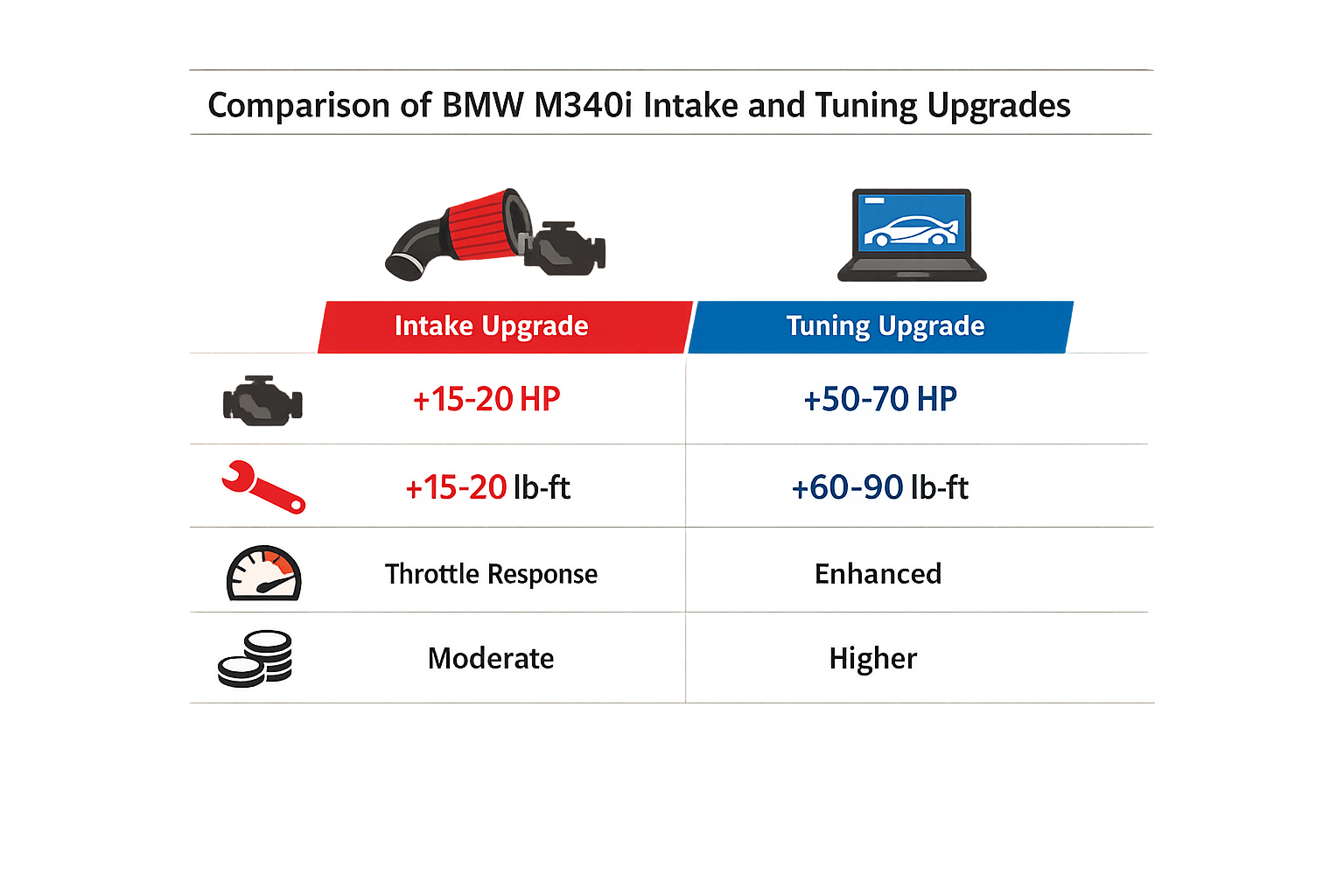
A tune, on the other hand, reprograms the engine's fuel and boost maps to deliver real horsepower and torque gains—often 50 to 80 wheel horsepower depending on the tuner and supporting mods. The factory tune is conservative; a quality flash unlocks what the B58 was built to handle. But once you tune, the car expects a certain airflow profile. If you then bolt on an intake, the tune may need adjustment to prevent running lean or throwing codes.
The question isn't whether both upgrades are worth doing—they are. The question is which one you do first, and whether you're prepared to retune after adding the intake. If you want sound and feel now and plan to tune later, the intake-first route works, but expect to pay for a retune when you flash the ECU. If you want power now and sound later, tune first, then add the intake and have the tuner adjust the map. For more on maintaining your BMW's cooling system during performance upgrades, see BMW Coolant and Cooling Parts: What to Check Before Ordering.
In the sections ahead, I'll walk through the problem each upgrade solves, the sequence that makes mechanical sense, and the practical tips that keep you from paying twice for the same result.
Problem Statement
The question comes up every week at the counter: intake first or tune first on a G20 M340i? I've watched people burn through charge pipes and plumbing because they picked the wrong order, and I've seen others waste money on an intake that does nothing until the ECU is unlocked. The dilemma is real, and the wrong choice costs you time and parts.
The M340i's B58 engine is already running high boost from the factory — around 20 psi peak on the stock map. An aftermarket intake by itself doesn't change the fueling or timing, so you're pulling in more air that the ECU isn't programmed to use. The result is negligible power gain, maybe 5–10 hp if the intake is well-designed, and that's optimistic. You've spent $400–$600 on a part that sounds better but doesn't move the needle.
The Tune-First Problem
Flip it around: tune first, stock intake. Now the ECU is asking for more air and more boost — often 24–26 psi depending on the file — and the factory airbox and turbo inlet are working overtime. The plastic charge pipe that connects the turbo to the intercooler is the weak link here. I've seen charge pipes crack or blow off under the higher pressure, especially during aggressive pulls or hot-weather driving. When it goes, you get an instant loss of boost, rough acceleration, and a check-engine light. The car is undriveable until you replace the pipe, and you're looking at $200–$400 for an upgraded aluminum unit that should have gone in before the tune.
The Real Cost of Getting It Wrong
Most owners don't budget for both upgrades at once, so they pick one and plan to do the other later. If you go intake-only, you've bought a part that won't deliver its potential until you tune, which means you're driving around with an incomplete modification and no meaningful performance gain. If you go tune-only, you're running elevated boost on stock plumbing that wasn't designed for it, and the charge pipe is the first thing that fails. Either way, the wrong sequence means you're either leaving power on the table or risking a breakdown that sidelines the car.
The dilemma isn't just about power — it's about reliability and cost. An intake on a stock tune is low-risk but low-reward. A tune on stock plumbing is high-reward but high-risk. The question is which risk you're willing to manage, and in what order the parts should go on the car to avoid both wasted money and a failure that could have been prevented.
Solution Steps
Step 1: Start with the Tune
I tell every M340i owner the same thing at the counter: tune first. The ECU calibration unlocks power the engine already has — boost pressure, timing, fuel delivery — and you feel it immediately. An intake by itself changes the sound more than the dyno sheet. The tune rewrites the map; the intake just feeds it air, and the stock airbox does that job already.
A quality tune delivers measurable gains in throttle response and power output. When you add an intake later, the tuner can adjust the calibration to account for the increased airflow, but the tune itself is what moves the needle. Run the tune on the stock intake for a few thousand miles. You will know what the car does, and you will know whether you want more sound or more flow when you add hardware.
Step 2: Add the Intake After the Tune
Once the tune is in and you have driven the car, add the intake. A cold air intake delivers measurable gains in throttle response, intake sound, and power output, particularly when paired with an ECU tune. The intake does not make big power on its own, but it supports the tune and changes the character of the car — you hear the turbo spool, you hear the bypass valve, and the engine pulls harder in the upper RPM range where the stock box starts to choke.
Order the intake, install it, and take the car back to the tuner for a re-flash. The revised map accounts for the increased airflow and keeps the air-fuel ratio where it needs to be. Skip the re-flash and you risk running lean under load, especially in high ambient temperatures. The tune and the intake work together; neither one is optional once you have both.
Step 1
Install the intake and schedule the re-flash
Fit the intake according to the manufacturer's instructions, then book the tuner within the same week. The re-flash takes twenty minutes and ensures the ECU sees the new airflow correctly. Do not drive hard until the re-flash is done.
Step 3: Plan for Stage 2 Hardware If You Want More
If the intake and tune are not enough, the next step is Stage 2 hardware: a high-flow downpipe, an upgraded intercooler, and a performance intake system. For a Stage 2 tune, it is recommended to use these components together to ensure reliability and performance, especially in high ambient temperatures. The downpipe reduces backpressure, the intercooler keeps charge temps down, and the intake feeds the turbo the volume it needs at higher boost.
Stage 2 is a different commitment. You are changing exhaust components, which means emissions compliance becomes a question depending on where you live. You are also pushing the turbo, the fuel system, and the ignition components harder, so service intervals shorten. For tuned M340i models, service intervals for ignition components like spark plugs and coils should be shorter than stock recommendations to prevent misfires and performance issues. Budget for more frequent plug changes and keep an eye on the coils.
Step 4: Understand the Warranty Trade-Off
Both the intake and the tune affect your factory warranty, but the tune is the one that shows up in the ECU. BMW can see the flash counter and the modified maps when the car comes in for service. Some dealers will deny a powertrain claim if they find a tune, even if the failure is unrelated. The intake is visible but less definitive — it is a bolt-on part, and you can argue it is just an airflow improvement.
If the car is still under warranty and you plan to keep it that way, think carefully before you tune. If the warranty has expired or you are willing to accept the risk, the tune is the better first step. Either way, document everything: keep the invoice, keep the stock file, and know which tuner you used. If something breaks and you need to go back to stock, you want that process to be fast.
For more on maintaining your BMW's cooling system and ensuring longevity after performance upgrades, see BMW Coolant and Cooling Parts: What to Check Before Ordering.
Tips and Tricks
I've watched too many M340i owners spend money twice because they didn't think about sound, warranty, and the order of operations. Here's what matters before you order anything.
Check Your Warranty Status First
If you're still under factory coverage, a tune voids powertrain warranty the moment it touches the ECU. Dealers can and do pull flash logs. An intake is visible but doesn't alter calibration, so it's a softer line — though some dealers still flag it. If you're inside warranty and want the tune, accept that you're self-insuring the engine from that point forward. If that's not acceptable, wait or stick to bolt-ons.
Sound Is Part of the Decision
The stock M340i intake is quiet. A carbon fiber intake changes that — you hear turbo spool, you hear the induction note under throttle, and it's louder at cruise. Some people buy the intake for the sound alone. If you tune first, you get power but the stock intake stays silent. If sound matters to you, the intake delivers it immediately. The tune doesn't.
Performance Gains Are Modest on Stock Tune
Premium carbon fiber intakes for the M340i show documented gains of around +9 WHP and +8 lb-ft torque on stock vehicles. That's real, but it's not transformative. You feel it in throttle response more than seat-of-the-pants acceleration. The intake's bigger contribution is feeding the turbo when the tune asks for more boost — which is why the intake-then-tune sequence makes mechanical sense, even if the intake alone is underwhelming.
Symptoms That Point to an Intake Upgrade
Flat mid-range throttle response, slow turbo spool, and a stock sound that doesn't match your performance expectations are the usual signs. If you're chasing peak power, the tune is the answer. If you're chasing response and sound, the intake moves the needle. If you're chasing both, do the intake first so the tune has clean air to work with.
Example: AWE S-FLO Carbon Intake
The AWE S-FLO carbon intake for the B58-equipped M340i is a common choice — it's a well-engineered piece that improves airflow and delivers a distinctive intake sound. It's not the only option, but it's representative of what a quality intake does: better flow, more noise, modest power gain, and a platform for the tune to build on. The part itself doesn't require recalibration, so you can run it on the stock map indefinitely if you choose.
Don't Mix Cheap Intakes with Aggressive Tunes
A budget intake with a poorly designed filter or a leaky seal can introduce unmetered air, which throws off the MAF reading. When you add an aggressive tune on top of that, the ECU is working with bad data and the result is usually a check engine light or a rich/lean condition that costs power. If you're going to tune, use an intake that's been validated on the platform. The savings on a cheap intake disappear the first time you're chasing a fuel trim code.
Conclusion
I've watched hundreds of M340i owners walk through the same decision at the counter, and the answer is always the same: tune first. The ECU calibration unlocks the power the B58 already makes; the intake changes the sound and maybe adds five horsepower if the tune is already there. Start with a Stage 1 flash, drive it for a month, then decide if you want the intake for the induction noise. The other way around leaves power on the table and teaches you nothing about what the engine actually needs.
The warranty question is real, and I tell customers this every time: the moment you flash the ECU, you own the drivetrain risk. BMW's TD1 flag is permanent, and any claim that touches the engine, transmission, or emissions system will be denied if the dealer pulls the code. An intake alone usually flies under the radar unless it causes a check-engine light, but it also does almost nothing by itself. If you're not ready to accept that trade, keep the car stock and save the money for the next one.
Making the Right Choice for Your Build
For most drivers, a Stage 1 tune delivers the best return: 80–100 horsepower, sharper throttle response, and a car that finally feels like it matches the M340i badge. Add the intake later if you want the sound, but don't expect it to move the needle on the dyno. If you're chasing serious power—440+ horsepower—you need both, plus a catted downpipe and the tuner's custom map to make the hardware work together. A well-calibrated Stage 2 setup consistently delivers 440–460 bhp and 590–625 Nm at the crank, representing a gain of around 120 bhp and 175 Nm over the factory figures.
The cheapest way costs more in the long run. Buy the tune from a shop that offers revisions, not a one-size map off a forum. Use the intake the tuner recommends, or skip it entirely if they say the stock airbox flows enough. And if you're serious about keeping the car past warranty, budget for an oil analysis every 5,000 miles and watch the knock counts—because the B58 will tell you when the tune is too aggressive, but only if you're paying attention.
For related guidance on maintaining your BMW's cooling system and ensuring proper fluid specifications, see BMW Coolant and Cooling Parts: What to Check Before Ordering.
Written by
Lee Shahin
Founder, European Wholesale Parts
Lee Shahin founded European Wholesale Parts in Pleasanton, California, after 18 years in the Mercedes-Benz and BMW parts trade. He came to the parts side from the shop floor: he opened a European repair shop in Northern California in the early 1990s, specialising in Mercedes-Benz and BMW, and grew it with his wife Laurie into a parts and delivery operation serving body shops and independent repair facilities across the region. Nearly two decades at the parts counter taught him where the expensive mistakes happen, and most of them are fluids: the wrong coolant in an aluminium block, an oil without the sheet approval the engine was designed for, a transmission topped with the wrong ATF. That is what he writes about here. Every article names the manufacturer specification by its exact designation, explains what the wrong fluid does mechanically, lists products that carry the approval, and gives the capacity and interval for the models and years the specification covers. When a reader needs a part sourced, the quote desk at European Wholesale Parts is where Lee and Laurie still answer the phone.