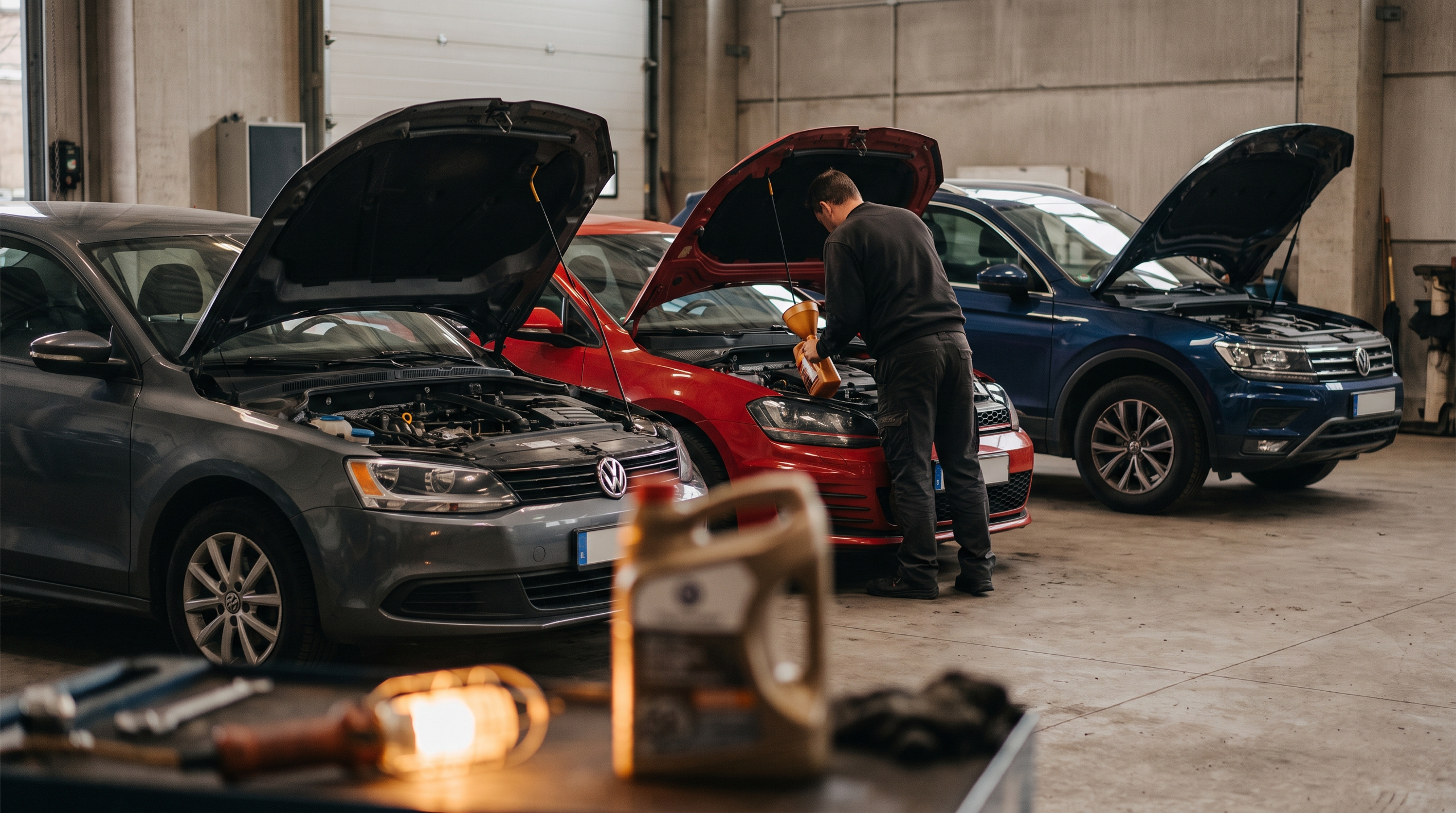
VW Jetta GTI Tiguan Oil Types for 1.8T, 2.0T, TDI Engines
VW Jetta GTI Tiguan oil types for 1.8T, 2.0T, TDI engines are VW 502.00 for gasoline turbos, VW 507.00 for diesels with particulate filters, and VW 508.00 for newer low-viscosity applications.
Introduction
VW Jetta GTI Tiguan oil types for 1.8T, 2.0T, TDI engines are VW 502.00 for gasoline turbos, VW 507.00 for diesels with particulate filters, and VW 508.00 for newer low-viscosity applications. These numbered specifications define additive chemistry, ash content, and viscosity stability under thermal stress—not marketing categories, but engineering boundaries that protect variable valve timing systems, turbocharger bearings, and emissions hardware that costs thousands to replace when contaminated by the wrong lubricant.
After years of sourcing OEM parts for European makes, I've seen what happens when owners treat VW oil specs as suggestions rather than requirements—the damage shows up in ways that don't trigger check-engine lights until it's expensive.
VW publishes numbered oil specifications that define additive chemistry, ash content, and viscosity stability under thermal stress. The 502 00 spec covers most gasoline engines; 507 00 handles modern diesels with particulate filters. These aren't marketing categories. They're engineering boundaries that protect variable valve timing systems, turbocharger bearings, and emissions hardware that costs thousands to replace when contaminated by the wrong lubricant.
This guide walks through the exact oil type each engine requires, the capacity you'll need for a complete change, and why understanding Mercedes-Benz engine oil approvals follows similar logic—European manufacturers write specs to protect specific hardware, not to upsell premium products. You'll learn how to identify the correct VW specification from your owner's manual, what happens when you substitute a cheaper alternative, and how to avoid the most common mistakes that turn routine maintenance into catastrophic failure.
The 1.8T, 2.0T, and TDI engines share platforms across Jetta, GTI, and Tiguan models, but their oil requirements diverge based on combustion type and emissions equipment. Gasoline turbos run hotter and demand different detergent packages than diesels with soot-loaded filters. Mixing these requirements doesn't cause immediate seizure—it causes gradual deposit buildup that chokes variable cam phasers and clogs oil pickup screens until oil pressure drops below safe thresholds during highway merges.
What follows is a specification-first breakdown of each engine's oil type, the capacity you'll measure at the drain pan, and the maintenance habits that keep these engines running past 200,000 miles without major intervention.
Problem Statement
Walking into a quick-lube with a VW Jetta, GTI, or Tiguan and accepting whatever "full synthetic" they pour is how you end up with a timing chain rattle at 80,000 miles. The bottle says synthetic; the engine doesn't care. What matters is the VW approval number printed on the back label — 502.00, 504.00, 507.00 — and most generic shelf oils don't carry it. Without that spec, you're guessing.
The Real Cost of Wrong Oil
VW's 1.8T, 2.0T, and TDI engines were engineered around specific additive packages and viscosity windows. Use an oil that lacks the VW approval, and you introduce three failure modes: sludge accumulation in the valve train, premature wear on timing chain tensioners, and accelerated turbocharger bearing degradation. All three show up after the fact — long after the oil change receipt is filed.
The 2.0T TSI in the GTI is particularly sensitive. Its direct-injection system runs higher combustion temperatures, which means oil oxidation happens faster. An oil formulated to VW 502.00 includes detergents and anti-wear agents calibrated for that thermal load. A generic 5W-30 with an API rating but no VW approval doesn't. The result: carbon buildup on intake valves and cam follower wear that manifests as a ticking sound on cold starts.
TDI engines add another layer. The 504.00 and 507.00 specs exist specifically to protect diesel particulate filters and exhaust after-treatment systems. Use an oil with the wrong ash content, and you poison the DPF within 20,000 miles. Replacement cost: $2,500 to $4,000. The oil you saved $8 on just became the most expensive maintenance decision you'll make.
The approval number on the oil bottle is the only guarantee that the formulation passed VW's internal engine bench tests — API and ILSAC ratings are not substitutes.
Even among synthetic oils that meet a VW spec, viscosity grade matters. A 2015 Tiguan with the EA888 Gen 3 engine calls for 5W-30 VW 502.00 in moderate climates, but 0W-30 or 0W-40 in extreme cold or sustained high-load operation. Running 5W-40 year-round in a hot climate won't hurt, but running 10W-40 in a Minnesota winter will starve the variable valve timing solenoids during cold starts. The spec sheet in your owner's manual lists the approved viscosity range by ambient temperature — follow it.
If you've been running the wrong oil for multiple intervals, the damage is cumulative but not always catastrophic. Switching to the correct spec now limits further wear, but it won't reverse sludge that's already baked onto internal surfaces. In that case, consider an oil flush or short-interval changes (3,000 miles instead of 10,000) for the next two cycles to clean out residual contamination.
What VW Jetta GTI Tiguan Oil Types Do 1.8T, 2.0T, and TDI Engines Require?
Identifying the correct oil for your VW requires more than matching viscosity numbers. The approval code printed on the bottle matters more than the weight, and your owner's manual is the only source that lists both for your specific engine and model year.
Step 1: Locate Your Owner's Manual Oil Specification
Step 1
Find the VW approval number
Open your owner's manual to the maintenance section and locate the oil specification table. You're looking for a VW approval code—typically VW 502.00 for older turbocharged petrol engines or VW 508.00 for newer models. The viscosity (0W-20, 5W-30, etc.) is listed alongside the approval, but the approval number is what qualifies the oil for your engine's internal tolerances and service intervals.
The approval code ensures the oil meets Volkswagen's testing protocol for wear protection, sludge resistance, and turbocharger compatibility. Viscosity alone does not guarantee these properties.
Step 2: Cross-Reference Engine Type and Model Year
Step 2
Match engine code to oil requirement
Confirm your engine code from the vehicle identification sticker under the hood or in the driver's door jamb. For 1.8T and 2.0T engines in Jetta, GTI, and Tiguan models from recent years, the required oil is typically 0W-20 meeting VW 508.00. Older 1.8T and 2.0T variants may specify VW 502.00 with 5W-30 or 5W-40 viscosity. TDI diesel engines have separate approval requirements—consult the manual for the exact code.
Newer Tiguan models with the 2.0L turbocharged TSI engine use 0W-20 oil with a capacity of approximately 4.7 quarts. The 2024 Jetta with a 1.5L turbocharged TSI engine similarly requires 0W-20 and holds around 4.5 quarts. These capacities and specifications shift between model years, so the manual is authoritative.
Step 3: Verify the Approval on the Oil Bottle
Step 3
Check the back label for VW approval
Before purchasing, flip the oil bottle and scan the back label for the VW approval number your manual specifies. The approval will appear as "VW 502.00" or "VW 508.00" in the approvals section, often alongside other manufacturer codes. If the bottle lists only viscosity and API/ACEA ratings without the VW approval, it is not confirmed compatible regardless of marketing claims on the front.
For additional guidance on manufacturer-specific fluid approvals and how they differ across European makes, see Mercedes-Benz Engine Oil Approvals: MB 229.5, 229.51, 229.52 and Mercedes 229.5 Oil: Approval Requirements and Compatible Oils.
Step 4: Record Capacity and Service Interval
Once you've confirmed the approval and viscosity, note the oil capacity from the manual—this prevents overfilling or running short during a change. Service intervals are also listed in the manual and vary by approval: VW 508.00 oils typically support longer intervals than VW 502.00, but only if the oil carries that approval and you follow the prescribed change schedule.
Tips and Tricks for Maintaining Your VW's Engine
Maintaining your VW Jetta, GTI, or Tiguan engine goes beyond choosing the correct oil specification. The interval you follow, the conditions you drive in, and the certification you verify all determine whether the oil actually protects the engine or simply meets a marketing claim.
Verify VW Certification, Not Marketing Language
Oil companies print confusing phrases on bottles—"meets," "suitable for," or "recommended for" VW specifications. None of those mean the oil passed VW's approval process. Only use oil that carries the actual VW certification number for your engine. If the bottle does not print the VW 502.00, 504.00, or 507.00 approval on the label, it is not approved, regardless of what the marketing copy suggests.
Follow Severe-Service Intervals for Real-World Driving
VW's standard oil change interval assumes highway driving in moderate climates. If you make short trips, idle frequently, drive in extreme heat or cold, or tow loads, you are operating under severe-service conditions. For these scenarios, cut the standard interval in half. A 2.0T engine rated for a 10,000-mile interval should get fresh oil at 5,000 miles if you drive mostly short trips or in stop-and-go traffic. Severe service accelerates oil breakdown and contaminant accumulation faster than the standard interval accounts for.
Understand Modern Viscosity Requirements
Modern VW engines, including the 2.0 TSI, require oils with ultra-low viscosity for improved fuel economy. These engines are designed with tighter clearances and expect the oil to flow quickly at startup. Using a heavier viscosity than specified—even if it carries the correct approval—can starve oil-fed components during cold starts and reduce fuel efficiency. Stick to the viscosity grade printed in your owner's manual, not the viscosity you used in older vehicles.
The cheapest way to extend engine life is to change the oil before the oil degrades, not when the dashboard reminder appears.
Keep Records and Check for Leaks
Document every oil change with the date, mileage, and oil specification used. If you sell the vehicle or need warranty coverage, a complete service history proves you maintained the engine correctly. Between changes, check the oil level monthly and inspect the engine bay for leaks around the valve cover, oil filter housing, and oil pan. Low oil level causes more engine damage than wrong oil specification, and a small leak becomes a large repair if ignored.
For additional guidance on European vehicle fluid maintenance, see our Mercedes-Benz Engine Oil Approvals: MB 229.5, 229.51, 229.52 article and DOT 4 vs DOT 5.1 Brake Fluid for European Cars: Key Differences, which cover similar approval structures used across German manufacturers.
Frequently Asked Questions About VW Jetta GTI Tiguan Oil Types
Can I use 5W-30 instead of 0W-20 in my VW Jetta GTI Tiguan?
No. If your manual specifies 0W-20 VW 508.00, using 5W-30—even with VW approval—introduces higher cold-start viscosity that can starve variable valve timing solenoids and reduce fuel economy. Modern VW engines are designed with tighter clearances that require the exact viscosity grade listed in your owner's manual.
What happens if I use oil without VW approval?
Oil lacking the correct VW approval number may void your powertrain warranty and accelerate wear on timing chain tensioners, turbocharger bearings, and variable valve timing components. Dealers can detect unapproved formulations through oil analysis during warranty claims, and the chemical signature will be evident.
How often should I change oil in my VW Jetta GTI Tiguan?
VW's standard interval assumes highway driving in moderate climates. For severe service—short trips, frequent idling, extreme temperatures, or towing—cut the interval in half. A 2.0T engine rated for 10,000 miles should receive fresh oil at 5,000 miles under severe-service conditions to prevent accelerated oil breakdown and contaminant accumulation.
Do VW Jetta GTI Tiguan oil types differ between 1.8T, 2.0T, and TDI engines?
Yes. Gasoline 1.8T and 2.0T engines typically require VW 502.00 or 508.00, while TDI diesel engines demand VW 507.00 to protect diesel particulate filters. Using gasoline-spec oil in a TDI or diesel-spec oil in a gasoline engine will damage emissions hardware and void warranty coverage.
Can I mix different VW-approved oils?
Mixing oils with different VW approval numbers (e.g., 502.00 and 507.00) is not recommended. Each approval defines specific additive chemistry and ash content tailored to gasoline or diesel combustion. Mixing formulations dilutes the protective properties and can contaminate emissions systems, particularly diesel particulate filters.
Conclusion
Using the correct oil type for your VW Jetta, GTI, or Tiguan with 1.8T, 2.0T, or TDI engines is not a suggestion—it's a requirement for protecting the investment you made when you bought the vehicle. The VW 502 00, 504 00, and 507 00 specifications exist because these engines operate under conditions that demand precise viscosity stability, additive chemistry, and ash limits. Choosing oil based on price or convenience instead of the specification stamped in your owner's manual is choosing a shorter engine life.
The interval debate—factory 10,000 miles versus owner-preferred 5,000 to 7,500 miles—comes down to how you use the vehicle and how long you plan to keep it. Short trips, cold starts, and turbo heat cycles all degrade oil faster than the laboratory conditions that set the official interval. Many experienced owners split the difference and change every 7,500 miles with a 508-spec synthetic, which gives margin without waste. After years of sourcing VW-spec fluids and watching what fails when the wrong product goes in, I can tell you that the owners who follow the spec and shorten the interval are the ones who don't show up with sludge at 80,000 miles.
If you're uncertain about your specific engine or model year, verify the specification in the service booklet or the oil filler cap—not a forum post, not a quick-lube menu board. The approved oil list changes as formulations are tested and certified, so cross-checking with current VW documentation or a trusted fluid specification resource keeps you on the right side of warranty terms and engine longevity. The small effort to confirm the spec now prevents the large expense of correcting an oil-related failure later.
Learn the correct oil types for VW Jetta, GTI, and Tiguan with 1.8T, 2.0T, and TDI engines. Ensure optimal performance and longevity.
Written by
Lee Shahin
Founder, European Wholesale Parts
Lee Shahin founded European Wholesale Parts in Pleasanton, California, after 18 years in the Mercedes-Benz and BMW parts trade. He came to the parts side from the shop floor: he opened a European repair shop in Northern California in the early 1990s, specialising in Mercedes-Benz and BMW, and grew it with his wife Laurie into a parts and delivery operation serving body shops and independent repair facilities across the region. Nearly two decades at the parts counter taught him where the expensive mistakes happen, and most of them are fluids: the wrong coolant in an aluminium block, an oil without the sheet approval the engine was designed for, a transmission topped with the wrong ATF. That is what he writes about here. Every article names the manufacturer specification by its exact designation, explains what the wrong fluid does mechanically, lists products that carry the approval, and gives the capacity and interval for the models and years the specification covers. When a reader needs a part sourced, the quote desk at European Wholesale Parts is where Lee and Laurie still answer the phone.