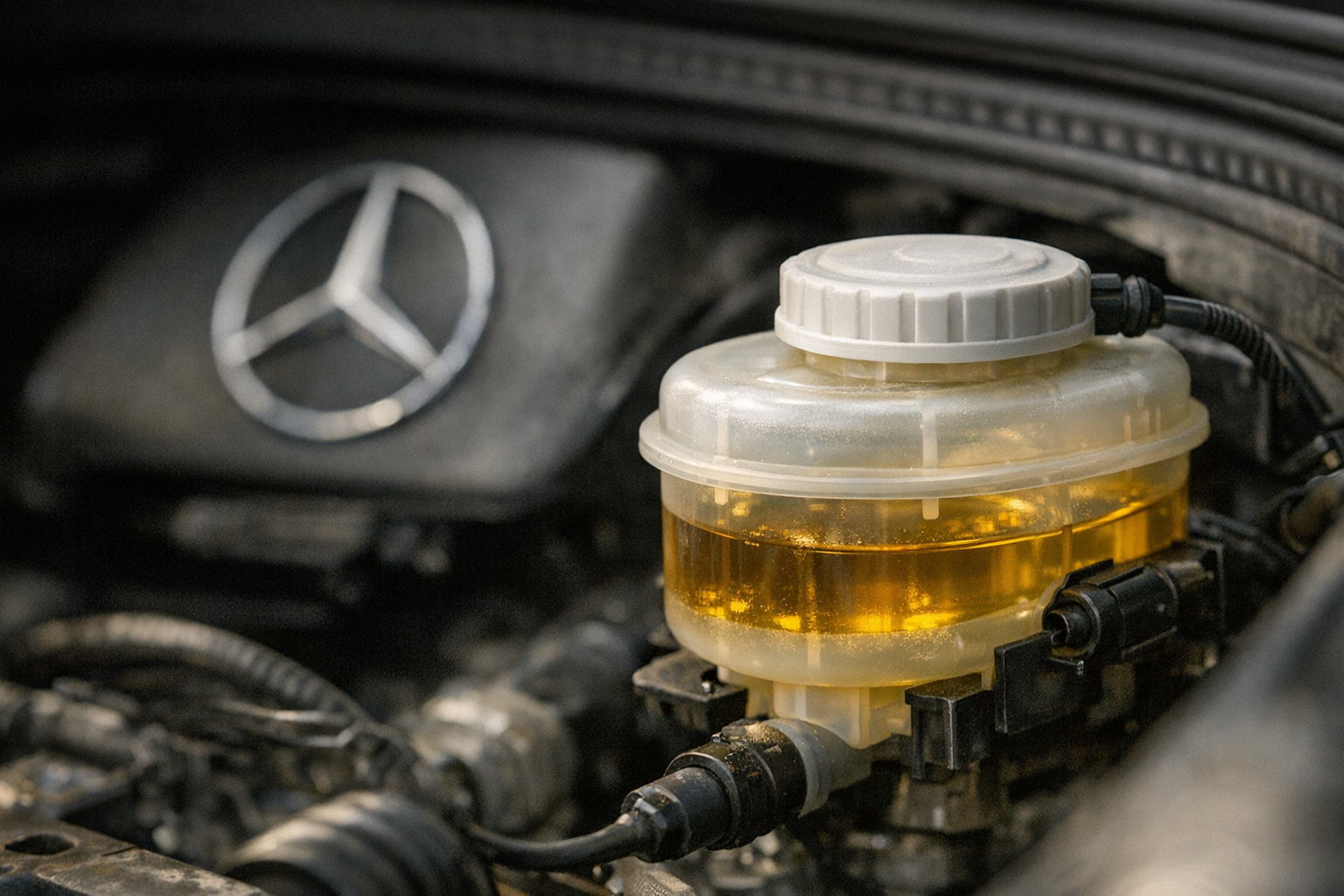
Mercedes-Benz Brake Fluid: DOT 4 Plus & MB 331.0 Guide
Brake fluid sits at the center of every safety system in a Mercedes-Benz. It transmits pedal force to the calipers, activates ABS and ESP interventions, and operates under extreme thermal and pressure conditions.
Introduction
Brake fluid sits at the center of every safety system in a Mercedes-Benz. It transmits pedal force to the calipers, activates ABS and ESP interventions, and operates under extreme thermal and pressure conditions. Mercedes-Benz specifies DOT 4 Plus brake fluid meeting the MB 331.0 approval for most vehicles built in the last two decades. This specification ensures compatibility with aluminum and composite brake system components, maintains stable boiling points under hard use, and resists the moisture absorption that degrades stopping performance.
The MB 331.0 standard is stricter than the minimum DOT 4 requirements. It sets tighter limits on viscosity at low temperatures, mandates higher dry and wet boiling points, and includes corrosion inhibitors tailored to the alloys Mercedes uses in master cylinders and ABS modules. When you see DOT 4 Plus on a bottle, it signals compliance with these enhanced requirements—not just the baseline federal motor vehicle safety standard.
Brake fluid is hygroscopic, meaning it pulls moisture directly from the atmosphere through microscopic pores in hoses and seals. Over time, water content rises, boiling points drop, and internal corrosion begins. A two-year change interval is the factory standard for most Mercedes-Benz models, regardless of mileage. This timeline reflects the rate at which moisture infiltrates a sealed system under normal conditions. If you're unfamiliar with how different brake fluid formulations compare across European makes, see our guide on DOT 4 vs DOT 5.1 brake fluid for European cars to understand the distinctions.
I've spent years tracking down the correct MB sheet approvals for fluids across German makes, and brake fluid is one area where using the wrong spec shows up fast—either as a spongy pedal, premature ABS faults, or corrosion you won't see until a caliper seizes. The MB 331.0 callout isn't a suggestion; it's the minimum standard that keeps the system predictable under the conditions Mercedes engineers designed for.
Problem Statement
Brake fluid is hygroscopic—it pulls moisture straight out of the air through microscopic gaps in seals, reservoir caps, and flex lines. That moisture doesn't just sit there; it lowers the fluid's boiling point and corrodes internal brake components from the inside. Mercedes-Benz specifies brake-fluid replacement every two years or 20,000 miles, whichever comes first, because by that point the fluid has absorbed enough water to compromise performance under load.
Why Moisture Matters
When brake fluid absorbs even a few percent water by volume, its dry boiling point drops sharply. Under hard braking—descending a mountain pass, towing, or emergency stops—the calipers generate enough heat to boil moisture-laden fluid. Boiling creates vapor pockets in the lines, and vapor compresses where liquid does not. The result is a soft, spongy pedal that travels farther before the pads bite, stretching your stopping distance exactly when you need it shortest.
Corrosion and Component Wear
Water in the brake system also attacks metal surfaces. ABS modulators, master cylinders, and caliper pistons corrode internally, creating pitting and deposits that stick pistons, foul solenoids, and score bored surfaces. A corroded ABS unit costs thousands to replace; fresh fluid every two years costs a hundred dollars and an hour of labor. The math is unambiguous.
Skipping the interval doesn't trigger an immediate fault code or dashboard warning. The degradation is silent until you need maximum braking force and discover the pedal has turned to mush halfway to the floor. By then, the damage is done—both to the fluid and to the components it was supposed to protect.
Solution Steps for Maintaining Mercedes-Benz Brake Fluid
Maintaining brake fluid in a Mercedes-Benz requires following the factory interval and bleeding sequence. The process is straightforward when you understand the manufacturer's expectations and work methodically through each caliper.
Step 1: Confirm the Service Interval
Step 1
Verify the replacement schedule
Mercedes-Benz USA mandates brake fluid replacement every two years, regardless of mileage. This interval prevents moisture absorption and internal corrosion in the hydraulic system. Some models specify 20,000 miles as an alternative threshold, but the biennial timeline is the controlling factor for most ownership patterns.
Check your service booklet or maintenance records to determine when the fluid was last changed. If the vehicle has no documented flush in the past two years, schedule the service immediately.
Step 2: Gather the Correct Fluid and Tools
Step 2
Assemble materials before starting
You need DOT 4 Plus fluid meeting MB 331.0 specification, a brake bleeder kit or clear tubing, a catch bottle, and a box-end wrench sized for your model's bleeder screws. Using generic DOT 4 instead of DOT 4 Plus risks voiding warranty coverage on newer models, so verify the bottle carries the MB approval marking.
Plan for approximately one liter of fresh fluid for a complete four-wheel flush. Having extra fluid on hand prevents interruptions mid-service.
Step 3: Bleed in the Proper Sequence
Step 3
Start furthest from the master cylinder
Begin with the caliper furthest from the master cylinder and work toward the closest. For most Mercedes-Benz platforms, this means right rear, left rear, right front, left front. This sequence ensures air moves away from the hydraulic control unit rather than toward it.
Attach clear tubing to the bleeder screw, submerge the other end in your catch bottle, and have an assistant pump the brake pedal three times before holding pressure. Crack the bleeder screw, allow old fluid to flow until the stream runs clear and bubble-free, then close the screw before the pedal reaches the floor. Repeat at each corner.
Step 4: Top Off and Verify Pedal Feel
Step 4
Check reservoir level and test brakes
After bleeding all four corners, fill the reservoir to the MAX line with fresh fluid. Start the engine and pump the brake pedal several times—it should feel firm with no sponginess. If the pedal sinks slowly or feels soft, air remains in the system and you need to re-bleed the affected corner.
Models equipped with advanced ABS systems may require electronic activation of solenoid valves during the flush. If you lack the diagnostic equipment to cycle the ABS pump, have the final bleed performed at an independent shop with a capable scan tool. For more context on DOT 4 specifications across European platforms, see our guide on DOT 4 vs DOT 5.1 brake fluid.
Tips and Tricks for Brake Fluid Maintenance
Keeping Mercedes-Benz brake fluid in proper condition requires a calendar-first mindset, not just watching the odometer. Standard DOT 4 absorbs roughly 3% water per year whether the car sits or drives daily, so time matters more than miles. Plan your service intervals around the two-year mark regardless of how little you've driven.
Treat Brake Fluid as a Calendar Item
Mercedes sets the interval at two years or 20,000 miles, whichever comes first. In practice, the calendar always wins. A car driven 5,000 miles in two years needs the same fluid change as one driven 40,000 miles in that period—the hygroscopic nature of glycol-based fluid doesn't care about mileage. Set a recurring reminder tied to the date of your last service, not your next oil change.
Check Reservoir Level Between Services
The reservoir on most Mercedes models sits near the master cylinder under the hood. Fluid level should stay between MIN and MAX lines; a slow drop over months is normal pad wear, but a sudden drop signals a leak. If you're topping off more than once between service intervals, have the system inspected—don't just keep adding fluid.
When topping off, use only MB 331.0-approved DOT 4 Plus. Mixing a generic DOT 4 dilutes the low-viscosity properties and can trigger ABS/ESP faults on newer models. Keep a small bottle of the correct spec in your garage; it's cheaper than a tow for a brake-system fault.
Avoid Contamination During Storage
Brake fluid starts absorbing moisture the moment you crack the seal. Store unopened bottles in a cool, dry place away from solvents or petroleum products. Once opened, a bottle is good for about six months if tightly capped; after that, assume it's pulled enough atmospheric water to be unreliable. If you opened a bottle two years ago for a top-off, throw it out and buy fresh for the next service.
Recognize When to Service Early
If you track the car or drive aggressively in mountainous terrain, the fluid sees higher thermal loads than street use. Boiling point degrades faster under repeated heat cycling. Consider a yearly interval if you regularly threshold-brake from triple-digit speeds or spend weekends on track. The cost of annual fluid changes is negligible compared to a single fade incident or ABS module replacement.
Similarly, if the car sits unused for months at a time, condensation inside the reservoir and lines accelerates water absorption. A garaged car driven 2,000 miles over two years still needs the fluid changed on schedule—sitting doesn't preserve it.
Use the Right Fluid, Not the Closest Match
MB 331.0 is not interchangeable with generic DOT 4, even if the DOT rating is identical. The low-viscosity formulation keeps ABS/ESP valves cycling cleanly at low temperatures and high speeds. Using a standard-viscosity DOT 4 might meet the boiling-point spec on paper but can cause sluggish modulator response or fault codes. When in doubt, cross-reference the approved product list in your owner's manual or buy from a Mercedes dealer to ensure compliance.
For a deeper comparison of DOT 4 variants and their compatibility with European ABS systems, see our guide on DOT 4 vs DOT 5.1 brake fluid for European cars.
Conclusion
Mercedes-Benz brake fluid isn't a commodity choice—it's a spec-first decision that directly affects stopping distance, ABS modulation, and caliper longevity. DOT 4 Plus and MB 331.0 exist because the hydraulic systems in modern Mercedes vehicles demand specific wet boiling points, low-viscosity flow at temperature extremes, and corrosion inhibitors tuned to aluminum and magnesium components. Using a generic DOT 4 that lacks the MB 331.0 approval saves a few dollars per bottle but introduces variables you can't see until a caliper seizes or the pedal goes soft under hard braking.
The two-year or 20,000-mile replacement interval isn't arbitrary—it's the window before hygroscopic moisture accumulation degrades wet boiling point below the threshold Mercedes engineers validated. I've pulled fluid from cars at 30 months that tested below 300°F wet; the owner thought the brakes felt fine until an emergency stop from highway speed revealed the truth. Regular replacement is the cheapest insurance against hydraulic failure, and it's non-negotiable if you want the system to perform as designed when it matters.
If you're working across European platforms, understanding manufacturer-specific brake fluid requirements is part of the baseline. BMW's DOT 4 Low Viscosity standard follows a similar philosophy but with different viscosity targets; knowing the distinctions keeps you from cross-contaminating systems that look compatible on paper but aren't in practice. The spec sheet is the contract—meet it exactly, change it on schedule, and the brakes do what the engineers promised.
Learn about Mercedes-Benz Brake Fluid specifications, including DOT 4 Plus, MB 331.0, and the recommended change intervals for optimal vehicle performance.
Written by
Lee Shahin
Founder, European Wholesale Parts
Lee Shahin founded European Wholesale Parts in Pleasanton, California, after 18 years in the Mercedes-Benz and BMW parts trade. He came to the parts side from the shop floor: he opened a European repair shop in Northern California in the early 1990s, specialising in Mercedes-Benz and BMW, and grew it with his wife Laurie into a parts and delivery operation serving body shops and independent repair facilities across the region. Nearly two decades at the parts counter taught him where the expensive mistakes happen, and most of them are fluids: the wrong coolant in an aluminium block, an oil without the sheet approval the engine was designed for, a transmission topped with the wrong ATF. That is what he writes about here. Every article names the manufacturer specification by its exact designation, explains what the wrong fluid does mechanically, lists products that carry the approval, and gives the capacity and interval for the models and years the specification covers. When a reader needs a part sourced, the quote desk at European Wholesale Parts is where Lee and Laurie still answer the phone.