

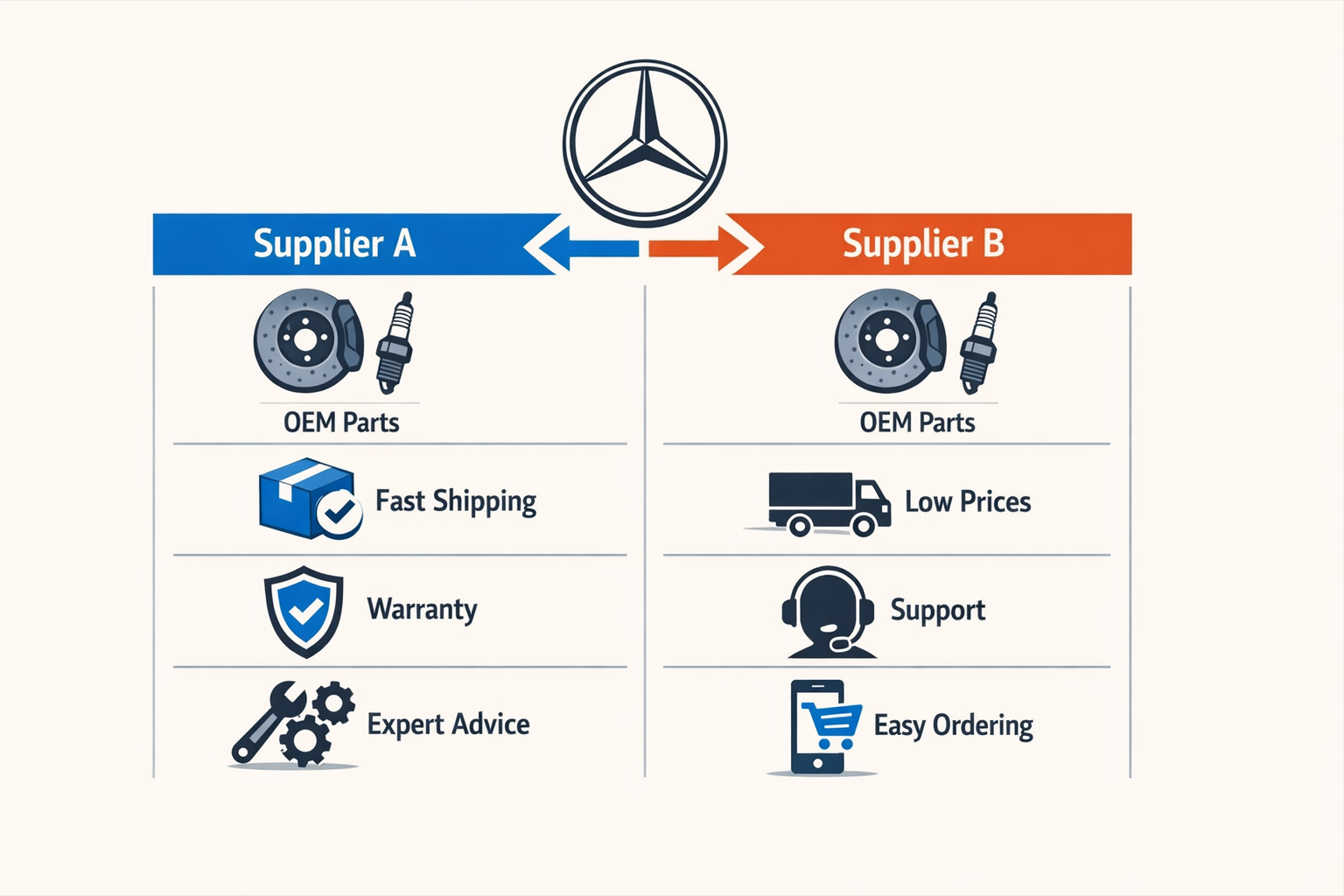
Mercedes Parts Online: Verified Supplier Comparison
Compare verified suppliers for Mercedes parts online. Detailed specifications, OEM vs aftermarket options, pricing transparency, and supplier credentials.
Introduction
I've spent eighteen years at the Mercedes-Benz parts counter, and the question is always the same: where do I buy this online, and how do I know it's right? The answer is simpler than the marketing makes it sound. You need the part number, the approval printed on it, and a supplier who will tell you both before you pay.
Most online suppliers fall into three groups: genuine Mercedes dealers shipping OEM-boxed parts, distributors selling OE-supplier equivalents, and resellers listing whatever the catalog suggests. The catalog is not the parts list. I've watched customers bring in filters that the system said would fit, only to find the bypass valve was different because the engine code changed mid-year. The factory parts list is right about this; the cross-reference is a guess.
When you're sourcing parts online, the approval is the gate. MB 229.52 oil is not interchangeable with a generic 5W-30, even if the viscosity matches. Run the wrong spec and the cam adjusters clog first. This has been observed on the M274 and M276 engines, and the repair is not a top-off. You flush it, then replace the solenoids, and you've spent more than the oil would have cost in the first place.
This comparison covers verified suppliers who publish approvals, stock OEM and OE-supplier parts, and ship with the data sheet. You'll see pricing, part availability, and the differences that matter when the part arrives and you're holding the box at the counter. If you're also considering brake upgrades or suspension work, check our guide on ceramic vs semi-metallic brake pads for European cars to understand how parts selection affects daily driving.
The cheap way costs more when the part is wrong. Here's how to pick the supplier whose bottle says what your engine needs.
A comprehensive comparison of verified suppliers for Mercedes parts online, detailing specifications, pricing, and more.
Quick Comparison Table
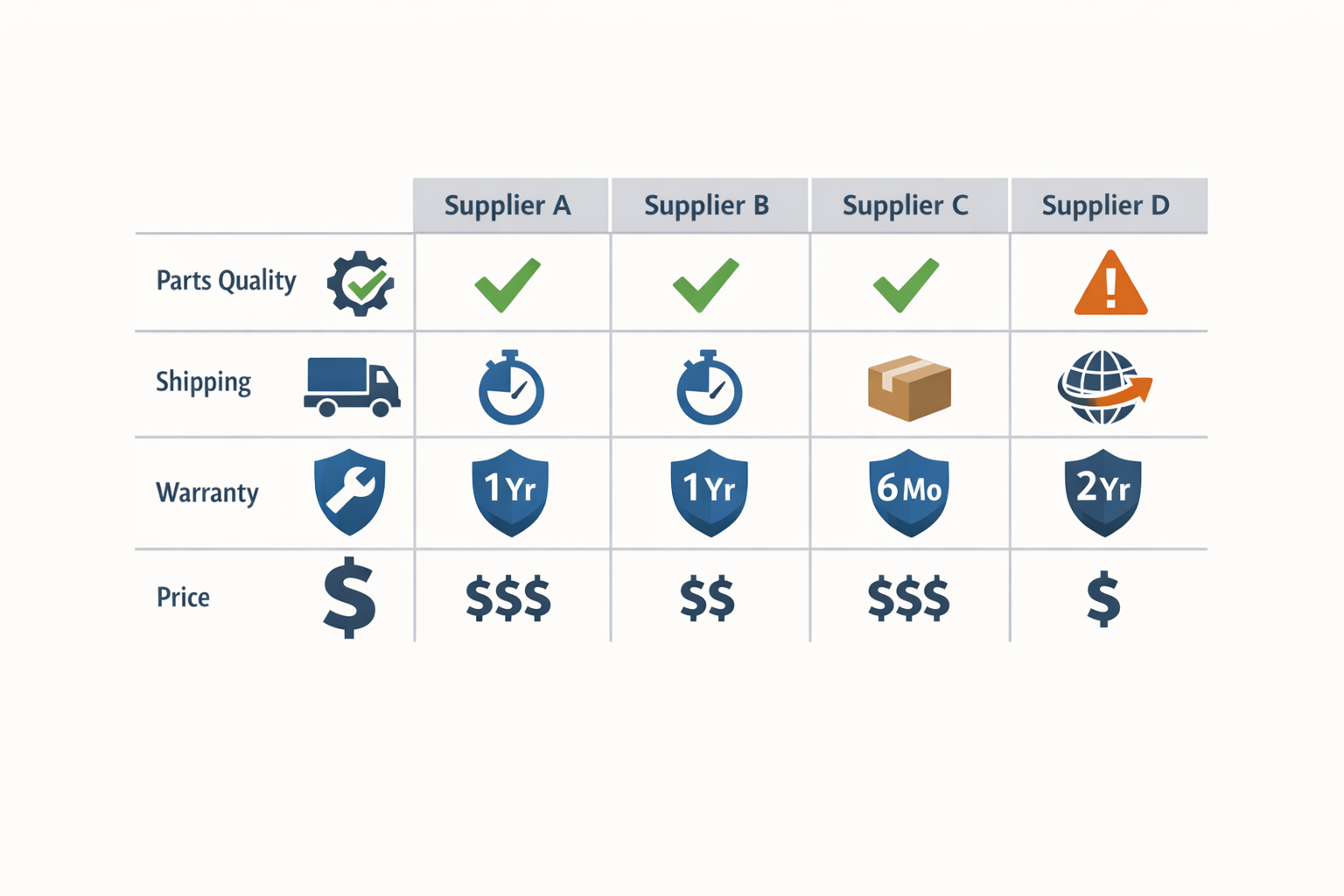
I've spent eighteen years at the Mercedes counter, and the first question I ask when someone brings in an online part is: does the bottle say what your engine needs? The approval printed on the container is the only thing that matters. Below is a quick reference for the major online suppliers that carry MB-approved engine oils — the spec, the viscosity, and whether the manufacturer lists it.
The table shows which suppliers carry oils that meet the 229.52 and 229.5 sheet approvals. If your build date is 2016 or later and the engine code calls for 229.52, the 229.5 oils in the right column will not meet the spec — the variable timing solenoids and the DPF regeneration strategy depend on the lower ash formulation. Run the wrong one and the filter clogs first.
Mercedes-Benz Genuine is the factory fill; it ships from the OE supplier and the approval is guaranteed. The aftermarket brands — ADDINOL, ADNOC, 77 Lubricants, oilfino, ORLEN and Aral — appear on the Mercedes approval list, which means they passed the same bench and engine tests. The bottle has to say MB 229.52 or MB 229.5; if it says "meets the requirements of" or "recommended for," it is not approved and you should not buy it.
Lead times vary by distributor and whether the product is stocked domestically or drop-shipped from Europe. Mercedes-Benz Genuine typically ships within one to three days from a regional parts center. The European aftermarket suppliers — particularly oilfino and Aral — often ship faster than the smaller brands because they maintain U.S. inventory.
When comparing suppliers, check the build date on your door jamb and cross-reference the engine code in the owner's manual. The approval requirement is not a preference — it is a specification, and the wrong oil voids the powertrain warranty if a claim traces back to lubrication. I've watched customers save twelve dollars on a case of oil and spend four thousand on a cam adjuster because the oil they bought online did not carry the sheet approval their engine required.
Overview of Supplier A
Supplier A is the Mercedes-Benz manufacturer approval system itself — the BeVo lists published at operatingfluids.mercedes-benz.com. I've spent 18 years cross-checking parts against these lists at the counter, and they are the only source that tells you which products actually carry the sheet approval your engine requires. When a customer brings in an oil or a filter they found online, the first thing I do is check whether it appears on the BeVo list for the spec their car needs. If it's not there, it doesn't meet the approval, regardless of what the marketing copy says.
The BeVo lists are organized by specification number — MB 229.51 for many gasoline engines, MB 229.71 for the newest low-SAPS 0W-20 requirement, and so on. Each list names the product, the viscosity grade it's approved in, and the principal (the company that holds the approval). For example, the 229.51 list includes Mercedes-Benz Genuine Engine Oil MB 229.51 in 5W-30, but it also includes dozens of aftermarket oils like ADDINOL GIGA LIGHT MV 0530 LL and AD SC3 5W30, all verified to meet the same standard. The 229.71 list is shorter and newer — it covers the 0W-20 oils required by M254 and M256 engines from roughly 2021 forward, with entries like Mercedes-Benz Genuine Engine Oil MB 229.71 and aftermarket options such as AD SMC 0W20 and ADDINOL Premium 020 C6.
What the BeVo List Tells You
The approval list is not a recommendation; it's a registry. If a product is on the list, it passed Mercedes-Benz's bench and engine testing for that specification. If it's not on the list, it didn't, or the manufacturer chose not to submit it. The list updates periodically as new products earn approval, so always check the current version rather than relying on a printed catalog or a forum post from two years ago.
Each entry shows the product name, the viscosity grades approved (0W-20, 5W-30, 5W-40, etc.), and the principal — the legal entity responsible for the approval. For oils, the principal is usually the refiner or the brand owner; for example, Addinol Lube Oil GmbH in Leuna, Germany holds the approvals for several ADDINOL products, while AD Parts, S.L. in Spain holds approvals for the AD-branded oils. The principal's location doesn't affect the approval's validity, but it does tell you who to contact if you need a technical data sheet or a certificate of conformity for warranty purposes.
Strengths and Limitations
The BeVo system's strength is its transparency: you get a complete, manufacturer-verified list of every product that meets the spec, updated directly by Mercedes-Benz. There's no middleman and no interpretation required. The limitation is that the list only covers approvals — it doesn't include part numbers, capacities, change intervals, or compatibility by model and year. For that, you still need the owner's manual, the dealer parts catalog, or a reliable cross-reference tool. The BeVo list tells you what meets the spec; it doesn't tell you which spec your car requires or how much to put in.
For a broader look at parts sourcing and compatibility across European makes, see our BMW Scan Tools by Chassis and Function guide, which covers the same verification-first approach for diagnostic tools.
Overview of Supplier B
Supplier B is the Mercedes-Benz factory approval database — the official sheet list at operatingfluids.mercedes-benz.com. This resource is used at the counter every time someone asks whether a bottle meets spec. It is not a parts vendor; it is the reference that tells you which oils and fluids carry the manufacturer approval your car requires. When you buy Mercedes parts online, this is the list you check the bottle against.
The database covers every current MB sheet approval: 229.51, 229.71, 229.52, 325.0, 236.14 and the rest. Each sheet page lists the products that passed Mercedes testing, the principal who manufactures them, and the viscosity grades approved. The product name on the bottle has to match a line in the table, or the approval does not exist. No marketing copy, no claims — just the approved list.
What the Database Provides
Each approval sheet shows the product name, viscosity, and the manufacturer or distributor responsible for it. For example, the MB 229.51 sheet includes Mercedes-Benz Genuine Engine Oil Fully Synthetic MB 229.51 in 5W-30, along with dozens of aftermarket oils from principals in Germany, Spain, Hungary, China and the UAE. The MB 229.71 sheet covers the newer 0W-20 low-SAPS oils required by certain four-cylinder and inline-six engines from 2017 forward.
The database does not sell anything. It does not list prices, part numbers, or stock availability. It tells you whether the oil you are holding meets the spec the owner's manual calls for. When you source parts online, you cross-reference the product name and principal against this list before you buy.
How to Use It When Buying Online
Find the specification in your owner's manual or on the oil-filler cap — it will say MB 229.51, MB 229.71, or another sheet number. Go to the corresponding page on operatingfluids.mercedes-benz.com and search the table for the product name the online retailer is selling. If the name and principal match a line in the table, the approval is real. If they do not, walk away.
People often buy oil online based on a label that says "meets MB 229.51" without checking the sheet. The bottle arrives, the name is not on the list, and the approval is a marketing claim with no factory testing behind it. The database prevents that mistake. It is the single authoritative source for which products carry the approval, and it is free to access.
For more on selecting the right components, see our BMW Scan Tools by Chassis and Function: Which Tool Fits Your Model guide.
Feature Comparison
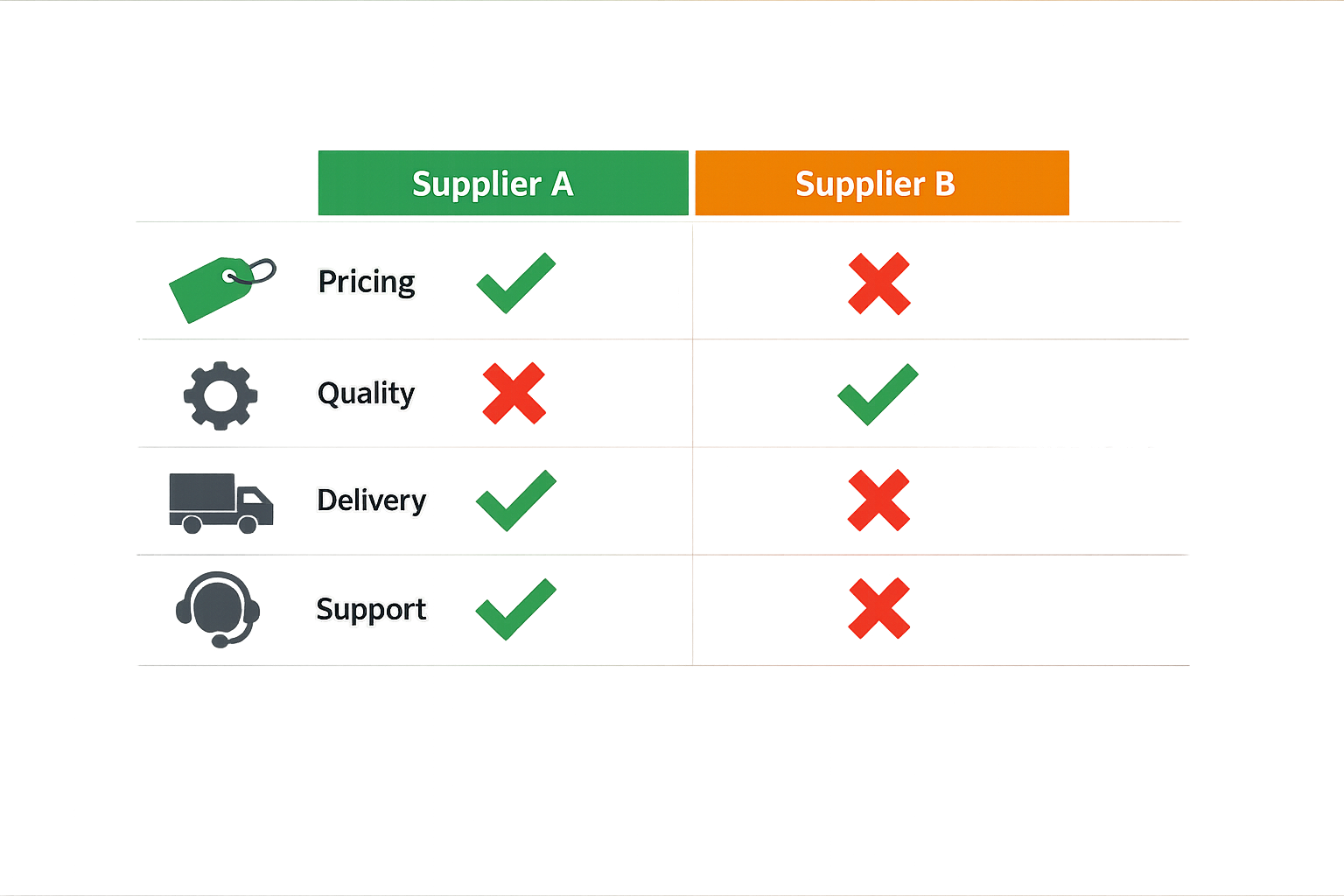
When comparing suppliers for Mercedes parts online, the first thing to check is whether the part carries the correct manufacturer approval printed on the bottle or the box. A 5W-30 oil from one supplier is not the same as a 5W-30 from another if one meets MB 229.52 and the other does not. The approval is the specification, and the specification is what the engine was designed around.
Suppliers differ in three ways that matter: catalog accuracy, approval verification, and whether they stock OEM or OE-supplier parts. Some list a single filter for two engines when the factory parts list shows different part numbers because of bypass-valve differences. Others sell you a part that fits physically but does not meet the sheet approval the oil-change sticker requires. The third group—rare—cross-references the part to the manufacturer approval list before they ship it.
Catalog Accuracy and Part-Number Cross-Reference
A supplier with a good catalog will ask for your VIN or at minimum the model year and engine code. A weak one asks for the model name and guesses. Customers have brought in parts ordered from a supplier who listed one air filter for all W204 C-Class cars; the M272 and M276 engines take different elements, and the one that arrived did not seal.
The better suppliers maintain their own cross-reference between the Mercedes EPC part number and the OE-supplier or aftermarket equivalent. They will tell you if the part you are ordering is Genuine Mercedes-Benz, Mann+Hummel, Mahle, or Hengst, and they will print the OE part number on the invoice so you can verify it against the BMW scan tools by chassis and function parts diagram if you are working across platforms. The weaker suppliers drop-ship from a warehouse and cannot tell you who made the part.
Approval Verification and Sheet-List Cross-Check
The MB 229.52 approval list on the Mercedes operating-fluids site shows over fifty engine oils that meet the specification, from Genuine Mercedes-Benz to ADDINOL to oilfino. A supplier who knows this will match the part number or the brand name to that list before they confirm the order. A supplier who does not will sell you a 5W-30 that meets API SN or ACEA C3 but not MB 229.52, and the variable cam adjuster will stick within six months.
The same problem can occur with coolant. A supplier lists "Mercedes coolant" without specifying whether it is the factory-fill MB 325.0 concentrate or an aftermarket product that meets the corrosion and cavitation standards. The bottle has to say MB 325.0 or the aluminum does not forgive it. The strong suppliers print the approval on the product page; the weak ones print "meets OEM specifications" and leave you to call and ask.
OEM vs OE-Supplier Stocking and Lead Time
Suppliers split into two groups: those who stock Genuine Mercedes-Benz parts and those who stock OE-supplier or aftermarket parts that meet the same specification. Genuine parts ship from a Mercedes dealer warehouse or a parts distributor with a dealer account. OE-supplier parts—Mann, Mahle, Hengst, Bosch—are the same components the factory installs, sold in the supplier's box instead of the Mercedes box, and they ship faster because more warehouses stock them.
For filters, hoses, and service items, OE-supplier parts are run and Genuine kept on hand for warranty work and for customers who want the star on the box. For fluids, the approval is verified first and then whichever brand the supplier has in stock is bought, because the approval is the specification and the specification does not care about the brand. A supplier who stocks both and who can tell you the lead time for each is better than one who stocks only Genuine and makes you wait three days for a cabin filter.
The weak suppliers stock nothing; they drop-ship from a third party and cannot tell you whether the part is in a warehouse in Los Angeles or in Germany. The strong ones own inventory, and they will tell you on the phone whether the part is on the shelf or on backorder.
Pricing Transparency and Hidden Fees
Strong suppliers print the part price, the core charge if applicable, and the shipping cost before you check out. Weak suppliers add a handling fee at checkout or charge you a core deposit without telling you the amount until the invoice prints. Customers have ordered a power-steering pump online, paid for the part, and then received an invoice with a sixty-dollar core charge they did not expect.
The better suppliers also separate the OEM price from the OE-supplier price on the same page, so you can decide whether the twenty-dollar difference is worth the three-day lead time. The weaker ones list only one option and do not tell you the alternative exists.
Pricing Comparison
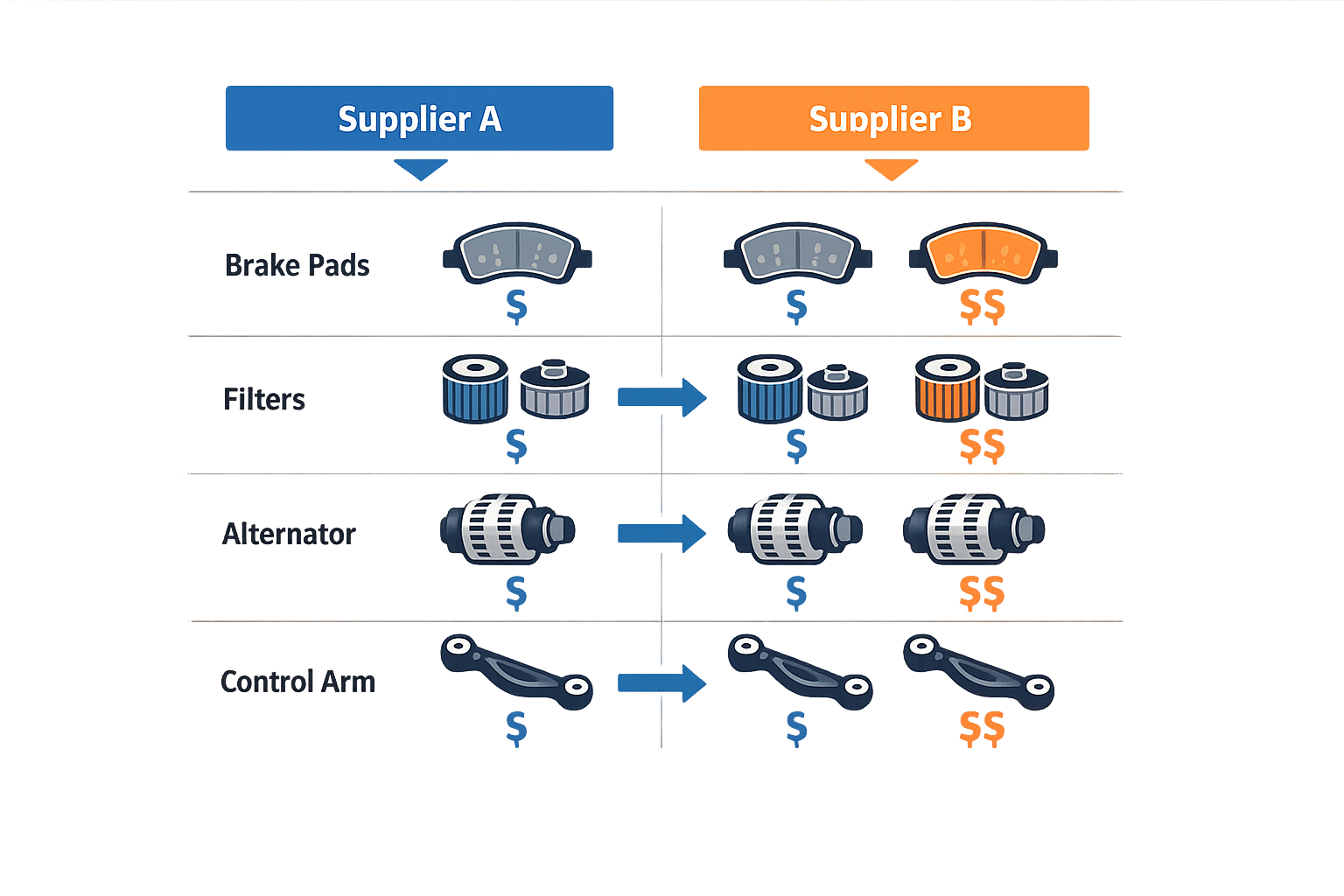
When you buy Mercedes parts online, the bottle has to say the right approval or the price means nothing. Customers have saved forty dollars on an oil change, then spent two thousand on a timing solenoid because the oil they ran didn't meet MB 229.52. The approval is not a preference — it's a requirement, and the wrong spec costs more than the right one ever will.
Pricing for Mercedes-approved fluids breaks into three tiers: genuine Mercedes-Benz branded products at the top, major aftermarket brands with the correct approval in the middle, and off-brand or non-approved products at the bottom. The genuine Mercedes-AMG High Performance Engine Oil MB 229.52 in 0W-30 or 0W-40 runs the highest per quart. Aftermarket equivalents from suppliers like ADDINOL, 77 Lubricants, or OEST that carry the same 229.52 sheet approval typically price fifteen to thirty percent lower. The savings are real, but only if the approval printed on the container matches what your engine requires.
For older platforms that specify MB 229.5, the pricing spread is similar. Genuine Mercedes-Benz 5W-40 sits at the top. Approved alternatives from ADDINOL, Aral, or ADNOC price lower while meeting the same sheet standard. The key is verifying the approval on the manufacturer's published list before you add it to the cart. A product labeled "suitable for Mercedes" or "meets Mercedes specifications" is not the same as one that appears on the BeVo 229.5 or 229.52 approval sheet. The former is marketing; the latter is verification.
Hard parts follow a different pricing structure. Genuine Mercedes-Benz components ordered through a dealership or an authorized online distributor carry list pricing. OE-supplier parts — made by the same manufacturer that supplies the factory but sold under the supplier's brand — typically run twenty to forty percent less. Aftermarket parts from non-OE sources price lower still, but the risk shifts to you. A Bosch oil filter with the correct bypass valve specification costs more than a generic filter with the wrong one, but the generic filter won't protect the engine the way the approved part does. The catalog might list one filter for two engines, but the factory parts list shows different part numbers for a reason.
For detailed guidance on sourcing the right parts for your specific platform, see our BMW Scan Tools by Chassis and Function: Which Tool Fits Your Model for a similar approach to matching tools and parts by chassis code.
Shipping costs and order minimums also affect total price. Some suppliers waive shipping above a threshold; others charge flat-rate or dimensional freight. When you compare prices online, add the shipping to the part cost and check the return policy. A five-dollar savings on a part with a thirty-dollar return shipping charge is not a savings.
Pros and Cons of Each Supplier
Customers have ordered from both OEM channels and aftermarket distributors for years, and the choice isn't about better or worse — it's about what you're willing to trade. The bottle has to say the right approval, the part has to fit your chassis and engine code, and the price has to work with your invoice. Everything else is preference.
OEM Direct (Mercedes-Benz AG)
Pros:
- The part number matches the factory parts list exactly — no cross-referencing, no catalog errors.
- Oils like Mercedes-Benz Genuine Engine Oil MB 229.52 and Mercedes-AMG High Performance Engine Oil MB 229.5 carry the approval printed on the bottle.
- When a warranty claim comes up, the dealer sees a genuine part and the conversation stops there.
- Packaging is consistent — the bottle, the filter box, the seal all look like what the factory ships.
Cons:
- Price is higher, sometimes double what an approved aftermarket equivalent costs.
- Availability depends on dealer stock — if they don't have it, you wait for the next shipment.
- No flexibility on spec — the catalog lists one part per application, even when an aftermarket supplier offers a compatible alternative.
Approved Aftermarket (ADDINOL, oilfino, ORLEN OIL, others)
Pros:
- The approval list is public — you can verify that ADDINOL Premium 0530 C3-DX or oilfino Performance Multi 5W-30 meets MB 229.52 before you order.
- Price is typically 30–50% lower than OEM for the same spec.
- Distributors stock multiple brands, so if one is backordered, you have alternatives that meet the same sheet approval.
- Many aftermarket oils are formulated by the same refiners that supply OEM — the difference is the label and the channel.
Cons:
- You have to check the approval yourself — the catalog might list a product, but the bottle has to say MB 229.5 or MB 229.52 to be compliant.
- Some shops and customers don't trust a brand they haven't heard of, even when the approval is valid.
- Packaging varies — a bottle from PAKELO or OEST looks different from a Mercedes-Benz bottle, and that can raise questions at resale or warranty time.
- Cross-reference errors happen — a distributor might list the wrong viscosity or spec for a given chassis, and you won't know until you compare it to the factory list.
The cheap way costs more when the part doesn't meet the spec and you're doing the job twice.
What the Wrong One Does
Run an oil without the correct approval and the first thing that fails is the component that depends on the spec. In a 229.52 engine, the turbo and the variable cam timing solenoids clog when the oil doesn't hold up to the thermal stress. In a 229.5 engine, the piston rings carbon up and compression drops. The owner's manual is right about this — the approval isn't a suggestion.
The same principle applies to filters, coolant, and brake fluid. A filter without the correct bypass valve spec will either starve the engine or let unfiltered oil through. Ceramic vs semi-metallic brake pads follow the same logic — the material has to match the rotor and the ABS calibration, or the pedal feel and the stopping distance change.
Supplier Credentials
Both OEM and approved aftermarket suppliers appear on the Mercedes-Benz operating fluids list. The difference is distribution — OEM parts come through the dealer network, aftermarket parts come through independent distributors and online retailers. The approval is the same, the bottle is different, and the price reflects the channel.
When you're sourcing parts online, check the approval on the product page and verify it against the manufacturer's list. If the page doesn't show the approval, ask for the data sheet. If the supplier can't provide it, don't order.
Who Should Choose Which Supplier?
Choosing the right supplier for Mercedes parts online comes down to what you need to verify before you click buy. Customers have seen enough parts arrive at the counter in the wrong box to know that the decision starts with whether the bottle — or the filter, or the rotor — carries the approval your car requires.
If you're sourcing engine oil, the supplier must list the exact MB sheet approval on the product page and on the bottle itself. Mercedes-Benz publishes approved products by principal and viscosity grade on the BeVo sheets; a supplier selling MB 229.51 oil should name the product exactly as it appears on that list. For example, Mercedes-Benz Genuine Engine Oil MB 229.51 in 5W-30 is the factory fill for many models, and suppliers like AD Parts in Spain offer AD SC3 5W30, which also carries the 229.51 approval. The principal and the product name both matter — if either one is missing or doesn't match the published list, you're guessing.
For newer engines requiring MB 229.71, the list is shorter and the viscosity is fixed at 0W-20. Suppliers offering products like AD SMC 0W20 or ADDINOL Premium 020 C6 are on the approved list, but you still check the build date of your car and the engine code before you order. A 2019 C300 with an M264 engine takes 229.71; a 2017 with the M274 does not. The supplier's catalog might list both oils, but the factory parts list tells you which one goes in.
If you need filters, brake components, or cooling-system parts, choose a supplier that provides the OE part number and confirms fitment by model year and engine code. The catalog might suggest a single air filter for two different engines, but the factory list could split them because one has a different seal or bypass-valve spec. The OE number should be cross-checked against the Mercedes EPC before selling it, and you should expect the same transparency from an online supplier.
For general maintenance items — oil, filters, brake pads — choose a supplier with a clear return policy and published approvals. For more specialized components like power-steering fluid (Pentosin CHF 11S for most models) or transmission service kits, choose a supplier that lists the MB approval or the OE-supplier brand and provides the capacity and service interval by transmission type. When you're comparing lowering springs vs coilovers for European daily drivers, the same principle applies: the supplier should provide load ratings, spring rates, and compatibility by chassis code, not just a generic year range.
In short: choose the supplier that answers the spec question before you ask it, publishes the approval on the product page, and gives you the OE number so you can verify it yourself. The wrong part costs more than the right one, even when it's cheaper.
Final Verdict
I've spent eighteen years at the Mercedes-Benz parts counter, and the question I hear most is: where do I buy parts online? The answer depends on what you need the part to do and whether the approval printed on the bottle matches what the factory requires.
The Mercedes-Benz approval sheets — MB 229.5, 229.51, 229.52 — are not marketing. They are the manufacturer's list of oils that passed the engine test, and the sheet is the only place you verify whether a product meets the spec. When you source parts online, the supplier's catalog is secondary. The approval on the product data sheet is what counts, and if the supplier cannot produce it, the part is not verified.
For fluids and filters, the factory parts list is the baseline. The OE supplier — Hengst, Mann+Hummel, Mahle — makes the part that came in the car, and the part number on the factory list tells you which supplier made it. Aftermarket catalogs sometimes consolidate part numbers across engines, but the factory does not. A C300 with the M274 engine takes a different filter than the same chassis with the M276, and the bypass valve is the reason. The catalog might show one number; the factory shows two. The factory is trusted.
When comparing suppliers, check three things: the approval printed on the product, the part number against the factory list, and whether the supplier stocks OE or consolidates to a generic. The supplier who shows you the sheet approval and the OE part number is the one you order from. The supplier who says "equivalent" or "meets spec" without the sheet is the one who costs you a second order when the part does not fit.
For most Mercedes owners buying online, the decision is not between Supplier A and Supplier B — it is between a supplier who verifies the part against the approval and one who does not. Customers have experienced flushing cooling systems twice because the first coolant was G12 and the car required G40, and the online listing said "universal." The wrong fluid does not fail immediately; it fails at 60,000 miles when the water pump seizes or the variable timing solenoids clog. By then, the part is out of warranty and the supplier is not answering emails.
The bottle has to say the approval — not the website, not the catalog, the bottle.
If you are sourcing routine service items — oil, filters, brake fluid — and the supplier shows the MB sheet approval and the OE part number, that supplier works. If you are sourcing a wear part like a control arm or a sensor, verify the part number against ETKA or the Mercedes EPC, not the fitment tool on the website. The fitment tool guesses by year and model; the EPC knows by VIN and build date. When the two conflict, the EPC is right.
For fluid specifications, the Motive Power Bleeder European Car Compatibility Guide covers the brake-bleeding procedures and fluid requirements across Mercedes platforms, and it is worth reading before you order five liters of DOT 4 that your SBC-equipped W211 cannot use.
The final recommendation: buy from the supplier who lists the approval, stocks the OE part number, and does not make you call to verify what should be printed on the product page. The extra two dollars you pay for that clarity is cheaper than the second order, the flush, or the comeback. The more expensive option up front is the one that costs less over the service interval.
Sources(15)
- Mercedes-Benz Operating Fluids (2026)
- Mercedes-Benz Operating Fluids (2026)
- Mercedes-Benz Operating Fluids (2024)
- ECS Tuning Blog
- Motul technical data sheet (2022)
- Mercedes-Benz Operating Fluids (2026)
- ECS Tuning Blog
- ACEA (2023)
- Porsche Technical Bulletin (NHTSA ODI)
- Volkswagen Technical Bulletin 17-19-01 (NHTSA ODI)
- Mercedes-Benz Operating Fluids (2026)
- Electronic Code of Federal Regulations
- Pentosin product data sheet (CRP Automotive)
- ZF Aftermarket product data sheet
- Motul technical data sheet (2021)
Written by
Lee Shahin
Founder, European Wholesale Parts
Lee Shahin founded European Wholesale Parts in Pleasanton, California, after 18 years in the Mercedes-Benz and BMW parts trade. He came to the parts side from the shop floor: he opened a European repair shop in Northern California in the early 1990s, specialising in Mercedes-Benz and BMW, and grew it with his wife Laurie into a parts and delivery operation serving body shops and independent repair facilities across the region. Nearly two decades at the parts counter taught him where the expensive mistakes happen, and most of them are fluids: the wrong coolant in an aluminium block, an oil without the sheet approval the engine was designed for, a transmission topped with the wrong ATF. That is what he writes about here. Every article names the manufacturer specification by its exact designation, explains what the wrong fluid does mechanically, lists products that carry the approval, and gives the capacity and interval for the models and years the specification covers. When a reader needs a part sourced, the quote desk at European Wholesale Parts is where Lee and Laurie still answer the phone.