

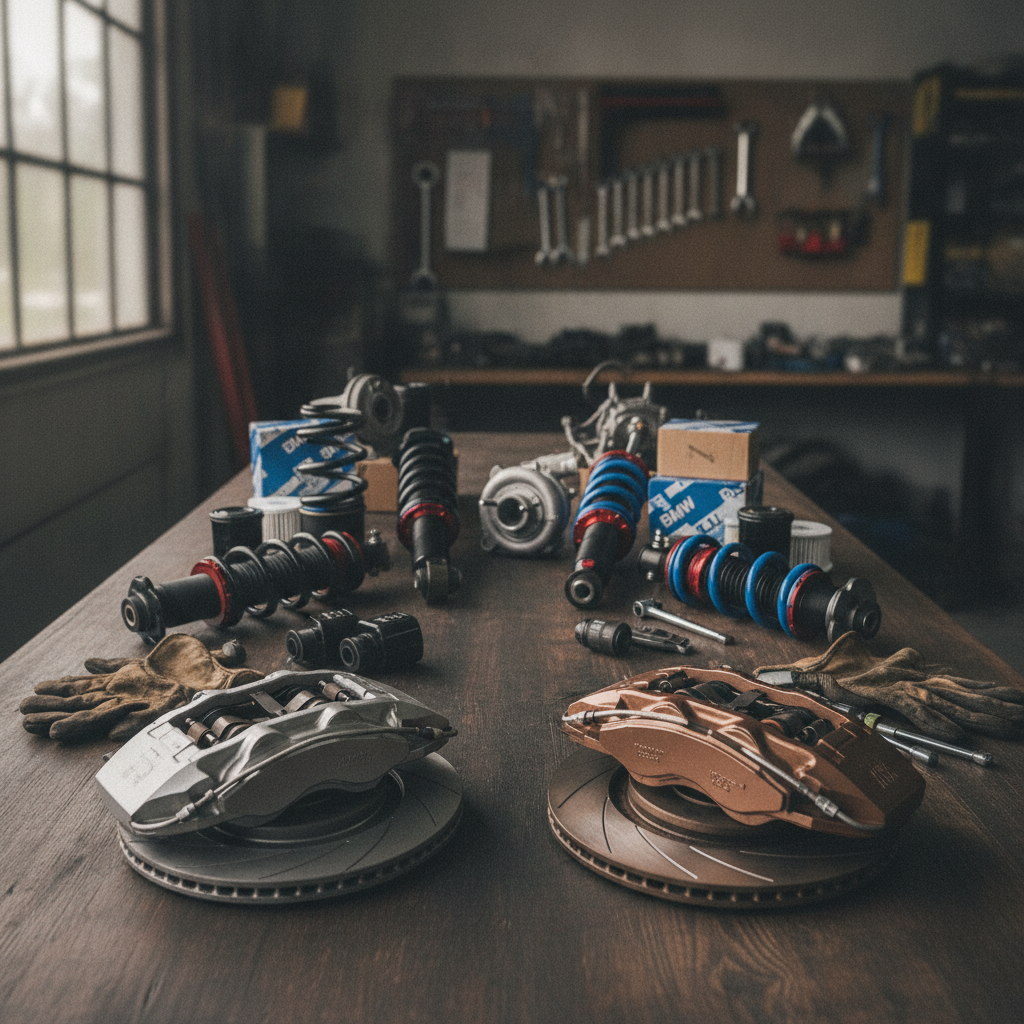
BMW Parts: OEM vs Aftermarket Sourcing Options Explained
Learn the differences between OEM and aftermarket BMW parts sourcing options, their benefits, and how to choose the right parts for your vehicle.
Introduction
I've spent eighteen years at the parts counter, and the question is always the same: OEM or aftermarket? For BMW parts, the answer isn't about preference — it's about what the repair requires and what happens when you get it wrong. A customer brings in a universal coolant for an E90, runs it, and two weeks later the heater stops working. That's not bad luck; that's the wrong spec doing what the wrong spec does.
The choice between OEM and aftermarket BMW parts affects more than your invoice. It determines whether the part fits the build date, whether it carries the manufacturer approval the system needs, and whether your warranty survives the repair. The catalog might list one oil filter for an E46, but the factory parts list splits it by engine code because the bypass valve is different. Miss that detail and you're back at the counter.
Sourcing BMW parts correctly means knowing where each option comes from, what it's approved for, and what it costs when it fails. OEM parts come through the dealer network with BMW's part number printed on the box. Aftermarket parts come from independent suppliers — some are OE-supplier overruns with the same spec, others are budget alternatives that meet a different standard. The difference shows up in the cooling system, the timing chain, and the oil pan gasket. For filters, fluids, brakes, spark plugs, and lighting, the approval on the bottle or the box is what matters, not the brand name.
This article walks through the sourcing options, the approvals that separate them, and the repairs where each one belongs. You'll see BMW coolant specifications and what to check before ordering, the part numbers that matter, and the mistakes that cost more than the part you saved money on. At the counter, we sell both — but only after we check the build date and the engine code.
Problem Statement
BMW owners and independent shops face three recurring problems when sourcing parts: catalog errors, specification mismatches, and invisible compatibility boundaries. The same mistakes happen at the counter repeatedly, and they cost real money.
The catalog often lists a single filter for both engines, but the factory parts list might specify differently due to variations like the bypass valve. You order what the screen shows, the part arrives, and it doesn't fit. The return costs time, the customer waits, and the job stalls. Cross-checking distributor catalog fitments against manufacturer specifications catches this before the order goes out, but most people skip that step until it burns them once.
The Specification Trap
BMW publishes specific approvals for fluids — LL-01, LL-04 for oil, and the blue-to-grey coolant transition that still confuses people. A part that meets "European spec" or "OE equivalent" means nothing unless the approval is printed on the bottle. Shops mix coolants thinking they're close enough, and six months later the heater core is clogged. Draining and filling your cooling system becomes a regular maintenance requirement when the wrong fluid goes in, not just part of a repair.
The second trap is part supersession. BMW replaces a part number, and the old number disappears from the system. Aftermarket catalogs still list the old number, so you order it, and what arrives is either the updated part or something that doesn't fit the revision your car actually has. Build date matters, and the VIN decode doesn't always catch mid-year changes.
Real-World Failures
Customers bring in common maintenance parts — spark plugs, coils, brake pads — that were "BMW compatible" but lacked the specific heat range, gap spec, or friction code the car needed. The part bolts on, the car runs, and two thousand miles later the misfire comes back or the brakes judder. The cheap way costs more when you're doing the job twice.
For more on ensuring you have the right cooling system components before ordering, see BMW Coolant and Cooling Parts: What to Check Before Ordering.
The problem isn't that aftermarket parts are bad — it's that the catalog doesn't tell you which approval the part meets, and the counter person doesn't ask which engine code or build date you have. You're buying on price and part number, and the specification is invisible until something fails.
Solution Steps
Sourcing BMW parts the right way comes down to checking three things in order: the part number on your car, the approval or specification it requires, and whether the replacement carries that same approval. Too many comebacks at the counter happen because someone skipped the middle step.
Step 1: Identify the Exact Part Number
Start with the part itself, not the catalog. BMW stamps part numbers on filters, sensors, and many wear items. If the part is already off, read the number directly. If it's still on the car, check the owner's manual service section or the underhood label for fluids and filters. The build date matters — a 2011 328i and a 2013 328i with the same engine code can spec different oil filters if BMW revised the part mid-run.
For fluids, the approval is the part number. A 2015 335i takes LL-04 oil, and that approval is printed on every bottle that meets it. The brand is a choice; the approval is a requirement.
Step 2: Decide Between OEM and OE-Supplier Aftermarket
OEM parts come in the blue-and-white BMW box with the Genuine logo. OE-supplier parts come from the same factory that makes the OEM part, sold under the supplier's name — Mann, Mahle, Bosch, Hengst. For filters, sensors, and most wear items, I stock both. The OE-supplier part is the same piece without the markup. For complex modules, programmed controllers, and anything with a software component, OEM is the safer call. The programming and calibration are guaranteed.
Aftermarket that is not OE-supplier is a different category. Universal fit, no approval, no factory backing. It is not sold for BMW applications where a spec exists.
Step 3: Verify the Approval on the Replacement
This is where mistakes happen. The catalog says the part fits, but fitting is not the same as meeting the spec. For oil, the LL-01 or LL-04 approval has to be printed on the back label of the bottle. For coolant, it has to say it meets the current BMW spec, which as of this writing is the grey phosphate-free formula that replaced the older blue. BMW Coolant and Cooling Parts: What to Check Before Ordering covers the transition and what happens when you mix them.
Step 4: Cross-Check Distributor Fitment Against Factory Parts List
The distributor catalog lists one filter for two engines, but the factory parts list might specify different part numbers because of a valve or gasket difference. This has played out with E90 oil filters — the catalog showed universal fit, but BMW split the application by production date, and the bypass-valve spring rate was different. The wrong filter worked fine until it didn't, and then the variable valve timing solenoid clogged.
When the catalog and the factory list disagree, the factory list wins. If you don't have access to BMW's ETK parts system, ask your parts supplier to pull the ETK screenshot for your VIN. That is the list that matters.
Step 5: Order With the Part Number and the Approval
Give your supplier the BMW part number and the approval or spec it has to meet. For an oil change on an N55 engine, that is LL-04 oil and the filter for your specific build date. For a cooling-system refresh, that is the current grey coolant and the thermostat, water pump, and expansion tank that match your engine code. The parts counter can cross-reference the BMW number to the OE-supplier equivalent, but only if you start with the right number.
The tab and the project time depend on what you are replacing, but the process is the same every time: part number from the car, approval from the spec, replacement that carries both.
Tips and Tricks
A lot of mistakes at the counter come down to skipping the simple checks. Here's what keeps you out of trouble when you're sourcing BMW parts.
Check the Build Date Before You Order
BMW changes parts mid-year. A water pump for a 2011 335i built in March is not the same as one built in September if there was a production update. The VIN tells you the build date — use it. Catalogs list both early and late production numbers, and ordering the wrong one means you're doing the job twice.
The same goes for oil filters. The catalog often lists a single filter for both engines, but the factory parts list might specify differently due to variations like the bypass valve. Cross-check distributor catalog fitments against the BMW parts diagram. If the part numbers don't match, the catalog is wrong.
Work With a Cool Engine
When you're draining coolant or doing any cooling system work, let the engine cool completely. Hot coolant under pressure will burn you, and a hot engine makes it harder to see what you're doing. This is basic, but people still rush it.
Change Oil Every 5,000 Miles, Not What the Interval Says
BMW's extended service intervals are optimized for lease cycles, not engine longevity. I tell every customer the same thing: change the oil every 5,000 miles if you're keeping the car past 100,000. The LL-01 and LL-04 approvals are real, and the oil meets them, but 10,000-mile intervals leave sludge in the valve train on N54 and N55 engines. Run it shorter, and the variable timing stays clean.
Match the Part Number, Not the Description
Descriptions lie. Part numbers don't. If you're ordering a control arm, the catalog might say "fits all E90 models," but the BMW part number splits by engine and suspension package. The xDrive cars use different bushings than the RWD cars, and the M-Sport suspension has its own geometry. Get the part number off the old part or pull it from RealOEM, then match it exactly.
Know When OEM Is the Only Option
Some parts don't have a good aftermarket equivalent. High-pressure fuel pumps, variable valve timing solenoids, and anything with a BMW-specific calibration or software component — buy the OEM part. The aftermarket versions might fit, but they don't behave the same under load. Shops have replaced an aftermarket high-pressure fuel pump three times before giving up and installing the BMW part that should have gone in first.
For more on BMW scan tools and diagnostics by chassis, we cover which tools actually read the modules you need.
Use the Right Fluid, Not the Cheap One
Universal coolants are a recurring problem. Customers bring in the orange stuff, top off a G48 system, and then the heater stops working because the mixture precipitates and clogs the heater core. BMW specifies the coolant by part number for a reason — it's not a preference, it's a requirement. The same applies to power steering fluid: Pentosin CHF 11S is what the system takes, and substituting it with generic ATF wears the pump seals.
The bottle has to say the approval — if it doesn't, it's not approved, no matter what the parts-store guy tells you.
Buy Wear Items in Sets
Control arms, bushings, and suspension links wear as a system. Replacing one side and leaving the other creates an imbalance, and you'll be back under the car in six months doing the other side. Buy both sides, do them together, and get an alignment immediately after. The alignment costs the same whether you do one side or both, so you're just paying for the parts twice if you split it.
Conclusion
The same pattern at the counter has been observed for eighteen years: someone brings in a universal part, runs it, and the repair comes back. The bottle has to say the approval. The catalog has to match the build date and engine code. The cheap way costs more when the heater stops working or the variable timing solenoids clog.
OEM BMW parts carry the manufacturer approval printed on them. Aftermarket parts that meet the same spec work — if the spec is right and the fitment is exact. The catalog often lists a single filter for both engines, but the factory parts list might specify differently due to variations like the bypass valve. Cross-check the distributor catalog fitments against the manufacturer specifications. Don't assume. Don't mix. Don't top a blue coolant system with orange.
The owner's manual is right about the fluid specs. The part number on the old part is right about the fitment. Everything else is a guess, and guesses cost money. When you're not sure which part fits your chassis, check the scan tool compatibility by model year and function — the same principle applies to every component: match the part to what the car actually is, not what the year suggests it might be.
Run the right spec. Buy from a source that knows the difference. Keep the receipts. That's the counter advice, and it hasn't changed.
Sources(14)
- ECS Tuning Blog
- ECS Tuning Blog
- Audi Technical Service Bulletin (NHTSA ODI)
- Volkswagen Technical Bulletin 17-19-01 (NHTSA ODI)
- Audi Technical Service Bulletin (NHTSA ODI)
- ACEA (2023)
- Audi Technical Service Bulletin (NHTSA ODI)
- BMW of North America maintenance booklet
- Pelican Parts Technical Articles
- Pelican Parts Technical Articles
- Pelican Parts Technical Articles
- Motul technical data sheet (2022)
- Pelican Parts Technical Articles
- Pelican Parts Technical Articles
Written by
Lee Shahin
Founder, European Wholesale Parts
Lee Shahin founded European Wholesale Parts in Pleasanton, California, after 18 years in the Mercedes-Benz and BMW parts trade. He came to the parts side from the shop floor: he opened a European repair shop in Northern California in the early 1990s, specialising in Mercedes-Benz and BMW, and grew it with his wife Laurie into a parts and delivery operation serving body shops and independent repair facilities across the region. Nearly two decades at the parts counter taught him where the expensive mistakes happen, and most of them are fluids: the wrong coolant in an aluminium block, an oil without the sheet approval the engine was designed for, a transmission topped with the wrong ATF. That is what he writes about here. Every article names the manufacturer specification by its exact designation, explains what the wrong fluid does mechanically, lists products that carry the approval, and gives the capacity and interval for the models and years the specification covers. When a reader needs a part sourced, the quote desk at European Wholesale Parts is where Lee and Laurie still answer the phone.