

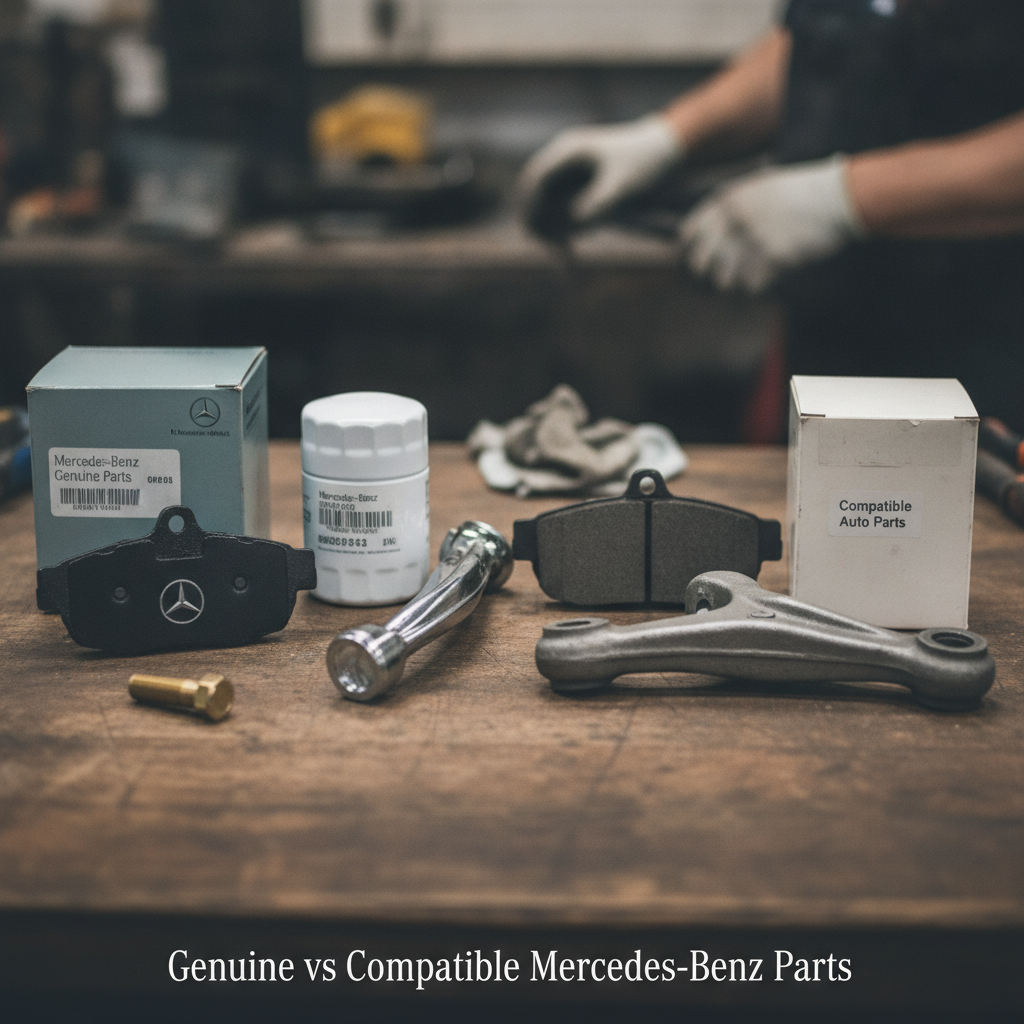
Mercedes-Benz Parts: Genuine vs Compatible Options Explained
Explore the differences between genuine and compatible Mercedes-Benz Parts, including tips on sourcing and making the right choice for your vehicle.
Introduction
Years at the counter watching people choose Mercedes-Benz parts have shown that the question is always the same: do I need the genuine part or will the cheaper one work? The answer depends on what the part does and whether the aftermarket supplier meets the factory specification. A brake pad or an oil filter has published standards; a control-arm bushing or a sensor often does not. Genuine Mercedes-Benz parts come from Mercedes-Benz AG with a part number that traces back to Stuttgart. Compatible Mercedes-Benz parts come from third-party manufacturers who may or may not have tested their product against the original.
The difference matters because Mercedes engineers specify tolerances, materials and approvals that keep the car running as designed. When a compatible part meets those specifications, it works. When it does not, you pay twice: once for the part and once for the repair it causes. Some aftermarket suppliers publish test data and approvals; others print a part number on the box and hope it fits. At the counter, the approval on the bottle, the sheet number on the oil, and the manufacturer's name on the brake fluid are checked. If the part carries the right approval, it is sold. If it does not, the customer is informed about what happens when the wrong one goes in.
This article walks through the practical differences between genuine and compatible Mercedes-Benz parts, the specifications that matter, and how to source parts that meet the factory standard without paying dealer markup. We cover fluids, filters, wear items and when the genuine part is the only safe choice. By the end, you will know which Mercedes-Benz parts accept quality aftermarket alternatives and which ones require the factory number.
For related guidance on sourcing quality components for European platforms, see our BMW Scan Tools by Chassis and Function article.
What Makes Mercedes-Benz Parts Selection Challenging?
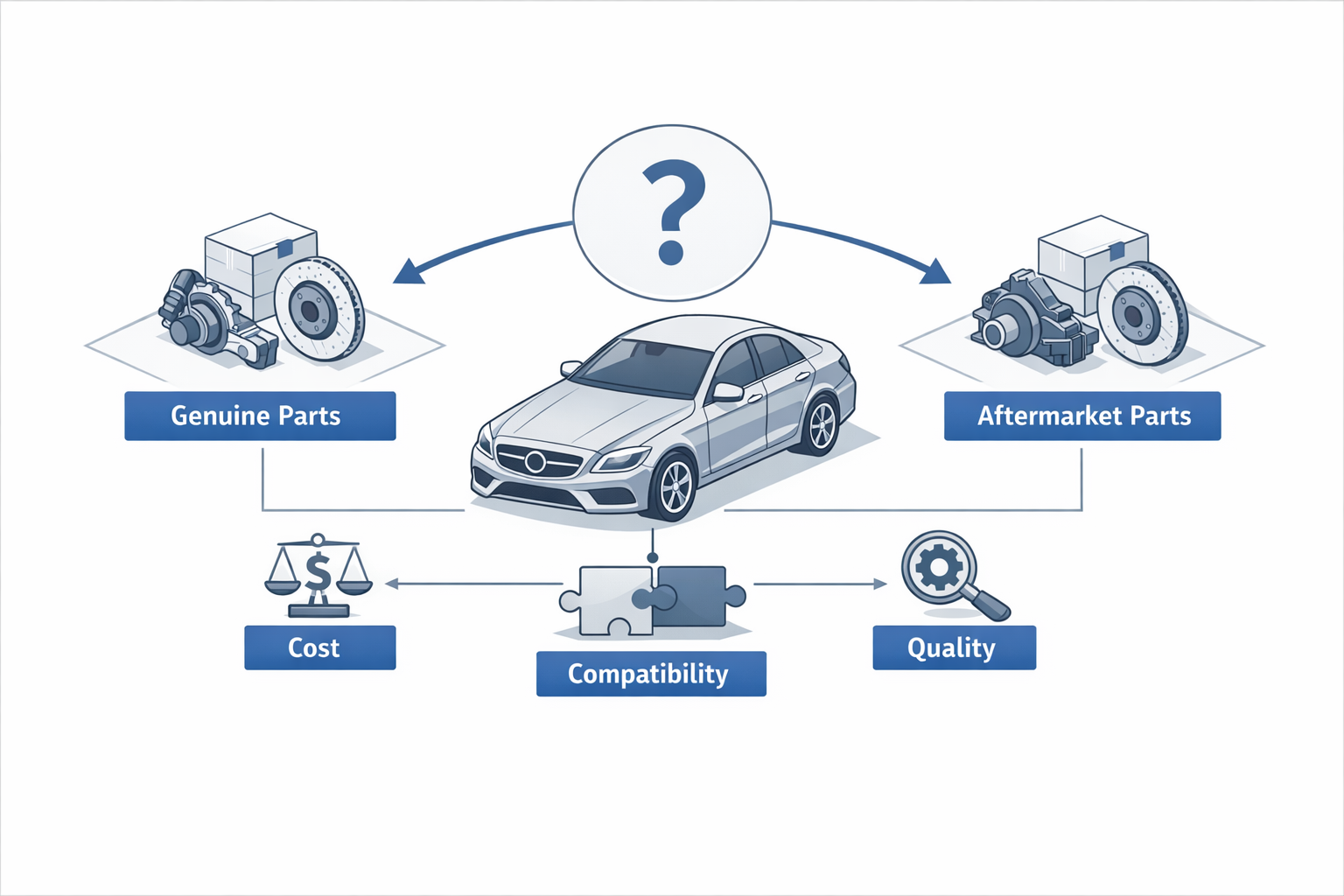
The first question at the counter is always the same: do I have to buy the Mercedes-Benz parts from the dealer, or can I run something else? Owners often walk out with the wrong answer because they didn't know what the bottle has to say, or because the counterperson didn't check the approval list. The problem is not whether alternatives exist—they do—it's whether the alternative meets the sheet specification your engine requires.
Mercedes-Benz publishes approval sheets for every fluid and many service parts. MB 229.5 is a multigrade oil spec; MB 229.51 is the low-SAPS version for diesels with particulate filters. The bottle has to say one of those numbers, printed right on the label, or it is not approved no matter what the viscosity reads. Run a 5W-40 without the sheet approval and you are outside spec the moment you pour it in.
The Warranty and Performance Risk
Genuine parts carry the Mercedes star and meet every internal test the factory runs. Compatible parts—those with the printed approval—meet the published standard but come from a different principal. Both are legal. The mistake is assuming that any 5W-30 or any brake pad with the right dimensions will work the same way.
When the approval is missing, the part might fit and it might not fail immediately, but you have no mechanical argument if something goes wrong. Mercedes-Benz Genuine Engine Oil Fully Synthetic MB 229.51 is on the 229.51 sheet; so is ADDINOL GIGA LIGHT MV 0530 LL. Both meet the standard. A house-brand 5W-30 with no sheet number does not, even if the price is half.
The genuine-versus-compatible question is not about brand loyalty; it is about reading the approval and knowing what your engine code requires. For a detailed look at how wheel and tire choices interact with suspension modifications, see our BMW M340i Lowering Springs vs Coilovers for Daily Driving guide—the same principle applies: the spec is not a suggestion.
How to Choose the Right Mercedes-Benz Parts
Step 1: Check the Part Number Against the Mercedes-Benz Operating Fluids Database
Every parts decision starts the same way: find the exact specification the car requires, then check what meets it. For fluids, Mercedes publishes approved products on operatingfluids.mercedes-benz.com by sheet number. If you need engine oil for a car that calls for MB 229.52, the MB 229.52 sheet lists every approved product by viscosity grade and principal. The bottle has to carry that sheet approval — not a generic ACEA rating, not an API service classification, the actual MB number. A 5W-30 that meets ACEA C3 but lacks 229.52 approval will not protect the variable cam timing on an M276 engine the way the spec requires.
For brake fluid, the same rule applies: the MB 331.0 sheet names the approved products. Run DOT 4 without that approval and you introduce a fluid the ABS module was not calibrated for. The difference shows up in pedal feel first, then in the accumulator cycle rate.
Open the owner's manual or service booklet and find the MB sheet number — it is a three-digit number followed by a decimal, like 229.52 or 331.0. Write it down. Do not substitute a generic standard.
Step 2: Compare Genuine Parts to OE-Supplier Alternatives
Genuine Mercedes-Benz parts carry the star. OE-supplier parts — Bosch, Mahle, Mann, Sachs — are the same components Mercedes installs at the factory, sold in a different box. Both are sold at the counter. The genuine part comes with the Mercedes part number and packaging; the OE-supplier part comes with the supplier's number and often costs less. The part itself is identical when the supplier is the original manufacturer.
The mistake is assuming every aftermarket part is an OE-supplier part. Some are pattern parts: reverse-engineered copies that meet no Mercedes testing protocol. A pattern oil filter might use thinner media or a weaker bypass spring. It fits the threads, but it does not filter to the same micron rating, and it does not protect the same way. When comparing prices, compare the source: OE-supplier or pattern. The number on the box tells you which.
Step 3: Verify Compatibility by Engine Code and Model Year
Mercedes-Benz parts are not interchangeable across platforms the way some assume. The M274 and M276 engines both take 0W-40 oil, but the M274 uses a cartridge filter and the M276 uses a spin-on canister. The part numbers do not cross, and neither do the capacities. Customers often buy the wrong filter because they searched by model name instead of engine code. The engine code is stamped on the data plate under the hood and printed in the service booklet. Use it.
For wear items — brake pads, rotors, suspension bushings — the build date matters as much as the model year. Mercedes changes suppliers mid-production. A 2015 C300 built in March uses different front pads than one built in October. The VIN breaks the tie. Run the VIN through a Mercedes parts lookup, not a generic year-make-model search, and you get the correct part the first time.
Before ordering, enter the last eight digits of the VIN into a Mercedes parts catalog or give them to your parts supplier. The VIN resolves production changes that a model-year search misses.
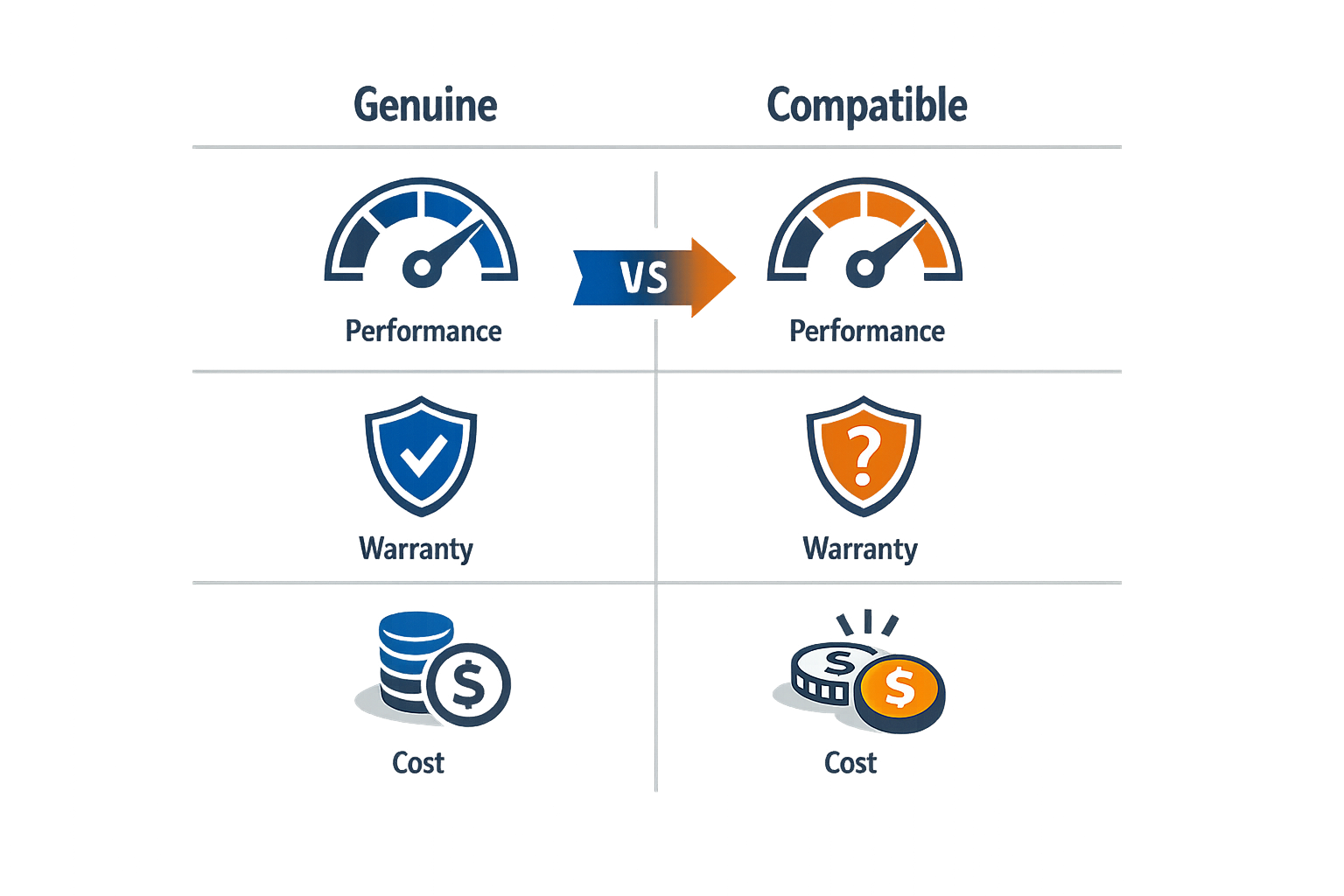
Step 4: Weigh Cost Against Warranty and Longevity
The cheap way costs more when the part fails early or when a claim gets denied. Genuine parts and OE-supplier parts carry a warranty that covers the part and the labor if it fails during the coverage period. Pattern parts either carry no warranty or cover the part only, not the time it takes to replace it. On a job that requires removing the intake manifold to reach a failed thermostat, the labor cost is ten times the part cost. If the pattern thermostat fails at 18 months and you pay the labor again, you have spent more than the genuine part would have cost in the first place.
Warranty claims can also be rejected because a pattern part introduced a fault the dealer traced back to the component. Mercedes-Benz warranty coverage and some extended plans require genuine or OE-equivalent parts for covered repairs. Install a pattern part during the warranty period and you have voided coverage on the affected system. Read the warranty terms before you decide.
Choosing Based on Performance, Not Just Price
Performance means the part does what the engineering specification requires, not what the marketing copy claims. For fluids, performance is the approval printed on the bottle. For filters, it is the micron rating and the bypass-valve pressure. For brake components, it is the friction coefficient and the thermal range. Genuine parts meet these specifications because Mercedes tested them. OE-supplier parts meet them because they are the same parts. Pattern parts might meet some of them, or none, and the packaging will not tell you which.
When sourcing a part, the question is: does this component affect engine protection, braking performance, or emissions compliance? If yes, use genuine or OE-supplier. If it is a trim clip or a cabin filter, pattern is fine. The decision is not about brand loyalty; it is about what happens when the part does not perform. On a $60,000 car, a $12 oil filter is not the place to save money.
For more on choosing the right components for European platforms, see our guide to ceramic vs semi-metallic brake pads for European cars and our Motive Power Bleeder European Car Compatibility Guide.
Tips and Tricks
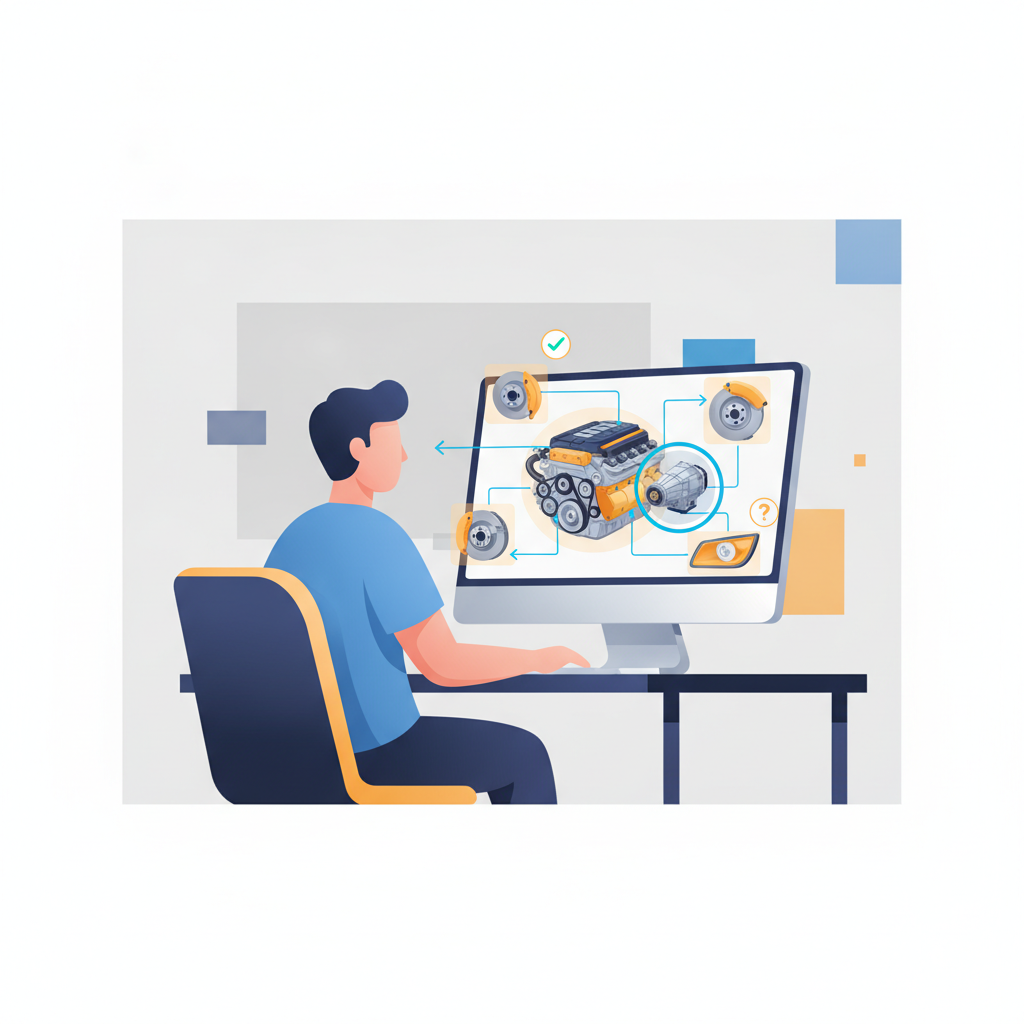
Customers often waste hours chasing part numbers that changed three bulletin revisions ago. The first rule: check with your parts department before ordering anything. Mercedes updates part supersessions constantly, and what worked for a 2015 C300 might not cross to the 2016 model even when the engine code matches. ETKA and the manufacturer's electronic catalog are the only live references — a printed diagram is already outdated.
Check the Approval, Not the Marketing
When sourcing fluids or wear items, the bottle has to say the spec. For engine oil, that means the MB sheet number printed on the label — 229.3, 229.5, 229.51, whatever your engine requires. The brand name doesn't matter; the approval does. Expensive synthetics that don't carry the sheet approval exist, and budget oils that do are available. Run the wrong one and the variable timing solenoids clog first, then the cam adjusters. The repair costs more than a decade of oil changes.
Use the Right Catalog for the Job
ETKA lists fasteners, bolts, nuts and screws by repair manual reference, and it updates when a torque spec or part number changes. If ordering hardware for a suspension job, cross-reference the repair manual section to the ETKA line item. Generic metric bolts might fit the threads, but they won't meet the grade or coating spec, and that matters on anything that sees road salt or carries a critical load. The parts department can pull the current number; you just need to give them the repair manual callout.
For filters and service items, the OE-supplier catalogs — Mann, Mahle, Hengst — show which part they supply to the assembly line and which aftermarket number crosses to it. The OE-supplier part is the same piece that went in at the factory, just without the star on the box. Both are stocked at the counter, and the price difference pays for itself when the filter seals right and the bypass valve opens at the correct pressure. If help is needed cross-referencing parts across different European makes, see our BMW Scan Tools by Chassis and Function guide for diagnostic approaches that apply across platforms.
Don't Mix Specifications
Topping off is where most mistakes happen. If your car takes MB 229.51 and you add a quart of 229.5 because that's what the quick-lube had, you've now got a mixture that meets neither spec. The ash content is wrong, the detergent package is wrong, and the next oil analysis will show it. Flush it and start over, or run it to the next change and then go back to the correct sheet approval. Mixing is the mistake; the fix is to stop mixing.
The approval printed on the bottle is not a preference — it's a requirement, and the aluminum doesn't forgive it.
Conclusion
The same question plays out at the counter for years: genuine or compatible? The answer depends on what breaks when you guess wrong. For critical components — engine management sensors, high-pressure fuel parts, transmission solenoids — the genuine part is the part that carries the manufacturer's approval and the engineering data behind it. A compatible sensor might fit the connector, but if the signal curve is off by 5%, the ECU adapts poorly and you chase a driveability concern for months.
For consumables and wear items — filters, brake pads, wiper blades — a quality OE-supplier part meets the same spec the factory uses and costs less than the star-branded box. The key is knowing which supplier made the original and whether their aftermarket line carries the same approval. The sheet number on fluids, the OE part cross-reference on filters, and the material spec on brake components are what to look for. If those match, the part works; if they don't, it's a gamble.
Mercedes-Benz parts are not interchangeable by description alone. Two oil filters with the same thread and gasket can have different bypass-valve pressures; two brake pads with the same dimensions can have different friction codes. The build date, the engine code, and the option package all matter, and the only reliable check is the EPC or a distributor catalog that lists the supersessions. When sourcing parts, verify the application by VIN, not by model year, and confirm that the approval printed on the part matches what the service sheet requires.
The cheap way costs more when the part fails early or triggers an adaptation fault that requires a dealer scan. Run the right spec, check the bottle or the box for the approval, and if the data isn't there, don't install it. For help identifying the correct BMW scan tools by chassis and function or sourcing verified OE-supplier parts for European platforms, reach out — we sell both genuine and approved-equivalent components, and we know which is which.
FAQ
What is the difference between genuine and compatible Mercedes-Benz parts?Genuine Mercedes-Benz parts are manufactured by Mercedes-Benz AG or their contracted OE suppliers and carry the factory part number. Compatible parts are third-party alternatives that may fit your vehicle but do not carry the manufacturer's approval unless they display the specific MB sheet number on the label.
Do compatible Mercedes-Benz parts void my warranty?Installing a compatible part that lacks the required MB approval can void warranty coverage on the affected system. Mercedes-Benz warranty terms and most extended service contracts require genuine or OE-equivalent parts that meet published specifications. Always verify the approval before installation during the warranty period.
How do I verify a Mercedes-Benz parts approval?Check the product label for the MB sheet number that matches your owner's manual specification. For fluids, visit operatingfluids.mercedes-benz.com and search by the sheet number (such as MB 229.52 or MB 331.0) to see the list of approved products. The bottle or package must display that exact approval.
Are OE-supplier parts the same as genuine Mercedes-Benz parts?OE-supplier parts from manufacturers like Bosch, Mahle, Mann and Sachs are often the same components Mercedes installs at the factory, sold in different packaging. When the supplier is the original manufacturer and the part carries the correct approval, it meets the factory specification. Pattern parts—reverse-engineered copies—do not.
When should I only use genuine Mercedes-Benz parts?Use genuine parts for critical components that affect engine management, high-pressure fuel systems, transmission controls, or emissions compliance. If the aftermarket alternative does not publish test data or carry the required MB approval, the genuine part is the only safe choice.
Sources(17)
- Motul technical data sheet (2022)
- Mercedes-Benz Operating Fluids (2026)
- Mercedes-Benz Operating Fluids (2026)
- Mercedes-Benz Operating Fluids (2025)
- LIQUI MOLY
- ECS Tuning Blog
- Pentosin product data sheet (CRP Automotive)
- Pentosin product data sheet (CRP Automotive)
- Mercedes-Benz Operating Fluids (2024)
- Mercedes-Benz Operating Fluids (2026)
- Mercedes-Benz Operating Fluids (2026)
- BMW of North America maintenance booklet
- Audi Technical Service Bulletin (NHTSA ODI)
- Mercedes-Benz Operating Fluids (2026)
- LIQUI MOLY
- Mercedes-Benz Operating Fluids (2026)
- Audi Technical Service Bulletin (NHTSA ODI)
Written by
Lee Shahin
Founder, European Wholesale Parts
Lee Shahin founded European Wholesale Parts in Pleasanton, California, after 18 years in the Mercedes-Benz and BMW parts trade. He came to the parts side from the shop floor: he opened a European repair shop in Northern California in the early 1990s, specialising in Mercedes-Benz and BMW, and grew it with his wife Laurie into a parts and delivery operation serving body shops and independent repair facilities across the region. Nearly two decades at the parts counter taught him where the expensive mistakes happen, and most of them are fluids: the wrong coolant in an aluminium block, an oil without the sheet approval the engine was designed for, a transmission topped with the wrong ATF. That is what he writes about here. Every article names the manufacturer specification by its exact designation, explains what the wrong fluid does mechanically, lists products that carry the approval, and gives the capacity and interval for the models and years the specification covers. When a reader needs a part sourced, the quote desk at European Wholesale Parts is where Lee and Laurie still answer the phone.