

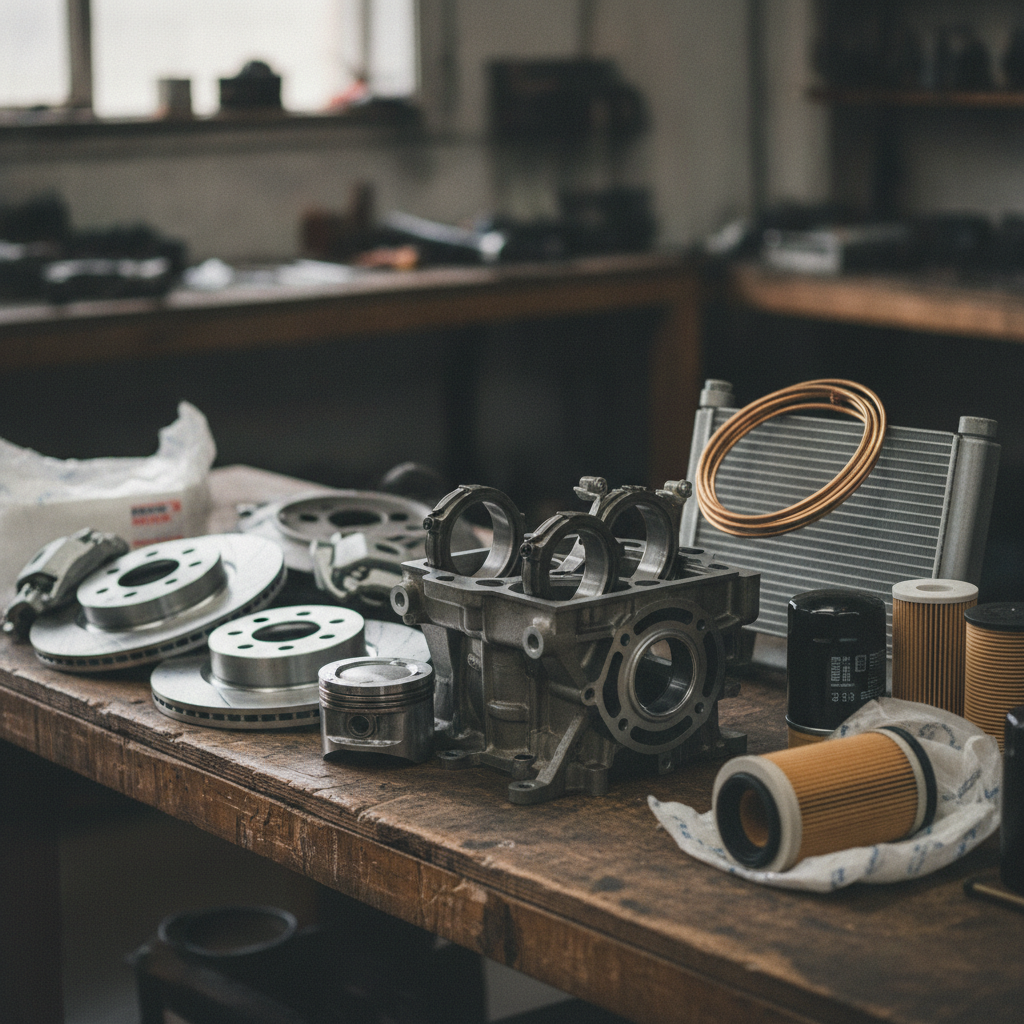
OEM Parts: What You're Actually Buying for Your Vehicle
Learn what OEM parts are, why they matter for your vehicle, and what to consider when buying OEM parts from dealers versus aftermarket options.
Introduction to OEM Parts
I have spent years at the counter answering one question in fifty different forms: what is an OEM part, and why does it cost what it costs? The answer is mechanical, not philosophical. OEM stands for Original Equipment Manufacturer — the supplier that made the part the factory installed when your car was built. When you buy an OEM part today, you are buying the same specification, made on the same tooling, shipped in a box with the vehicle manufacturer's part number printed on it.
That part number is the contract. It says the part meets the dimensional tolerance, material specification and test protocol the vehicle manufacturer requires. On a BMW, that means the oil filter canister is sized for the correct flow rate and the o-ring is the correct durometer for the operating temperature range of the engine it serves. On an Audi, it means the coolant reservoir is molded from a plastic compound that resists stress-cracking at the temperatures the G13 coolant reaches. The OEM part is not always better because it is OEM — it is specified because it is correct.
The confusion starts when people conflate OEM with "dealer-only" or "more expensive." Many OEM parts are available through independent distributors, and many come in boxes that do not carry the vehicle manufacturer's branding. What matters is the part number and the supplier code. I have sold Mahle oil filter kits that are OEM for BMW and Mann filters that are OEM for Mercedes — the same part, in the same box, that the dealer sells, but without the markup. The OEM designation is about the specification and the supply chain, not the retail channel.
For European platforms, this distinction is critical. A Mercedes engine that requires MB 229.52 oil will not tolerate a generic 5W-30 that lacks the sheet approval, even if the viscosity is identical. The approval is printed on the bottle, and the bottle has to say it. The same principle applies to parts: the OEM brake pad compound for a Porsche is formulated to work with the specific rotor metallurgy and ABS calibration of that chassis. An aftermarket pad may stop the car, but it may also trigger a pad-wear sensor fault or cause judder that the OEM compound would not.
What OEM Actually Means on the Shelf
When you ask for an OEM part, you are asking for a part that carries the vehicle manufacturer's part number and meets their production specification. That part may be made by Bosch, Mahle, Continental, ZF or any of a dozen Tier 1 suppliers — the vehicle manufacturer does not make most of the parts themselves. What they do is write the specification, approve the supplier, and assign the part number. The OEM part is the one that satisfies all three.
The aftermarket part, by contrast, is made to a specification the aftermarket supplier wrote. It may be dimensionally identical, it may use the same materials, and it may even come off the same production line — but it does not carry the vehicle manufacturer's part number, and it is not sold under their liability. That is the trade you make when you buy aftermarket: you accept the aftermarket supplier's testing and warranty instead of the vehicle manufacturer's.
For service items like filters, fluids and wear parts, that trade is often reasonable. For engine internals, emissions components and safety systems, it is not. I have watched mechanics replace a failed aftermarket thermostat on a BMW twice in six months because the aftermarket unit opened at the wrong temperature and the engine overheated. The OEM thermostat, which cost twelve dollars more, would have lasted the life of the cooling system. The cheap way costs more.
The value of OEM parts is not emotional — it is mechanical. The part fits, it works, and it does not introduce a variable the vehicle manufacturer did not plan for. That is what you are buying, and that is what the price reflects.
The Problem with Non-OEM Parts
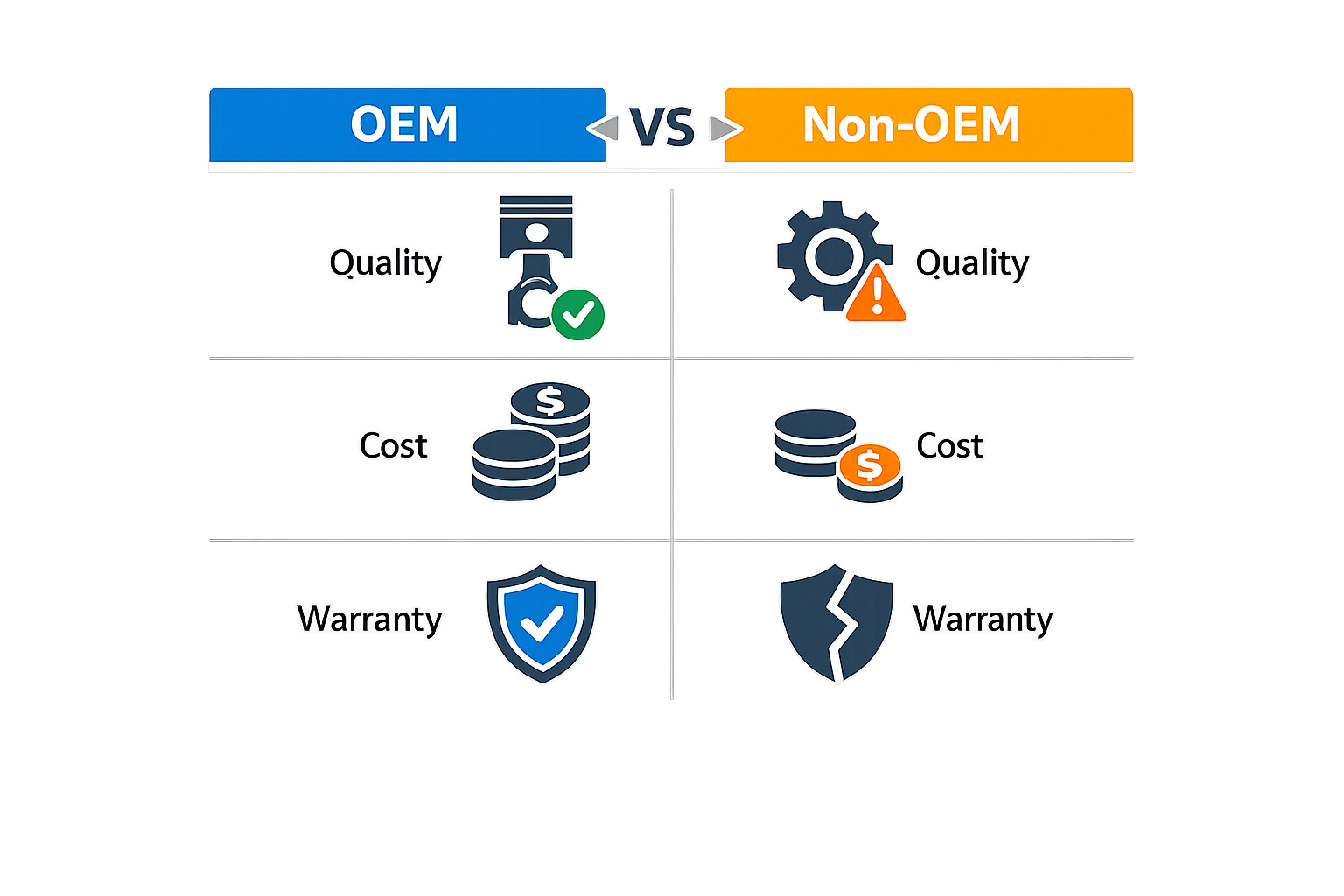
The question at the counter is always the same: can I save money with the aftermarket version? Sometimes yes, sometimes no — and the times it goes wrong, it goes wrong in ways that cost more than the original part.
I've watched people bring back alternators three times in six months because the aftermarket rebuild didn't hold. The OEM unit costs more up front, but it runs five years without a callback. The cheap way costs more when you add the labor every time it fails.
Fitment and Tolerance Issues
Non-OEM parts are made to a drawing, not to the factory's process. A control arm that looks identical may use different rubber in the bushing or a slightly softer steel in the forging. On a Mercedes W204, that half-millimeter of slack in the ball joint changes the thrust angle, and you're back for an alignment in six months instead of three years.
The bolt holes line up, the part bolts in, but the engineering isn't the same. European platforms are tight on tolerances — a throttle body that's 2mm off in the bore diameter will throw mixture codes and the customer thinks the car is broken when it's just the wrong part.
Material and Manufacturing Differences
An OEM water pump casting is specified to a metallurgy standard and a surface finish. The aftermarket version may use a different alloy or skip the coating, and it corrodes from the inside in two years. You don't see it until it fails, and by then the labor to replace it is the same as the first time.
Aftermarket oil filter housings may crack at the seam because the plastic isn't the same formula. The OEM part is glass-filled nylon with a specific impact rating; the aftermarket version is whatever polymer was cheap that quarter. It works until it doesn't, and when it splits, you're cleaning oil off the subframe.
Warranty and Liability Gaps
When an OEM part fails under warranty, the dealer replaces it and the manufacturer covers the claim. When an aftermarket part fails, you're arguing with a counterman about whether it's covered, and the labor isn't part of the deal.
The other issue is traceability. Technical service bulletins and recalls reference OEM part numbers. If you're running an aftermarket equivalent and a safety recall comes through, the VIN lookup won't flag your car because the system doesn't know what's actually installed. You're outside the notification chain.
The part that saves you forty dollars can cost you four hundred in labor when it fails early and takes another component with it.
Verification Challenges
Part information in technical bulletins is subject to change, and manufacturers update specifications without changing the part number. An aftermarket supplier working from an old drawing may not know the revision happened. You order what you think is the right part, and it doesn't match the current production standard.
I always tell people: check with the parts department for the latest supersession before you commit to an aftermarket substitute. The OEM system tracks every revision and every replacement number. The aftermarket catalog might still list a part that was superseded three years ago. For more on choosing quality components for European platforms, see our guide on ceramic vs semi-metallic brake pads.
Steps to Identify Quality OEM Parts
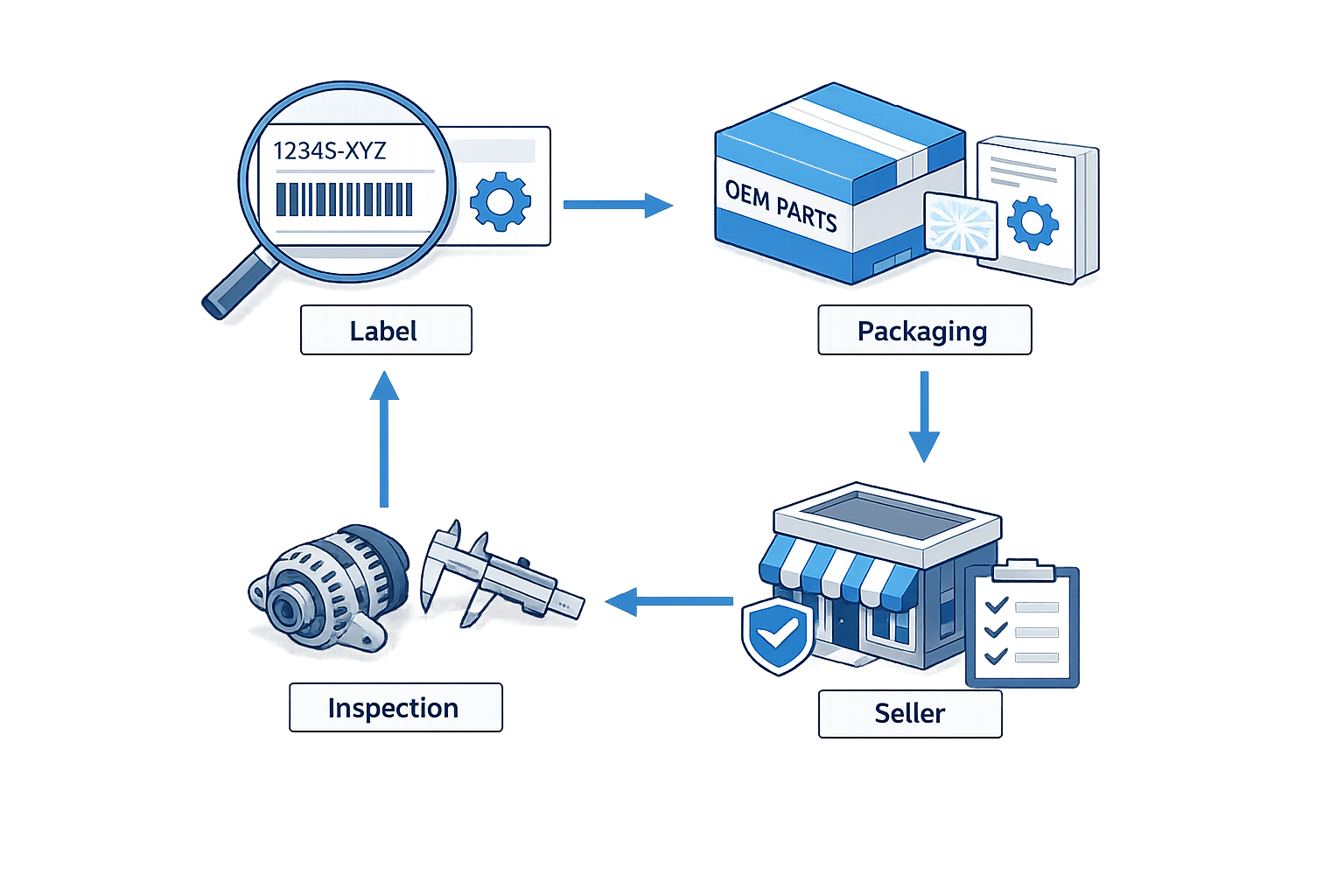
I've watched customers at the counter hold two boxes side by side, both claiming to be the right part, and not know which one to trust. The difference between a genuine OEM part and something else comes down to verifiable details, not packaging.
Check the Part Number Against the Manufacturer's Catalog
Your vehicle identification number tells you which variant you have. A 2015 328i with the N20 engine takes different parts than the same year with the N26. Pull the VIN, then cross-reference it in the dealer's parts system or ETKA for VW/Audi. The part number that comes back is the one the factory installed.
The number printed on the package must match the number the system returned for your VIN. If it's close but off by a digit, it's not the same part. Manufacturers revise parts mid-year, and the wrong revision won't fit or won't meet the spec your engine expects.
Part information in technical service bulletins changes, so always verify current details with your parts department before ordering. What was correct last year may have been superseded.
Confirm the Specification Meets Your Vehicle's Requirements
For fluids and filters, the part number is only half the story. The bottle or box has to carry the manufacturer approval your car requires.
If your BMW calls for LL-04 oil, the bottle must say LL-04 on the label. If your Audi needs G13 coolant, the jug must state G13. A product that meets one VW standard does not automatically meet another — 502.00 and 504.00 are not interchangeable, and neither are the coolant formulations.
Manufacturers have unique terminology for oil and fluid specifications, and these align with SAE, API, ILSAC and ACEA standards. When you see MB 229.51 or Porsche C30, that code tells you the formulation passed the tests the engine was designed around. A product without that approval on the data sheet is not OEM-equivalent, no matter what the marketing says.
Verify the Source
Genuine OEM parts come through the dealer network or from distributors who source from the same suppliers the factory uses. At the counter, I check the supplier code on the invoice. If it's Bosch, Mahle, Hengst, Mann+Hummel or another OE contractor, the part is built to the same drawing the factory uses, even if the box doesn't carry the car manufacturer's logo.
When you're comparing options for a specific platform — say, brake pads for a European daily driver — knowing which suppliers hold OE contracts helps you distinguish between a part that meets the spec and one that approximates it.
The part number, the approval and the supplier code together confirm what you're buying; any one of them alone does not.
Tips and Tricks for Buying OEM Parts
I've watched people walk out with the wrong part because they didn't ask the right questions at the counter. The first trick is knowing your vehicle's exact build date and engine code before you order anything. The dealer parts system keys off the VIN, but a good independent counter will ask you for the engine designation — a 2015 328i could have an N20 or an N26, and the oil filter housing is different.
Start with the Part Number, Not the Description
Never order by part name alone. "Oil filter" covers six different housings across one model year. Get the manufacturer part number from your owner's manual, the old part itself, or a reliable catalog. Cross-reference that number with what the supplier shows you on the screen. If the part number on the box doesn't match what you asked for, don't install it.
For European makes, the OE supplier often stamps their logo next to the manufacturer's number. Mann, Mahle, Bosch, Hengst — these are the companies that make the parts the factory installs. You're buying the same component, sometimes in different packaging.
Check the Approval on Consumables
Oil, coolant and brake fluid aren't parts, but the same principle applies. The bottle has to say the approval your car requires. A BMW with LL-04 in the manual won't run right on LL-01, even though both are "BMW oil." The spec is printed on the back label. If it's not there, it doesn't meet it.
For more guidance on selecting the right components for your vehicle, see our BMW Scan Tools by Chassis and Function guide.
Know When to Go Dealer-Direct
Some parts move so slowly that only the dealer stocks them. Trim clips, interior fasteners, and body seals often aren't cataloged by aftermarket distributors. If you're replacing a one-off bracket or a model-specific sensor, call the dealer first. The price difference on a low-volume part is often negligible, and you won't wait three weeks for a special order.
For high-wear items — brake pads, filters, belts — the OE supplier sells the same part through multiple channels. You pay for the dealer's inventory and logistics, not a better component.
Buy in Sets When the Manual Says To
Ignition coils, fuel injectors and suspension links are sold individually, but the service manual often specifies replacement in sets. Mixing old and new creates an imbalance the ECU can't always correct. If one coil failed and the others have the same mileage, replace all of them. The labor is already paid for.
Dispose of Fluids Properly
When you change oil, coolant or brake fluid, catch it in a sealed container and take it to a recycling center. Most auto parts stores accept used fluids. Don't pour it down a drain or leave it in an open pan in the garage.
Conclusion: The Value of OEM Parts
I've watched the same pattern at the counter for years: the customer who bought the cheap part comes back twice. The one who bought OEM comes back once, when the next service interval is due. That difference is the value.
OEM parts are not a preference — they are a requirement when the specification matters. A Mercedes coolant system, a BMW timing solenoid, an Audi G13 circuit: these are not forgiving platforms. The part either meets the approval printed in the owner's manual or it does not. When it does not, the repair cost is higher than the part saving ever was.
The decision is simpler than it looks. Check the build date, check the engine code, verify the approval on the bottle or the box matches what the manual calls for. If you are sourcing a fluid or a filter for a European make, the manufacturer's specification is the starting point — not the price, not the brand familiarity, not what worked on a different platform. The factory fill exists because the engineering requires it.
Price reflects assurance. An OEM part costs what it costs because the liability sits with the manufacturer, the fit is guaranteed, and the approval is printed on the data sheet. Aftermarket options exist, and some meet the same spec — but only when the approval is there in writing. Without it, you are guessing, and the aluminium does not forgive guessing.
For more guidance on sourcing the right parts for European platforms, see our BMW Scan Tools by Chassis and Function: Which Tool Fits Your Model article.
The value of OEM parts is not in the part itself — it is in what does not happen next. The system works, the interval holds, the next service is routine. That is what you are buying.
Sources(19)
- Volkswagen Technical Bulletin 17-19-01 (NHTSA ODI)
- Motul technical data sheet (2022)
- Mercedes-Benz Operating Fluids (2026)
- Motul technical data sheet (2021)
- Pentosin product data sheet (CRP Automotive)
- ACEA (2023)
- LIQUI MOLY
- Pentosin product data sheet (CRP Automotive)
- Pentosin product data sheet (CRP Automotive)
- BMW of North America maintenance booklet
- ECS Tuning Blog
- Audi Technical Service Bulletin (NHTSA ODI)
- Pelican Parts Technical Articles
- Pelican Parts Technical Articles
- ECS Tuning Blog
- Understanding Original Equipment Manufacturer (OEM)
- Mercedes-Benz Operating Fluids (2026)
- Mercedes-Benz Operating Fluids (2026)
- Volkswagen Technical Bulletin 19-17-01 (NHTSA ODI)
Written by
Lee Shahin
Founder, European Wholesale Parts
Lee Shahin founded European Wholesale Parts in Pleasanton, California, after 18 years in the Mercedes-Benz and BMW parts trade. He came to the parts side from the shop floor: he opened a European repair shop in Northern California in the early 1990s, specialising in Mercedes-Benz and BMW, and grew it with his wife Laurie into a parts and delivery operation serving body shops and independent repair facilities across the region. Nearly two decades at the parts counter taught him where the expensive mistakes happen, and most of them are fluids: the wrong coolant in an aluminium block, an oil without the sheet approval the engine was designed for, a transmission topped with the wrong ATF. That is what he writes about here. Every article names the manufacturer specification by its exact designation, explains what the wrong fluid does mechanically, lists products that carry the approval, and gives the capacity and interval for the models and years the specification covers. When a reader needs a part sourced, the quote desk at European Wholesale Parts is where Lee and Laurie still answer the phone.