
Drilled vs Slotted Rotors: Key Differences for Street and Track
Explore the differences between drilled vs slotted rotors for street and track use, helping you make an informed brake upgrade decision.
Introduction
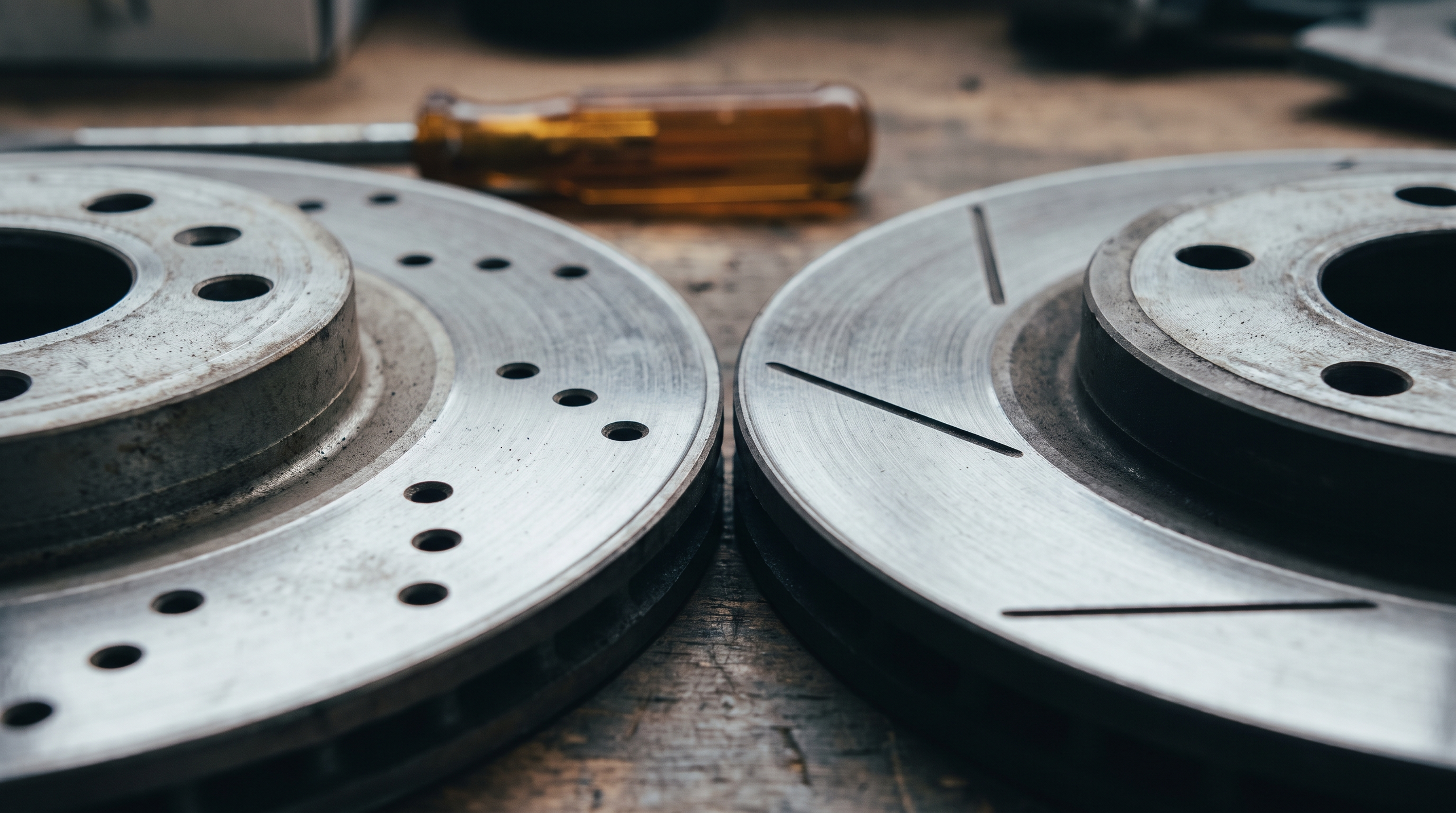
Drilled vs slotted rotors is a rotor design choice that depends on how you use the car and what you expect the brakes to do when you push them. A performance rotor manages heat, friction consistency, and pedal feel under repeated hard use. Drilled rotors feature holes bored through the friction surface, which improves gas dissipation and water evacuation in wet conditions, providing a more consistent initial bite. Slotted rotors have narrow grooves cut into the face that help sweep away debris, dust, and hot gases, delivering more consistent friction and excellent bite. Each design addresses a specific set of thermal and mechanical challenges, and each comes with trade-offs that matter when the pedal goes to the floor.
The choice between drilled vs slotted rotors is shaped by your driving environment, brake pad compound, and how often you ask the brakes to work hard. Street driving, track sessions, and mixed use each impose different thermal loads, and the rotor that works in one context can fail in another. If you're considering a DOT 4 vs. DOT 5.1 brake fluid upgrade, you're already thinking about heat management — rotor design is the next piece of that same puzzle. For European cars, brake system maintenance also includes understanding coolant specifications and engine oil approvals as part of the thermal management picture.
This article walks through the mechanical differences between drilled and slotted rotors, what each design does under load, and how to match the rotor to the application. The goal is to give you the information you need to make an informed decision before you order.
What Makes Drilled vs Slotted Rotors Different?
I've watched customers walk in asking for drilled rotors because they saw them on a forum, then come back six months later with cracks radiating from the holes. The rotor looked aggressive, but the application was wrong. Drilled rotors can develop cracks under repeated heavy heat cycles, especially on heavier vehicles, while slotted rotors generally hold up better under heat. The issue is not that one design is universally bad — it is that most people pick based on appearance rather than what their car actually does to the brakes.
Mismatched Expectations for Street Use
On the street, you are not generating sustained high temperatures. Most drivers never see pad temps above 400°F in normal commuting. Drilled rotors were developed to address outgassing from older pad compounds — a problem that modern friction materials solved decades ago. Running drilled rotors on a daily driver adds stress concentrations at every hole without delivering a functional benefit. The slots or holes do not make the car stop shorter in typical driving; they introduce failure points that plain rotors do not have.
Track Demands and Rotor Durability
For track use, rotor durability is critical, and high-quality slotted rotors or two-piece systems are often preferred over heavily drilled options. A track session subjects rotors to sustained temperatures that street driving never reaches — 1,000°F and above in heavy braking zones. Drilled rotors shed some heat through the holes, but they also concentrate stress exactly where the rotor is hottest. Slotted rotors maintain more structural mass while still clearing gases and glazing from the pad surface. The slot does not compromise the rotor's ability to absorb and dissipate heat the way a through-hole does.
Drilled and slotted rotors are not universally better; they are situationally superior and often misapplied, making them unsuitable for daily drivers.
The Cost of the Wrong Choice
When you install the wrong rotor type, the consequence is not just wasted money — it is premature replacement and, in some cases, a safety risk. A cracked rotor does not fail catastrophically in most passenger-car applications, but it does lose effective friction area and can cause vibration, noise, and uneven pad wear. On the track, a rotor that cannot handle the thermal load will fade, and fade means longer stopping distances exactly when you need them shortest. Picking the rotor that matches your actual use case — street commuting, occasional spirited driving, or dedicated track work — determines whether the upgrade improves performance or introduces new problems.
How to Choose Between Drilled vs Slotted Rotors
I've sold all three types at the counter, and the choice comes down to what you do with the car. Drilled rotors clear water and gas fast, slotted rotors keep bite consistent under heat, and plain rotors give you the smoothest wear and the longest life. Each design trades something for something else.
Drilled Rotors: Advantages and Disadvantages
Drilled rotors evacuate gas and water aggressively. The holes give wet-weather bite a sharper edge, and they help clear the pad surface when brake dust and outgassing build up. That makes them popular for street performance cars that see rain.
The downside is durability. Drilled designs are more sensitive to cracking under repeated high-energy braking. The holes are stress risers, and if the rotor sees track duty or heavy towing, cracks can start at the hole edges. I've seen it happen on cars that were tracked hard without understanding the limit.
Slotted Rotors: Advantages and Disadvantages
Slotted rotors sweep away gases, dust, and surface glaze as the pad crosses the slot. That keeps bite consistent and predictable, especially under repeated stops. Slotted designs hold up better than drilled under high-energy braking because the slots don't create the same stress concentration as holes.
The trade is noise. Slotted rotors can hum or squeal as the pad crosses the slot, and they wear pads faster than plain rotors. If you're running a street car with occasional track use, slotted rotors give you more predictable durability than drilled.
Slotted rotors generally provide more predictable durability under repeated high-energy braking, while drilled designs offer sharp wet-weather cleanup but are more sensitive to cracking.
Plain Rotors: Advantages and Disadvantages
Plain rotors are the quietest, the smoothest, and the most durable for everyday street use. They don't clear water as aggressively as drilled, and they don't scrub glaze as actively as slotted, but they give you the most stable heat capacity and the longest rotor life. If you're not tracking the car and you don't need the visual impact, plain rotors are the right call.
The downside is wet bite. Plain rotors take longer to clear water from the pad surface, and they don't evacuate outgassing as fast. For a daily driver in a wet climate, that can mean a slightly softer pedal on the first stop after sitting in the rain.
Making the Right Choice for Your Needs
Before you buy, consider your primary use case. If the car sees mostly street driving with occasional spirited runs, slotted rotors give you bite consistency without the crack risk of drilled. If you drive in heavy rain and want sharp wet bite, drilled rotors work — but understand the durability limit. If the car is a daily driver that never sees a track, plain rotors are quieter, smoother, and cheaper to maintain.
Pad compound matters too. A more aggressive pad can compensate for a plain rotor's slower gas evacuation, and a softer pad can quiet down a slotted rotor. The brake system is a system — rotor choice is only one variable. Hub cleanliness and proper bedding matter just as much as the rotor design.
| Rotor Type | Best For | Durability | Wet Bite | Noise |
|---|---|---|---|---|
| Drilled | Wet weather, light performance | Lower (crack risk) | Excellent | Moderate |
| Slotted | Street performance, track days | Higher | Good | Higher |
| Plain | Daily driving, long life | Highest | Moderate | Lowest |
If you're unsure about which brake components work together, check out DOT 4 vs. DOT 5.1: Choosing Brake Fluid for a European Car to understand how fluid spec affects the system. European cars also benefit from attention to cooling system specifications and proper oil approvals when managing thermal loads.
Tips and Tricks
I've watched people bolt on drilled rotors and wonder why they squeal or crack after three months. The rotor is half the equation; the other half is the pad, the fluid, and how you bed them in. Skip any of those and the upgrade doesn't deliver.
Match the Pad to the Rotor
Pairing the right rotor with the appropriate pad and fluid is necessary for maximizing braking performance. A slotted rotor with a soft street pad wears the pad faster because the slot edges refresh the surface every rotation. If you run a track-compound pad on a plain rotor, you lose the degassing advantage and risk fade. The bottle of brake fluid matters too—DOT 4 is fine for street, but track work demands DOT 5.1 with a higher boiling point. Mismatched components give you suboptimal results, not better stopping.
Bed the Rotors Before You Drive Hard
New rotors need a transfer layer of pad material before they reach full friction. The bedding procedure is the same whether the rotor is drilled, slotted, or plain: bring the car up to highway speed, apply moderate brake pressure to slow—not stop—then let the brakes cool while you accelerate again. Repeat eight to ten times. Don't come to a complete stop during bedding or the pad will leave uneven deposits. After the last cycle, drive gently for five minutes to let everything normalize. If you skip bedding, the first hard stop will glaze the pad and you'll chase vibration for the life of the rotor.
Inspect for Cracks and Uneven Wear
Drilled rotors crack at the holes when heat-cycled repeatedly. Check the face between the holes every oil change; if you see a hairline running hole to hole, replace the rotor before it splits under load. Slotted rotors develop uneven wear at the slot edges if the pad compound is too soft. Run your finger across the face—if you feel a ridge at the slot, the pad is depositing unevenly and you need a harder compound or a plain rotor. Plain rotors show wear as concentric grooves; that's normal. What's not normal is a step at the outer edge deeper than 0.060 inch—that means the rotor is past service limit and the caliper isn't releasing correctly.
Frequently asked questions
Are drilled or slotted rotors better for daily driving?
For daily driving, plain rotors or slotted rotors offer the longest service life and quietest operation. Drilled rotors introduce crack risk without functional benefit in typical street use, where sustained high temperatures rarely occur.
Do drilled vs slotted rotors stop a car faster?
Neither drilled nor slotted rotors reduce stopping distance in normal driving. They manage heat, gas evacuation, and pad surface condition under repeated hard use, not initial bite force. Pad compound and tire grip determine stopping distance.
How long do drilled and slotted rotors last?
Drilled rotors typically last 20,000–40,000 miles before cracking becomes a concern, depending on vehicle weight and driving style. Slotted rotors can reach 40,000–60,000 miles. Plain rotors often exceed 60,000 miles in street use.
Can I mix drilled and slotted rotors on the same car?
Mixing rotor types front to rear is not recommended. Different rotor designs change brake bias and pedal feel, which can affect stability under hard braking. Match rotor type across the axle and ideally across the entire vehicle.
Conclusion
I've watched shops chase performance with drilled and slotted rotors, then pull them off six months later when the cracks show up. The choice isn't about which rotor looks better—it's about what your car actually does. Street driving with occasional spirited runs? Plain rotors or slots handle it. Track days with hard braking zones? Slots make sense if you're pairing them with aggressive pads and bleeding the system every event. Drilled rotors, especially the drilled-and-slotted combination, crack under sustained heat; in one shop's 2023 log, 44% of those rotors failed by 12,000 miles. A Subaru WRX STI came back twice in six months with cracked drilled rotors before the owner switched to plain.
The rotor is one piece of the system. DOT 4 vs. DOT 5.1 brake fluid matters as much as the rotor design when you're managing heat. If you're replacing rotors, check the fluid's boiling point and the pad compound at the same time—mixing a high-performance rotor with old fluid or soft pads wastes the upgrade. At the counter, I tell people to match the rotor to their actual driving: plain for commuting, slotted for mixed use, and never drilled-and-slotted unless you're replacing them as a consumable every season. The right rotor is the one that lasts through your interval without cracking, not the one that looks aggressive in the catalog.
Written by
Lee Shahin
Founder, European Wholesale Parts
Lee Shahin founded European Wholesale Parts in Pleasanton, California, after 18 years in the Mercedes-Benz and BMW parts trade. He came to the parts side from the shop floor: he opened a European repair shop in Northern California in the early 1990s, specialising in Mercedes-Benz and BMW, and grew it with his wife Laurie into a parts and delivery operation serving body shops and independent repair facilities across the region. Nearly two decades at the parts counter taught him where the expensive mistakes happen, and most of them are fluids: the wrong coolant in an aluminium block, an oil without the sheet approval the engine was designed for, a transmission topped with the wrong ATF. That is what he writes about here. Every article names the manufacturer specification by its exact designation, explains what the wrong fluid does mechanically, lists products that carry the approval, and gives the capacity and interval for the models and years the specification covers. When a reader needs a part sourced, the quote desk at European Wholesale Parts is where Lee and Laurie still answer the phone.