

Polyurethane vs Rubber Bushings for European Street Cars
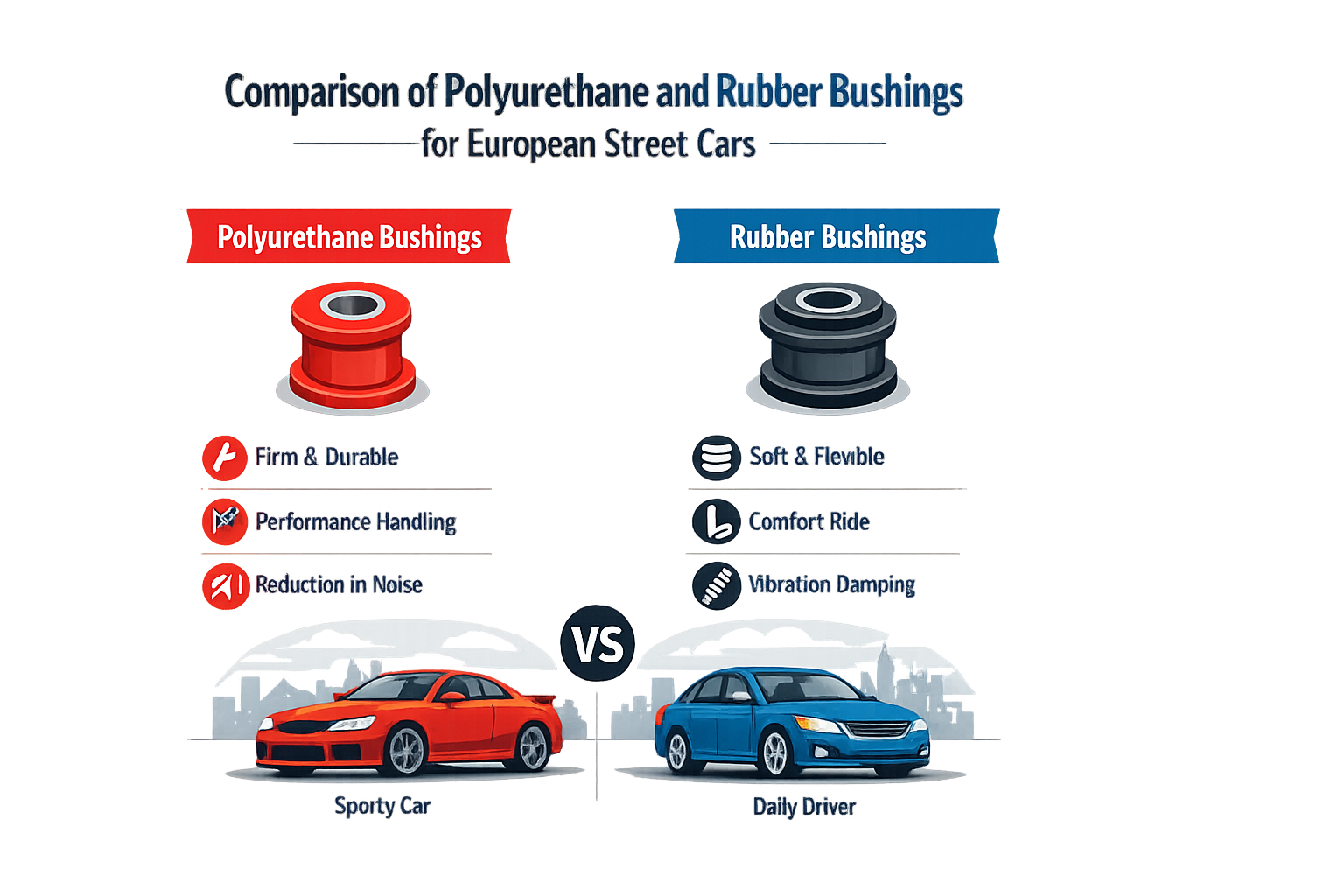
Explore the pros and cons of polyurethane vs rubber bushings for European street cars, examining performance, durability, and comfort.
Introduction
I've watched this decision play out at the counter for years. A customer brings in a tired E46 or a B5 Passat with clunking control arms, and the question is always the same: rubber or polyurethane? The answer depends on what you're willing to give up, because bushings are a compromise and the material you choose sets the terms.
Bushings connect suspension components to the chassis and allow controlled movement while isolating vibration. Rubber does this by flexing and absorbing energy; polyurethane does it by deflecting less and transmitting more. European manufacturers spec natural rubber because it keeps NVH low and delivers the refinement buyers expect. Polyurethane tightens the suspension's response but makes the cabin noisier and the ride harsher, especially on cold mornings and rough pavement.
The choice matters most on daily-driven street cars where ride quality, cabin noise, and long-term durability intersect. Track cars and autocross builds tolerate polyurethane's trade-offs; commuter sedans and family wagons usually don't. If you're replacing worn bushings on a Mercedes, BMW, Audi, VW, Porsche, or Volvo that sees regular street use, understanding what each material does to the suspension's behavior — and to the driver's experience — is the first step. For related fluid specifications that also require precision, see Mercedes-Benz Engine Oil: MB 229.5, 229.51, and 229.52 Approvals.
What Bushings Do and Why Material Matters
Bushings sit between metal suspension parts and the chassis. They allow the control arms, subframe mounts, sway bar links, and differential mounts to move through their range without metal-on-metal contact. Rubber compresses and twists to absorb impact energy and isolate the cabin from road noise. Polyurethane is stiffer, so it deflects less under the same load and transmits more of that energy into the chassis.
Natural rubber is the dominant material for chassis bushings because it balances elasticity, fatigue resistance, and low-temperature flexibility. It isolates vibration effectively and maintains its properties across a wide temperature range, which is why OE suppliers use it in everything from front control arm bushings to rear subframe mounts. Polyurethane resists oil, ozone, and road salt better than rubber and lasts longer, but it increases cabin noise and makes the suspension feel harsher, especially over expansion joints and broken pavement.
The trade-off is not subtle. Polyurethane bushings make the steering respond faster and reduce suspension deflection under hard cornering, but they also transmit clunks, rattles, and road texture directly into the chassis. On a street car driven year-round in Northern California or anywhere with cold mornings, that difference is immediate and permanent.
Problem Statement
I've watched the same question come across the counter for fifteen years: polyurethane or rubber? The owner wants the car to handle better, but they also want to drive it every day. The problem is that those two goals pull in opposite directions, and the bushing you choose determines which one wins.
Rubber bushings are softer than polyurethane. That softness damps road noise and lets the suspension move more freely, which gives you a compliant ride — the kind European engineers designed the car around. But that same compliance means less responsiveness when you corner hard or brake aggressively. The bushings flex, the geometry shifts, and the car feels looser than it should.
The Wear Question
Rubber bushings are what the factory installs, and they work well until they don't. They're more susceptible to wear from heat, oil, and the road chemicals that coat Northern California highways every winter. I've seen control-arm bushings on a ten-year-old E90 that look like they've been chewed — cracked, oil-soaked, and compressed into shapes they were never meant to hold. Polyurethane doesn't do that. It resists oil and heat, and it holds its shape for years longer than rubber.
The Noise and Harshness Trade
The challenge is that polyurethane's durability comes with a penalty. It's stiffer, so it transmits more vibration into the chassis. On a daily driver — a C-Class commuting to San Jose, an A4 running errands in the East Bay — that stiffness shows up as harshness over expansion joints and a low hum that wasn't there with the factory rubber. Some owners don't mind it. Others bring the car back and ask if we can put the old ones back in.
The bushing you choose determines whether the car rides like the factory intended or handles like you wish it did — you don't get both.
The real problem is that the decision isn't just about performance versus comfort. It's about whether you're willing to live with the consequences of a stiffer suspension every single day, or whether you'd rather replace rubber bushings more often and keep the ride the engineers intended. Most owners don't know which one they actually want until the polyurethane is already installed.
Solution Steps
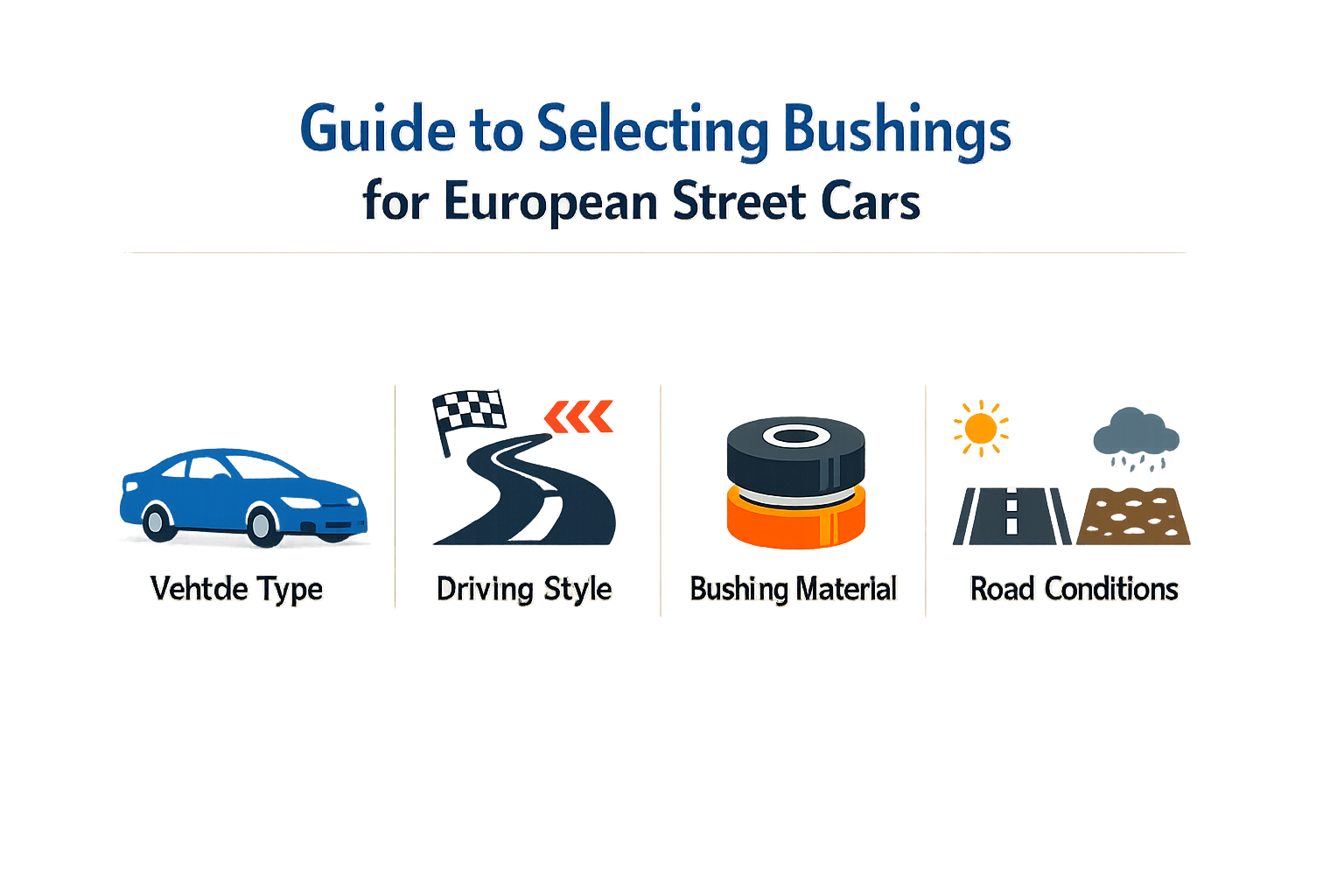
I've sold bushings to shops running everything from stock E90s to track-prepped Caymans, and the decision always comes down to what the car does most of the time. The right bushing for a daily-driven 328i is the wrong one for a car that sees autocross weekends, and mixing the two costs you either comfort or control.
Step 1: Define Your Primary Use Case
Step 1
Identify how you drive the car
Start with the honest answer: is this a commuter, a weekend canyon car, or something that sees timed laps? If the car spends five days a week in traffic and one Saturday on a backroad, it is a street car. If it runs autocross or track days even twice a year, that changes the calculation. Polyurethane makes sense for dual-purpose road and track use, autocross, and hard-launching cars where steering response and suspension geometry matter under load. Rubber is the correct choice for pure street driving where ride quality and cabin noise are priorities.
Step 2: Evaluate Tolerance for NVH and Maintenance
Step 2
Assess noise, vibration, and upkeep
Polyurethane bushings transmit more road noise and vibration into the cabin because they do not isolate the way rubber does. On a long highway run or over expansion joints, you will hear and feel the difference. Polyurethane also requires maintenance — re-greasing every few years to prevent squeaking, binding, and accelerated wear. Rubber bushings require no maintenance and stay quiet for their service life. If you are not prepared to pull the car back apart to grease bushings or live with occasional squeaks, rubber is the better path.
Step 3: Match Bushing Type to Suspension Goals
Step 3
Align bushing choice with handling priorities
Polyurethane bushings are firmer than rubber, which gives better road feel and improved steering response. The suspension geometry stays more consistent under cornering load because the bushings deflect less. For a car with upgraded sway bars, sport shocks, or lowering springs, polyurethane completes the package. For a stock suspension or a car where you want the factory ride character preserved, rubber keeps the original compliance and isolation the engineers designed in. Mixing polyurethane and rubber across the suspension is a mistake — the car will handle unevenly because one end deflects more than the other.
Step 4: Check Part Availability and Fitment
Not every application has a polyurethane option, and not every polyurethane kit is made to the same standard. Some European platforms have limited aftermarket bushing support, and the kits that do exist may require trimming or modification to fit correctly. Before you commit, verify that the kit is available for your exact model and year, and that it includes all the bushings you intend to replace. A partial kit that leaves half the suspension on rubber defeats the purpose. OEM rubber bushings are always available through the dealer or OE-supplier channels, and fitment is guaranteed.
Step 5: Plan the Installation and Break-In Period
Polyurethane bushings require proper greasing during installation, and the grease type matters. Use the grease the manufacturer specifies — usually a synthetic or lithium-based product — and coat every contact surface. Undertorque the fasteners and the bushings will squeak; overtorque them and you preload the suspension in the wrong position. Rubber bushings must be torqued at ride height, not on the lift, so the rubber is not twisted when the suspension cycles. Both types need a break-in period where the car may feel different than it will after a few hundred miles. Do not judge the result on the first drive.
For more on matching components to your European platform, see Mercedes-Benz Engine Oil: MB 229.5, 229.51, and 229.52 Approvals.
Tips and Tricks
I've watched shops install polyurethane bushings without greasing the bore first, and the squeaking starts before the car leaves the lot. The bushing has to move inside the metal sleeve — dry polyurethane on steel binds, then it chirps. Grease the contact surfaces during installation, and plan to re-grease every two to three years. Rubber bushings bond to the sleeve at the factory; you install them once and forget them.
Maintenance Is the Real Cost
Polyurethane requires attention. Every few years, you pull the bushing, clean the bore, apply fresh grease, and reinstall. Skip it and the bushing wears unevenly, the suspension binds mid-travel, and the alignment drifts. I sell both materials at the counter, and the polyurethane customers who come back happy are the ones who knew this going in. Rubber asks for nothing until it cracks, which on a European street car driven year-round is typically eight to twelve years depending on climate and mileage.
Installation Notes for European Platforms
European cars often use hydraulic mounts at the engine and subframe positions — these combine rubber elastomers with fluid-filled chambers to damp powertrain vibration. You cannot substitute polyurethane for a hydraulic mount; the fluid chamber is integral to the isolation design, and a solid bushing transmits every firing pulse straight into the cabin. At the control arms and sway bar links, polyurethane is mechanically compatible, but check the torque spec and tighten the fastener with the suspension at ride height, not on the lift. Polyurethane preloads differently than rubber, and if you torque it with the suspension hanging, the bushing twists under its own preload when the car settles, and you lose the benefit.
The cheap way costs more: a polyurethane bushing installed dry will squeak within a week, and by then the labor to pull it and do it right doubles the bill.
When sourcing bushings, verify the part number against the build date and the suspension package code. A 2015 E-Class with sport suspension uses a different control-arm bushing than the base suspension, and the polyurethane aftermarket sometimes lists one part for both — it fits the bore, but the durometer is wrong for the spring rate. At the counter, I check the VIN and the original part number before I hand over the box. If the customer wants polyurethane for a daily driver in San Francisco stop-and-go traffic, I tell them what it will feel like and I sell them the rubber. If they want it anyway, I make sure they know about the grease.
Conclusion
I've watched the bushing question come up at the counter for twenty years, and the answer is always the same: what you choose depends on what you're willing to live with. Polyurethane delivers better road feel and improved steering response because it's firmer, but that firmness also means more noise and vibration transferred into the cabin. Rubber—particularly natural rubber—remains the factory choice for European street cars because it isolates vibration, absorbs road harshness, and keeps the cabin quiet at the cost of some precision.
When to Choose Each Material
For a daily-driven European car where comfort matters, rubber is the correct answer. Natural rubber balances elasticity, fatigue resistance, and low-temperature flexibility, which is why manufacturers use it as the OEM material. If you're building a car for track days or spirited weekend drives and you can tolerate the trade-offs, polyurethane makes sense—the steering response is sharper and the bushings last longer under repeated loading.
The mistake is mixing priorities. Don't install polyurethane bushings expecting OEM refinement, and don't expect rubber to deliver polyurethane's steering precision. The material you choose sets the character of the suspension, and there's no halfway option that gives you both.
At the counter, I tell customers to be honest about how they use the car. A 530i that sees freeway commutes and grocery runs doesn't need polyurethane anywhere. A Cayman that runs autocross every other weekend can justify it in the control arms and sway bar links. The bushing material isn't a preference—it's a specification that determines what the suspension does and how the car feels when you're in it. Choose based on the job the car actually does, not the one you imagine it might do someday.
For more guidance on selecting the right components for your European car, see our article on DOT 4 vs. DOT 5.1: Choosing Brake Fluid for a European Car.
Written by
Lee Shahin
Founder, European Wholesale Parts
Lee Shahin founded European Wholesale Parts in Pleasanton, California, after 18 years in the Mercedes-Benz and BMW parts trade. He came to the parts side from the shop floor: he opened a European repair shop in Northern California in the early 1990s, specialising in Mercedes-Benz and BMW, and grew it with his wife Laurie into a parts and delivery operation serving body shops and independent repair facilities across the region. Nearly two decades at the parts counter taught him where the expensive mistakes happen, and most of them are fluids: the wrong coolant in an aluminium block, an oil without the sheet approval the engine was designed for, a transmission topped with the wrong ATF. That is what he writes about here. Every article names the manufacturer specification by its exact designation, explains what the wrong fluid does mechanically, lists products that carry the approval, and gives the capacity and interval for the models and years the specification covers. When a reader needs a part sourced, the quote desk at European Wholesale Parts is where Lee and Laurie still answer the phone.