


Euro Car Parts Sourcing: Direct Import vs Local Supply
Explore Euro Car Parts Sourcing through direct import versus local supply chains. Compare lead times, costs, and quality control for your European vehicle.
Introduction to Euro Car Parts Sourcing
I've spent eighteen years at the parts counter for Mercedes-Benz and BMW, and the question comes up daily: do I order it from Europe or pull it off the shelf here? The answer is never one-size-fits-all. A local warehouse stocks oil filters and brake pads for a 2015 E-Class, but the MB 229.52 oil that engine requires may not be on the shelf at all. You can get a 5W-30 that day, but if the bottle does not carry the sheet approval, the cam adjusters pay for the shortcut.
Euro car parts sourcing is not about geography alone. It is about whether the part meets the specification the car was built around. European manufacturers engineer to approvals — oil standards, coolant formulations, brake fluid DOT ratings with specific additive packages. A direct-import supplier in Germany ships what the factory ships. A U.S. distributor repackages, relabels, or substitutes, and the approval may or may not survive the trip. Shops can chase misfires for weeks because they topped a G13 Audi with universal green coolant bought locally. The European car service kits we assemble always start with the spec, then the source.
The European automotive sector is massive, employing over thirteen million people and generating a trade surplus exceeding one hundred billion euros annually. That scale means parts move through complex supply chains before they reach a repair shop in California. Some parts ship direct from the OE supplier's European warehouse. Others pass through a U.S. importer who consolidates shipments, rebrands products, and redistributes regionally. Each handoff introduces a chance for specification drift — a different viscosity grade, a coolant concentrate mixed to a different ratio, a filter element that fits the housing but flows at the wrong rate.
Direct import gives you traceability. You see the original part number, the original packaging, and the original data sheet. Local supply gives you speed. You call in the morning, the part arrives by lunch, and the car leaves that afternoon. The tension between those two priorities defines euro car parts sourcing. Neither path is wrong, but both demand that you know what the car actually needs and what the part actually is. When the spec is non-negotiable — engine oil, transmission fluid, coolant — I verify the approval first and the price second. When the part is a wear item with a wide tolerance — wiper blades, cabin filters, some brake components — local supply closes the job faster.
The sections ahead break down the challenges each sourcing path presents, the steps to navigate them, and the practical tricks that keep lead times short and comebacks zero. The goal is not to pick a side but to match the source to the specification every time.
Understanding the Challenges of Sourcing Euro Car Parts
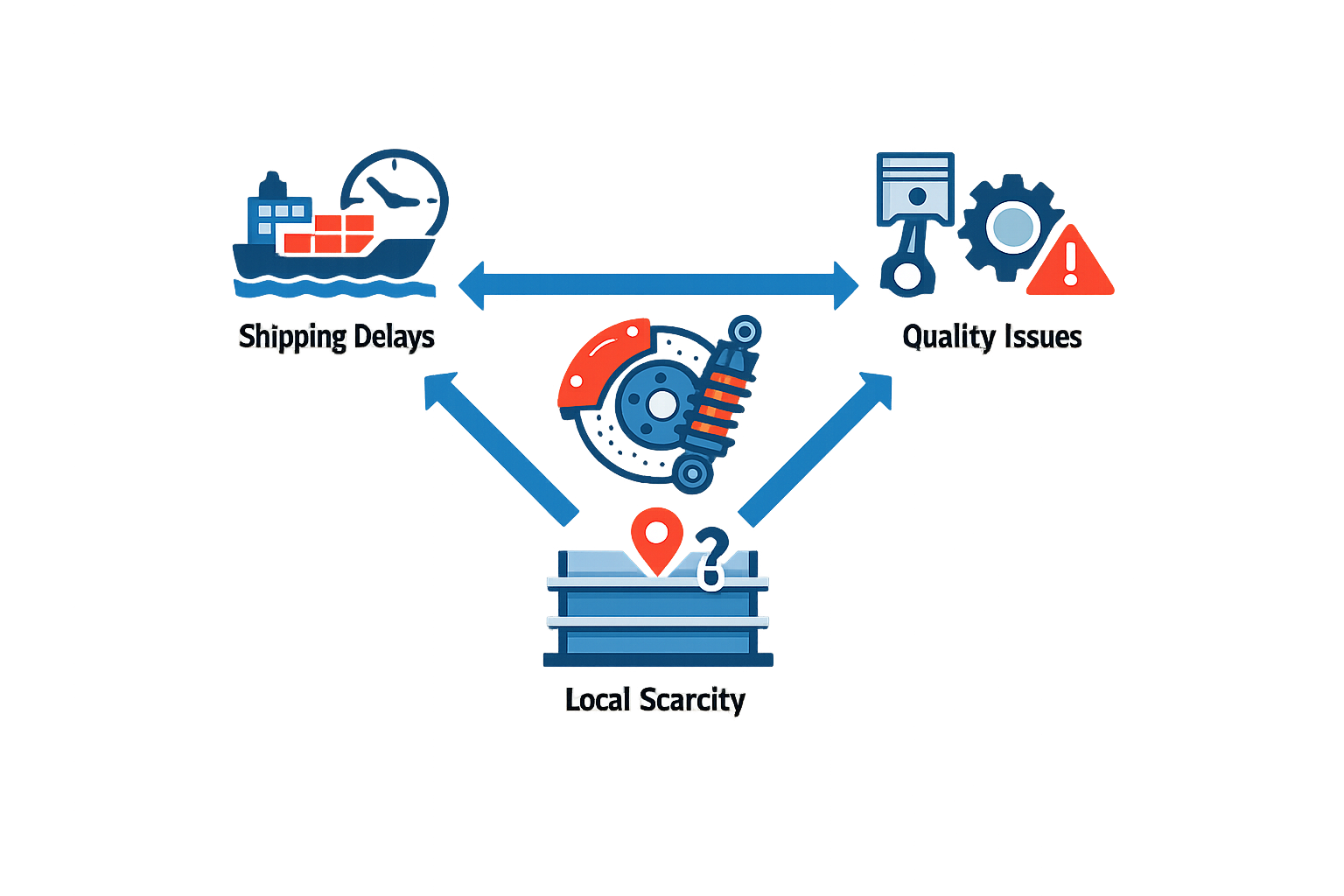
The first problem is availability. Some engine oils listed on manufacturer approval sheets are not available in the North American market. You order a 5W-30 that meets MB 229.51, the catalog shows it, the supplier says it ships from Germany in six weeks, and then you find out the product never made it past European distribution. The car sits, the customer waits, and the invoice grows.
The second problem is verification. A local supplier stocks a 10W-40 labeled "European formula" with no sheet approval printed on the bottle. You cross-check the brand against the VW 502.00 list and it is not there. The supplier insists it meets the spec, but the manufacturer's approval database does not list that product name. Without the approval on the bottle, you cannot run it — the variable cam timing solenoids on a 2.0T will clog if the additive package is wrong.
Approval Confusion and Regional Variants
Manufacturers publish approval lists by region. A Castrol product approved under MB 229.51 in Europe may carry a different formulation and a different approval in North America, even when the viscosity grade matches. The bottle has to say the approval, not just the brand name. Technicians sometimes assume that "Castrol Edge" is universal; it is not. The European spec and the North American spec are two different oils.
Direct import solves the approval problem when you need a specific formulation that only ships in Europe. Local supply solves the lead-time problem when the part is stocked domestically and meets the same approval. The challenge is knowing which route gives you the right part without delay. For a broader comparison of sourcing strategies, see our guide on OEM vs Aftermarket parts.
Lead Time and Inventory Risk
Direct import means longer lead times. A filter kit shipped from a German warehouse to California takes two to four weeks if customs clears without delay. Local suppliers stock common service items, but their catalogs may not include low-volume approvals like Porsche C30 or the updated VW 508.00/509.00 standards. You order local, the part arrives in two days, and then you discover it does not meet the spec the engine requires.
The inventory risk cuts both ways. Local suppliers carry what moves; if your market does not service many 2015-and-later Audi 3.0T engines, the supplier will not stock a 0W-30 that meets VW 504.00. Direct import gives you access to the full European catalog, but you pay for air freight and you wait.
Navigating Euro Car Parts Sourcing: Solutions and Steps
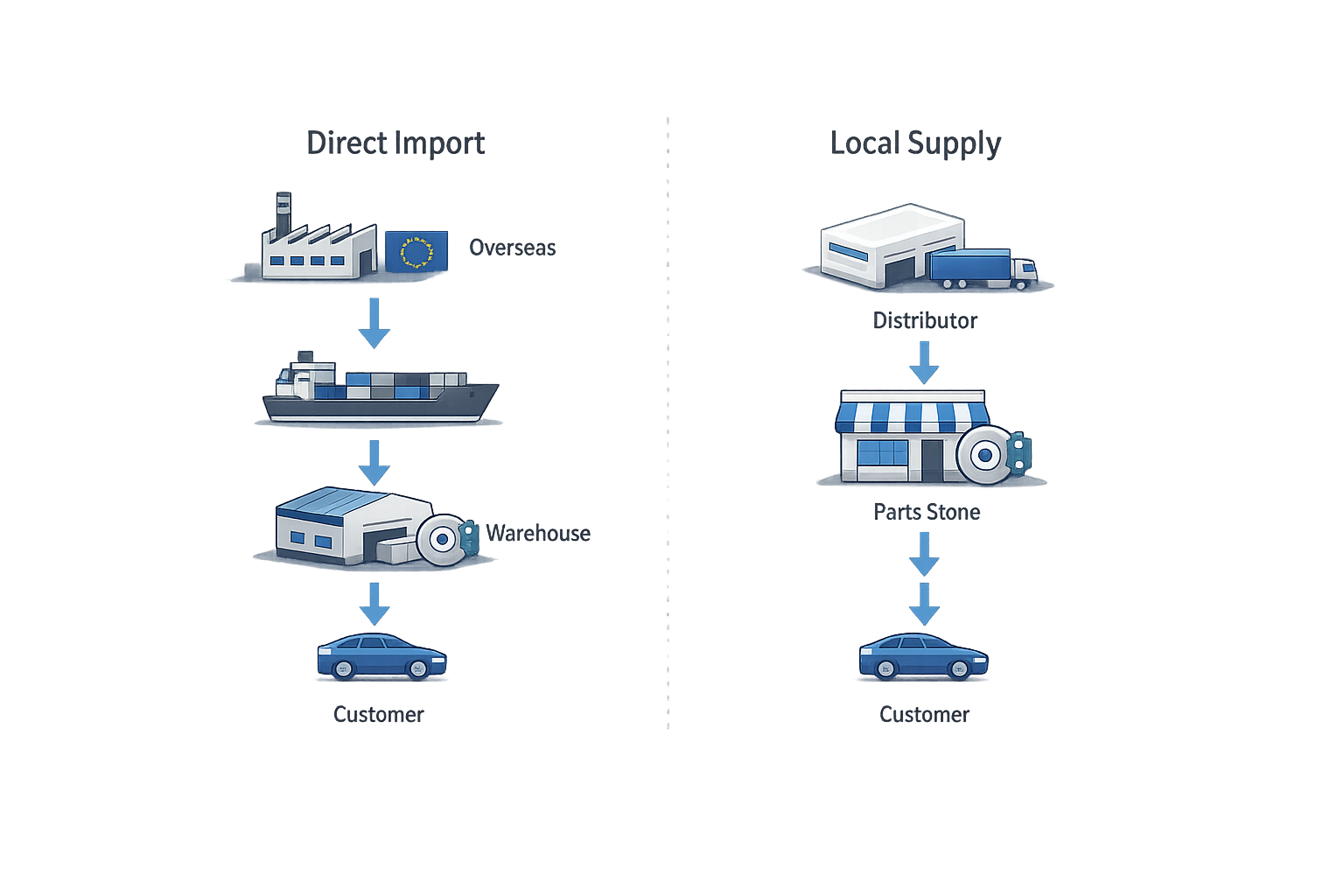
Sourcing the right part starts with the approval, not the price. When you need a filter, fluid or component for a European make, the first step is to identify what the car actually requires — by model year, engine code and the manufacturer's sheet number. Only after you have that specification do you compare how to get it: direct from Europe or through a local distributor.
Step 1: Verify the Manufacturer Approval
Check the owner's manual or the manufacturer's online approval database for the exact specification. For engine oil, that means a sheet number like MB 229.51 or MB 229.52 for Mercedes-Benz. For coolant, it is G12evo or G13 for VW/Audi. Write down the approval, the model year range it covers, and the engine code. Do not proceed to sourcing until you have this in hand.
The bottle has to say the approval. A 5W-30 without MB 229.51 printed on the label is not the same product, even if the viscosity matches. Engines can develop timing-solenoid clogs because someone ran a generic oil that lacked the low-ash additive package the approval requires.
Step 2: Identify Local Suppliers with the Approval
Contact your regional distributor or parts counter and ask if they stock a product that carries the manufacturer approval you need. Request the product data sheet or a photograph of the label. If the supplier cannot produce proof that the part meets the spec, move to the next option.
Local supply works when the distributor's catalog is current and the parts meet the approval. FUCHS SE in Germany supplies multiple viscosities under MB 229.51, and those products are available through North American distributors. The lead time is short, the price is competitive, and the approval is on the bottle. When that chain is intact, local sourcing is the faster route.
Step 3: Evaluate Direct Import for Hard-to-Find Approvals
If no local supplier stocks the approval, search the manufacturer's approval database for principals located in Europe. Contact them directly or through an import broker to confirm availability, minimum order quantity, and lead time. Factor in shipping, customs clearance, and the risk of receiving a product that does not match the data sheet.
Direct import becomes necessary when the part is not distributed in your region or when the local supply chain cannot guarantee the approval. Mercedes-Benz AG lists its own Genuine Engine Oil MB 229.52 in multiple viscosities, and those products ship from Germany. The lead time is longer — typically three to six weeks — and you pay for freight and clearance, but you receive the exact product the factory specifies.
Step 4: Cross-Check the Part Number and Capacity
Once you have identified a supplier, confirm the part number against the manufacturer's parts catalog. For fluids, verify the capacity required for your specific engine or transmission. A 2012 C300 with the M276 engine takes 8.5 liters of MB 229.51 oil; a 2015 C400 with the same engine code takes the same. If the supplier quotes a different capacity, ask why.
Capacities and intervals are not interchangeable across model years. The same engine code can have different sump sizes depending on the chassis, and running a liter short or a liter over changes the oil pressure and the rate at which additives deplete. Shops can order by model name rather than engine code and end up with the wrong capacity listed on the invoice.
Step 5: Compare Lead Time, Cost and Quality Assurance
Compare the total landed cost of direct import against the local supplier's price, including lead time. If the local product meets the approval and ships within 48 hours, the premium over direct import is often justified. If the local product does not carry the approval or the lead time exceeds two weeks, direct import may be the safer choice despite the higher cost.
The cheapest vendor is the one whose approval you can verify without calling three people. When the local supplier stocks the right product and the label matches the manufacturer's database, you save time and reduce the risk of receiving a counterfeit or mislabeled item. When the local chain cannot supply the approval, direct import is not a preference — it is a requirement.
For a broader comparison of OEM versus aftermarket parts across European makes, see OEM vs Aftermarket: Which European Car Parts Should You Buy.
Tips and Tricks for Efficient Sourcing of Euro Car Parts

I've watched people order the wrong oil because they didn't check the approval on the bottle. The cheapest vendor is the one whose catalog you can cross-check against the manufacturer's list without finding gaps. Here is how you avoid the mistakes that cost more than the part.
Check the Approval List First
Before you place an order, pull the manufacturer's approval sheet. For Mercedes, that is the MB 229.51 list at operatingfluids.mercedes-benz.com. For VW and Audi, it is the 502.00, 504.00 or 507.00 standards published in the service bulletins. The bottle has to say the approval is printed on it — not "meets" or "exceeds," but the actual sheet number.
The Mercedes 229.51 list shows products by principal and viscosity grade. You will see entries like "Castrol EDGE 0W-30" under Castrol Limited, or "Pennzoil Platinum Euro LX" under Pennzoil-Quaker State. If your supplier's product is not on that list, it does not meet the spec, regardless of what the marketing copy says.
Cross-Reference by Engine Code and Build Date
The approval changes by engine code and build date. A 2015 C300 with the M274 engine takes MB 229.5, but the same model year with the OM651 diesel requires 229.51. VW publishes updates in technical service bulletins; some engine oils listed may not be available in the North American market, so you cross-reference against what your distributor stocks.
Check the build sticker or the owner's manual for the engine designation. For BMW, it is the N-series or B-series code. For VW and Audi, it is the EA or CBZA designation. The approval follows the engine, not the model name.
Open the distributor catalog and filter by the approval number. If the product sheet does not list the approval, do not order it. If it lists a superseded approval (for example, 229.3 when the engine requires 229.51), it is the wrong product.
Use OE-Supplier Cross-References
When sourcing filters, gaskets and wear items, the OE-supplier part number is the safest cross-reference. Mahle, Mann+Hummel and Hengst supply the factory; their aftermarket catalogs carry the same part under a different box. The part number on the OE piece matches the aftermarket catalog entry, so you know the fit is identical.
For European car service kits, verify that the kit includes the filter, drain plug and crush washer by OE or OE-supplier part number. A kit that substitutes a generic filter saves two dollars and costs you a comeback when the bypass valve opens at the wrong pressure.
Verify Fluid Capacities by Platform and Year
Capacities change by platform and model year. A B8 Audi A4 with the 2.0T takes 5.5 quarts with the filter; the B9 platform takes 6.9 quarts. If you order based on the model name alone, you will be short or you will have a quart left over. The capacity is in the service manual, indexed by engine code and platform designation.
Know When Direct Import Adds Value
Direct import makes sense when the local distributor does not stock the approval you need, or when the product is available in Europe but not yet listed in the North American catalog. Shops have sourced Pentosin CHF 11S directly when the local supply dried up, and have ordered G13 coolant from a European distributor when the domestic warehouse showed a six-week lead time.
The trade-off is lead time and freight cost. A direct shipment from Germany to California takes two to three weeks and adds $40 to $80 in shipping per case. If the part is a consumable and you can wait, it works. If it is a breakdown repair, the local supply is faster even when the per-unit cost is higher.
Conclusion: Making the Right Choice for Euro Car Parts Sourcing
I've spent eighteen years at the Mercedes-Benz and BMW parts counter, and the question of direct import versus local supply comes down to one thing: what does the bottle say, and can you get it when you need it. The manufacturer approval is the starting point — MB 229.51, BMW LL-04, VW 507.00 — and everything else is secondary. If a local supplier stocks the right approval and you can verify it on the data sheet, that is the faster route. If the local catalog shows a generic substitute without the sheet approval, you are taking a risk the engine will pay for later.
Direct import gives you access to products that meet the exact specification when the local supply chain does not carry them. FUCHS SE in Germany produces oils that meet MB 229.51 and 229.52, and if your local distributor does not stock an approved product, ordering direct from a European supplier may be the only way to get the right fluid. The trade-off is lead time — a week or two instead of same-day pickup — but the alternative is running a non-approved oil and watching the variable timing solenoids clog or the DPF load with ash ahead of schedule.
Local suppliers work when they cross-reference their catalog against the manufacturer approval list and stock products that appear on it. Shops can rely on a local parts house for years because the counter staff knew how to read the approval tables and kept the right inventory on hand. The mistake is assuming that any 5W-30 or any G13 coolant will do the job — the approval has to match, and the bottle has to say so. When the local option meets that standard, it is the better choice: you get the part today, you verify the approval before you leave the counter, and you move on to the next job.
The decision is not about loyalty to one supply chain or the other. It is about matching the part or fluid to the specification the vehicle requires and getting it in a timeframe that keeps the car moving. For routine service items — filters, brake pads, wear parts — local supply usually covers it, provided the supplier catalogs OE or OE-equivalent parts that fit the platform. For specialty fluids or hard-to-find approvals, direct import from a European distributor may be the only path that gets you the right product. Either way, verify the spec first, then choose the source that delivers it.
If you are weighing OEM versus aftermarket parts for your European vehicle, the same principle applies: the approval or the fitment specification is what matters, not the badge on the box. The right choice for euro car parts sourcing is the one that gets you the correct approval in the timeframe you need it — nothing more, nothing less.
Sources(16)
- ACEA (2023)
- Motul technical data sheet (2022)
- Volkswagen Technical Bulletin 17-19-01 (NHTSA ODI)
- Audi Technical Service Bulletin (NHTSA ODI)
- Mercedes-Benz Operating Fluids (2026)
- BMW of North America maintenance booklet
- Pelican Parts Technical Articles
- LIQUI MOLY
- Mercedes-Benz Operating Fluids (2026)
- Porsche Technical Bulletin (NHTSA ODI)
- Pelican Parts Technical Articles
- LIQUI MOLY
- Motul technical data sheet (2021)
- Pelican Parts Technical Articles
- Pelican Parts Technical Articles
- Mercedes-Benz Operating Fluids (2026)
Written by
Lee Shahin
Founder, European Wholesale Parts
Lee Shahin founded European Wholesale Parts in Pleasanton, California, after 18 years in the Mercedes-Benz and BMW parts trade. He came to the parts side from the shop floor: he opened a European repair shop in Northern California in the early 1990s, specialising in Mercedes-Benz and BMW, and grew it with his wife Laurie into a parts and delivery operation serving body shops and independent repair facilities across the region. Nearly two decades at the parts counter taught him where the expensive mistakes happen, and most of them are fluids: the wrong coolant in an aluminium block, an oil without the sheet approval the engine was designed for, a transmission topped with the wrong ATF. That is what he writes about here. Every article names the manufacturer specification by its exact designation, explains what the wrong fluid does mechanically, lists products that carry the approval, and gives the capacity and interval for the models and years the specification covers. When a reader needs a part sourced, the quote desk at European Wholesale Parts is where Lee and Laurie still answer the phone.