

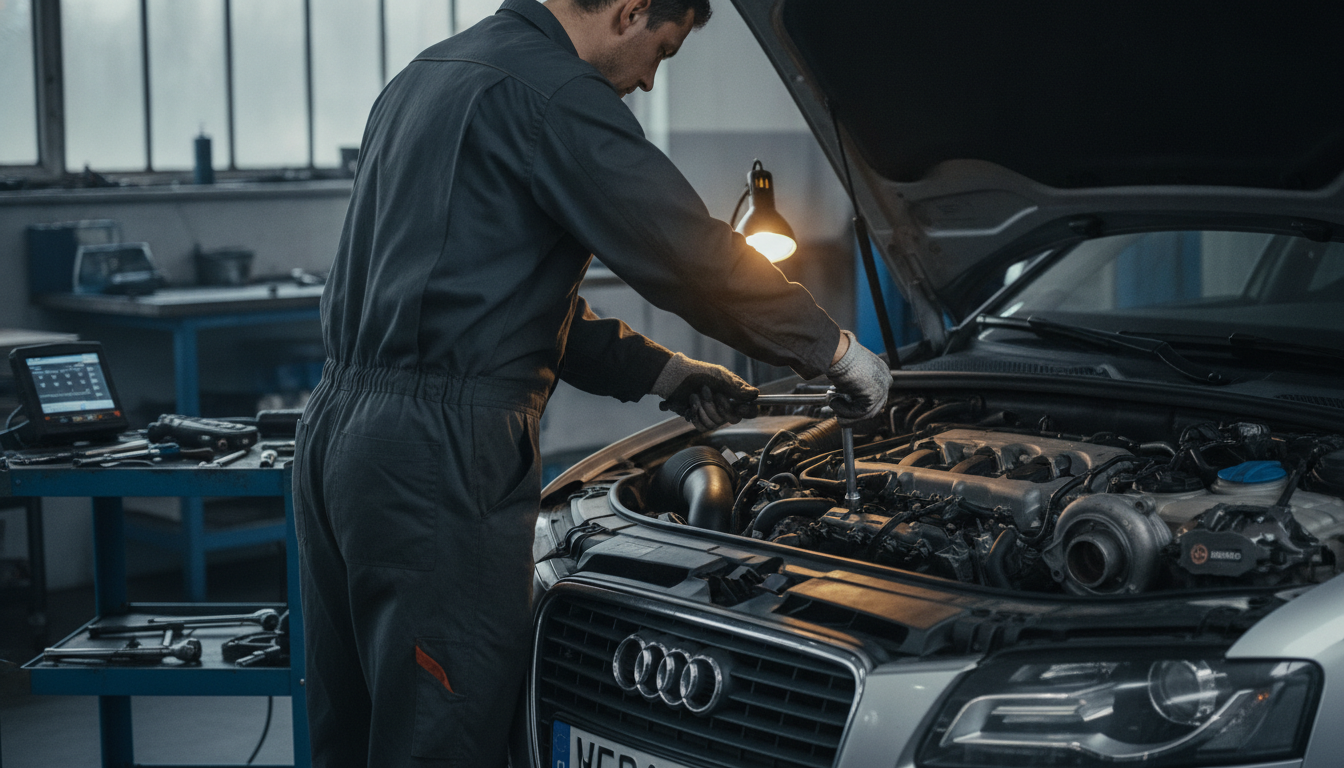
Automotive Repair Services for European Cars: How to Choose
Choosing automotive repair services for European cars requires understanding manufacturer-specific requirements.
Introduction
Choosing automotive repair services for European cars requires understanding manufacturer-specific requirements. European makes like Mercedes-Benz, BMW, Audi, VW, Porsche and Volvo publish exact specifications for every fluid that goes into their cars. These aren't suggestions. MB 229.51, VW 507.00, Porsche A40 — each one describes a formulation the engine was designed around.
I've spent years at the parts counter watching European car owners learn the hard way that not every shop can service their vehicle correctly. A customer brings in a 2015 328i, asks for an oil change, and the shop fills it with whatever 5W-30 is on the shelf. Six months later, the variable valve timing system is throwing codes because the oil didn't meet BMW LL-01. The bottle has to say it — the approval printed right on the label — or the engine doesn't get what it needs.
Finding reliable automotive repair services for European vehicle fluid systems starts with confirming the shop knows these designations and stocks products that carry them.
The challenge isn't just finding a shop that will work on your car. It's finding one that understands what happens when the wrong fluid goes in. Green coolant in an aluminium Mercedes block leaves silicate deposits in the heater core within a couple of years. A VW 2.0T filled with oil that lacks the 502.00 approval builds sludge in the cam bridge. The damage is specific, it's predictable, and it's expensive.
This article walks through how to identify a shop that treats manufacturer approvals as requirements, not preferences. You'll learn what questions to ask, what certifications actually indicate competence with European platforms, and how to verify that a shop has access to the parts your car needs. Skill and the right parts come first. Convenience follows.
What Makes Automotive Repair Services for European Cars Different?
Finding a shop that knows what your European car actually needs is harder than it looks. Most general repair places stock universal fluids and filters, and they will tell you those work fine. They do not. A Mercedes that wants MB 229.51 oil will not run right on a generic 5W-30, no matter what the viscosity chart says. The variable timing solenoids clog first, then the cam adjusters stick, and by the time the check engine light comes on you are looking at a valve-body flush or worse.
The real problem is that European makes publish their own approvals, and those approvals are not interchangeable. VW 502.00 is not the same as VW 504.00, even though both are 5W-30. One is for fixed-interval service, the other is for extended intervals, and the additive packages are different. A shop that does not know that difference will sell you the wrong oil, and you will not find out until the turbo starts burning it or the timing chain stretches early. I have watched this happen more times than I can count.
Authorized dealers are one answer, but they are not the only answer. Volkswagen's own warranty materials state that authorized dealers are committed to quality service and recommend LongLife engine oil from Volkswagen Genuine Parts. That is true, and it is also true that independent shops with the right training and supplier relationships can meet the same specs at a lower labor rate. The question is how you tell the difference before you hand over the keys.
Diagnostic tools matter too. A generic OBD-II scanner will pull codes, but it will not read the proprietary modules that European cars use for transmission adaptation, brake bleeding, or service resets. A shop that works on VAG platforms needs VCDS or OBDeleven access. A shop that works on BMW needs ISTA or an equivalent. If they do not have those tools, they cannot perform the procedures the factory service manual calls for, and they will guess. Guessing costs you money.
The Buyers Guide that dealers are required to post on used cars lists the major mechanical and electrical systems and some of the common problems to watch for. That same mindset applies when you are choosing a repair shop: you need to know what systems your car has, what those systems require, and whether the shop in front of you has the parts, the fluids, and the scan tools to service them. If they cannot answer those questions in the first five minutes, walk out. The cheap estimate is not a bargain if the work is wrong.
For more on ensuring your European vehicle's fluid systems are serviced correctly, see our guide on finding reliable automotive repair services for European vehicle fluid systems.
How Do You Find the Right Automotive Repair Services for European Cars?
Finding the right shop for your Mercedes, BMW or Audi is not guesswork. I start with three questions: Does the shop stock the fluids your car actually requires? Can they show you the approval on the bottle? Do they keep service records that prove the work was done to spec? If any answer is no, keep looking.
Verify the Shop Stocks Manufacturer-Approved Fluids
Your owner's manual names a specification — MB 229.5, VW 507.00, BMW LL-04. The bottle has to say so. Walk into the shop and ask to see the oil they will put in your car. If they hand you a jug that does not carry the printed approval, that is not the right shop. The spec is not a preference; it is a requirement. I have watched shops argue that "all synthetic 5W-30 is the same." It is not. A BMW with LL-01 oil in an LL-04 engine will clog the variable valve timing within 20,000 miles.
The same rule applies to coolant. A Mercedes with an aluminium block takes a coolant that meets MB 325.0. Pour in green silicate coolant and the heater core will plug with deposits inside two years. The right shop knows this and keeps the right fluid on the shelf.
Ask About Service Records and Documentation
Keep all service records and receipts, regardless of who performs the service. This includes oil changes, tire rotations, belt replacement, new brake pads and inspections. These receipts prove the vehicle was properly maintained. A good shop will hand you an invoice that lists the oil specification by name, the filter part number and the capacity filled. If the invoice says only "oil change," you have no proof of what went in.
I keep every receipt in a folder in the glove box. When a warranty claim or a fluid question comes up, the paper trail answers it. The shop you choose should do the same: print the spec, print the interval, print the part numbers. If they cannot or will not, find one that does.
Step 1
Confirm fluid specifications before the first service
Before you book an appointment, call the shop and ask which oil and coolant specifications they use for your year and model. Write down what they tell you, then check it against the owner's manual. If the two do not match, the shop is guessing.
Step 2
Inspect the service area for OE and OE-supplier parts
Walk through the shop if they will let you. Look at the parts shelves. Do you see Mahle filters, Hengst filters, Mann+Hummel? Do you see Pentosin fluid bottles with the VW or BMW approval printed on the label? A shop that services European cars will stock these parts because they are what the cars require. If you see only generic brands, ask what they install and why.
Step 3
Request a written estimate with part numbers and specifications
Ask for an estimate that lists the part number, the fluid specification and the labor time. A written estimate forces the shop to commit to the spec before they touch the car. If the estimate says "oil" without a number, or "coolant" without an approval, send it back and ask for the full detail. The right shop will not hesitate to provide it.
Follow the Manufacturer's Service Schedule
Service the car at regular intervals, following the manufacturer's recommended service schedule. The interval is in the manual: 10,000 miles for most MB 229.5 oils, 15,000 miles for VW 507.00 in a TDI, 7,500 miles for a naturally aspirated BMW M car. The interval is not a suggestion. Run past it and the oil breaks down; the turbo sees metal shavings; the variable cam adjuster scores. The shop you choose should track the interval for you and call when it is due.
Be aware of when the warranty period ends and get any problems checked out beforehand. If a noise starts at 35,000 miles and your powertrain warranty ends at 36,000, book the diagnosis now. A good independent shop will document the concern and give you a record to take to the dealer if the repair is covered. Waiting until after the warranty expires means you pay.
The interval is not a suggestion. Run past it and the oil breaks down; the turbo sees metal shavings; the variable cam adjuster scores.
Confirm Access to OEM and OE-Supplier Parts
European cars need parts that meet OEM specifications. That does not always mean dealer parts, but it does mean parts from manufacturers that supply the factory. Ask the shop where they source their filters, their sensors, their gaskets. If they say "we use quality aftermarket," ask for the brand name. Mahle, Bosch, Continental, Hengst, Sachs — these are OE suppliers. If the brand is unfamiliar, look it up before you agree to the work.
I source parts from distributor catalogs that list the OE manufacturer and the supersession history. The right independent shop does the same. They know which Mahle filter crosses to which Mercedes part number, and they know when a spec changed mid-year. If the shop cannot tell you where the part comes from, they are guessing, and you are paying for the guess.
For more detail on how to evaluate a shop's fluid service capabilities, see our guide on understanding proprietary specifications in European auto parts sourcing.
Tips and Tricks for Choosing a Repair Shop
I've watched customers make the same mistakes at the counter for years: they choose a shop based on price, then come back when the wrong fluid goes in or a generic part fails. Here's what actually matters when you pick a place to service your European car.
Get Everything in Writing
Before any wrench turns, the shop should give you a written estimate that lists the parts, the labor and the total. If they promise to use OEM coolant or a specific oil approval, that promise belongs on paper. The FTC advises getting all promises in writing — it's not paranoia, it's documentation you can hand an insurance adjuster or a warranty administrator if something goes wrong.
The same rule applies to warranties on the work. If the shop says they guarantee the repair for 12 months or 12,000 miles, that guarantee should be on the invoice. A verbal assurance means nothing when you're back three months later with a failed water pump.
Ask About the Parts They Stock
A shop that works on European cars should have relationships with OE-supplier distributors, not just the generic parts chains. Ask them where they source their fluids and filters. If they can't tell you the approval number on the oil they plan to put in your BMW, or if they say "all 5W-30 is the same," walk out.
For more on identifying reliable aftermarket parts suppliers, check that resource — it covers the distributor networks and OE-supplier brands that meet manufacturer specs.
Verify Their Diagnostic Equipment
European cars speak proprietary languages. A generic OBD-II scanner reads some codes, but it won't tell you why your Audi's DSG is in limp mode or why your Mercedes threw a chain-stretch fault. The shop needs a factory-level scan tool or an equivalent like VCDS for VW/Audi, INPA or ISTA for BMW, or XENTRY for Mercedes.
Ask them directly: "What scan tool do you use for my make?" If they hesitate or say they'll "figure it out," they're not equipped for the job.
Check How They Handle Warranty and Escalation
A good independent shop has a process for when something doesn't go as planned. Volkswagen's own warranty booklet emphasizes that customer feedback is critical and outlines how unresolved concerns escalate to a Customer CARE Representative. An independent shop should have a similar path: a manager you can call, a written complaint process, and a willingness to involve the parts supplier or the manufacturer when a defect surfaces.
If the shop's answer to "What happens if this repair fails?" is defensive or vague, you're looking at someone who doesn't plan for accountability.
The bottle has to say the approval. If it doesn't, it's not a preference — it's a requirement the shop is ignoring.
Trust the Shop That Asks Questions
The best shops don't assume. They ask for your VIN, your build date, and your service history before they quote a fluid flush or a timing-belt interval. A 2010 Passat and a 2015 Passat take different oil; a pre-facelift E90 and a post-facelift E90 have different coolant requirements. The shop that treats all European cars as one category is the shop that will put G12++ in a G13 system and tell you it's fine.
When a technician asks to see your owner's manual or calls a parts supplier to verify a spec, that's not inefficiency — that's diligence.
Conclusion
I've watched too many European cars come through the counter with the wrong fluid in them because the shop didn't check the spec. The bottle has to say MB 229.5 or VW 507.00 or whatever your car requires — not close, not equivalent, the actual approval printed on it. When you pick automotive repair services for European cars, ask them what oil they're putting in and what the capacity is. If they can't name the spec and the quarts, walk.
The right shop knows that a 2015 C300 with the M274 engine takes 6.9 quarts of MB 229.5 and that topping it with a generic 5W-30 clogs the variable timing solenoids within a year. They know that G12evo and G13 coolants are not interchangeable and that mixing them is the mistake, not the solution. They stock the parts that meet the manufacturer approval, not the ones that cost less. The cheap way costs more when you're flushing a heater core or replacing a timing chain tensioner that failed because the oil film wasn't thick enough.
Proper maintenance with the correct fluids and parts keeps your European car dependable and safe. Choose a shop that understands manufacturer specifications, uses EPA-certified or OE-equivalent replacement parts, and can show you the approval on the bottle before it goes in your engine. Your warranty allows you to use any qualified service establishment, but the work has to meet the manufacturer's specifications or you pay for the next repair yourself.
For more guidance on finding reliable automotive repair services for European vehicle fluid systems, the principles are the same: spec first, consequence second, and the approval printed on the bottle before anything goes in the car.
FAQ
What makes automotive repair services for European cars different from general repair shops?European cars require manufacturer-specific fluid approvals (MB 229.5, VW 507.00, BMW LL-04) that general shops often don't stock or understand. The wrong fluid causes predictable, expensive damage to timing systems, turbos, and cooling components.
How do I verify a shop can service my European car correctly?Ask to see the oil or coolant bottle with the manufacturer approval printed on the label. Request a written estimate listing part numbers and fluid specifications. Confirm they have factory-level diagnostic tools (VCDS for VW/Audi, ISTA for BMW, XENTRY for Mercedes).
Can independent shops provide automotive repair services for European cars as well as dealers?Yes, if they have the right training, supplier relationships, and diagnostic equipment. The key is verifying they stock OE-supplier parts (Mahle, Bosch, Hengst) and know the exact manufacturer approvals your car requires.
Sources(22)
- ACEA (2023)
- Motul technical data sheet (2022)
- Volkswagen of America
- Mercedes-Benz USA
- Volkswagen Technical Bulletin 17-19-01 (NHTSA ODI)
- Audi Technical Service Bulletin (NHTSA ODI)
- Volkswagen of America Owners Literature (2018)
- U.S. Federal Trade Commission (2011)
- FTC Consumer Advice
- Volkswagen of America
- FTC Consumer Advice
- BMW USA
- Audi USA
- LIQUI MOLY
- Volkswagen of America
- OBDeleven Help Center
- Audi USA
- Volkswagen of America (NHTSA ODI)
- BMW of North America maintenance booklet
- U.S. Federal Trade Commission
- FTC Consumer Advice
- FTC (Aug 2023)
Written by
Lee Shahin
Founder, European Wholesale Parts
Lee Shahin founded European Wholesale Parts in Pleasanton, California, after 18 years in the Mercedes-Benz and BMW parts trade. He came to the parts side from the shop floor: he opened a European repair shop in Northern California in the early 1990s, specialising in Mercedes-Benz and BMW, and grew it with his wife Laurie into a parts and delivery operation serving body shops and independent repair facilities across the region. Nearly two decades at the parts counter taught him where the expensive mistakes happen, and most of them are fluids: the wrong coolant in an aluminium block, an oil without the sheet approval the engine was designed for, a transmission topped with the wrong ATF. That is what he writes about here. Every article names the manufacturer specification by its exact designation, explains what the wrong fluid does mechanically, lists products that carry the approval, and gives the capacity and interval for the models and years the specification covers. When a reader needs a part sourced, the quote desk at European Wholesale Parts is where Lee and Laurie still answer the phone.