G12 vs G13 Coolant: Are They Compatible?
Explore G12 vs G13 coolant compatibility, specifications, and which is suitable for your vehicle in this detailed comparison.
Introduction
I've spent years at the counter watching people assume that a higher number on the coolant bottle means a better product or a safe replacement. It does not. G12 and G13 are VW/Audi coolant specifications, and each one is tied to specific vehicle platforms, engine materials, and cooling-system designs. The bottle has to say the approval your car requires, not just a similar name or a matching color.
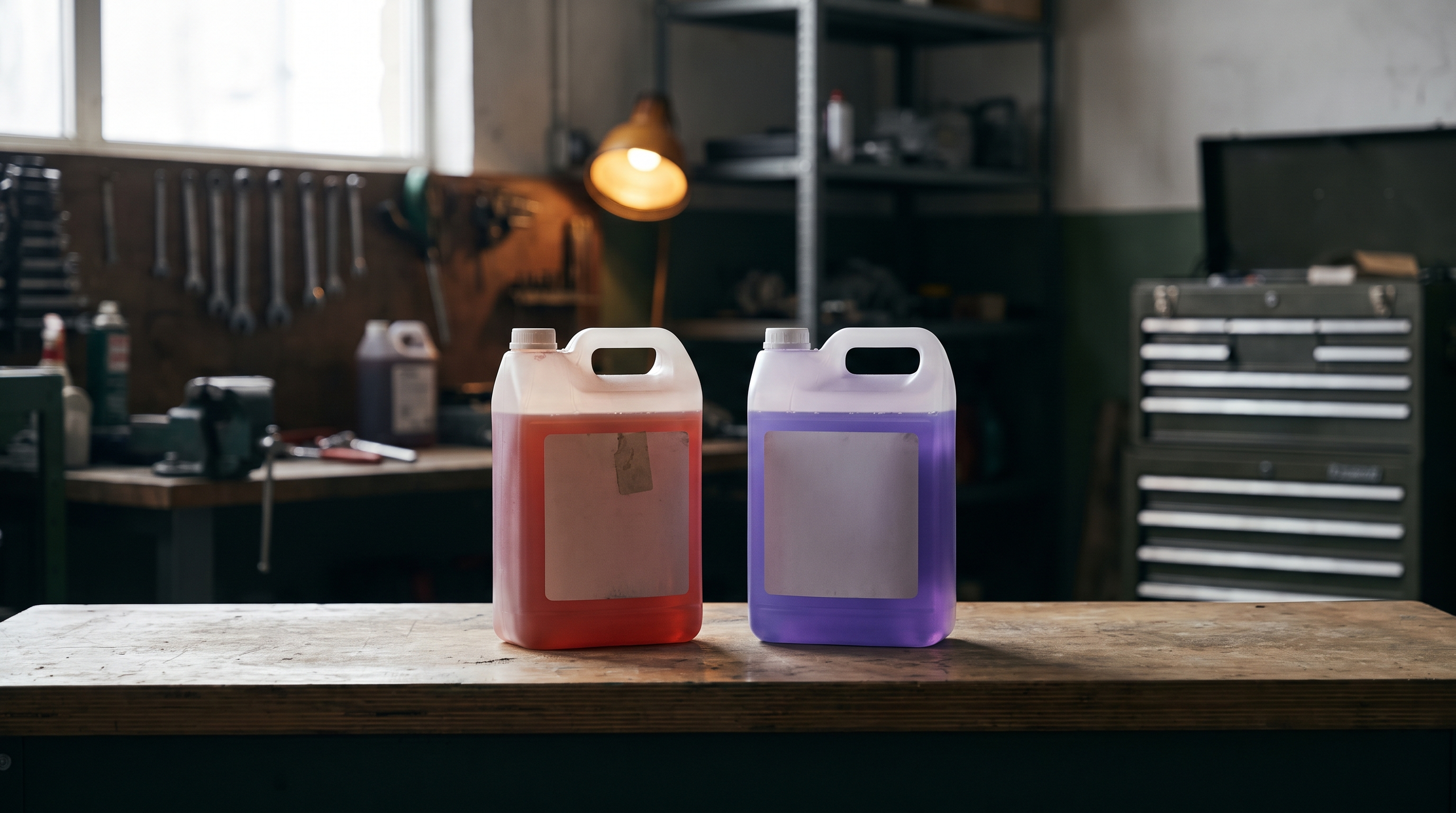
The confusion starts because both coolants are pink or purple, both are long-life formulations, and both appear on the same shelf. But G12 is an older organic-acid technology (OAT) coolant, and G13 is a newer glycerin-based formulation that VW introduced to meet environmental regulations. The two are not interchangeable unless your vehicle's service literature explicitly approves both. Run the wrong one and the aluminum components in the cooling system corrode first—cylinder heads, radiators, and water pumps all fail from the inside out.
This comparison covers the specifications, the approvals, the differences in chemistry, and which vehicles require which fluid. I'll also explain what happens when the wrong coolant goes in, how to read the approval on the bottle, and whether topping one with the other is ever acceptable. By the end, you will know exactly which coolant your car needs and why the distinction matters. For other European coolant systems, see BMW Antifreeze: Current Grey Spec and the Blue It Replaced or Volvo Antifreeze: Understanding the Blue-Green Specification.
Overview of G12 Coolant
G12 is an organic-acid-technology coolant that VW and Audi specified for platforms built roughly from the mid-1990s through the early 2010s. The bottle has to say VW TL 774 D on it; that is the approval G12 actually refers to. I have watched mechanics pour the wrong coolant into a G12 system because they went by color instead of the spec printed on the jug, and the mixing is the mistake that costs them.
G12 coolant has a freezing point of around -35 °C and a lifespan of 2-3 years or 60,000 km. The organic inhibitors do not deplete as fast as the older silicate formulas, but they still have a service life. When the interval passes, the corrosion protection drops and the aluminium does not forgive it. The radiator and cylinder-head passages corrode from the inside, and by the time you see discolored coolant at the overflow, the damage is done.
What G12 Covers
G12 applies to VW and Audi models from approximately 1997 to 2008, depending on the platform. The Passat B5, Golf Mk4, A4 B6 and A6 C5 all used G12 as the factory fill. Some Seat and Škoda models from the same years also specify TL 774 D. The owner's manual is right about this—check the build date and the coolant section, and match the approval exactly.
G12+ is an older coolant specification used in Seat models built before approximately 2012, characterized by its purple color. G12+ is not the same as G12; it is TL 774 F, and the two approvals use different organic acid inhibitors. Mixing G12 and G12+ dilutes the protection package, and the result is the same as running weak coolant: accelerated corrosion and a shorter service life.
G12 and Manufacturer Approvals
G12 and G13 correspond to different VW TL 774 specifications, which are not interchangeable. The correct coolant choice depends on the vehicle and the manufacturer's service instructions. At the counter, the question is always whether the customer can top off G12 with G13 or vice versa. The answer is no. The approvals are different, the inhibitor chemistry is different, and mixing them gives you neither one working at full strength.
If you are running a pre-2008 VW or Audi, the system was filled with G12 at the factory. When you service it, flush it and refill with a product that carries the TL 774 D approval. Do not top it with G13 because the bottle is pink and the reservoir is pink. Read the approval printed on the label, not the color chart.
Overview of G13 Coolant
G13 (TL 774-J) appeared around 2011–2012. It is not the newest VW/Audi coolant — G12evo (TL 774-L, ~2019–2020) is the current standard and supersedes G13. It appeared in 2012 when VW wanted something more environmentally friendly than the older G12 formulations. The base is different: G13 uses a glycerin and ethylene glycol blend instead of pure ethylene glycol. That change makes it less toxic if it leaks into groundwater, which is why VW and Seat switched to it across most of their lineup from 2012 forward.
The bottle has to say VW TL 774 G or TL 774 J to meet the G13 spec. Those are the two approvals that cover G13 coolant. You will see the designation printed on the label. If it is not there, it is not G13, no matter what the marketing copy claims.
Performance Specifications
G13 delivers a freezing point down to -40 °C and a service life up to 5 years or 150,000 km, whichever comes first. That matches the protection range of G12evo and G12++, so the thermal performance is equivalent. The difference is in the base chemistry, not the numbers.
The additive package is still organic acid technology, the same corrosion inhibitor family that G12 and G12evo use. That means G13 protects aluminum, cast iron and copper components the same way the later G12 variants do. The glycerin base does not change how the inhibitors work; it just changes the environmental profile of the coolant if it ends up in the soil.
Applications and Manufacturer Approvals
VW Group introduced G13 for most Seat models from 2012 onward, and it spread across VW, Audi, Škoda and Porsche platforms where the factory wanted the greener formulation. Check the build date and the owner's manual. If your car was built after 2012 and the manual calls for TL 774 G or TL 774 J, you need G13. Earlier cars that specify G12++ or G12evo do not take G13 unless the manual explicitly approves it.
G13 is not a universal upgrade. It is a specification tied to specific platforms and build dates. If your Audi or VW calls for G12++ (TL 774 F), run G12++. If it calls for G13 (TL 774 G or J), run G13. The approval printed on the bottle has to match the approval in the manual. That is the rule.
Feature Comparison of G12 and G13 Coolants
The difference between G12 and G13 starts with what each one is made from. G12 uses ethylene glycol as the base, and G13 uses glycerol. That change affects everything downstream: the ecological profile, the service life, and what the coolant does to seals and gaskets over time. I have watched shops drain G12 and fill G13 without understanding that the switch is not about color or brand preference — it is about the chemistry the manufacturer approved for the aluminum and rubber in that specific cooling system.
Chemical Composition and Base Fluid
G12 coolant is ethylene-glycol-based with organic acid technology inhibitors. G13 replaces the ethylene glycol with glycerol, keeping the same OAT inhibitor package. The glycerol base is less toxic and biodegrades more readily than ethylene glycol, which is why VW introduced G13 in the first place. Both formulations protect aluminum, cast iron, and mixed-metal systems, but the glycerol in G13 has a different viscosity profile at temperature extremes.
The glycerol base in G13 also means it handles heat slightly differently. Glycerol has a higher boiling point than ethylene glycol when mixed at the same concentration, but the thermal conductivity is marginally lower. In practice, both coolants regulate temperature equally well within the operating range of a modern European engine.
Performance Characteristics
Both coolants perform the core functions — temperature regulation, corrosion prevention, and cavitation protection — at the same level. The pink or purple color you see in the reservoir is nearly identical between G12 and G13, and the visual difference does not tell you which one is in the system. What does differ is the service interval: G13 is rated for a longer lifespan, typically matching or exceeding the G12evo interval, though G12evo — not G13 — is the current factory and service coolant for the newest VW and Audi models.
| Feature | G12 | G13 |
|---|---|---|
| Base fluid | Ethylene glycol | Glycerol |
| Inhibitor type | Organic acid (OAT) | Organic acid (OAT) |
| Service life | Standard OAT interval | Extended interval |
| Toxicity | Higher (ethylene glycol) | Lower (glycerol) |
| Biodegradability | Poor | Better |
| Aluminum compatibility | Yes | Yes |
The corrosion inhibitors in both formulations protect the same metals. G12 and G13 are both safe for aluminum radiators, aluminum cylinder heads, and the brass or copper components in older heat exchangers. The difference is not in what they protect — it is in how long the inhibitor package stays effective before it needs to be replaced.
Environmental Impact
G13 has the better ecological profile. Glycerol is derived from renewable sources and breaks down more readily in the environment than ethylene glycol. Ethylene glycol is toxic to animals and persists longer in soil and water. That is the reason VW developed G13: to meet stricter environmental standards without compromising cooling-system protection.
For shops and fleet operators, the environmental advantage of G13 matters when you are disposing of used coolant. Glycerol-based coolants are easier to handle under waste-disposal regulations in some jurisdictions, and the lower toxicity reduces the risk if a spill occurs during service.
G13 is generally a better choice for modern vehicles due to its longer lifespan and better ecological properties.
The extended service life of G13 also means less frequent coolant changes, which reduces waste over the life of the vehicle. If your Audi or VW specifies G13, you are not just meeting the approval — you are also cutting the number of times coolant goes into the waste stream.
For more on how different European makes handle coolant specifications, see Volvo Antifreeze: Understanding the Blue-Green Specification.
Pricing Comparison of G12 and G13 Coolants
I've watched the coolant aisle long enough to tell you the price difference between G12 and G13 is real, but small — and it means nothing if you put the wrong one in. A gallon of G12 concentrate typically runs $25 to $35 at the counter. G13 sits $5 to $10 higher, usually $30 to $45 per gallon. The gap comes from formulation cost: G13 uses glycerin as the base instead of ethylene glycol, and glycerin costs more to source and stabilize.
What Drives the Price
The base chemical is the biggest factor. Ethylene glycol in G12 is a commodity; glycerin in G13 is not. Add the corrosion inhibitors — both use silicate-free organic acid technology, but G13's package has to work with a different base — and the blending cost goes up. Brand matters too. OE-branded coolant from VW or Audi carries a markup over aftermarket bottles that meet the same spec, but the approval printed on the label is identical. I stock both: the OE bottle and the aftermarket equivalent. The aftermarket saves $8 to $12 per gallon and meets the same TL-774 G or J standard.
Volume pricing changes the math. A case of six gallons drops the per-unit cost by 10 to 15 percent, and concentrate is always cheaper per mixed gallon than pre-diluted. If you're flushing a system, buy concentrate and mix it yourself with distilled water. Pre-diluted is convenience, not value.
Where G13 Costs More and Why It Doesn't Matter
G13 runs higher because it's newer and the market is smaller. Fewer suppliers make it, so there's less price competition. But here's what matters: if your car calls for G13, the $10 premium per gallon is not optional. The cooling system doesn't negotiate. A 2015 Golf with a TSI engine takes G13. Run G12 to save ten dollars and the water pump seals leak first, then the heater core. The repair is $800 to $1,200. The cheap way costs more.
If your car specifies G12, you can run G13 — it's backward compatible — but you pay extra for no benefit. The system was designed around G12's properties. G13 works, but you're buying environmental compliance you don't need. Save the money and run what the build date calls for.
OE vs Aftermarket: The Real Comparison
OE coolant from the dealer is $40 to $50 per gallon for either spec. Aftermarket bottles with the TL-774 approval printed on them run $25 to $35 for G12 and $30 to $45 for G13. The approval is the same. The corrosion inhibitor package is the same. The difference is the label and the markup. I sell both at the counter, and I tell customers the same thing: check the bottle for the VW TL-774 number that matches your owner's manual, then buy the one that fits your budget. The cooling system can't read the brand name.
For BMW antifreeze specifications, the same rule applies: the approval matters, the brand does not.
The bottle has to say TL-774 G or J; after that, price is the only variable that changes.
Cost Per Service
A typical VW or Audi cooling system holds 6 to 8 quarts of mixed coolant. That's 1.5 to 2 gallons of concentrate if you're doing a full drain and fill. At $30 per gallon for G12 concentrate, you're spending $45 to $60 in fluid. Add $10 to $20 for G13. A flush with pre-diluted coolant doubles that because you're buying water at coolant prices. The math is simple: concentrate and a gallon of distilled water saves you $30 to $40 per service.
If you're topping off, the difference is negligible. A quart of either spec costs $8 to $12. But topping off repeatedly means you have a leak, and that's the real cost.
The Bottom Line on Price
G13 costs more because it uses glycerin. The premium is $5 to $10 per gallon, and it's not optional if your car was built after 2012 and specifies TL-774 J. If your car takes G12, running G13 works but wastes money. If your car takes G13, running G12 to save ten dollars will cost you a four-figure repair. The price difference is real; the decision is not.
Pros and Cons of G12 vs G13 Coolants
I've watched shops weigh G12 against G13 for years, and the decision always comes down to what the car requires and what the wrong choice costs. Both coolants work, but each has trade-offs that matter when you're standing at the counter with a jug in your hand.
G12 Coolant: Advantages and Disadvantages
G12 has been the standard for VAG platforms since the late 1990s, and it delivers reliable corrosion protection with a long service life. The organic-acid formula resists breakdown, which is why the factory interval stretches to five years or more in many applications. It's widely available, and most European parts distributors stock multiple brands that meet the spec.
The downside is environmental. G12 is ethylene-glycol-based, and that means it's toxic. Disposal requires proper handling, and spills are a problem if you have pets or wildlife around the shop. The other issue is compatibility: G12 does not mix with G11 or G13 without forming gel, and that gel blocks passages. If the previous owner topped off with the wrong color, you're flushing the system before you add G12.
G13 Coolant: Advantages and Disadvantages
G13 uses a glycerin base instead of ethylene glycol, which makes it less toxic and easier to dispose of in most jurisdictions. The environmental advantage is real, and that's why VAG moved to G13 as the factory fill starting around 2008. The corrosion-protection performance matches G12, and the service interval is the same.
The trade-off is cost. G13 runs higher per liter than G12, and availability varies depending on your distributor. Some shops stock it, others don't, and that can matter if you need a top-off and the nearest supplier is an hour away. The other consideration is backward compatibility: G13 is approved for systems that originally took G12, but you still need to check the build date and engine code before you pour. Just because the bottle says G13 doesn't mean it's right for every VAG platform.
What the Wrong One Does
If you run G12 in a car that specifies G13, the cooling system still works — the chemical difference doesn't cause immediate failure. The issue is warranty and emissions compliance, because VAG moved to G13 for environmental reasons, not mechanical ones. If you're under warranty, use what the manual says.
If you run G13 in an older car that took G12, the system tolerates it as long as the G13 meets the original G12 spec. But if you mix G13 into a system that still has G11 residue, you get the same gel problem G12 causes. The lesson is simple: flush first, then fill with the correct spec. Topping off with a different class is the mistake that clogs the heater core.
Who Should Choose G12 or G13 Coolant?
The decision is not a preference — it is a requirement. I have watched too many people walk out of the parts store with the wrong bottle because they assumed the number on the label was a suggestion. It is not. Your vehicle either requires G12 or G13, and the answer is in the owner's manual or on the expansion tank cap, not on a forum or a parts-counter guess.
Check the Build Date and the Spec
If your Audi or VW was built before 2008, it likely came with G12 or G12+ from the factory. If it was built after 2008, it likely came with G13. The year alone does not decide it — the engine code and the factory fill do. A 2007 A4 with a BPG engine takes G12+; a 2009 A4 with a CAEB engine takes G13. The bottle has to say the spec that matches what the manual calls for. A coolant bottle marked G13 is not automatically the right replacement for a bottle marked G12, and the compatibility of coolants should not be assumed based on color or numerical designation alone.
When to Stay with G12
If your car left the factory with G12 or G12+ and the system has never been flushed, stay with G12. The organic acid technology in G12 is not compatible with the glycerin base in G13 unless the system is completely drained and flushed. Topping a G12 system with G13 creates a hybrid chemistry that the aluminum block and radiator do not tolerate well. If you are topping off between services, use the same spec that is already in there. If you are doing a full flush, you can move to G13 if the manual lists it as an approved alternative — but only after the system is empty.
When to Use G13
If your car was built after 2008 and the manual specifies G13, use G13. The glycerin-based formulation meets the same corrosion and heat-transfer requirements as G12 but with a lower environmental impact. If you are buying a newer Audi, VW, Porsche, or SEAT, G13 is the factory fill and the correct replacement. Do not downgrade to G12 because it is cheaper or because the parts store has more of it in stock. The approval printed on the bottle must match the approval in the manual.
For related fluid specifications on European platforms, see BMW Antifreeze: Current Grey Spec and the Blue It Replaced.
Final Verdict on G12 vs G13 Coolant
The question is always the same at the counter: can I use the older spec? For G12 versus G13, the answer depends on what the owner's manual says and what year the car is. I've watched customers mix them because the color looks close, and I've watched the same customers come back when the system throws a fault or the heater stops working right. The verdict is not about which coolant is better in a vacuum — it is about what the cooling system was designed to take and what happens when you ignore that.
G13 Is the Current Spec for a Reason
G12evo (TL 774-L) is the current VW/Audi coolant and supersedes G13; G13 does not replace G12evo. G13's glycerin base is a genuine formulation change, not just a marketing refresh. The formulation is different: G13 uses glycerin as the base instead of ethylene glycol, which makes it less toxic and more stable over a longer service life. Both coolants regulate temperature and prevent corrosion equally well under normal operating conditions, but G13 lasts longer between changes and meets stricter environmental standards. If your car was built after 2008 and the manual specifies G13, that is the spec you run. The system is calibrated for it, and the seals and hoses are matched to the glycerin base.
When G12 Is Still the Right Call
If your Audi or VW was built before 2008 and the manual says G12 or G12evo, you stay with that spec. The older systems were not designed for glycerin-based coolant, and while G13 is backward-compatible in some applications, the factory fill is the safe bet. Mixing G12 and G13 is the mistake — the two formulations do not blend cleanly, and the result is reduced corrosion protection and a shorter service life for the mixture. If you are topping off a G12 system and you only have G13 on hand, flush it and refill with the correct spec as soon as you can. Do not run a mixed system through a full service interval.
The Owner's Manual Is Right About This
The final verdict is simple: check the build date and the manual, then buy the coolant that matches the printed spec. G13 is the better choice for modern vehicles because it lasts longer and meets current environmental requirements, but it is only the right choice if the car was designed for it. G12 is not obsolete — it is the correct spec for older platforms, and trying to upgrade to G13 in a system that was not built for it does not gain you anything. At the counter, I sell both, and the deciding factor is always the same: what does the bottle have to say, and does it match what the car requires? If the answer is yes, run it. If the answer is no, do not.
For related European cooling system specifications, see Volvo Antifreeze: Understanding the Blue-Green Specification.
Written by
Lee Shahin
Founder, European Wholesale Parts
Lee Shahin founded European Wholesale Parts in Pleasanton, California, after 18 years in the Mercedes-Benz and BMW parts trade. He came to the parts side from the shop floor: he opened a European repair shop in Northern California in the early 1990s, specialising in Mercedes-Benz and BMW, and grew it with his wife Laurie into a parts and delivery operation serving body shops and independent repair facilities across the region. Nearly two decades at the parts counter taught him where the expensive mistakes happen, and most of them are fluids: the wrong coolant in an aluminium block, an oil without the sheet approval the engine was designed for, a transmission topped with the wrong ATF. That is what he writes about here. Every article names the manufacturer specification by its exact designation, explains what the wrong fluid does mechanically, lists products that carry the approval, and gives the capacity and interval for the models and years the specification covers. When a reader needs a part sourced, the quote desk at European Wholesale Parts is where Lee and Laurie still answer the phone.